Showing posts with label Armidale. Show all posts
Showing posts with label Armidale. Show all posts
Friday, 13 December 2013


Monday, 23 September 2013
Thursday, 25 July 2013
Friday, 28 June 2013
Google Reader Has Gone Under!
Google reader no longer exists, but if you go to the bottom of this Blog, you can follow via Email.
Thank you.
Regards, Keith.

Thank you.
Regards, Keith.

Sunday, 5 May 2013
The Half-axe.
Skinning some more poles for a wigwam today. This is the half-axe I carry when doing heavier constructions, good for debarking. Size difference shown against my tomahawk. Both are trade axes. So if you want a half-axe, just get the larger size tomahawk head & fit a longer helve/handle.


Friday, 26 April 2013
Tuesday, 9 April 2013
NARRATIVE OF THE CAPTIVITY OF WILLIAM BIGGS. Part 11. FINAL Chapter.

A French Fur Trader at Work
Courtesy of the Oneida Nation
My
friend McCauslin took me to a Frenchman's house--he was a baker by
trade,
the only baker in town--to board with him until I got an opportunity
to go home. Two days after I went to stay at the baker's, the
Indian that claimed me, his squaw and the young squaw that followed us to
the new town, came to see me and stayed three or four hours with me. He
asked me to give him some tobacco. I told him I had no money. He thought
I could get anything I wanted. I bought him a carrot of tobacco; it
weighed about three pounds; he seemed very well pleased. He and his wife
wanted me very much to go back home with them again. I told them I could
not, that I was very anxious to go home to my wife and family.
Three
or four days after that they revisited me, and still insisted on me to
go home with them. I told them that I expected every day to get an opportunity
to go home. I had some doubts about going back with them; I thought
perhaps they might play some trick on me, and take me to some other
town; and their water was so bad I could not drink it--nothing but a small
pond to make use of for their drinking and cooking, about forty
or
fifty yards long and about thirty yards wide. Their horses would not only
drink from, but wallow in it; the little Indian boys every day would
swim in it, and the Indians soak their deerskins in it. I could not
bear to drink it. When they would bring in a kettle of water to drink,
they would set it down on the floor. The dogs would generally took
the first drink out of the kettle. I have often seen when the dogs would
be drinking out of a kettle, an Indian would go up and kick him off,
and take up the kettle and drink after the dog. They had nothing to eat the
last week I was with them but Indian potatoes--some people call them
hoppines--that grew in the woods, and they were very scarce.
Sometimes
the Indian boys would catch land terrapins. They would draw their
heads out and tie a string around their neck and hang them up a few
minutes, and then put them in a kettle of water with some corn--when they
had it--without taking the entrails out or shell off the terrapin, and eat
the soup as well as the meat. We had all liked to have starved that
week; we had no meat; I was glad to get away.
I staid
three weeks with the French baker before I got an opportunity to start
home. I had a plenty to eat while I remained with the baker--good light
bread, bacon and sandy hill cranes, boiled in leyed corn, which made a
very good soup. I paid him three dollars per week for my board.
There
was a Mr. Pyatt a Frenchman, and his wife, whose residence was at St.
Vincennes, with whom I had some acquaintance. They had moved up to that
Kickapoo town in the fall of the year in order to trade with the Indians
that winter. They were then ready to return home to Vincennes. Mr.
Pyatt had purchased a drove of horses from the Indians. He had to go by land
with his horses. Mrs. Pyatt hired a large perogue and four
Frenchmen
to take her property home to Vincennes. I got a passage in her perogue.
She was very friendly to me; she did not charge me anything for my
passage.
We
arrived in Vincennes in forty-eight hours after we left the Kickapoo trading
town, which is said to be two hundred and ten miles. The river was
very high, and the four hands rowed day and night. We never put to land
but twice to get a little wood to cook something to eat.
I staid
five days at Vincennes before I got an opportunity of company to go on
my way home. It was too dangerous for one man to travel alone by land
without a gun. There was a Mr. Duff, who lived in the Illinois country,
came to Vincennes to move a Mrs. Moredock and family to the Illinois.
I got a passage with him by water. The morning I started from Vincennes
he was just ready to start before I knew I could get a passage
with
him, and I had not time to write. I got a Mr. John Rice Jones, a friend
of mine, to write to Col. Edgar, living in Kaskaskia, in the Illinois,
who was a particular friend of mine, and sent it by the express,
a Frenchman, that was going to start that day from Vincennes to Kaskaskia,
which he could ride in four days, and request Col. Edgar to
write
to my wife, who lived at Bellfontain, about forty miles from Kaskaskia,
and inform her that I was at Post Vincennes, on my return home
with a Mr. Duff by water, and inform her that I would be at Kaskaskia
on a certain day; I think it was two weeks from the time I left
Vincennes, and for her to send me a horse on that day to Kaskaskia.
Col.
Edgar wrote to her immediately, as soon as he received Mr. Jones' letter.
That was the first time she heard from me after I was taken prisoner.
I had written to her while I was at the Kickapoo town. That letter
never reached her. I had two brothers living at the Bellfontain; they
met me on the day I proposed being at Kaskaskia and brought me a
horse.
The next day I got home to the Bellfontain.
End of
the Project Gutenberg EBook of Narrative of the Captivity of William
Biggs
among the Kickapoo Indians in Illinois in 1788, by William Biggs
Saturday, 30 March 2013
NARRATIVE OF THE CAPTIVITY OF WILLIAM BIGGS. Part 9.

By Robert Griffing.
The
next day was the 9th day of April, and thirteenth day that I had been
their prisoner. The chief Indians and warriors that day held a general
council, to know in what manner and way to dispose of me. They collected
in the cabin where I lived. While they were in council their dinner
was cooking. There were about ten in number, and they all sat down on
the floor in a circle, and then commenced by their interpreter, Nicholas
Coonse.
The
first question they asked me was, "Would I have my hair cut off like they
cut theirs?" I answered "No." The second question they asked me was,
"If I would have holes bored in my ears and nose and have rings and lead
hung in them like they had?" I answered "No." The third question they
asked me was, "If I could make hats?" (I had a large bag of beaver fur
with me when they took me prisoner; from that circumstance I suppose they
thought I was a hatter.) I answered "No." The fourth question they asked
me was, "If I was a carpenter?" and said they wanted a door made for
their cabin. I answered "No." The fifth question they asked me was, "If
I was a blacksmith; could I mend their guns and makes axes and hoes for
them?" I answered "No." The sixth question they asked me was,
"If I could
hoe corn?" I answered "No". The seventh question they asked me was,
"If I could hunt?" I answered. "No. I could shoot at a mark very well, but I never hunted any." Then they told Coonse to ask me how I got my
living; if I could do no work. I thought I had out-generalled them, but
that question stumped me a little. The first thought that struck my mind, I
thought I would tell them I was a weaver by trade, but a second thought
occurred to my mind, I told Coonse to tell them I made my living by
writing. The Indians answered and said it was very well. The eighth question
they asked me was, "If I had a family?" I answered "Yes, I had a wife
and three children." The ninth question they asked me was, "If I wanted
to go home to see my wife and children?" I answered "Yes," They said,
"Very well, you shall go home by and by." The tenth question they asked
was, "If I wanted a wife then?" I answered "No," and told
them it was not
the fashion for the white people to have two wives at the same time.
They said, very well, I could get one if I wanted one, and they said if
I staid with them until their corn got in roasting ears, then I must
take a wife. I answered them yes, if I staid that long with them. They
then told me that I might go anywhere about in the town, but not go out of
sight of the town, for if I did, there were bad Indians round about
the town and they would catch me and kill me, and they said they could
run like horses; and another thing they said, don't you recollect the
Indians that took you prisoner and cut a lock of hair out of the crown
of your head. I told them yes. Then they told me in consequence of that,
if you attempted to run away, you could not live eight days. If you
will stay with us and not run away, you shall not even bring water to
drink. I told them I wanted to go home to my family, but I would not go
without letting them know before I went. They said, very well. They appeared
well pleased with me and told me again I might go anywhere about in the town, but not go out of sight of the town.
Friday, 29 March 2013
Making a Hammer Stall & Documentation.
A hammer stall, also known as a hammer cap, is a leather device like a thumb stall which is placed over the hammer on a flint lock as a safety measure. With the stall in place, the flint in the jaws of the cock can not strike the hammer face, and therefore prevents accidental discharge of the gun. Although the hammer stall seems to have been mainly used by the military in the 18th century, it is possible that civilians and militia could have used them. To date, I have been unable to find any original images or originals in museum collections. Being made of leather it is possible that none have survived, though I would have thought that some of the larger military arms collections would still have intact stalls.
Quotes:


Quotes:


Items used for leather-work From top and left to right: A leather palm pad, used to push the needle through the leather if it is a tight fit. I did not need to use this when making this Hammer Stall; an awl, beeswax for waxing the linen thread; needle, and linen thread.

Further research has shown that "Boot" may not be a period term. Hammer stall or hammer cap or even in one case the term "Thumb stall" was used. The term "Frizzen" is apparently a 19th century term derived from a similar German word.
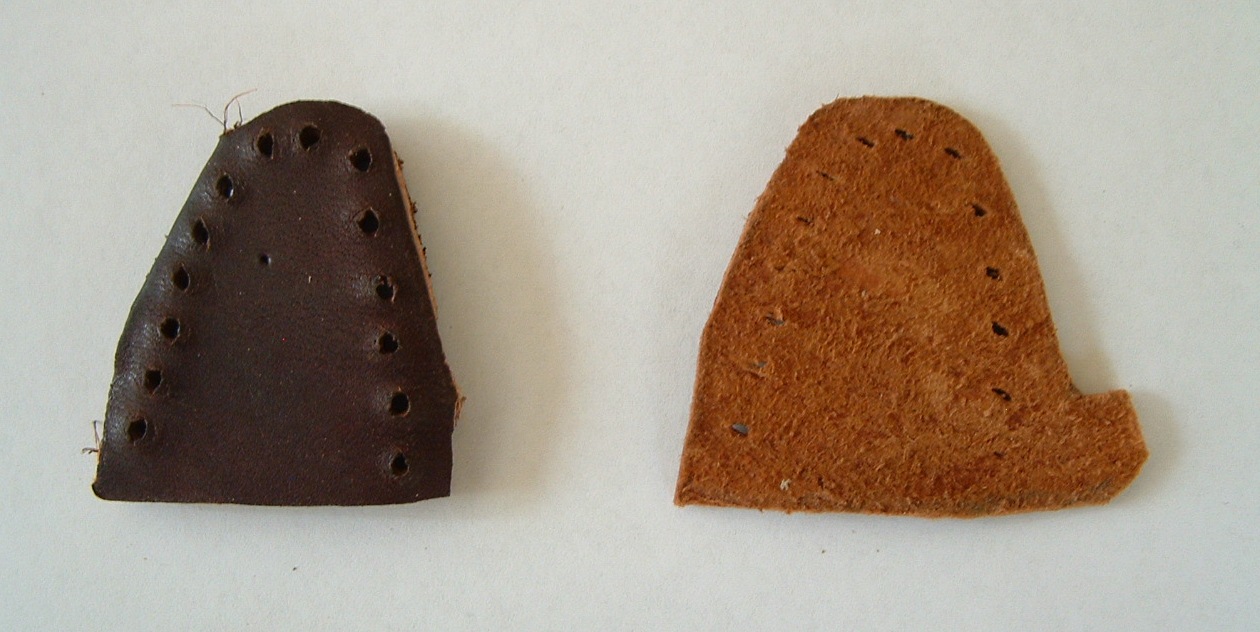

On this one I placed the suspension tab on the back half of the stall because I had more of that leather, I was using scraps. But the tab can go on the back or the front half.


Here you can see a hammer stall I made some years ago for my fusil. The stall is in place on the hammer or steel.
Wednesday, 27 March 2013
A Scouting Trip.
Last weekend my wife and I had to go scouting for wood. Being a forest and not woodland the trees are fairly close together so we had to find a route where by we could get the wagon in. We could have gone up the flats in the bottom of the valley, but there is a header stream that runs through this valley and the ground is soft and easily damaged.
We cut our way through to each fire wood source as we went, and occasionally stopped to take in the view and see what we could find. These images are from that fire wood scouting trip.


We cut our way through to each fire wood source as we went, and occasionally stopped to take in the view and see what we could find. These images are from that fire wood scouting trip.

Ryvardenia Cretacea, a bracket fungi used as tinder. This one on a Stringybark Tree.

On the ground beneath the same tree we found another bracket fungi from last year which had fallen from the tree.

Two more bracket fungi growing on a Mountain Gum.

In the cleft in this Stringybark Tree, center of photo, is a bees nest.

A section of bark has been removed from this tree with an iron axe. Possibly to make a shelter or a cover for something.

There are three scars around this tree where it looks as though it has been cut with a stone axe, taking off two sections of bark. The third cut is quite high, so someone would have had to climb this tree to remove this bark.

Wednesday, 20 March 2013

NARRATIVE OF THE CAPTIVITY OF WILLIAM BIGGS. Part 4.

The
second day we started very early in the morning and traveled about
thirty-five
miles, which was the 29th of March.
The
third day we traveled about thirty miles, which was the 30th of
March.
They killed a deer that day--in the evening they took the
intestines
out of the deer and freed them of their contents, when they
put
them in the kettles with some meat and made soup, I could not eat
any of
it.
The
fourth day we traveled about twenty-five miles. We stopped about 3
o'clock
in the afternoon at a pond. They staid there all night. They had
some
dried meat, tallow, and buffalo marrow, rendered up together,
lashed
and hung upon a tree about twenty feet from the ground, which
they
had left there in order to be sure to have something to eat on
their
return. They killed two ducks that evening. The ducks were very
fat.
They picked one of the ducks, and took out all its entrils very
nice
and clean, then stuck it on a stick, and stuck the other end of the
stick
in the ground before the fire, and roasted it very nice. By the
time
the duck was cooked, one of the Indians went and cut a large block
out of
a tree to lay the duck upon; they made a little hole in the
ground
to catch the fat of the duck while roasting. When the duck was
cooked,
they laid it on this clean block of wood, then took a spoon and
tin
cup, and lifted the grease of the duck out of the hole and took it
to the
cooked duck on the table, and gave me some salt, then told me to
go and
eat. I sat by and eat the whole of the duck, and could have eat
more if
I would have had anything more to eat, though I had no bread. I
thought
I had never eat anything before that tasted so good. That was
the
first meal I had eaten for four days. The other duck they pulled a
few of
the largest feathers out off, then threw the duck, guts, feathers
and all
into their soup-kettle, and cooked it in that manner.
The
fifth day we traveled about thirty miles. That night I felt very
tired
and sore, my hands, arms, legs and feet had swelled and inflamed
very
much, by this time; the tying that night hurt me very much, I
thought
I could not live until morning; it felt just like a rough saw
cutting
my bones. I told the Indians I could not bear it, it would kill
me
before morning, and asked them to unslack or unloose the wrist rope a
little,
that hurt me the most. They did so, and rather more than I
expected,
so much that I could draw my hands out of the tying, which I
intended
to do as soon as I thought the Indians were asleep. When I
thought
the Indians were all asleep I drew my right hand out of tying,
with an
intention to put it back again before I would go to sleep, for
fear I
should make some stir in my sleep and they might discover me.
But,
finding so much more ease, and resting so much better, I fell
asleep
before I knew it, without putting my hand back into the tying.
The
first thing I knew about 3 o'clock in the morning, an Indian was
sitting
astraddle me, drawing his tomahawk and rubbing it across my
forehead,
every time he would draw a stroke with the pipe of his
tomahawk,
he threatened to kill me, and saying I wanted to run away; I
told
him to kill away. I would as leave die as live. I then told him I
was not
able to run away. He then got off me, and the rest of the
Indians
were all up immediately. They then held a short council and
agreed
to tie me as tight as ever, and they did so. I got no more sleep
that
night. I never asked them to loose my ropes any more.

Sunday, 17 March 2013
Historical Trekking Dates 2013.
New England Colonial Living History group 1680-1760.
Winter Historical Trek
2013.
This year we will also
be camping in Butterfly Valley. We are at present in the process of cutting a
trail in to cut winter wood. This will be a good opportunity to check the area
out and maybe put some timber aside for constructing shelters.
There are a few
alternative routes into the camping area, depending on whether you want a short
easy trip or a longer trek. A header stream runs through this valley, and in
the camping area there is another stream which joins the header stream.
Anyone interested in
constructing a shelter beforehand let me know. Otherwise I will either do it
alone or wait until the actual trek.
The first trek will
take place on Friday 31st of May 2013. This will last the whole
weekend so members can attend anytime over that weekend. There may also be
shorter treks taken before that date for shelter construction so if you are
interested, contact me for details.
Regards, Keith.
Wednesday, 13 March 2013
Monday, 11 March 2013
Gunpowder, Then and Now. Paper Cartridges.
After posting my video on how I make paper cartridges for my fusil, I got this message:
"The British Military load for the brown bess was 125g of powder with an extra 40 grains for the pan for a total of 165g per cartridge. the powder from the original cartridge I saw was course like 1f, Ive fired this combo from a repro french 1727 and it shoots well using the 1f as the priming powder, the only draw back is it burns slow in the pan so you have to watch your follow through".
Gunpowder now is not the same as gunpowder 300 years ago. I personally would not be loading 125 grains in any hand held gun. Whether or not it is proofed for such a load is not the point, the point is that there is no need for such a high load as this with modern gunpowder.
1Fg is cannon grade gunpowder, and I have no idea what it was doing in an original 18th century Brown Bess cartridge, unless (a) it was a mistake, or (b) they had run out of the regular gunpowder. Either way, just because it was done, does not mean that you should do it!
For those of you not familier with modern gunpowder/Black Powder, 1FG is a large grained gunpowder made for cannons. 2Fg is generally for any caliber over .45 but can be used in smaller calibers. 3Fg is for .45 caliber & smaller, but can be used in larger calibers with a load adjustment, i.e. the smaller the grains of powder, the higher the internal pressure. So if you are using a recommended load of 2Fg, DO NOT use the same load when using 3Fg. Use less. 4Fg is made these days as a priming powder. 4Fg is a very fine grain gunpowder and should NEVER be used as a main charge. You may also find it interesting to know that 300 years ago there were no priming horns made or used for hand held guns/rifles. The same gunpowder used as a main charge, was also used to prime the pan of the flintlock.
1Fg being a large grained gunpowder used only in cannons, would be very slow to burn if used for priming. I really can't see the British army and navy using 1Fg gunpowder as a standard in the Brown Bess.


"The British Military load for the brown bess was 125g of powder with an extra 40 grains for the pan for a total of 165g per cartridge. the powder from the original cartridge I saw was course like 1f, Ive fired this combo from a repro french 1727 and it shoots well using the 1f as the priming powder, the only draw back is it burns slow in the pan so you have to watch your follow through".
Gunpowder now is not the same as gunpowder 300 years ago. I personally would not be loading 125 grains in any hand held gun. Whether or not it is proofed for such a load is not the point, the point is that there is no need for such a high load as this with modern gunpowder.
1Fg is cannon grade gunpowder, and I have no idea what it was doing in an original 18th century Brown Bess cartridge, unless (a) it was a mistake, or (b) they had run out of the regular gunpowder. Either way, just because it was done, does not mean that you should do it!
For those of you not familier with modern gunpowder/Black Powder, 1FG is a large grained gunpowder made for cannons. 2Fg is generally for any caliber over .45 but can be used in smaller calibers. 3Fg is for .45 caliber & smaller, but can be used in larger calibers with a load adjustment, i.e. the smaller the grains of powder, the higher the internal pressure. So if you are using a recommended load of 2Fg, DO NOT use the same load when using 3Fg. Use less. 4Fg is made these days as a priming powder. 4Fg is a very fine grain gunpowder and should NEVER be used as a main charge. You may also find it interesting to know that 300 years ago there were no priming horns made or used for hand held guns/rifles. The same gunpowder used as a main charge, was also used to prime the pan of the flintlock.
1Fg being a large grained gunpowder used only in cannons, would be very slow to burn if used for priming. I really can't see the British army and navy using 1Fg gunpowder as a standard in the Brown Bess.

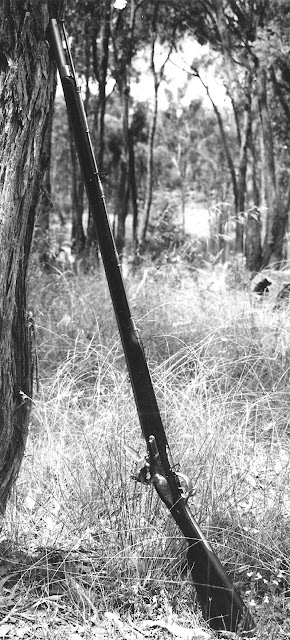
Long Land pattern Brown Bess.


Paper cartridges made for smoothbore muzzle-loading guns.
Sunday, 10 March 2013
Off Topic, but a worthy cause.
My Friend Gorges has this post on his blog. I am posting it here because I have a lot of followers in America, & it is quite possible that this person may have emigrated to Australia.
SUNDAY, MARCH 10, 2013
*****NOTICE!*****
-


A brother is looking for Jolli - child survivor A7734 from Auschwitz, born in 1940, 4.5 years old at liberation. Clues lead to possible adoption by a Christian family, then to USA. If you have information, contact to the USA. Whatever name and location, his tattooed number is A7734. And his brother still hopes to meet him. Please help us by spreading the word. FamilyRoots2000@gmail.comto .
Thursday, 7 March 2013
Bandhani = Bandana or Bandannoes
Bandhani (there are several similar spellings) means to tie or dye tie. Bandhani is in fact an ancient form of tie dyeing where spot of material are bound or wound with thread then dyed to produce a series of white spots in a variety of designs. This art form was widely used in the east, but in the late 17th century and early 18th century, Bandhani was exported to the New World in the form of large handkerchiefs. From the name Bandhani, came the name Bandana or Bandanna or Bandannoe.
The most common colours seem to have been black and red, but I can find little information relating to the 17th and 18th centuries. Patterns are also unknown to me, though I have read that somewhere there are examples found in tombs. This form of tie dyeing was performed on cotton, silk and wool fabrics. Here below are the designs and patterns that I think are most likely to have been available in the period 1680 to 1760.


The most common colours seem to have been black and red, but I can find little information relating to the 17th and 18th centuries. Patterns are also unknown to me, though I have read that somewhere there are examples found in tombs. This form of tie dyeing was performed on cotton, silk and wool fabrics. Here below are the designs and patterns that I think are most likely to have been available in the period 1680 to 1760.


The two types above are for sale from: http://www.timetraveltextiles.com/cgi-bin/mivavm?/Merchant2/merchant.mvc+Screen=CTGY&Store_Code=TTT&Category_Code=BD;

These are original copies made in Manchester England in 1750ad.


This shows some fabric bound and tied ready for dyeing.

Bandhani in ajanta painting.
Bibliography: The Worldwide History Of Dress By Patricia Rieff Anawalt
Subscribe to:
Posts (Atom)