A LIVING HISTORY BLOG.

18TH CENTURY LIVING HISTORY IN AUSTRALIA.
Showing posts with label William Biggs. Show all posts

Thursday, 4 April 2013

NARRATIVE OF THE CAPTIVITY OF WILLIAM BIGGS. Part 11.

Robert Griffing.


While Coons was gone for the bread, the Indian that claimed me asked me to write his name. I asked him to speak his name distinctly. He did. I had heard it spoken several times before. His name was "Mahtomack." When I was done writing he took it up and looked at it and said it was "Depaway." He then went to his trunk and brought his powder horn, which had his name wrote on it by an officer at Post Vincennes in large print letters, and compared them together. They both were the same kind of letters and his name spelt exactly the same. He seemed mightily pleased and said it was "bon vely good." It was a big captain he said wrote his name on the powder-horn at Opost. The wife of the Indian that claimed me, next morning combed and queued my hair and gave me a very large ostrich feather and tied it to my hat. The Sunday following after I was
taken to that town, there was a number of Indians went from that town to the old Kickapoo trading town. They took me with them to dance what is called the "Beggar's Dance." It is a practice for the Indians every spring, when they come in from their hunting ground, to go to the trading towns and dance for presents; they will go through the streets and dance before all the traders' doors. The traders then will give them presents, such as tobacco, bread, knives, spirits, blankets, tomahawks, &c.

While we were in town that day I talked with my friend McCauslin to speak to the Indians and try to get them to sell me, but they would not agree to sell me then. They said they would come down the Sunday following and bring me with them, perhaps they would then agree to sell me. They complied with their promise and brought me down with them. My friend McCauslin then inquired of them if they had agreed to sell me;
they told him they would. McCauslin then sent for the interpreter, and the Indians asked one hundred buckskins for me in merchandize. The interpreter asked me if I would give it? I told him I would. The Indians then went to the traders' houses to receive their pay. They took but seventy bucks' worth of merchandize at that time. One of the articles they took was bread, three loaves, one for the Indian that claimed me, one for his wife, the other one for me. I saw directly they wanted me to go back home with them. After a little while they started and motioned and told me I must go with them. I refused to go. The Indian fellow took hold of my arm and tried to pull me forward. I still refused going with them. He still continued pulling and his wife pushing me at the back. We went scuffling along a few yards till we got before my friend McCauslin's cabin door. He discovered the bustle and asked me what the Indians wanted. I told him they wanted me to go home with them. He asked me if I wanted to go. I told him no. He then told me to walk into his cabin and sit down and he would go and bring the interpreter. I went in and the two Indians followed me into the cabin and sat down. The interpreter came in immediately and asked the Indians what they wanted. They told him they wanted me to go home with them. The interpreter then asked if I wanted to go with them. I told him no. He then told the Indians they had sold me and that they had nothing more to do with me, that I was a freeman, that I might stay where I pleased. They then said they had not received all their pay. The interpreter then asked them why
they did not take it all? They said they expected I would go home with them and remain with them until I got an opportunity to go home. The interpreter then told them they could get the balance of their pay. They said if I did not go home with them they must have thirty bucks more. The interpreter asked me if I was willing to give it. I told him yes. I did not want to go back again. The Indians then went and took their thirty dollars of balance and thirty more and went off home. I then owed the traders that advanced the goods for me one hundred and thirty buckskins for my ransom, which they considered equal to $260 in silver.
There were five traders that were concerned in the payment of the goods to the Indians. One of them was a Mr. Bazedone a Spaniard, who sometimes traded in the Illinois country, with whom I had some acquaintance. I told him if he would satisfy the other four traders, I would give him my note, payable in the Illinois country. He did so, and I gave him my note for the $260, to be paid twelve months after date in the Illinois country, and $37 more for my boarding and necessaries I could not do without, such as a bear skin and blanket to sleep on, a shirt, hat, tobacco and handkerchief.

Saturday, 30 March 2013

NARRATIVE OF THE CAPTIVITY OF WILLIAM BIGGS. Part 9.


By Robert Griffing.

The next day was the 9th day of April, and thirteenth day that I had been their prisoner. The chief Indians and warriors that day held a general council, to know in what manner and way to dispose of me. They collected in the cabin where I lived. While they were in council their dinner was cooking. There were about ten in number, and they all sat down on the floor in a circle, and then commenced by their interpreter, Nicholas Coonse.
 The first question they asked me was, "Would I have my hair cut off like they cut theirs?" I answered "No." The second question they asked me was, "If I would have holes bored in my ears and nose and have rings and lead hung in them like they had?" I answered "No." The third question they asked me was, "If I could make hats?" (I had a large bag of beaver fur with me when they took me prisoner; from that circumstance I suppose they thought I was a hatter.) I answered "No." The fourth question they asked me was, "If I was a carpenter?" and said they wanted a door made for their cabin. I answered "No." The fifth question they asked me was, "If I was a blacksmith; could I mend their guns and makes axes and hoes for them?" I answered "No." The sixth question they asked me was, "If I could hoe corn?" I answered "No". The seventh question they asked me was, "If I could hunt?" I answered. "No. I could shoot at a mark very well, but I never hunted any." Then they told Coonse to ask me how I got my living; if I could do no work. I thought I had out-generalled them, but that question stumped me a little. The first thought that struck my mind, I thought I would tell them I was a weaver by trade, but a second thought occurred to my mind, I told Coonse to tell them I made my living by writing. The Indians answered and said it was very well. The eighth question they asked me was, "If I had a family?" I answered "Yes, I had a wife and three children." The ninth question they asked me was, "If I wanted to go home to see my wife and children?" I answered "Yes," They said, "Very well, you shall go home by and by." The tenth question they asked was, "If I wanted a wife then?" I answered "No," and told them it was not the fashion for the white people to have two wives at the same time. They said, very well, I could get one if I wanted one, and they said if I staid with them until their corn got in roasting ears, then I must take a wife. I answered them yes, if I staid that long with them. They then told me that I might go anywhere about in the town, but not go out of sight of the town, for if I did, there were bad Indians round about the town and they would catch me and kill me, and they said they could run like horses; and another thing they said, don't you recollect the Indians that took you prisoner and cut a lock of hair out of the crown of your head. I told them yes. Then they told me in consequence of that, if you attempted to run away, you could not live eight days. If you will stay with us and not run away, you shall not even bring water to drink. I told them I wanted to go home to my family, but I would not go without letting them know before I went. They said, very well. They appeared well pleased with me and told me again I might go anywhere about in the town, but not go out of sight of the town. 

Thursday, 28 March 2013

NARRATIVE OF THE CAPTIVITY OF WILLIAM BIGGS. Part 8.


The next morning after breakfast, they all left that camp; they put all their property into a large perouge and moved by water up the Wabash river to the old Kickapoo trading town, about ten miles from their sugar camp; they sent me by land and one Indian with me. When we had got about half way to the town, we met with a young Frenchman; his name was Ebart; I was very well acquainted with him in the Illinois country; he spoke tolerably good English. The Indian then left me, and I went on to the
town with the young Frenchman; I got to the town before the Indians arrived with their perouge, and the young Frenchman showed me their cabin, and told me to stay there until they would come, that they would be there in a few minutes. I there met with an English trader, a very friendly man, whose name was John McCauslin; he was from the north of England; we made some little acquaintance. He was a Freemason and
appeared very sorry for my misfortune and told me he would do everything in his power to befriend me and told me I was with good Indians, they would not hurt me. He inquired of me where I lived and asked if I had a family. He then told me of the circumstance of the Indians killing one of their own men that day they caught me. He said it was a fact, he was a bad Indian and would not obey the commands of his captain and that he was still determined to kill me. My Indian family soon arrived and
cleared up their cabin and got their family ready. They were a smart, neat and cleanly family, kept their cabin very nice and clean, the same as white women, and cooked their victuals very nice. After dinner wasover, there came four Indians in the old chief's cabin. Two of them werethe old chief's brother's children. They appeared to be in a very fine
humor. I did not know but that they belonged to the same family and town. They had not been there more than one hour, until the old chief and the four Indians sat down on the floor in the cabin and had a long discourse about an hour and a half. Then all got up. The old chief then told me I must go with those Indians. I told him I did not want to go.
He then told me I must go; that they were his children and that they were very good Indians; they would not hurt me. Then the old chief gave me to the oldest brother, in place of his father who was killed about one year before by the white people; he was one of their chiefs. Then the four Indians started off and I with them; they went down to the
lower end of the town and stopped at an Indian cabin and got some bread and meat to eat. They gave me some. I did not go into the Indian cabin. They had not been in the cabin more than ten or twelve minutes before the old chief's young squaw came up and stood at the door. She would not go in. I discovered the Indians laughing and plaguing her. She looked in a very ill humor; she did not want them to take me away. They
immediately started from the cabin and took a tolerably large path that led into the woods in a pretty smart trot. The squaw started immediately after them. They would look back once in a while, and when they would see the squaw coming they would whoop, hollow and laugh. When they got out of sight of the squaw they stopped running and traveled in a moderate walk. When we got about three miles from the town, they stopped
where a large tree had fallen by the side of the path and laid high off
the ground. They got up high on the log and looked back to see if the
squaw was coming. When the squaw came up she stopped and they began to plague her and laugh at her. They spoke in English. They talked very vulgar to the squaw. She soon began to cry. When they got tired plaguing her, they jumped off the log and started on their road in a trot, and I ran with them. The squaw stood still till we got most out of sight. They would look back and laugh and sometimes hollow and whoop, and appeared
to be very much diverted. They did not run very far before they slackened in their runnings. They then walked moderately until they got to their town, which was three miles further from the tree they stopped at. We got into their town about one hour and a half before the sun set.
That same evening the squaw came in about half an hour after we arrived. I met with a young man that evening who had been taken prisoner about eighteen months before I was taken. His name was Nicholas Coonse (a Dutchman), then about 19 years of age. He heard I was coming, and he came to meet me a little way out of town. He was very glad to see me and I to see him, and we soon made up acquaintance. Coonse and myself were
to live in one cabin together. The two brothers that I was given up to, one of them claimed Coonse and the other claimed me. They both lived in the same cabin. When the squaw arrived, she came immediately to our cabin and stood outside at the door; she would not come in. I noticed the Indians plaguing and laughing at her; she looked very serious. About sunset, Coonse asked me if I wanted a wife. (He could not speak very
good English, but he could speak pretty good Indian.) I told him no. He then told me if I wanted one I could have one. I asked him how he knew that. He said, "There is a squaw that wants to marry you," pointing at her. I told him I reckoned not. He says, "Yes. Indeed, she tus; she came after you a purpose to marry you." I told Coonse I had a wife, and I did not want another one. He says, "O, well, if you want her you can haf her." She stood by the door for some time after dark. I did not know when she went away; she said two days and three nights before she returned home. I never spoke a word to her while she was there. She was a very handsome girl, about 18 years of age, a beautiful, full figure and handsomely featured, and very white for a squaw. She was almost as
white as dark complexioned white women generally are. Her father and mother were very white skinned Indians.
Olive Oatman, 19th century Indian captive.


Tuesday, 19 March 2013

NARRATIVE OF THE CAPTIVITY OF WILLIAM BIGGS. Part 3.


It is a law with the Indians when they go to war, if an Indian will
not obey the counsels and commands of his captain or chief, to kill
them. When their meat was cooked, they ate very hearty, and when they
were done eating, three of the Indians got up, put on their budgets and
started, this young Indian was one of them. I also got up to show a
willingness to be ready. The old chief told me to sit down, and the
three Indians started off. In about three or four minutes after we
started, but varied a little in our course. We had not traveled more
than one hundred yards when we heard the report of a gun. The old chief
then told me that they had killed the Indian that wanted to kill me. The
other two Indians fell in company with us before night. We then traveled
till about 10 o'clock in the night, when we encamped at a large grove of
timber in a prairie, about four miles from the edge of the woods; made
no fire that night. We traveled about forty miles that day. After they
rested a while they sat down to eat their jirk. They gave me some but I
could not eat any. After they were done eating, one of the Indians was
sitting with his back against a tree, with his knife between his legs. I
was sitting facing him with my feet nearly touching his. He began to
inquire of me of what nation I belonged to. I was determined to pretend
that I was ignorant and could not understand him. I did not wish them to
know that I could speak some Indian language, and understand them better
than I could speak. He first asked me in Indian if I was a Matocush,
(that is a Frenchman in English). I told him no. He asked me if I was a
Sagenash, (an Englishman). I told him no. He again asked if I was a
Shemolsea, (that is a long knife or a Virginian). I told him no. He then
asked me if I was a Bostonely, (that is American). I told him no. About
one minute afterwards, he asked me the same questions over again. I then
answered him yes; he then spoke English and caught up his knife in his
hand, and said "you are one dam son of a bitch." I really thought he
intended stabbing me with his knife. I knew it would not do to show
cowardice, I being pretty well acquainted with their manner and ways. I
then jumped upon my feet and spoke in Indian and said manetway, kien,
depaway, in English it is no, I am very good, and clapped my hand on my
breast when I spoke and looked very bold; the other Indians all set up
such ha! ha! and laugh that it made the other Indian look very foolish.
He sat still and looked very sulky. After they had rested a while, they
began to prepare to lay down. They spread down a deer-skin and blanket
for me to lay on. They had tied a rope around my arms above my elbows,
and tied that rope across my back, and a rope around my neck; they then
tied the end of another rope behind to the neck rope, then down my back
to the pinion rope; then they drew my hands forward across my stomach
and crossed my wrists; then tied my wrists very tight; then tied my legs
together, just below my knees; then tied my feet together with a rope
round my ankles; then took a small cord and tied in between my wrists,
and also between my ankles very tight, in order to prevent me from
drawing out my hands or feet; they then took another cord and tied one
end to the neck rope; then to the hand rope; then from the hand rope to
the knee rope; they then took a rope about six feet long and tied one
end to the wrist rope, and the other end to a stake about six feet from
me stretched very tight, and an Indian laid on that rope all night; then
they took another rope about the same length, and tied one end to the
knee rope and the other end to a stake, and another Indian laid on that
all night; then they tied a large half-dressed elk rope, one end to the
back part of the neck rope which made a knot as big as my fist, the
other end they tied to a stake about six feet from my head. When they
finished their tying me, they covered me with a blanket. They tied me in
the aforegoing way nine nights in succession; they had me stretched and
tied so tight, that I could not move one inch to turn or rest myself;
that large knot was on the back of my neck, so that I was obliged to lay
on it all night, and it hurt my neck very much. I never suffered as much
in the same length of time in all my life; I could hardly walk when we
got out to their town. They never made me carry anything except a
blanket they gave me to keep myself warm, when they took all my clothes
from me. The Indians carried a deer-skin and blanket all the way for me
to lodge upon. When my hands and feet became sore with the tying the
Indians would always pull off my moccasins at night and put them on in
the morning, and patch them when they would require it.

Sunday, 17 March 2013

NARRATIVE OF THE CAPTIVITY OF WILLIAM BIGGS

My thanks to the American Indian History blog for bringing this narrative to my attention.
http://americanindianshistory.blogspot.com.au/


The Project Gutenberg EBook of Narrative of the Captivity of William Biggs
among the Kickapoo Indians in Illinois in 1788, by William Biggs
NARRATIVE OF THE CAPTIVITY OF _WILLIAM BIGGS_AMONG THE KICKAPOO INDIANS IN Illinois in 1788

Written By Himself
NARRATIVE OF THE CAPTIVITY OF WILLIAM BIGGS
AMONG THE KICKAPOO INDIANS IN ILLINOIS IN 1788
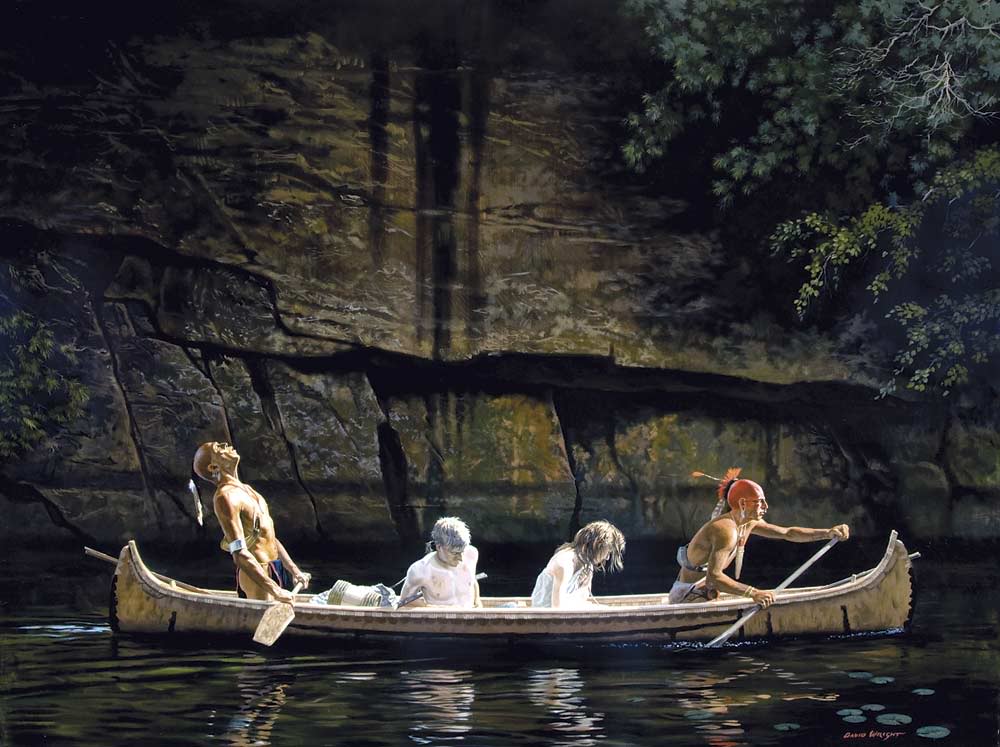
This narrative of William Biggs capture shows the importance of wearing your clothing and equipment in a proper and secure manner. Had Biggs payed proper attention to the securing of his saddle and the load he was carrying, it is quite possible that he would have escaped this ambush.
Captives, By David Wright.

In the year 1788, March 28th, I was going from Bellfontain to Cahokia,
in company with a young man named John Vallis, from the State of
Maryland; he was born and raised near Baltimore. About 7 o'clock in the
morning I heard two guns fired; by the report I thought they were to the
right; I thought they were white men hunting; both shot at the same
time. I looked but could not see any body; in a moment after I looked to
the left and saw sixteen Indians, all upon their feet with their guns
presented, about forty yards distant from me, just ready to draw
trigger. I was riding between Vallis and the Indians in a slow trot, at
the moment I saw them. I whipped my horse and leaned my breast on the
horse's withers, and told Vallis to whip his horse, that they were
Indians. That moment they all fired their guns in one platoon; you could
scarcely distinguish the report of their guns one from another. They
shot four bullets into my horse, one high up in his withers, one in the
bulge of the ribs near my thigh, and two in his rump, and shot four or
five through my great coat. The moment they fired their guns they ran
towards us and yelled so frightfully, that the wounds and the yelling of
the Indians scared my horse so that he jumped so suddenly to one side of
the road, that my gun fell off my shoulder, and twisted out of my hand;
I then bore all my weight on one stirrup, in order to catch my gun, but
could not. I had a large bag of beaver fur, which prevented me from
recovering my saddle, and having no girth nor crupper to my saddle, it
turned and fell off my horse, and I fell with it, but caught on my feet
and held the mane; I made several attempts to mount my horse again; but
the Indians running up so close, and making such a frightful yelling,
that my horse jumped and pranced so that it was impossible for me to
mount him again, but I held fast to my horse's mane for twenty or thirty
yards; then my hold broke and I fell on my hands and knees, and stumbled
along about four or five steps before I could recover myself. By the
time I got fairly on my feet, the Indians were about eight or ten yards
from me--I saw then there was no other way for me to make my escape but
by fast running, and I was determined to try it, and had but little
hopes at first of my being able to escape. I ran about one hundred yards
before I looked back--I thought almost every step I could feel the
scalping knife cutting my scalp off. I found I was gaining ground on
them, I felt encouraged and ran about three hundred yards farther, and
looking back saw that I had gained about one hundred yards, and
considering myself quite out of danger. A thought then occurred to me,
that I was as safe and out of danger as I would be if I were in the City
of Philadelphia: the Indians had quit yelling and slacked their
running--but I did not know it then. It being a tolerable cold morning
and I was heavily clad, I thought perhaps the Indians would give me a
long chase, and probably that they would hold out better than I could;
although at that time I did not feel the least tired or out of breath. I
concluded to throw off my two coats and shoes, as I would then be better
prepared for a long race. I had my great coat tied around me with a silk
handkerchief pretty much worn--I recollect tying it with a slip knot,
but being in a hurry, it was drawn into a double hard knot; I tried some
little time to get it loose--the longer I tried the harder the knot
seemed to get, that stopped my running considerably; at length I broke
it by some means, I do not know how. In the morning I forgot to put on
my shot pouch before I put on my great coat, and then put it on over it.
I pulled off the sleeves of my great coat, not thinking of my shot-pouch
being over my coat, it having a very short strap, the coat got so tight
in the strap that I could not get it loose for a considerable time.
Still trying, it hung down and trailed on the ground, and every two or
three steps it would wrap around my legs and throw me down, and I would
catch on my hands and knees, it served me so several times, so that I
could make no headway at running. After some considerable time, I broke
the strap and my great coat dropped from me--I had no knife with me.