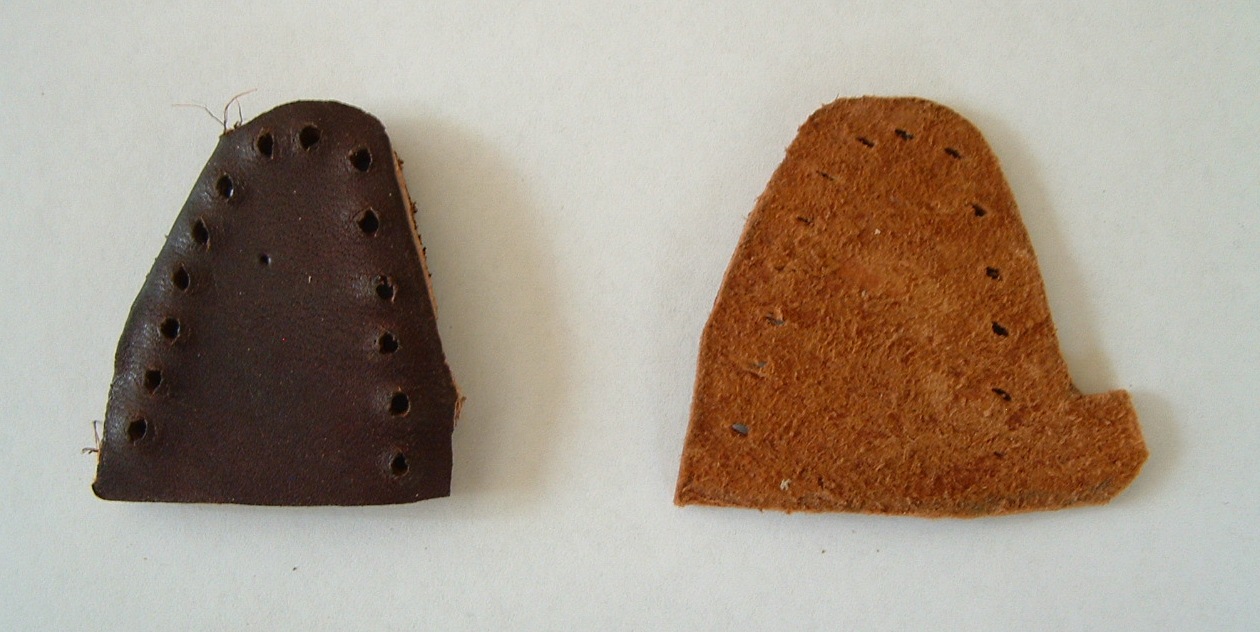
The
Flint Lock Hammer.
The
part of the flint lock that is struck by the flint which is held in the cock,
is called a “hammer” or steel. The reason it has this name is because the earlier Snaphance lock had a steel that reminded people of a hammer. See below.

Here on the Snaphance lock on the left you can see the shape of the hammer, & on the right, we see the hammer on the later flintlock.

Here again the lock on a pistol shows the hammer shape of the steel.

This is the lock on my Flintlock Fusil.
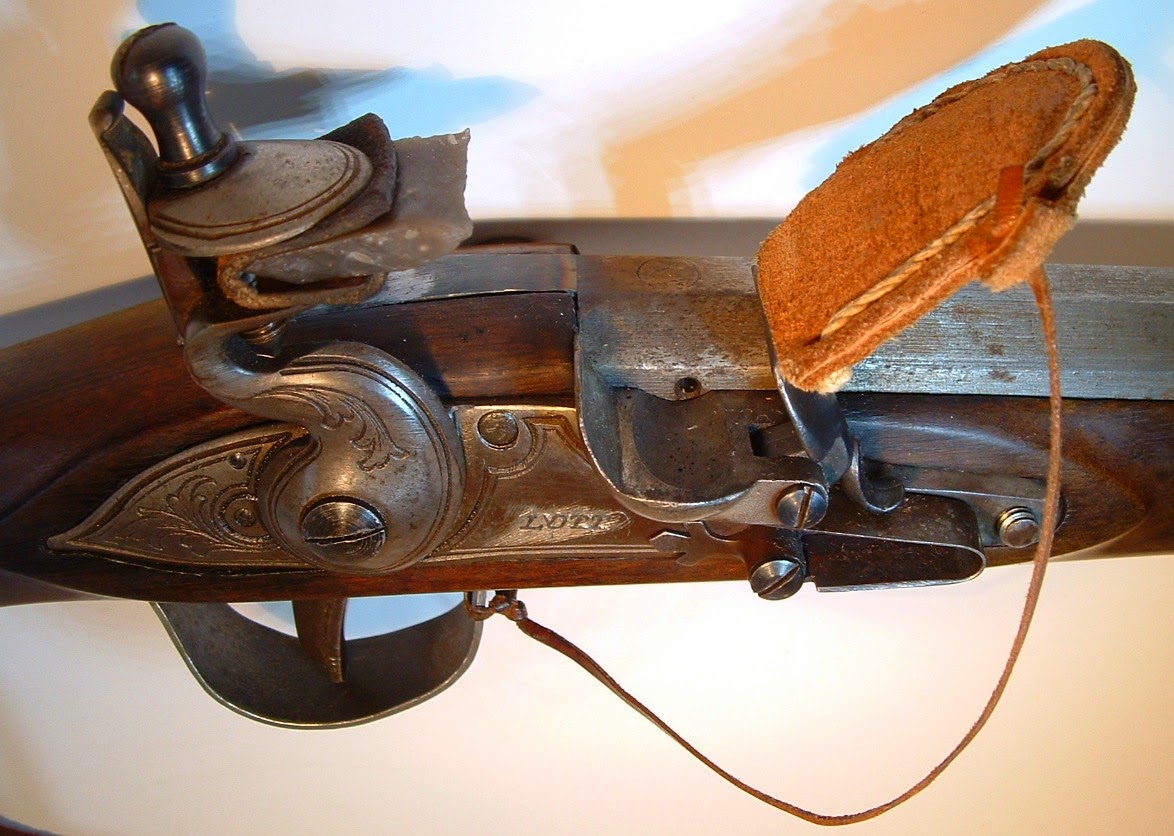
Here you can see the hammer boot or cap in place on the hammer.
Hammer Stall Documentation.
Lieutenant Colonel Wyatt immediately gave the order,
Off hammer caps'
Thorp, 1808.
...On Service, leather Hammer-stalls are undoubtedly
an advantage to a Battalion, when loaded, and resting on their Arms, as
accidents may be prevented by having them fixed upon the hammers of the
Firelocks..."
Cuthbertson. (pg 93, XIII).
It is left to their [officers] discretion in time of
real Action to disencumber such men as they may think proper entirely of them
[arms], taking care that they be lodged in their Ammunition Carriages and to
prevent any possible Accident happening therefrom, thumb stalls have been
ordered to be provided which the men are constantly to keep on the hammer of
their pieces except when posted centrys." Great Britain, Royal Artillery
Regiment Library, Woolwich, Brigade Orderly Book, James Pattison Papers. 1778.
The hammer stalls shall always be made of red Russia
leather.
The
men arms to be clean and in perfect repair, to be completed
with stoppers, pickers and brush, and hammer caps, which ought to be
made of
black leather.
CAMP AT WATSONS FERRY
20TH SEPTEMBER 1761.
REGTL.ORDERS
with stoppers, pickers and brush, and hammer caps, which ought to be
made of
black leather.
CAMP AT WATSONS FERRY
20TH SEPTEMBER 1761.
REGTL.ORDERS
On
service, leather Hammer-Stalls are undoubtedly an advantage
to the
battalion, when loaded and resting on their arms, as accidents
may be prevented, by having them fixed upon the hammers of the
firelocks.
(Cuthbertson, Bennett. System, for the Complete Interior Management
and Oecomomy for a Battalion of Infantry , Bristol, 1765. page 93)
to the
battalion, when loaded and resting on their arms, as accidents
may be prevented, by having them fixed upon the hammers of the
firelocks.
(Cuthbertson, Bennett. System, for the Complete Interior Management
and Oecomomy for a Battalion of Infantry , Bristol, 1765. page 93)
The term used now for the hammer on a flint lock is “frizzen”. This term was first used for the hammer on a flintlock in the 19th century. No one it seems knows where this name originated from, though it seems quite possible that it originated from my following findings:
Flint & Steel/Flint & Frezell or Fusil.
Frizzle ,fri'z'l),
sbl dial. Also 7 frezel, 9 friz- (z)el. [? Corruption of FUSIL.] (See quot.
1892.) 1629 Z. BOYD Last Kattell Soule 1266 He is euer readie to strik fyre
with his frezell and his flint,
1670-80; < French: musket, Old French fuisil, foisil steel for striking fire <Vulgar Latin *focīlis, derivative of Latin focus fire.
(in the sense: steel for a tinderbox): from Old French fuisil, from VulgarLatin focīlis (unattested), from Latin focus fire.
fusil
noun
A light flintlock musket.
Origin of fusil
French, steel in a flintlock, firearm,
from Old French fuisil, steel for a tinderbox, from Vulgar
Latin*focīlis (petra), fire-(stone), from Late Latin focus, fire,
from Latin, hearth.

The author's English style steel.

Author's Tinderbox.

Showing an open tinderbox with tinder inside & the flint & steel beside it.