A LIVING HISTORY BLOG.

18TH CENTURY LIVING HISTORY IN AUSTRALIA.
Showing posts with label primary documentation. Show all posts

Monday, 30 March 2020

Candles & Candle Wicking 18th Century.


Common plant fibres for candle wicks were apparently Cotton,  Linen, & Hemp.

Candles & Candle Wicking  18th Century.
Pensive I lay, e'en from the dead of night,
Until the sun his daily course began,
Reflecting on the candle's wasting light,
And moraliz'd the fate of mortal man.

White and unsully'd was that cotton wick,
When from the chandler first to me it came;
Behold how black! the greasy drops how thick!
Such colour takes it from imparted flame.

Such is the youth, of manners strict and pure,
Till led by vice he quits his reason's guide;
By flatt'ry drawn, he stoops to vice's lure,
And from the paths of reason wanders wide.

His passions melt, his manly vigour faints,
Nor mourns he ought his former vigour gone,
For foul society his former morals taints,
And mother Douglas marks him for her own.

The fool who sells is freedom for a smile,
Or for a ribband barters peace of mind,
Like wasting wicks just glimmers for a while,
Then dies in smoke, and leaves a stink behind.

The many perils that ambition wait,
When soaring high, we still the lower fall,
Are but the SNUFFERS of expiring light,
And death's the grand EXTINGUISHER of all.
Elegy on a Tallow Candle - Unknown, 1762

 Old Days, Old Ways: An Illustrated Folk History of Ireland
Cotton candle
A CANDLE with a COTTON WICK. Since this appears in the sixteenth century, presumably made because it gave a better product than any of the alternatives, the eighteenth-century occurrence of the term 'cotton candle' in the Dictionary Archive is surprisingly late.
OED earliest date of use: 1587
Sources: Inventories (late).
In Edinburgh in the sixteenth century it would appear that candle wicks were of two types: rag wick and hard wick.
 Although rag wicks are described in slightly more detail in other sources, the hard wick is rather obscure, possibly referring to a wooden core, as with candle-fir, though this is speculative. It is clear that the rag wick was more expensive, with candles of rag wick costing 9d. per pound, and hard wick 8d. per pound .
 The description of rag wick is slightly clearer, as this type was quite literally made of old rags.
 One Aberdeenshire example, from a inventory of Bishop Alexander Gordon’s palace, states that the wardrobe contained ‘five payr of riffyneschet is ane yer of sewit with sylk for candliweik-kis’.
 While it is quite telling that a bishop would have his servants make candle wicks out of silk rags, they were rags nonetheless, demonstrating a lack of waste and propensity to recycle which were just as familiar to the islanders of Coll, when in 1773 Samuel Johnson noted that they made their own candles with wicks of ‘small shreds of linen cloth’.
 Apparently not all wicks were made of old rags, though, as the  ‘Book of the Rates of Customs’ shows, imported ‘candle week is the hundreth weight’ could be had for £3.
Wicks were made from cotton,  hemp,  or,  less often,  from milkweed.
http://passionforthepast.blogspot.com/2016/09/candles-light-at-its-brightest.html

A New and Complete Dictionary of Arts and Sciences (1754-55).

The Whole Law Relative to the Duty and Office of a Justice of the Peace : Comprising Also the Authority of Parish Officers. Volume 1 of 4 1800ad;

The Monthly Magazine, Volume 9 1800ad;

US Textile Production in Historical Perspective: A Case Study from Massachusetts;

 
History of the Cotton Manufacture in Great Britain;

The Universal Magazine,  1749;

At the same Place is made and sold, fine CANDLES, which being made of neat, clean Tallow, and fine Cotton, free from any Mixture of Adulteration, will burn longer, give a brighter Light, and better Smell, than those Stuff called Candles sold in the Market, or any of them which are mixed or made of Yarn, Tow, &c.
The Pennsylvania Gazette
December 26, 1765

To purify Tallow.
Take 58 of tallow, 38 of mutton-suet, melt them in a copper caldron, with half a pound of hot water to each pound of grease. Then, as soon as they are melted, mix eight ounces of brandy, one of salt of tartar [potassium carbonate/pearl ash], one of cream of tartar [potassium bitartrate], one of sal ammoniac [ammonium chloride], and 2 of pure dry potash [potassium chloride & others]. Throw the mixture into the caldron, and make the ingredients boil a quarter of an hour; then let the whole cool. The next day the tallow will be found on the surface of the water, in a pure cake. Take it out and expose it to the action of the air, on canvass, for some days. It will become white, and almost as hard as wax. The dew is very favourable to its bleaching; make your wicks of fine and even cotton, give them a coat of melted wax; then cast your mould candles. They will have much the appearance of wax, and one, six to the pound, will burn 14 hours, and never run.

The Pennsylvania Gazette
May 18, 1791


Tuesday, 28 January 2020

All about soap & shaving in the 18th century.


All about soap & shaving in the 18th century.
Image taken from Perret’s Book “The Art to Shave Oneself” 1770

A question was raised about what soap was used for shaving in the 18th century, so I thought I would do a little research. No doubt many of you carry a piece of soap in your pack as I do, so soap is an interesting subject even if you do not shave.
George Washington's shaving items.

Honing a straight razor  Perret’s Book “The Art to Shave Oneself” 1770

Honing a straight razor  Perret’s Book “The Art to Shave Oneself” 1770
The Art of Cookery Made Plain and Easy: Which Far Exceeds Any Thing of the kind yet published by Hannah Glasse 1747


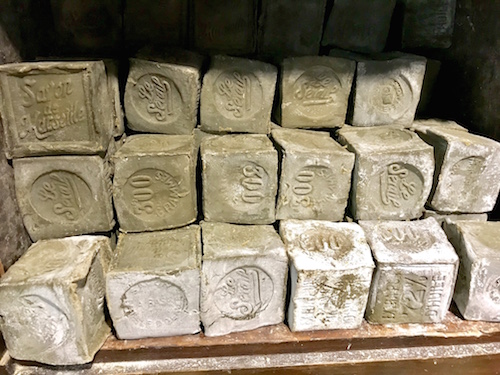
It seems that soap came in large bars, sometimes a person could choose the length of the bar they wished to purchase, & this bar was then cut to size. Other methods saw these bars cut into bricks for sale. I do not get the impression that we are talking about the bars of soap we purchase these days, I think these bricks were square & much larger. This type of soap was known as hard soap, soft soap was apparently the sort of soap that was made at home by the settlers. Whether or not there was a preference in hard or soft soap for shaving I can’t say, but it was this ordinary soap that was used for washing & shaving.

Cutting bars of soap by Diderot

Soap.
Ordinary soap was used for shaving in the 18th century.
Spain during the 11th and 12th centuries, where Spanish Muslims made Castile soap.
http://www.todayifoundout.com/index.php/2013/03/the-history-of-soap/
Castile soap for shaving, washing & weight loss.
In 1752 Richard Barnard of Temple Bar claimed to be the inventor of the ‘True original shaving powder’. A rival powder, advertised the same year by J. Emon, claimed to ‘make razors cut easy and [was] very good for tender faces’.
https://dralun.wordpress.com/2016/05/17/splash-it-all-over-a-brief-history-of-aftershave/
“To make very good washing balls take storax of both kings, benjamin, calamus aromaticus, labdanum of each a like; and bray them to powder with cloves and orris; then beat all with a sufficient quantity of soap till it be stiff, them with your hand you shall work it like paste, and make round balls thereof.” 
Gervaise Markham, The English Housewife 1683.
 “TO BE SOLD BY EDWARD LANGDON, IN FLEET STREET, NEAR THE OLD NORTH MEETING HOUSE, A QUANTITY OF HARD SOAP BY THE BOX, SOFT SOAP BY THE BARREL”.
Pearlash soap add, Boston Gazette Mid 18th century.
https://spadet.com/19th-century-soap-making-its-history-and-techniques/


In all the material I have researched so far, no where does it mention the size of bar soap, nor are there any images of sketches of 18th century soap. However, I did find a painting, & it does give a fair indication of the size of a brick of soap.
A Lady’s Maid Soaping Linen

c.1765–82


Soap detail.

This is an image of Marseille soap as it is sold today, I have no proof, but I suspect that this could have been what it looked like in the 18th century.


Wednesday, 22 January 2020

Belt Bag, Shot Pouch & Cartridge Box Primary Documentation.

Bag, pouch, belt bag, belt pouch.

Shot pouch, shot bag.

Cartouche box or cartridge box.
Shot bag or shot pouch for goose shot.

Large shot pouch or shot bag for bird shot.

Ball bag or ball pouch for ball.

Small shot bag or shot pouch for bird shot.


For those of you who may be confused with the different names used to describe a pouch or bag, the simple fact is that in the 18th century they used these terms interchangeably, just as we do now, so you could have a shot pouch, or a shot bag, or even a ball bag or a ball pouch & they may or may not be all the same thing!


Shot Pouch Documentation.

SHOT [fcfcot, Du.] the going out or reach of a Bow, Gun, Jjr. as far as it can carry ; all Sorts of Bullets for Fire t Arms.
CARTOOSE  [ Cartouche, F. ] CARTOUCH , CARTRIDGE ] A charge of powder put into a Paper Cafe, exactly fitted to the Muzzel of the Gun, O"c.
BAG [Bcljje, Sa\. En>^a, L.] a Sack oc Pouch.
POUCH [Pocca, Sax. Pochette, ?.] Bag or Purie.
BELT [Belt, S**.] a Girt to hang i Sword by : A Ho a Difcafc in Sheep.
BOX [Boxe, SaK.} a wooden Cheft or )ffcr. BOX [of Bofejieop, Sax.] the Wood of the Box-tree.
CASE  a little Box, or Covering to put any thing in.
\ BALL fjl&al, Beln."] any round thing.
18th century dictionary.

Belt Bag or Belt Pouch Documentation.

BAG.
16th century term for the girdle pouch.
The Dictionary of Fashion History
By Valerie Cumming, C. W. Cunnington, P. E. Cunnington

BAGS AND PURSES IN 16TH CENTURY GERMANY
Tasche or Beutel are the German words for bag or purse, and when looking at artwork from 16th c Germany there are lots of purses to be seen on men, women and children. Small ones, big ones, hanging low from belts, others securely fastened to the belt.
BAG  a Sack or Pouch.
POUCH  Bag or Purse.
BELT [Belt, S**.] a Girt to hang a Sword by : Also a Difeafe in Sheep.


Thursday, 3 October 2019

Medical Use of Honey in the 17th & 18th centuries. Documentation.


18th Century Medicinal Uses for Honey.
 ‘A poultis for a Swelling by My Aunt Dorothy Pates’, for example, used honey as a binding agent. Another recipe, said to be ‘approved by the best doctars [sic]’ used a clove of garlic saturated in fine English honey and put in the ear for eight days to cure pain and restore hearing.   
 Abigail Smith and others, ‘Collection of medical and cookery receipts’ (c. 1700).  Wellcome Library, London, MS 4631, f. 7r.
 Ibid., f. 23 v

“Cut the white heels from some red rose buds, and lay them to dry in a place where there is a draught of air; when they are dried, put half a pound of them into a stone jar, and pour on them three pints of boiling water; stir them well, and let them stand twelve hours; then press off the liquor (liquid) and when it has settled, add to it five pounds of honey; boil it well, and when it is of the consistence of thick syrup, put it by for use. It is good against mouth sores, and on many other occasions.”
‘Honey of Roses’ and The Family Herbal by Sir John Hill 1759.
The leaves being applied with honey to running sores or ulcers, do cleanse them.
SYRUPS MADE WITH VINEGAR AND HONEY.
The Project Gutenberg EBook of The Complete Herbal, by Nicholas Culpeper
17th Century.


Friday, 4 January 2019

Trail Foods. William Byrd.


Trail Foods. Byrd. The Secret History.
William Byrd II (March 28, 1674 – August 26, 1744) 
“The Portable Provisions I would furnish our Foresters withal are Glue-Broth and rockahomini : one contains the Essence of Bread, the other of Meat.
The best way of making Glue-Broth is after the following method: Take a Leg of Beef, Veal, Venison, or any other Young Meat, because Old Meat will not so easily Jelly. Pare off all the fat, in which there is no Nutriment, and of the Lean make a very strong Broth, after the usual Manner, by boiling the meat to Rags till all the Goodness be out. After Skimming off what fat remains, pour the Broth into a wide Stew-Pan, well tinn'd, & let it simmer over a gentle, even Fire, till it come to a thick
Jelly. Then take it off and set it over Boiling Water, which is an Evener Heat, and not so apt to bum the Broth to the Vessel. Over that let it evaporate, stirring it very often till it be reduc'd, when cold, into a Solid Substance like Glue. Then cut it into small Pieces, laying them Single in the Cold, that they may dry the Sooner. When the Pieces are perfectly dry, put them into a Cannister, and they will be good, if kept Dry, a whole East India Voyage.
This Glue is so Strong, that two or three Drams, dissolv'd in boiling Water with a little Salt, will make half a pint of good Broth, & if you shou'd be faint with fasting or Fatigue, let a small piece of this Glue melt in your Mouth, and you will find yourself surprisingly refreshed. One Pound of this cookery wou'd keep a man in good heart above a Month, and is not only Nourishing, but likewise very wholesome. Particularly
it is good against Fluxes, which Woodsmen are very liable to,
by lying too near the moist ground, and guzzling too much cold Water. But as it will be only us'd now and then, in times of Scarcity, when Game is wanting, two Pounds of it will be enough for a Journey of Six Months. But this Broth will be still more heartening if you thicken every mess with half a Spoonful of Rockahominy, which is nothing but Indian Corn
parched without burning, and reduced to Powder. The Fire drives out all the Watery Parts of the Corn, leaving the Strength of it behind, and this being very dry, becomes much lighter for carriage and less liable to be Spoilt by the Moist Air.
Thus half a Dozen Pounds of this Sprightful Bread will sustain a Man for as many Months, provided he husband it well, and always Spare it when he meets with Venison, which, as I said before, may be very Safely eaten without any Bread at all.
By what I have said, a Man needs not encumber himself with more than 8 or 10 Pounds of Provisions, tho' he continue half a year in the Woods. These and his Gun will support him very well during that time, without the least danger of keeping one Single Fast. And tho' some of his days may be what the French call Jours maigres, yet there will happen no more of those than will be necessary for his health, and to carry off the Excesses
of the Days of Plenty, when our Travellers will be apt to indulge their Lawless Appetites too much”.
“After these necessary Matters were settled, I ordered 1000 lb
of Brown Biscuit, & 200 lb of white to be provided, & 6 Baggage Horses to carry it, at the rate of 3 Baggs containing 200 lb. each Horse. As for meat I intended to carry none, but to depend intirely upon Providence for it. But because the Game was not like to be plentifull till we got above the Inhabitants, I directed all the men to find themselves with 10 day's Provision. I augumented my Number of Men to 17, which together with 3 which Firebrand undertook to get made up the Complement of 20. For these I provided Ammunition after the Rate of 2lbs of Powder a Man, with Shot in proportion”.
Byrd. The Secret History.

“We, on the part of Virginia, that we might be sure to be punctual, arriv'd at Mr. Kinchin's, the place appointed, on the 19th, after a Journey of three days, in which nothing Remarkable happen'd.
We found three of the Carolina-Commissioners had taken Possession of the House, having come thither by water from Edenton, By the Great Quantity of Provisions these Gentlemen brought, and the few men they had to eat them, we were afraid they intended to carry the Line to the South sea.
They had 500 lbs of bcaon and dry'd Beef, and 500 lbs of Bisket, and not above three or four men. The misfortime was, they forgot to provide Horses to carry their good things, or else trusted to the Incertainty of hireing them here, which, considering the Place, was leaving too much to that Jilt, Hazard.
On our part we had taken better Care, being completely furnisht with everything necessary for transporting our Baggage and Provisions. Indeed we brought no other Provisions out with us but 1000 lbs of Bread and had Faith enough to depend on Providence for our Meat, being desirous
to husband the publick Money as much as possible. We had no less than 20 men, besides the Chaplain, the Surveyors and
all the Servants, to be Subsisted upon this Bread. However, that it might hold out the better, our men had been Order'd to provide themselves at Home with Provision for Ten days, in which time we judg'd we should get beyond the Inhabitants, where Forest-Game of all sorts was like to be plenty at that time of the Year”.
“One of our Men Spy'd three Buffaloes, but his Piece being loaded only with Goose-shot, he was able to make no effectual Impression on their thick hides; however, this Disappointment was made up by a Brace of Bucks, and as many Wild Turkeys, kill'd by the rest of the company. Thus Providence was very Bountiful to our Endeavours, never disappointing those that Faithfully rely upon it, and pray heartily for their Daily Bread”.
Byrd. History of the Dividing Line.

Sunday, 22 May 2016

Memoir of Robert Witherspoon. 1730.


 Memoir of  Robert Witherspoon, A Scots-Irish family settles
in South Carolina in the 1730s.

 We were then put on board an open boat with tools and a years provision and one still mill for each family. They allowed each person over sixteen one ax, a broad ax, one narrow hoe. Our provisions consisted of indian corn, rice, wheaten flour, beef,  pork, rum and salt we were much distressed in this part of our passage as it was the dead of winter and we were exposed to the inclemency of the weather day and night and what added to the grief of all pious persons on board was the Atheistical blasphemous mouths of our patrons they brought us up as far as Potatoe Ferry on Black River, about twenty miles from Georgetown and turned us on shore where we lay in Samuel Commander’s barn for some time while the boat wrought her way up as far as the king’s tree with the goods and provision.
The boat that brought up the goods arrived at the Kingstree. The people were much oppressed in bringing their things as there was no horse there, they were obliged to toil hard, as they had no other way but to carry them on their back. The goods consisted of their bed-clothing chests provision tools post &c. [etc. At that time there were no roads every family had to travel the best they could, which was double distance to some for their only guides were swamps and branches. After a time the men got sufficient knowledge of the woods as to blaze paths, so the people learned to follow blazes from place to place.
As the winter season advanced there was but a short time for preparing land for planting — but the people were strong and healthy All that could do anything wrought diligently and continued clearing and planting as long as the season would admit. So they made provisions for that year. Their beasts were few and as the range was good there was no need of feeding creatures for some time to come.
The first thing my father brought from the boat was the gun[,] one of queen Anne’s muskets,  loaded with swan shot. One morning while we were at breakfast a travelling oppossum on his way passed the door. My mother screamed out there is a great bear we hid behind some barrels at the other end of our hut Father got his gun and steedied it on the fork that held up the end of the hut and shot him about the hinder parts which caused poor opossum to grin and open his mouth in a frightful manner. Father having mislaid his shot could not give it a second bout, but at last ventured out and killed it with a pail.
Another thing which gave us great alarm was the Indians when they came to hunt in the spring they were great in numbers and in all places like the Egyptian locast but they were not hurtful. Besides these things we had a great deal of trouble and hardships in our first settling, but the few inhabitants were favored with health and strength. We were also much oppressed with fear on divers other accounts, especially of being massacred by the Indians, or bit by snakes, or torn by wild beasts, or of being lost and perishing in the woods, of whom there were three persons who were never found.


Saturday, 21 May 2016

Indians At War-Period Quotes.

Summit Meeting By Robert Griffing.


Indians At War.
"Their Arms are a Gun and Tomahawk, and all the Provisions they carry from Home is a Pouch of Rockahominy. Thus provided and accoutr'd, they march towards their Enemy's Country, not in a Body, or by a certain Path, but Straggling in Small Numbers, for the greater convenience of Hunting and passing along undiscover'd. So soon as they approach the Grounds on which the Enemy is used to hunt, they never kindle any Fire themselves, for fear of being found out
by the smoak, nor will they Shoot at any kind of Game, tho' they shou'd be half Famisht, lest they might alarm their Foes, and put them upon their Guard. Sometimes indeed, while they are still at some distance, they roast either Venison or Bear, till it is very dry, and then having Strung it on their Belts, wear it round their Middle, eating very Sparingly of it, because
they know not when they shall meet with a fresh Supply. But coming nearer, they begin to look all round the Hemisphere, to watch if any smoke ascends, and listen continually for the Report of Guns, in order to make some happy Discovery for their own advantage".

 WILLIAM BYRD'S DIVIDING LINE HISTORIES
Mid 18th century.


Tuesday, 19 January 2016

A Jamestown settler describes life in Virginia, 1622


Well beloved good friend Henry Hovener
My comendations remembred, I hartely [wish] your welfare for god be thanked I am now in good health, but my brother and my wyfe are dead aboute a yeare pass’d And touchinge the busynesse that I came hither is nothing yett performed, by reason of my sicknesse & weaknesse I was not able to travell up and downe the hills and dales of these countries but doo nowe intend every daye to walke up and downe the hills for good Mineralls here is both golde silver and copper to be had and therefore I will doe my endeavour by the grace of god to effect what I am able to performe And I intreat you to beseeche the Right Hon: & Wor: Company in my behalfe to grant me my freedome to be sent either to me I dowbte not to doo well & good service in these countries humbly desyringe them also to provyde me some [appointed] fellowe & a strong boye to assiste me in my businesse, and that it may please the aforesaid Company to send me at my charge a bed wth a bolster and cover and some Linnen for shirtes and sheetes. Sixe fallinge bands wth Last Size pairs of shoes twoo pairs of bootes three pairs of cullered stockings and garters wth three pairs of lether gloves some powder and shott twoo little runletts of oyle and vinnegar some spice & suger to comfort us here in our sicknesse abowte ffyftie pounds weight of holland and Englishe cheese together, Lykewyse some knyves, spoons, combes and all sorts of cullerd beads as you knowe the savage Indians use Allso one Rundlett wth all sortes of yron nayles great and small, three haire sives, two hatchetts wth twoo broad yrons and some Allum And send all these necessaries thinges in a dry fatt wth the first shippinge dyrected unto Mr. Pontes in James Towne here in Virginia And whatsoever this all costes I will not onely wth my moste humble service but allso wth some good Tobacco Bevor and Otterskins and other commodities here to be had recompence the Company for the same And yf you could send for my brother Phillipps Sonne in Darbesheere to come hether itt [were] a great commoditie ffor me or suche another used in minerall workes And thus I comitt you to the Almighty. Virginia 13 January 1622.


Tuesday, 22 December 2015

Weskit Apologies.

In past articles I have used the term "weskit" to describe an 18th century waistcoat. Today one of my readers contacted me to tell me that this term "weskit" was a 19th century term. From where & from whom I I got this term weskit I can't remember, but regardless it is entirely my own fault for not double checking & doing my own research. So I want to apologies to all my readers for spreading this misinformation, I feel a right twit !!! Especially as I have also written extensively on the importance of doing "your own research" Arrrrggg!


weskit
First use: 1849
Origin: alteration of waistcoat
www.merriam-webster.com/dictionary/weskit

Weskit ~ vest
http://www.scottish-wedding-dreams.com/scottish-words.html#W ~ Scottish words
He stuffed this objet trove, whatever it was, into a weskit pocket without looking at it, and carried on briskly.
Adair, Tom (Intro) THREE KINDS OF KISSING - SCOTTISH SHORT STORIES

Virginia Piedmont (20)
When an R comes after a vowel, it becomes UH, and AW becomes the slided sound, AH-AW. Thus, four dogs becomes fo-uh dah-awgs. Some local words are: hoppergrass(grasshopper), old-field colt (illegitimate child), school breaks up (school lets out), weskit (vest).
http://robertspage.com/dialects.html

weskit A colloquial rendering of the word 'waistcoat'


Waistcoat+(or WesKit) Waistcoats vests were worn by most men as a normal part of their everyday clothing  in both summer and winter. Sleeved waistcoats were much preferred for winter. They were worn over the shirt and breeches and under a frock or coat. They were made of linen, fustian, silk or fine wool twill, and almost always lined. The length of the waistcoat was determined by the wearer, In the mid 1700s they were generally mid thigh and got shorter as the century progressed. They may have been striped, printed, checked, or solid, and matched or contrasted with the breeches and the coat. While many waistcoats were cut to fit the wearer snugly and fashionable, others were made with lacing or ties on the back to draw the waistcoat snug. Lacing or ties are very practical for weight gain and loss, but were seldom used on sleeved waistcoats. Most waistcoats had front pockets at the waist, yet some had "false pockets" with only a pocket flap complete with buttonholes.

WESKIT / WAISTCOAT The waistcoat was considered a “must” for wear if one did not have a jacket or coat on. Waistcoats were fashionable and daily wear for men of this time. Both sleeveless and sleeved waistcoats are correct.
JAEGER’S BATTALION ROGERS’ RANGERS A GUIDE FOR PROPER CLOTHING AND GEAR IN THE 1750s

Weskit "Das Kamisol": Made of white linen in the 1770's style is the primary weskit used for the summer uniform while weskits of hunter green wool is generally used for winter wear. Both the summer and winter weskit typically have pockets but is not a requirement. Weskits of other colors and materials may be used as an option but should be of the 1770's style.

Our unit chooses to follow these guidelines, as they seem the most likely conclusions based on primary documents. It should be noted however, that we are choosing to wear the Light Infantry pattern weskit that was approved by the King in 1771.

The pronunciation given for the word falcon by eighteenth-century authorities ... of words with their actual spelling: waistcoat (formerly pronounced “weskit”),


 (we are talking about a country where “breeches” is pronounced “britches” and “waistcoat” is “weskit”).

 "Waistcoat" used to be pronounced /'wEskIt/. ...... end of the 18th Century and regarded as a foreign word down to the middle of the 19th.

A SHORT HISTORY OF ENGLISH SPELLING Table 2.2 Some recent spelling-pronunciations Spelling Old pronunciation New pronunciation again / e en/ (a-genn) / e e n/ (a-gain) conduit / k nd t/ (kundit) / kndw t/ (kondwit) forehead / fr d/ (forrid) / f c :hed/ (forhedd) nephew / nevju:/ (nev-yoo) / nefju:/ (neff-yoo) often / fn/ (off’n) / ft e n/ (offt’n) waistcoat / wesk t/ (weskit) / we sk e t/ (waisscoat)

   b. A short garment worn beneath the coat or jacket as a usual part of male attire; a waistcoat. 
1666   S. Pepys Diary 8 Oct. (1972) VII. 315   The King hath yesterday in council, declared his resolution of setting a fashion for clothes... It will be a vest, I know not well how. But it is to teach the nobility thrift.
1666   S. Pepys Diary 15 Oct. (1972) VII. 324   This day the King begins to put on his Vest..being a long Cassocke close to the body, of black cloth and pinked with white silk under it, and a coat over it, and the legs ruffled with black riband like a pigeon's leg.

 So, it seems that the word or term "weskit" may well be 18th century, BUT, it was a pronunciation, NOT a written word to describe a waistcoat or vest.
Keith.