A LIVING HISTORY BLOG.

18TH CENTURY LIVING HISTORY IN AUSTRALIA.
Showing posts with label documentation. Show all posts

Thursday, 30 January 2020

Priming Horn Documentation Found!


Priming Horn Information.
“The priming-horn is intended to be filled with Pistol Powder, and the Ranger always to prime from it in time of action, by which method he will not be near so subject to burn priming or miss fire as He would by priming from a Cartridge, as the grain of the powder will be small and a very great fault which Men are subject to in time of action will be prevented, Vizt. That of spilling one half of their Cartridge of powder and sometimes more in priming and shutting their Pans, and when they have loaded and discharg’d their Pieces after the common method, it often happens that the Ball is not sent with half the force it is intended or anything near the distance it ought to go, which mistake will (I imagine) be avoided by the handiness of the Priming-horn, as the Men will have nothing more to do with the Cartridge than bite off the top, put it in the barrel at once and ram it down, and if the Cartridge is fill’d with Cannon powder it will have just the same effect I conceive as if fill’d with Pistol powder which will get into the touch-hole and catch fire as quick as can be wished…..” 21


End Note 21 from page 366: HL, LO6927, 13 Feb. 1758 Captain/Major George Scott, ranger captain:
Small Arms of the British Forces in America, 1664-1815, by Dr. De Witt Bailey.
My thanks to Gus for this information.
Keith.


Tuesday, 10 September 2019

Museum of Appalachia to Host “Days of the Pioneer” Antique Exposition - September 13th & 14th


Museum of Appalachia

P.O. Box 1189, Norris, TN 37828

Phone: 865-494-7680 or 494-0514

E-mail: janmarshall@museumofappalachia.org

www.museumofappalachia.org


Museum of Appalachia to Host “Days of the Pioneer” Antique Exposition - September 13th & 14th


The Museum is located 16 miles north of Knoxville, one mile east of I-75 at Exit 122. For additional information call (865) 494-7680 or visit the website at: www.museumofappalachia.org.

Sunday, 8 September 2019

Tools Made from Rasps or Files


Tools Historic Maritime I (1607-1676): The First Colonial Dominion The Davistown Museum - Tools Made from Rasps or Files 31-Jul-14 Blacksmiths re-use worn or damaged files and rasps by making them into something else. All the tools listed here are also listed in the sections and categories given. Historic Maritime I (1607-1676): The First Colonial Dominion Sub Category Woodworking: Axes and Hatchets 102409T1 Hatchet 13 1/2" long, 3 1/8" cutting edge It has a forge-welded edge. DTM http://www.davistownmuseum.org/pics/102409T1web1.jpg http://www.davistownmuseum.org/pics/102409T1web2.jpg SubCategory Woodworking: Boring Tools TAB1010 Stone drill 8 1/2" long This stone drill has clearly been re-fashioned from a used blacksmith rasp. It was made in the 17th or 18th century. It is typical of the type of tool early settlers would have used to drill a mooring hole. DTM http://www.davistownmuseum.org/pics/tab1007.jpg SubCategory Woodworking: Edge Tools 42602T4 Drawknife 10" wide, 4 1/2" wide blade This hand-forged tool has been carefully refashioned from file steel. The short chubby handles are in the English style and are made of carefully cut and glued leather. This nifty tool is difficult to date; it is probably made in the 18th century. It is displayed in the Maritime I case because it is so typical of the homemade tools of the early colonial period. This tool is, in fact, exactly what a small drawshave in the tool kits of the first New England settlers could have looked like. BDTM Historic Maritime II (1720-1800): The Second Colonial Dominion & the Early Republic SubCategory Agricultural Implements 102409T2 Grafting froe 13" long, 4" wide, 2 3/4" cutting edge DTM http://www.davistownmuseum.org/pics/102409T2web1.jpg http://www.davistownmuseum.org/pics/102409T2web2.jpg 913108T47A Grafting iron 9 1/2" long, 2 3/4" long blade DTM Blacksmith, Farrier, and Metalworking Tools SubCategory TBF3501 Bench vise 7" high, 2 1/2" wide The hold down is made from a recycled farriers' rasp. DTM 3114T3 Hoof knife 6" long, 1 1/4" wide, 2" edge DTM 61601T5 Tin snips 12 3/4" long These are clearly reforged from a file. The first rolled tin dates to the early 18th century. This reforged smith-made tool is at least 200 years old. DTM SubCategory Cobbler and Saddler Tools 1 Tools Historic Maritime II (1720-1800): The Second Colonial Dominion & the Early Republic The Davistown Museum - Tools Made from Rasps or Files 31-Jul-14 62406T3 Curriers' slick fleshing knife 6" long, 2" blade It is forge-welded from a recycled rasp. DTM SubCategory Domestic Utensils 11301T1 Block knife 20 5/7" long with 15 3/4" chopping arm and 5" wide iron blade The iron component of this food and/or tobacco chopper is made of a recycled farriers' file. DTM TBF3000 Cleaver 8 3/8" long with a 2 1/2" blade It was forged out of an old rasp. DTM SubCategory Knives 81101T14 Crooked knife 8 1/2" long, 3" blade Crooked knives are especially common in northern New England where they were used by Native Americans and European settlers for many purposes including basket-making and working birch bark. This knife has been reforged from an old file or rasp, one of early American artisans' most important sources of recycled forged steel. The crosshatched carving on the nicely fashioned applewood (?) handle suggests a Native American user. DTM http://www.davistownmuseum.org/pics/81101t14.jpg SubCategory Logging Tools 913108T49 Spud 8 1/2" long, 2" wide DTM SubCategory Miscellaneous Tools 40501T4 Pry bar 21 3/4" long Refashioned from an old rasp, this rip is a classic example of recycling a dull rasp. With a nicely forged rattail hanger, this tool is probably late 18th century. DTM SubCategory Woodworking: Boring Tools 31602T2 Turn screw 19 1/2" long with 15" long and 5/8" wide blade It has a nicely turned handle with a recycled iron ferrule. A recycled file has been used as the turn screw. An unusual hole has been wrought and drilled in the turn screw center. DTM TJR1301 Turn screw 12 1/2" long, 3 1/2" handle This shows the typical recycling of used rasps. DTM SubCategory Woodworking: Edge Tools 81801T11 Drawknife 6" long, 3 1/4" blade This carefully wrought shave is made from the recycled steel of a rasp or file and predates the patternmakers' drawknives that it resembles. Its use is unknown. DTM 2 Tools Historic Maritime II (1720-1800): The Second Colonial Dominion & the Early Republic The Davistown Museum - Tools Made from Rasps or Files 31-Jul-14 31702T2 Drawknife 10 1/2" wide, 5 5/8" blade This is an excellent example of an edge tool made out of recycled file steel with English style handles. DTM 32412T2 Drawknife 14" long, 8 1/2" long blade This drawknife is crudely welded together from a file and two separate pieces of steel. Courtesy of Liberty Tool Co. DTM 913108T39 Drawshave 20 3/4" long, 7 3/4" blade This shave is made from a recycled rasp or file. DTM 111001T21 Toothed chisel 3 7/16" long, 2" cutting head with 17 teeth This is an excellent example of recycling file steel. Its use is unknown; it is too delicate for stone facing. DTM SubCategory Woodworking: Planes 81101T12 Coachmakers' router 13 3/8" wide, 7/16" wide cutter This once common 18th century tool shows indications of being refashioned from an old file or rasp. DTM SubCategory Wrenches 43006T4 Wagon wrench 3/4" and 13/16" wide wrench openings It is a curved wrench, forge-welded and hand-filed from a handmade rasp. It is a nice example of an 18th century wagon wrench. DTM Historic Maritime III (1800-1840): Boomtown Years & the Dawn of the Industrial Revolution SubCategory Agricultural Implements TCR1001A Grafting froe 8 5/8" long with a 3 1/4" blade This tool is refashioned from an old file or rasp. It was a basic necessity for Davistown residents maintaining orchards in the 19th century. DTM http://www.davistownmuseum.org/pics/tcz1006.jpg http://www.davistownmuseum.org/pics/tcr1001a.jpg Blacksmith, Farrier, and Metalworking Tools SubCategory 913108T7 Blacksmiths' tongs 13" long DTM 913108T37 Blacksmiths' tools (5) A) 2 1/2"; B) 9 1/4"; C) 6 1/2"; D) 1 3/4"; E) 7 3/4" This is a set of tools a blacksmith may have made for his own use. They consist of: B) grafting tool, C) spud, D) wedge, and two farriers' hoof cutters A) and E). DTM 021812T4 Clinch cutter This is a farriers' tool rendered out of a recycled rasp or file. DTM 3 Tools Historic Maritime III (1800-1840): Boomtown Years & the Dawn of the Industrial Revolution The Davistown Museum - Tools Made from Rasps or Files 31-Jul-14 032103T3 Farriers' chisel 7 3/8" long, 2" long cutter This is an excellent example of recycled steel. Originally a steel rasp, worn out rasps were saved and reworked into other useful edge tools. The peened top cutting edge reflects the transition from forged iron to a hammered steel cutting edge. DTM http://www.davistownmuseum.org/pics/032103t3_p1.jpg http://www.davistownmuseum.org/pics/032103t3_p2.jpg TG1010 Punch 5 1/4" long DTM 021812T6 Wedge 3" long, 1 1/4" wide This is possibly a farriers' or blacksmiths' tool made from a recycled rasp or file. It has a hand-drilled hole of 1/4" diameter that might be used for a handle. DTM SubCategory Cobbler and Saddler Tools TG1007 Tack pry 11 3/8" long It is made from a file. DTM SubCategory Coopers' Tools 81801T13A Coopers' _____? 6" long, 4" angle extension This tool is characterized by the same grooved crease found in all coopers' hammers, though slightly narrower (1/8") than the crease in 81801T13 (1/4"). It is clearly refashioned from recycled file steel and is very unusual. A specific identification is welcomed. DTM 092409T3 Coopers' adz 9 1/3" long, 1" wide with a 12" long handle DTM http://www.davistownmuseum.org/pics/092409T3web2.jpg http://www.davistownmuseum.org/pics/092409T3web4.jpg SubCategory Domestic Utensils 913108T37A Food chopper 6 1/2" long, 7 3/8" wide blade DTM SubCategory Hammers 032203T3 Snowball hammer 8 3/4" long, 2 3/16" cutter at one end This is a typical example of a late 18th century or early 19th century recycling of a precious forged steel rasp. After becoming dull, this rasp was reshaped into a tool for knocking the snow and ice from a shoed horse. What was the cutting edge used for? Notice that the malleable wrought iron top edge of the tool has been bent over from use, whereas the steel cutting edge shows no evidence of wear. This illustrates the varying amount of carbon in different sections of this tool. DTM http://www.davistownmuseum.org/pics/032203t3_p1.jpg http://www.davistownmuseum.org/pics/032203t3_p2.jpg SubCategory Knives 913108T15 Crooked knife 8 1/2" long, 3/4" long blade This is typical of the forge-welded crooked knife used by the settlers of North America for basketmaking and other uses. DTM 4 Tools Historic Maritime III (1800-1840): Boomtown Years & the Dawn of the Industrial Revolution The Davistown Museum - Tools Made from Rasps or Files 31-Jul-14 TG1009 Knife 9 1/2" long, 3 3/8" handle DTM SubCategory Miscellaneous Tools TG1006 Brick chisel 5 3/4" long, 1 1/2" wide It does not have a handle. DTM TG1008 Unidentified tool 16" long, 14" wood handle DTM Watchmakers, Jewelers, and Silversmiths' Tools SubCategory 041505T28 Spinning tool 15" long including a 14" wood handle, 2 1/2" long pewter ferrule The wood handle holds the tanged steel chisel. This cutting tool is clearly made of recycled file steel. It is an uncommon tool from a long lost trade. DTM SubCategory Woodworking: Boring Tools TCC3011 Burin 4" long This commonplace tool is refashioned out of an old file and has a beautifully turned handle. DTM SubCategory Woodworking: Edge Tools 22411T3 Drawknife 15 1/2" long, 6 1/2" wide, 10" long blade This drawknife is handmade from a file. DTM 913108T23 Drawknife 12" long, 7 3/4" long blade DTM TG1004 Drawshave 13 5/8" long, 9 1/2" blades It has no handles. DTM 10407T4 Drawshave 10 1/2" wide with a 7" cutting edge The handles are handmade and it is obviously forged from an old file. It is a typical edge tool utilizing the strategy of recycling a high quality (probably English or German) steel file. DTM http://www.davistownmuseum.org/pics/10407t4.jpg Woodworking: Edge Tools - Imported Cast Steel SubCategory Peter Stubs Tools TCC1008 Chisel 4 1/8" long, 3/4" wide "Stubs" It is made from one of Stub's recycled files. DTM http://www.davistownmuseum.org/bioStubs.htm Woodworking: Edge Tools Made in Maine SubCategory 3114T4 Crook knife 9" long, 4" blade LPC 5 Tools Historic Maritime III (1800-1840): Boomtown Years & the Dawn of the Industrial Revolution The Davistown Museum - Tools Made from Rasps or Files 31-Jul-14 SubCategory Woodworking: Other Tools TG1003 Center punch 3 1/2" wide DTM TCR1009 Turnscrew 12 1/2" long, 8 3/8" long blade This tool has been refashioned out of an old file. DTM TG1005 Wedge 1 3/4" wide DTM TG1011 Wedge 4 5/8" long, 2 5/16" wide DTM TG1015 Wedge 2 3/8" wide DTM SubCategory Wrenches TG1001 Wrench 13 1/2" long, 9/16" and 1 3/14" open ends DTM TG1002 Wrench 8" long, 3/4" and 5/8" wide open ends DTM Historic Maritime IV (1840-1865): The Early Industrial Revolution Blacksmith, Farrier, and Metalworking Tools SubCategory 32912T7 Ox shoe 4 1/2" long "L" Courtesy of Liberty Tool Co. DTM SubCategory Coopers' Tools 913108T45 Coopers' bung 7 3/4" long, 3 3/4" long blade It is unusual to see a coopers' bung used for a handle attached to a curved blade. DTM SubCategory Woodworking: Edge Tools 22411T16 Drawknife 8" long, 4" wide, 5" blade It is hand-forged from an old file. DTM The Industrial Revolution (1865f.): Other Factory Made Tools SubCategory Miscellaneous Tools 30311T7 Screwdriver 12" long, 1 1/2" wide It is handmade from a file. DTM 6 Tools The Industrial Revolution (1865f.): Other Factory Made Tools The Davistown Museum - Tools Made from Rasps or Files 31-Jul-14 30911T6 Tapered reamer 15" long, 8" blade This convex-shaped reamer is handmade from a file. DTM SubCategory Woodworking: Edge Tools 72714T1 Drawknife blade 11" long, 5 3/8" cutting edge, 4 1/4" handle tangs This drawknife is fashioned from a reforged file. LPC 31311T12 Gouge 17 " long, 11" long and 1" wide blade, 6" long handle DTM Woodworking: Edge Tools Made in Maine SubCategory 41212T6 Drawknife 16 1/2" long, 9 1/2" long cutting edge "T.C. JACKSON" "STINSON" This tool was made in Bath, Maine circa 1869 or earlier from a recycled steel file or rasp. Courtesy of Liberty Tool Co. DTM http://www.davistownmuseum.org/publications/volume10.html 22411T6 Drawknife 13 1/2" long, 5" long handles, 7 1/2" long blade "J. T. BUDGE" This drawknife is handmade from an old file. Possibly Budge was the maker/owner. The Penobscot County ME Archives History - Businesses listings for Lee in 1883 has J. T. Budge as a blacksmith. The Maine Register of 1889 lists J. T. Budge & Son as blacksmiths in Lee, Maine. DTM 7


Saturday, 20 April 2019

Customised Brass Trade Kettle.


I finally got round to cutting my Track Of The Wolf brass trade kettle down to a correct documented size! I also made & fitted the correct type of bail lugs for this type of kettle. It is much lighter now, & of course it will take up less room in my knapsack.

I am pleased with the way it turned out, but I know I could have done a better job if I had the right tools for the job.

Friday, 16 November 2018

More Documentation on the use of Wads or Wadding with Round ball in Smoothbores.


Round Ball & Wads or Wadding.
“ I slipped a boullet upon the shot and beate the paper into my gunne."
Voyages of Peter Esprit Radisson 1636-1710.  Being an account of his travels and experiences among the North American Indians, from 1652 to 1684.

Foard’’s findings are supported by Rogers (1968) who found that various unusual and unauthorised methods of loading were used by soldiers to speed up the time between firings since the time of Charles I. Powder was poured into the end of the barrel, the musket ball dropped on top without wadding. The charge was then rammed home by banging the butt of the musket on the ground. This led to the range and penetration ability of the musket ball to suffer.


A Few Words About Smoothbores.


In the 18th century smoothbores did NOT use a patched ball, the ball was loaded in the same way as using shot, with wads or wadding.


An Essay On Shooting 1789.

Monday, 5 November 2018

Original Kettle Sizes.

8 cm tall X 15 cm wide at top X 13 cm wide at base.

Height 4 1/2 cm x 12 cm diameter at the top x 10 cm diameter at the base.

or roughly: 1 3/4 inches tall x 4 3/4 inches diameter at the top x 4 inches diameter at the base.

If these measurements are correct, this lower example is the smallest kettle I have come across so far!

My copy of a period kettle.

12 cm tall x 18 cm diameter at the top x 13.5 cm diameter at the base.

So if I were to cut the height of this kettle down to 8 cm tall, this would be pretty much the same size as the first kettle at the top.

Sunday, 4 November 2018

More Gunpowder Bag Documentation. 1739.

One of the authors leathern gunpowder bags.

The Pennsylvania Gazette
April 12, 1739
BOSTON, February 26.
"Wednesday Morning a sorrowful Accident happen'd at the House of Cap. Thomas Homans in the westerly Part of this Town near Hooper's Meeting House: A small Quantity of Powder (suppos'd to be about a Quart) in a Leathern Bag, having been some time since put up on the Jam of a Chimney in a Chamber wherein they had been us'd to make a Fire, and the Family being about moving into the Country, did not suppose they should every have Occasion for a Fire there: But a young Child being out of Order two or three Days ago, they made a Fire in the same Chimney, and unhappily forgot the Powder,

Gunpowder sold in a paper package 1736.

THE SOUTH CAROLINA GAZETTE
July 24, 1736
Charleston, South Carolina
"On the 8th Inst. a sad Misfortune happened at Wiltown, Mr. Welsh who kept Store there, having weighed two lb. of Gun-powder and put it in a Paper upon the Counter, another Man came in to light his Pipe and letting some of the Fire upon the Paper, the Powder in it went off immediately and set one Barril with Powder which was under the Counter and another over against it in Fire at once, which blew up the House, whereby Mr. Welsh and a Boy were kill'd, and a great many Persons that were then in and about the House, miserably hurt and burnt."


Monday, 1 May 2017

Wednesday, 8 June 2016

Memoir of Robert Witherspoon 1730s.

Alert By Andrew Knez Jnr.

 Memoir of  Robert Witherspoon, A Scots-Irish family settles
in South Carolina in the 1730s.

 We were then put on board an open boat with tools and a years provision and one still mill for each family. They allowed each person over sixteen one ax, a broad ax, one narrow hoe. Our provisions consisted of indian corn, rice, wheaten flour, beef,  pork, rum and salt we were much distressed in this part of our passage as it was the dead of winter and we were exposed to the inclemency of the weather day and night and what added to the grief of all pious persons on board was the Atheistical blasphemous mouths of our patrons they brought us up as far as Potatoe Ferry on Black River, about twenty miles from Georgetown and turned us on shore where we lay in Samuel Commander’s barn for some time while the boat wrought her way up as far as the king’s tree with the goods and provision.
The boat that brought up the goods arrived at the Kingstree. The people were much oppressed in bringing their things as there was no horse there, they were obliged to toil hard, as they had no other way but to carry them on their back. The goods consisted of their bed-clothing chests provision tools post &c. [etc. At that time there were no roads every family had to travel the best they could, which was double distance to some for their only guides were swamps and branches. After a time the men got sufficient knowledge of the woods as to blaze paths, so the people learned to follow blazes from place to place.
As the winter season advanced there was but a short time for preparing land for planting — but the people were strong and healthy All that could do anything wrought diligently and continued clearing and planting as long as the season would admit. So they made provisions for that year. Their beasts were few and as the range was good there was no need of feeding creatures for some time to come.
The first thing my father brought from the boat was the gun[,] one of queen Anne’s muskets,  loaded with swan shot. One morning while we were at breakfast a travelling oppossum on his way passed the door. My mother screamed out there is a great bear we hid behind some barrels at the other end of our hut Father got his gun and steedied it on the fork that held up the end of the hut and shot him about the hinder parts which caused poor opossum to grin and open his mouth in a frightful manner. Father having mislaid his shot could not give it a second bout, but at last ventured out and killed it with a pail.
Another thing which gave us great alarm was the Indians when they came to hunt in the spring they were great in numbers and in all places like the Egyptian locast but they were not hurtful. Besides these things we had a great deal of trouble and hardships in our first settling, but the few inhabitants were favored with health and strength. We were also much oppressed with fear on divers other accounts, especially of being massacred by the Indians, or bit by snakes, or torn by wild beasts, or of being lost and perishing in the woods, of whom there were three persons who were never found.


Wednesday, 29 April 2015

NARRATIVE OF THE CAPTIVITY AND RESTORATION OF MRS. MARY ROWLANDSON. Part Five.


THE FOURTH REMOVE
And now I must part with that little company I had. Here I parted from my daughter Mary (whom I never saw again till I saw her in Dorchester, returned from captivity), and from four little cousins and neighbors, some of which I never saw afterward: the Lord only knows the end of them. Amongst them also was that poor woman before mentioned, who came to a sad end, as some of the company told me in my travel: she having much grief upon her spirit about her miserable condition, being so near her time, she would be often asking the Indians to let her go home; they not being willing to that, and yet vexed with her importunity, gathered a great company together about her and stripped her naked, and set her in the midst of them, and when they had sung and danced about her (in their hellish manner) as long as they pleased they knocked her on head, and the child in her arms with her. When they had done that they made a fire and put them both into it, and told the other children that were with them that if they attempted to go home, they would serve them in like manner. The children said she did not shed one tear, but prayed all the while. But to return to my own journey, we traveled about half a day or little more, and came to a desolate place in the wilderness, where there were no wigwams or inhabitants before; we came about the middle of the afternoon to this place, cold and wet, and snowy, and hungry, and weary, and no refreshing for man but the cold ground to sit on, and our poor Indian cheer.
Heart-aching thoughts here I had about my poor children, who were scattered up and down among the wild beasts of the forest. My head was light and dizzy (either through hunger or hard lodging, or trouble or all together), my knees feeble, my body raw by sitting double night and day, that I cannot express to man the affliction that lay upon my spirit, but the Lord helped me at that time to express it to Himself. I opened my Bible to read, and the Lord brought that precious Scripture to me. "Thus saith the Lord, refrain thy voice from weeping, and thine eyes from tears, for thy work shall be rewarded, and they shall come again from the land of the enemy" (Jeremiah 31.16). This was a sweet cordial to me when I was ready to faint; many and many a time have I sat down and wept sweetly over this Scripture. At this place we continued about four days.


THE FIFTH REMOVE
The occasion (as I thought) of their moving at this time was the English army, it being near and following them. For they went as if they had gone for their lives, for some considerable way, and then they made a stop, and chose some of their stoutest men, and sent them back to hold the English army in play whilst the rest escaped. And then, like Jehu, they marched on furiously, with their old and with their young: some carried their old decrepit mothers, some carried one, and some another. Four of them carried a great Indian upon a bier; but going through a thick wood with him, they were hindered, and could make no haste, whereupon they took him upon their backs, and carried him, one at a time, till they came to Banquaug river. Upon a Friday, a little after noon, we came to this river. When all the company was come up, and were gathered together, I thought to count the number of them, but they were so many, and being somewhat in motion, it was beyond my skill. In this travel, because of my wound, I was somewhat favored in my load; I carried only my knitting work and two quarts of parched meal. Being very faint I asked my mistress to give me one spoonful of the meal, but she would not give me a taste. They quickly fell to cutting dry trees, to make rafts to carry them over the river: and soon my turn came to go over. By the advantage of some brush which they had laid upon the raft to sit upon, I did not wet my foot (which many of themselves at the other end were mid-leg deep) which cannot but be acknowledged as a favor of God to my weakened body, it being a very cold time. I was not before acquainted with such kind of doings or dangers. "When thou passeth through the waters I will be with thee, and through the rivers they shall not overflow thee" (Isaiah 43.2). A certain number of us got over the river that night, but it was the night after the Sabbath before all the company was got over. On the Saturday they boiled an old horse's leg which they had got, and so we drank of the broth, as soon as they thought it was ready, and when it was almost all gone, they filled it up again.
The first week of my being among them I hardly ate any thing; the second week I found my stomach grow very faint for want of something; and yet it was very hard to get down their filthy trash; but the third week, though I could think how formerly my stomach would turn against this or that, and I could starve and die before I could eat such things, yet they were sweet and savory to my taste. I was at this time knitting a pair of white cotton stockings for my mistress; and had not yet wrought upon a Sabbath day. When the Sabbath came they bade me go to work. I told them it was the Sabbath day, and desired them to let me rest, and told them I would do as much more tomorrow; to which they answered me they would break my face. And here I cannot but take notice of the strange providence of God in preserving the heathen. They were many hundreds, old and young, some sick, and some lame; many had papooses at their backs. The greatest number at this time with us were squaws, and they traveled with all they had, bag and baggage, and yet they got over this river aforesaid; and on Monday they set their wigwams on fire, and away they went. On that very day came the English army after them to this river, and saw the smoke of their wigwams, and yet this river put a stop to them. God did not give them courage or activity to go over after us. We were not ready for so great a mercy as victory and deliverance. If we had been God would have found out a way for the English to have passed this river, as well as for the Indians with their squaws and children, and all their luggage. "Oh that my people had hearkened to me, and Israel had walked in my ways, I should soon have subdued their enemies, and turned my hand against their adversaries" (Psalm 81.13-14).

Friday, 29 March 2013

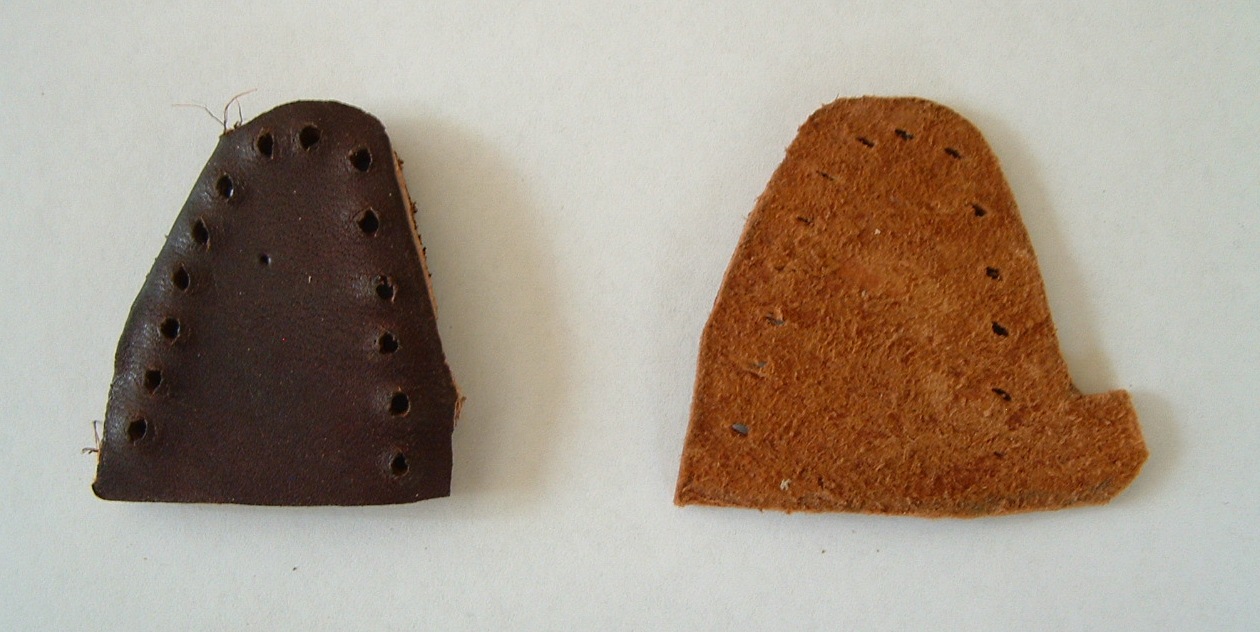
Making a Hammer Stall & Documentation.

A hammer stall, also known as a hammer cap, is a leather device like a thumb stall which is placed over the hammer on a flint lock as a safety measure. With the stall in place, the flint in the jaws of the cock can not strike the hammer face, and therefore prevents accidental discharge of the gun. Although the hammer stall seems to have been mainly used by the military in the 18th century, it is possible that civilians and militia could have used them. To date, I have been unable to find any original images or originals in museum collections. Being made of leather it is possible that none have survived, though I would have thought that some of the larger military arms collections would still have intact stalls.

Quotes:


Items used for leather-work  From top and left to right: A leather palm pad, used to push the needle through the leather if it is a tight fit. I did not need to use this when making this Hammer Stall; an awl, beeswax for waxing the linen thread; needle, and linen thread.

Further research has shown that "Boot" may not be a period term. Hammer stall or hammer cap or even in one case the term "Thumb stall" was used. The term "Frizzen" is apparently a 19th century term derived from a similar German word.


On this one I placed the suspension tab on the back half of the stall because I had more of that leather, I was using scraps. But the tab can go on the back or the front half.


Here you can see a hammer stall I made some years ago for my fusil. The stall is in place on the hammer or steel.

Sunday, 9 December 2012

Research,Research, Research.

I have mentioned the importance of research many times before, but it never hurts to remind people. Some mistakes in what you use may just cost you some embarrasment among your fellow living historians, others can be a lot more dangerous. I contacted a well known trader some time ago regarding the authenticity of his wares, in particular his 18th century copper kettles. He said the copper kettle in question had been authenticated by the maker!!! Sorry, not good enough. People spend a lot of money on this stuff, and although you can say "well they should do their own research", the fact is that some people don't, and they put their trust in the trader.
This Trader's image suggests that this copper kettle is 18th century. I have yet to see an 18th century kettle of this size. If one existed, and documentation exists, then I would genuinly appreciate someone showing it to me.
 
Powder horns it must be said are like a bomb hanging off your shoulder. I know this sounds frightening, and the last thing I want to do is put people off the sport or stop living historians from carrying their powder horns, but the danger exists.
There are several ways in which a powder horn can explode. One is if you leave the stopper out after loading and a spark gets into the horn from you firing your gun. Another is wearing the powder horn when lighting the camp fire. The stopper in the end of the horn can build up a black powder residue around the stopper, and a spark landing on this can result in an explosion.
For these reasons, the base plug is NEVER glued to secure it. It is only sealed with beeswax and secured with no more than 6-8 small pins or wooden pegs the size of a toothpick. The reason for this is so that IF the horn should explode, the pressure will blow the base plug out of the horn instead of fracturing the horn.

This horn was made by a proffessional hornsmith, he sells these horns for a living. Note the copper reenforcing buttplate over the top of the plug. Note how many nails are securing this plate and the plug. The description also states that this horn is scraped thin enough to be able to see through it. So the horn sides are weak, and the base plug is strongly secured!
Seeing as this manufacturer has seeminly no knowledge of the danger he is creating for his clients with this horn, I would strongly question the safety of the other horns that he makes.
If you are going to purchase a powder horn, ask the seller how it has been constructed. If he/she can't tell you with any certainty, go somewhere else. Place your life in your own hands, not in the hands of the trader or the manufacturer.
The other problem with bought horns, is that some makers do not seal the plug with beeswax, and powder residue can leak around the base plug. The danger here is obvious. Blow into the horn and see if it is sealed.