A LIVING HISTORY BLOG.

18TH CENTURY LIVING HISTORY IN AUSTRALIA.
Showing posts with label smoothbores. Show all posts

Sunday, 16 February 2020

Of The Recoil. Shooter's Guide 1816 Edition.

William Tylee Ranney (American genre artist, 1813-1857) Duck Hunters on the Hoboken, NJ Marshes 1849


Friday, 16 November 2018

More Documentation on the use of Wads or Wadding with Round ball in Smoothbores.


Round Ball & Wads or Wadding.
“ I slipped a boullet upon the shot and beate the paper into my gunne."
Voyages of Peter Esprit Radisson 1636-1710.  Being an account of his travels and experiences among the North American Indians, from 1652 to 1684.

Foard’’s findings are supported by Rogers (1968) who found that various unusual and unauthorised methods of loading were used by soldiers to speed up the time between firings since the time of Charles I. Powder was poured into the end of the barrel, the musket ball dropped on top without wadding. The charge was then rammed home by banging the butt of the musket on the ground. This led to the range and penetration ability of the musket ball to suffer.


A Few Words About Smoothbores.


In the 18th century smoothbores did NOT use a patched ball, the ball was loaded in the same way as using shot, with wads or wadding.


An Essay On Shooting 1789.

Tuesday, 21 February 2017

Antique Gun Auction Australia.


Australian Arms Auctions P/L, Melbourne Australia wish to advise that our next auction, No.48, will be conducted at a NEW VENUE on:- 
Date:        Sunday 7th May 2017 at 10.00 am
Viewing:  Saturday 12 noon until 5 pm & Sunday 8 am until 10 am, auction start. 
Venue:   Veneto Club – Basketball Stadium. 191 Bulleen Road Bulleen 3105 Melways 32 9-D
Excellent onsite parking facilities.  Club restaurant & cafĂ© available.

For those of you who have expressed an interest in submitting items for our May auction, please be advised that we are still accepting items.  Please contact us for further information ASAP.

A “catalogue online” advice will be sent to you in early April when it’s available to view online.

We thank you for past interest/purchases & we look forward to servicing your enquiries or bids for our up & coming auction.
Regards,
Cheryl Martyn
~~~~~~~~~~~~~~~~~~~~~~~~~~~~~~~~
Australian Arms Auctions Pty Ltd
P.O. Box 1142 Doncaster East Vic 3109
Roland Martyn  (61) 0428 54 33 77
Cheryl Martyn - Admin:  (61) 03 9848 7951
Fax: (61) 03 9840 7944
 NO LICENCE REQUIRED TO PURCHASE ANTIQUE FIREARMS 

Tuesday, 11 October 2016

Ramrods.

The ramrod seems to be the most forgotten part of an 18th century gun when it comes to looking for information. One would think that such an important tool would receive more attention. I have noted over the years that all ramrods, original antique & modern, are always too short to be of any practicle use. When I came to make a new ramrod for my fusil, I made it out of steel & I made it longer than the barrel. Secured in the ramrod pipes under the barrel it sticks out beyond the muzzle, but with a round ball it makes no difference to the accuracy.
This is the other end of my fusil's ramrod, the end which fits through the ramrod pipes. I forged a worm on the end for cleaning the barrel.

This is the screw tip to my fusil's steel ramrod. When removed, I can screw on a "screw" tip for pulling a load.

As you can see in this image, the ramrod I made extends beyond the muzzle. This gives me a little more rod to hold when loading.

The new wooden ramrod I made for my pistol has an antler tip.

The only information available for these ramrods is that they are English.

The only information available for these ramrods is that they are English.


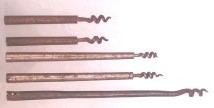
Ramrod or cleaning rod screw ends. No dates or any other information available.

Ramrod or cleaning rod worm ends. No dates or any other information available.

Flintlock blunderbuss by GE Kope Wangen, circa 1750. 
As you can see on this example the ramrod does not reach beyond the muzzle.


The first (top) ramrod is flared and is from a Double Barrel 12 Gauge Side by Side Percussion Shotgun made by SCOTT & Co. LONDON in the 1830's. The second ramrod has a brass tip and is from a Single Barrel 12 Gauge Percussion Shotgun having the Black Powder Belgium Liege Proof Mark of the 1830's.
As you can see in this image of my fusil, & the .32 caliber rifle below, the ramrods extend beyond the muzzle.


More information on ramrods & loading rods here: http://www.cablesfarm.co.uk/ramrods-and-loading-rods/#more-1442