A LIVING HISTORY BLOG.

18TH CENTURY LIVING HISTORY IN AUSTRALIA.
Showing posts with label authenticity. Show all posts

Friday, 16 November 2018

More Documentation on the use of Wads or Wadding with Round ball in Smoothbores.


Round Ball & Wads or Wadding.
“ I slipped a boullet upon the shot and beate the paper into my gunne."
Voyages of Peter Esprit Radisson 1636-1710.  Being an account of his travels and experiences among the North American Indians, from 1652 to 1684.

Foard’’s findings are supported by Rogers (1968) who found that various unusual and unauthorised methods of loading were used by soldiers to speed up the time between firings since the time of Charles I. Powder was poured into the end of the barrel, the musket ball dropped on top without wadding. The charge was then rammed home by banging the butt of the musket on the ground. This led to the range and penetration ability of the musket ball to suffer.


A Few Words About Smoothbores.


In the 18th century smoothbores did NOT use a patched ball, the ball was loaded in the same way as using shot, with wads or wadding.


An Essay On Shooting 1789.

Tuesday, 27 June 2017

18th Century Period Fire Lighting Methods. Ebook.

Authors, historical, living history, authenticity, flint and steel, burning glass, reading glass, fire-bow, Mountain men, woodsmen, woodsrunners, books, reading, experimental archaeology, plant tinder, fungi tinder, tinderbox, fire lighting, 18th century, 17th century, 19th century, survival, Indians, primitive, fur trade, French and Indian War, Revolution, historical trekking, long term wilderness living, colonial, Australia, North America, cooking, heating, Reenacting, Reenactment, 

Primitive Fire Lighting-Flint & Steel & Fire Bow.

Title: Primitive Fire Lighting
ID: 9784776
Category: History
Description: “Primitive Fire Lighting”, is a hands on guide to how to make fire with flint and steel and fire bow. This includes some history, a variety of methods, tinder plants identification, and tinder production, tips on fire place construction and use, how to prepare and lay a fire, wet weather fire lighting and magnifying glass fire lighting. The skills and methods in this book will be of interest to a wider range of readers including survivalists, historical re-enactors, bush-walkers and campers, historical–trekkers and even historical novel writers. Although the plant identifications list is mainly Australian it also has some information for England, Europe and America.
Publisher: Keith H. Burgess
Copyright Year: © 2010
Language: English
Country: Australia

Table of Contents
Illustrations. 4
FOREWORD. 6
FLINT AND STEEL FIRE LIGHTING. 8
PLANT FIBRE TINDERS: 11
TINDER PREPARATION. 15
Tinder preparation-charring: 15
OTHER FLINT and STEEL FIRE LIGHTING METHODS: 16
Emergency methods: 17
A WORD ABOUT BLACK POWDER: 17
THE CAMPFIRE FIREPLACE: 18
READING GLASS/MAGNIFYING GLASS FIRE LIGHTING 20
WET WEATHER FIRE LIGHTING. 21
A FINAL WORD OF CAUTION. 23
FIRE-BOW FIRE LIGHTING. 24
Introduction 24
FIRE-BOW FIRE LIGHTING. 25
A Brief Overview. 25
The Parts of the Fire-bow. 26
The Bow. 26
The Drill Piece. 27
The Fireboard. 29
The Tinder-board. 30
The Bearing Block. 31
The Bowstring. 32
Tinder. 32
Making Fire. 32
Making Cordage. 37
The Step for making Cordage. 38
AFTERWORD. 40
Fire steel suppliers. 45
About the author. 45

5.83" x 8.26", saddle-stitch binding, white interior paper (60# weight), black and white interior ink, white exterior paper (100# weight), full-colour exterior ink.
Cost: Book $11.00 US. Plus P&P. Download $7.00 US


Saturday, 6 September 2014

What is Authentic, and what is not?

What is Authentic, and what is not?
Way back when I first got into 18th century living history, there was a belief among many that if an object was made out of authentic natural materials, then it must be right. This was called being “primitive”. But later on I learnt that this was not how it should be done, a lot of research has to be done to make sure that (a) a particular item did in fact exist, (b) what materials that item was commonly made from, and (c) the item would have been available to your persona in your particular chosen period.
We, those of us who are serious living historians, do not wish to invent something new because it makes life easier; we are only concerned with what actually was. It is simply not good enough to say “well the material was available, and someone may have thought to do this”, yes they may have, but did they? Where is your proof? Where is your documentation?
I have seen items like tricky cap holders made from horn and wood, I have seen holes drilled in the base of knife handles to be used as a powder measure, knives that are also fire steels, and shelters that there is to my knowledge no record of ever existing. Take the diamond shelter for instance, just like the 20th century “Baker Tent” the Diamond shelter seems to have become accepted at Rendezvous because it is made from canvas.
 But no where is period writings have I read that this type of shelter was ever used, the most common shelter used seems to have been the lean-to, whether made using a blanket or an oilcloth. So if you want to use a diamond shelter or a Baker Tent, fine, but don’t kid yourself that you are camping in 18th century style.

"The hunting and target rifles by their various makers, intended for the use their title denotes, had the octagon barrel turned cylindrically at the muzzle for about one inch to fit the guide bullet starter which was used in loading the rifle when used for target work... weighed from about 9 to 14 pounds, and had a longer accuracy range than the hunting rifles as well as being more accurate. These were also provided with a 'straight starter,' much lighter than the other, for use when hunting with these rifles and had various combinations of sights"

Ned Roberts, THE MUZZLE-LOADING CAPLOCK RIFLE, 1944

"Some earlier percussion rifles are 'turned for a starter' i.e., have their octagon barrels turned cylindrical for an inch or a little less at the muzzle in order to accept a plunger-like arrangement for driving the bullet the first few inches into the barrel."

Holman J. Swinney, NEW YORK STATE GUNMAKERS, 1952
New 19th Century Plungers.


http://www.living-in-the-past.com/dadsoldgun.html


Non authentic turn screw/nipple wrench combination tool with horn handle.

The short Starter, did it exist?


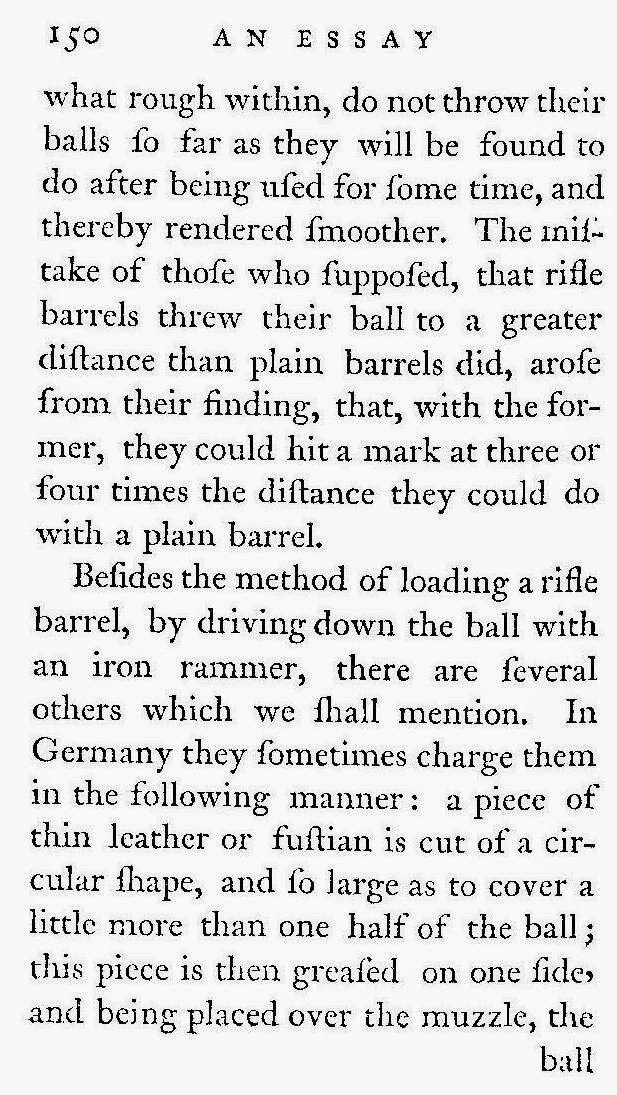
An Essay On Shooting 1789.

No mention above regarding a short starter, and it is quite precise in all other regards.


Sunday, 6 July 2014

More Info On Making Powder Horns.

Many of you will remember the post and video that I made on gunpowder horn safety http://woodsrunnersdiary.blogspot.com.au/2014/04/a-powder-horn-safety-test-in-belgium.html . That post prompted a powder horn maker to contact me and tell me that he and many of his powder horn maker friends were not at all pleased with me. They you see seal the butt plug on their horns they make for sale with modern epoxy glues!!!  They do not want to admit that they are wrong, because (a) they have been using epoxy for years, and (b) I suspect they are concerned that if they admit they are wrong, then they leave themselves open to liability if one of their horns blows up and injures or kills someone.
Now by not using glue, I am not saying that the horn will not split on the sides, but what I am saying is that if the butt plug is not glued, and it blows out if the horn explodes, then this will release a lot of the pressure and you are more likely to survive with minor injuries or no injuries at all. Anyway, I have been doing some research and contacting some professional horners, and below are their comments on this issue.
You decide, which you think is safer, to glue the butt plug in, or just to make sure it seals well without using glue. To me this is just plain common sense, also they did not have epoxy glues back in the 18th and 19th centuries.


Two original powder horns with the butt plug not present in the horn. There appears to be no sign of anything having been used to secure the butt plug except pegs or nails. Many it seems were just a very close fit and nothing was used to seal around the butt plug. Others have reportedly had beeswax, beeswax and tallow, tallow and even hemp was used to cork the seam if it leaked.


Sunday, 9 December 2012

Research,Research, Research.

I have mentioned the importance of research many times before, but it never hurts to remind people. Some mistakes in what you use may just cost you some embarrasment among your fellow living historians, others can be a lot more dangerous. I contacted a well known trader some time ago regarding the authenticity of his wares, in particular his 18th century copper kettles. He said the copper kettle in question had been authenticated by the maker!!! Sorry, not good enough. People spend a lot of money on this stuff, and although you can say "well they should do their own research", the fact is that some people don't, and they put their trust in the trader.
This Trader's image suggests that this copper kettle is 18th century. I have yet to see an 18th century kettle of this size. If one existed, and documentation exists, then I would genuinly appreciate someone showing it to me.
 
Powder horns it must be said are like a bomb hanging off your shoulder. I know this sounds frightening, and the last thing I want to do is put people off the sport or stop living historians from carrying their powder horns, but the danger exists.
There are several ways in which a powder horn can explode. One is if you leave the stopper out after loading and a spark gets into the horn from you firing your gun. Another is wearing the powder horn when lighting the camp fire. The stopper in the end of the horn can build up a black powder residue around the stopper, and a spark landing on this can result in an explosion.
For these reasons, the base plug is NEVER glued to secure it. It is only sealed with beeswax and secured with no more than 6-8 small pins or wooden pegs the size of a toothpick. The reason for this is so that IF the horn should explode, the pressure will blow the base plug out of the horn instead of fracturing the horn.

This horn was made by a proffessional hornsmith, he sells these horns for a living. Note the copper reenforcing buttplate over the top of the plug. Note how many nails are securing this plate and the plug. The description also states that this horn is scraped thin enough to be able to see through it. So the horn sides are weak, and the base plug is strongly secured!
Seeing as this manufacturer has seeminly no knowledge of the danger he is creating for his clients with this horn, I would strongly question the safety of the other horns that he makes.
If you are going to purchase a powder horn, ask the seller how it has been constructed. If he/she can't tell you with any certainty, go somewhere else. Place your life in your own hands, not in the hands of the trader or the manufacturer.
The other problem with bought horns, is that some makers do not seal the plug with beeswax, and powder residue can leak around the base plug. The danger here is obvious. Blow into the horn and see if it is sealed.
 

Tuesday, 2 October 2012

18th century, but still in use.

 The 20 gauge wad punch is early to mid 18th century & was my Father's and probably my Grandfather's and I am still using it.
 This 17th century lath hatchet was also passed down through the family.
 The 18th century compass (caliper type) top right was my Father's.
This 18th century writing box is another family item and I used it as a child and still do. On top is my 18th century book of Shakespear, and the silver cup is another family item.
So when thinking about your period equipment etc, take into account that it is perfectly acceptable to have in your posession items from an earlier period. Just because you are interpreting say 1740, that does not mean that everything you have should date to 1740.
"… every one retains the same garb their ancestors wore in the days of Hugh Capet and King Pippin, each man religiously preserving his vast blue trunk breeches … and a coat almost like a Dutch froes vest, or one of your Waterman liveries …"‘The Fief of Sark’ by Ewen & De Carteret Mid 17thc.

Tuesday, 30 November 2010

Authenticity and Survival.

Authenticity and Survival. (copyright).


The majority of living historians strive for authenticity in the equipment they carry and use, but equipment authenticity requires more than just having the correct equipment for the period, it must also be correct for you. There are many historical variations in knives, axes, shot pouches, carrying methods, hats, you name it. But only some of these when put to the test of use in the field will be suitable for you. Why does it matter? Well safety for one, using a knife or tomahawk that does not feel right in the hand can result in an accident. A knife sheath that falls out of you belt is not desirable. So think about these things when putting your gear together, you have choices within the bounds of authenticity.


I have seen many a person wearing a shot pouch which hangs down to mid thigh, I can only assume it is worn this way because it is easier to get into. However, there are other considerations to take into account when wearing your accoutrements. A shot pouch worn so low in the field will lead to problems, mostly through lack of control when moving through the woods, or running or even kneeling. The pouch will swing about when on the move and touch the ground when you bend down or kneel. So sometimes there is a priority beyond ease of use.


I read that French woodsrunners often carried a knife attached to their garters. This may be true, but how? Under the garter, or tied to the garter? The garter secures the leggings below the knee, this means that if a knife were attached to the garter, it would be constantly in motion when walking, and when dog trotting or running it would be shaken about severely. This in itself is not damaging, but the likelihood of losing the knife is high. So I carry my legging knife in the top of my legging. It is secure there and I can feel it without it causing discomfort, and there is far less chance of losing it.


So think about these things when putting your gear together, try things out, and if they don’t work, do not just accept it as a period fact. Do something about it. On a long trek your survival may depend on you having the right equipment carried in the correct manner, and you having the necessary skills. Just as it was 300 years ago. If you are a woodsrunner, man or woman, act like one, be one. Think about your personal needs and combine this with authenticity so it all works for you.


Monday, 4 October 2010

Where you come from matters.


This may seem a strange video to be showing here, but it holds some interesting information. Authenticity versus myth for one thing, and for another the fact that early history shapes our lives later on.


Too many living historians concentrate only on their persona/character in a particular period. Let us say for instance that you are interpreting and English woodsman in 1742 as I am. I did not just suddenly appear in 1742 dressed in 1742 style clothing and using 1742 equipment, I have a history before 1742, and that history shapes who and what I am now.


If it is 1742 now, then I was born in 1680 somewhere in England. Who and what were my Father and his Father before him? What was I doing as soon as I was allowed out and about on my own? Did I work for my Father? When I arrived in the New World in 1700, had I any experience in trapping and hunting? What equipment did I bring from home?


It is reasonable to suppose that if I was 20 years of age when I arrived in the New World that I would possess items made in the 17th century, and some of those items would still be with me in 1742. By the age of 20 coming from a working family in a small country village in England, it is likely that I have formed my own opinions on what clothing I like to wear, which clothing wears best and affords me the most protection. So now let’s for arguments sake move me forward in time to 1750. I am now in my 70s, and the clothing fashions are changing. Do I care about fashions born in Europe or England? No probably not. I like the way I am and the way I dress, I think the shorter weskits are silly and not practical. Why should I think of changing now?


So here we are back in 2010, what do you own that was not made in 2010?


Saturday, 10 October 2009

Authenticity Documentation.


18th century round-frock. The round frock is reversible being the same at the back as it is in the front.
The Farmer. Wearing a work frock in about 1760 (1780)  (Date updated by Capt. Tom 19th March 2010).


Dutch Boy Smoking. Wearing a similar work frock but with a button closure at the neck. In Cymru (Wales) this style was worn by Shepherds and was known as a coat-frock. The button front could extend anywhere from waist to almost reaching the lower skirt. Unfortunately I have to date not been able to date the Welsh/Cymru frock.


Voltair still wearing his old style clothes in a later period. Look at the short waistcoat on the other man.


A frock coat? Whatever it is it has not got the common large cuffs. It has no fold back cuffs at all.


Same here, and note the leggings in use in Europe.


Two similar coats with cuffs.


Another Dutch picture showing a work frock similar to the English frocks, though this one is worn under another garment.


Yesterday I posted the photo of Joy Spirit Hawk & White Wolf on the "Frontier Folk" forum and for doing so recieved a stream of verbal abuse. Why do I mention this? So that you do not make the mistake of joining that forum and end up with a bad impression of 18th century Living Historians! We are not all like that, thank goodness and in fact I had no idea that anyone in our fraternity was like that! There are some good people on that forum, but for me the rudeness and abusive comments of the few have spoilt it for me.


Apart from the abuse I was asked exactly what area in the New World did I think this mode of dress was worn. I get this question from time to time so let us look at it very quickly.


Here is an Englishman that has just arrived in the New World, where has he arrived in the New World? Does it matter? No of course it does not matter. It does not matter that he may have landed in New England and then travelled to Ohio country, he is still wearing the same clothes that he left England in, the same clothes he arrived in.


He or she does not change their clothing style from place to place, and what makes anyone think that in 1740 there was different styles of clothing for different areas of the New World! Different nationalities in different areas maybe, but it is the people who set the clothing style, not the place.


I don't care if this chap arrives in a work frock or a frock-coat, that is what he has and that is what he will wear until it wears out or he finds another reason for changing it.


There was no American style in 1740, there were no Americans in 1740, I mean this was still English/French settlements. Even if you were born there at this time, would you think yourself American or the nationality of your family?There were native peoples who had been there for centuries before the whites arrived and they sure as I am sitting here did not think of themselves as Americans!


There were Dutch, English, French, Swiss, and many other nations. Some had similar dress styles to others, some did not. But whatever they wore it was nothing whatsoever to do with the area they settled in in the early to mid 18th century. Do not let people fob you off with this question of area. What it probably means is that they don't know!


Another recommendation or something to at least think about. When you are interpreting a particular period, say 1740, do not expect everything that you wear and use to have come from this period. If I was born in 1680, then by 1700 I am 20 years of age. I am wearing 17th century clothing and I have 17th century items of equipment. I leave for the New World and I still have the same clothing and items of equipment.


I become a hunter/trapper, I do not purchase new clothing. I like this style of long weskit and do not want to change this style. It is now 1740, I am 60 years of age. I am wearing French fly breaches, Indian style leggings and centre seam woodland moccasins. I still wear a long weskit and a work frock, and I still have most of the 17th century items I brought over with me.


My fusil is now a flintlock, but nothing else has changed. I may have lost my clasp knife and replaced it with an 18th century style but why would I change anything else if it still worked?


It is now 1760, and I am still dressed the same. I am an old man and fixed in my ways and am not about to start wearing a shorter weskit and fall front breeches. My clothing is made for me if I need new clothing and it is made the way I like it.
Interesting information in Old English Household Life By Gertrude Jekyll at: http://books.google.com/books?id=dINkv8BLpu4C&pg=PA132&lpg=PA132&dq=English+labourer

Watson and The Shark.
By John Singleton Copley.
This is the painting recommended by Capt. Tom in the message below. Note the frocks the seamen are wearing.


If you have any comments please share. we/I still have a lot to learn and we won't learn if we don't share our knowledge.