17th Century Dolls.
18TH CENTURY LIVING HISTORY, HISTORICAL TREKKING, AND PERIOD WILDERNESS LIVING.
A LIVING HISTORY BLOG.
18TH CENTURY LIVING HISTORY IN AUSTRALIA.
Showing posts with label English. Show all posts
Saturday, 9 June 2018
Sunday, 14 January 2018
17C American Women: French Huguenot looks at 1687 Puritan Boston
17C American Women: French Huguenot looks at 1687 Puritan Boston: . A French Protestant Immigrant's Impression of in Boston, 1687 This French Huguenot arrived in Massachusettes with 30 families in th...
Labels:
1687,
17th century,
Boston,
English,
French,
Huguenot refugees,
living history,
trekking
Australia
Boston, MA, USA
Tuesday, 28 March 2017
New 18th Century Series on ITV.
Madam Lydia (Lesley Manville) (Photo: ITV Pictures)
More information here: http://www.mirror.co.uk/tv/tv-previews/racier-downton-abbey-period-drama-10105310
Labels:
18th century,
British,
English,
ITV,
living history,
period movies,
series
Australia
United Kingdom
Wednesday, 25 January 2017
The cooks and confectioners dictionary; or, The accomplish'd housewifes companion.
Labels:
18th century,
book,
British,
colonial,
cooking,
English,
food,
Historical,
living history,
New World,
recipes,
settlement
Australia
Australia
Saturday, 19 December 2015
More On Sausage.
Giacomo Ceruti 1698 – 1767.
Sausages to Boyl
PERIOD: England, 17th century | SOURCE: The
Whole Duty of a Woman: Or a Guide to the Female Sex, 1696 | CLASS: Authentic
DESCRIPTION: Sausages boiled in wine and herbs
Sausages to Boyl.
Put a pint of Claret to a quart of Water, put in some
sweet herbs finely shred, a blade or two of Mace, and some Cinamon, let them
boyl about a quarter of an hour, then serve them up with beaten Ginger, Cinamon
or Mustard and Sugar, in Sawcers.
SAUSAGES.
Take a leg of Pork, Parboil itt, take hogs sowit [suet]
and sage, and mix them together very small, put in a good deal of Pepper &
Salt as much as you think fitt, stir itt well together, then take Sheeps Gutts
and scower them very well with salt and fill them, tye them up in Links and
hang them up smoaking till you use them (MS 7998, Wellcome Collection).
Take either mutton, veale or pork (you may cut it from
the legg as much as will make a reasonable dish & not deface the legg) then
take of any ruff suet as much as your quantity of meat is, then beat it &
shread it very small, and putt to it a little sage shread small, & season
it with salt, pepper & nutmegg if you please, then take one egg white &
all mix them alltogether very well, Rub your hands with a little flower so
rowle it up in rowles twice as long as your finger, as thick as pig puddings,
frye them with butter or any other liquor, or you may stew them in mutton
broath with apples & onions. (MS4054, Wellcome Collection)
Half a pound of lean Veal, Pork, or Beef, Half a pound of
Beef Suet, One Score of Oysters just warmed in their own liquor, all to be
chopped very fine and mixed together with two Eggs well beaten, a very little
Cayenne, Salt and Nutmeg, and one or two Cloves, make them into flat Cakes or
Balls, roll them in Crumbs of Bread, and fry them of a pale Brown, add the
liquor of the Oysters to the Sausages. N.B. If the Oysters are small it will
require two Score. (MS 3082, Wellcome Collection)
Pieter Snyers (1681‑1752)
Labels:
17th century,
18th century,
Australian,
cooking,
English,
historical trekking,
living history,
New World,
sausage,
sausages,
survival,
Trail foods
Australia
Australia
Saturday, 5 December 2015
THE EVOLUTION Of the English Civilian Flintlock pistol 1650 ~ 1830
Labels:
1650,
17th century,
1830,
18th century,
19th century,
English,
flintlock,
Historical,
living history,
pistols
Australia
Australia
Monday, 2 November 2015
Another Candlewood Quote 17th Century.
A 17th Century Candlewood Splint Holder.
Those same knots the planters
split out into small shivers, about the thickness of a finger, or thinner; and
those they burn instead of candles, giving a very good light, and they call it
candlewood, and it is much used in New England and Virginia, and among the
Dutch planters in the villages.
The History of the Royal Society
of London, for Improving of Natural Knowledge from its First Rise. Thomas
Birch. 1662.
The candle, made of either tallow or
bayberry wax, was the standard lighting device at Jamestown. Pine torches were
often used out of doors, and rushlights and candlewood were undoubtedly used in
the humbler dwellings during the very early years of the settlement.
The
Project Gutenberg EBook of New Discoveries at Jamestown
by John
L. Cotter
J. Paul
Hudson
Labels:
17th century,
candlewood,
Dutch,
England,
English,
fire,
historical trekking,
lighting,
living history,
peerman splint holder,
splints
Australia
Australia
Thursday, 24 September 2015
The Fur Trade. Video.
Labels:
17th century,
18th century,
19th century,
colonial,
Eastern Woodland Indian,
English,
French,
fur trade,
historical trekking,
living history,
mountain men,
trappers,
woodsmen,
woodsrunners
Australia
North America
Friday, 7 August 2015
Trump, Tromp, Jew's Harp, Jaw Harp or Mouth Harp.
The Jaw Harp is a very old musical instrument going back in time to at least the Dark Ages. Practically every nationality back in time has had the Jaw Harp. It is probably one of the easiest instruments to master & being small & light it is ideal for carrying when trekking & camping for round the camp fire entertainment. Most Living History Traders have the Jaw Harp for sale.
This is the author's copy of the Jaw harp made from bronze.
Labels:
colonial,
English,
French,
German,
historical trekking,
jaw harp,
Jew's Harp,
living history,
mouth harp,
music. 18th century,
Tromp,
Trump
Australia
Australia
Tuesday, 4 August 2015
Pickling Onions in 18th Century England, & Know Your Onions.
Know Your Onions: https://britishfoodhistory.wordpress.com/2012/10/07/know-your-onions/
More Information At: http://savoringthepast.net/2015/08/01/pickling-onions-in-18th-century-england/
Labels:
18th century,
colonial,
England,
English,
foods,
onions,
pickled onions,
preserving,
survival
Australia
Australia
Friday, 24 July 2015
Equipment Update. A New Old Fire Steel.
One would think that with a bloke of my age & all the years I have been a woodsman, that there would not be any improvements to make to my gear. Then along comes something a little better than I have been using, & you realise that there are still improvements to be made.
Well I guess when you think about it, that is exactly as it was in the 18th century.
Another woodsman friend sent me an original fire steel, so I have swapped this original for the reproduction one I have been using for many years, & now carry the reproduction steel as a spare in the bottom of my knapsack. This original steel is about twice the size of my reproduction steel.
Keith.
Well I guess when you think about it, that is exactly as it was in the 18th century.
Another woodsman friend sent me an original fire steel, so I have swapped this original for the reproduction one I have been using for many years, & now carry the reproduction steel as a spare in the bottom of my knapsack. This original steel is about twice the size of my reproduction steel.
Keith.
Labels:
18th century,
English,
fire lighting,
fire steel,
flint & steel,
strike-a-light,
striker,
woodsman
Australia
Australia
Saturday, 25 April 2015
Flasks, Pocket & Saddle.
Finding the right type of water bottle for
your persona & period seems to be an ongoing quest, or at least it is for
me. I have tinned iron military water bottles but they don’t hold much water
& I prefer something from an earlier period. Being quite old now, I feel
more comfortable with an earlier period water container. I have a costrel, but
the sealant inside failed & exposed the leather & fouled the water. I
have re-sealed this bottle, but in doing so I overheated the costrel &
shrunk it. It did seal, but now I don’t trust it.
Recently someone in one of the Ranger groups
asked for advice on what type of water bottle he should get. In my search for
more information I used the term “flask”. This surprisingly brought up the name
“saddle flask”. Further searching brought up “pocket or saddle flask”.
Now this is a new one on me, so I researched
further. Most of the saddle flasks I found were Persian, but I did manage to
find some English flasks, & some American flasks.
Early American glass. The first factory in what is now the United States was a glass
plant built at Jamestown, Virginia, in 1608. The venture failed within a year
because of a famine that took the lives of many colonists. The Jamestown
colonists tried glassmaking again in 1621, but an Indian attack in 1622 and the
scarcity of workers ended this attempt in 1624. The industry was reestablished
in America in 1739, when Caspar Wistar built a glassmaking plant in what is now
Salem County, New Jersey. This plant operated until 1780.
This is purportedly an American saddle flask.
From the name I think we can safely assume that this large leather covered
water bottle was carried on a riding saddle or in a market wallet tied to the
saddle or similar. Then there is the accompanying name of “pocket flask”. I
think this is a mistake, because further research indicates that these are two
different flasks, & I think these pocket flasks were meant to be carried in
a coat pocket.
This green glass saddle flask is also
reportedly an American flask.
Large circa 1760
colonial American black glass flask.
Wistarburgh Saddle Flask 18th
Century.
Rich, dark green American chestnut with hemp
wicker. 4” tall and 2 3/8” at the widest point. Recovered during 1961
demolition of historic building in downtown Philadelphia. Found inside a wall. This
one I assume is a pocket flask.
Pocket flask. American 1765-74.
Midwestern flask 1815-40.
This image shows an English leather costrel
on the left, & a leather saddle flask on the right.
More Information: http://historical-american-glass.com/hilltown-glass-works-bucks-county-pennsylvania-1751-1766.html
Labels:
18th century,
19th century,
American,
Bottles,
English,
equipment,
flasks,
Glass,
historical trekking,
leather cover,
living history,
pocket flask,
saddle flask,
spirits,
survival,
travel,
water
Australia
Australia
Monday, 20 April 2015
17th & 18th Century Copper Mugs & Tankards.
My thanks to Ward Oles for asking for this information.
Beer Street 1751 England.
Late 18th Century. English.
The Ink Seller Mid 18th Century. French.
Jan Josef Horemans the Elder 1694-1759 Flemish.
Tavern Scene by Flemish artist David Teniers c. 1658
Johan Joseph Zoffany (1733 - 1810) (German, active in Britain (from 1760)
England 1762.
Copper Georgian Tankard.
Information on pewter tankards: https://ritaroberts.wordpress.com/2012/07/27/a-short-history-of-pewter-tankards/
Labels:
17th century,
18th century,
copper drinkware,
drinking,
English,
Flemish,
French,
historical trekking,
living history,
mugs,
tankards
Australia
Australia
Sunday, 25 January 2015
A Look At Some 18th Century Artifacts.
Primary documentation can't be beat, this is what every living historian looks for. But what I like most in some of the following images, is the proof that people used to make their own things from recycled materials. This does not give us licence to make just anything because it is made from period materials, but it does allow us to make the items that we know were self-made.
A white-tailed-deer antler with saw marks from the north cellar, evidence the Spragues were working antler.
A Barlow type folding jackknife and whetstone. Barlow jackknives had large iron bolsters (the iron behind the blade) which gave them more durability.
Several artifacts made from scrap brass: a small saw, a repaired kettle rim, and a small hasp for a small box.
Cufflinks were often decorated. Most have geometric designs or floral themes. The cufflink on the bottom right has a cornucopia engraved on it, likely symbolic of men’s roles as growers of food. On the top left is a brass aglet for lacing clothing and a possible “hook” part to a “hook-and-eye” fastener.
A lead net weight, a lead line sinker and two fishhooks.
European flint strike-a-lights and ballast cobble debris. The largest reddish piece is a strike-a-light made from Pennsylvania jasper.
Slag, a fragment of a nail header, scrap iron, nails blanks and various types of nails, including T-head, L-head, rose-head, headless and shoeing nails.
17th-century gunflints, found at Le Vieux Fort, Placentia.
Photo courtesy of Amanda Crompton.
Gunflints, lead shot, musket balls, a lead gunflint wrap, a fragment of a brass side plate with dragon motif and the finial to a bayonet scabbard.
A claw hammer head, side and top view.
A variety of items made from scrap iron, including a sieve, a funnel, and two knife blades made into strapping to reinforce something.
Personal items including a George II Oldhead halfpenny (1740-1754), George I “Irish Wood” halfpenny dated 1723, a William III halfpenny dated 1699, and a small piece of a silver coin. There are a plain brass ring, iron mouth harp, and pieces of a bone comb and a copper-alloy comb. These combs have two sizes of teeth: the larger for grooming, the smaller to remove nits and lice from the hair. In the bottom left is a small brass plate with the letters “IB” stamped into it.
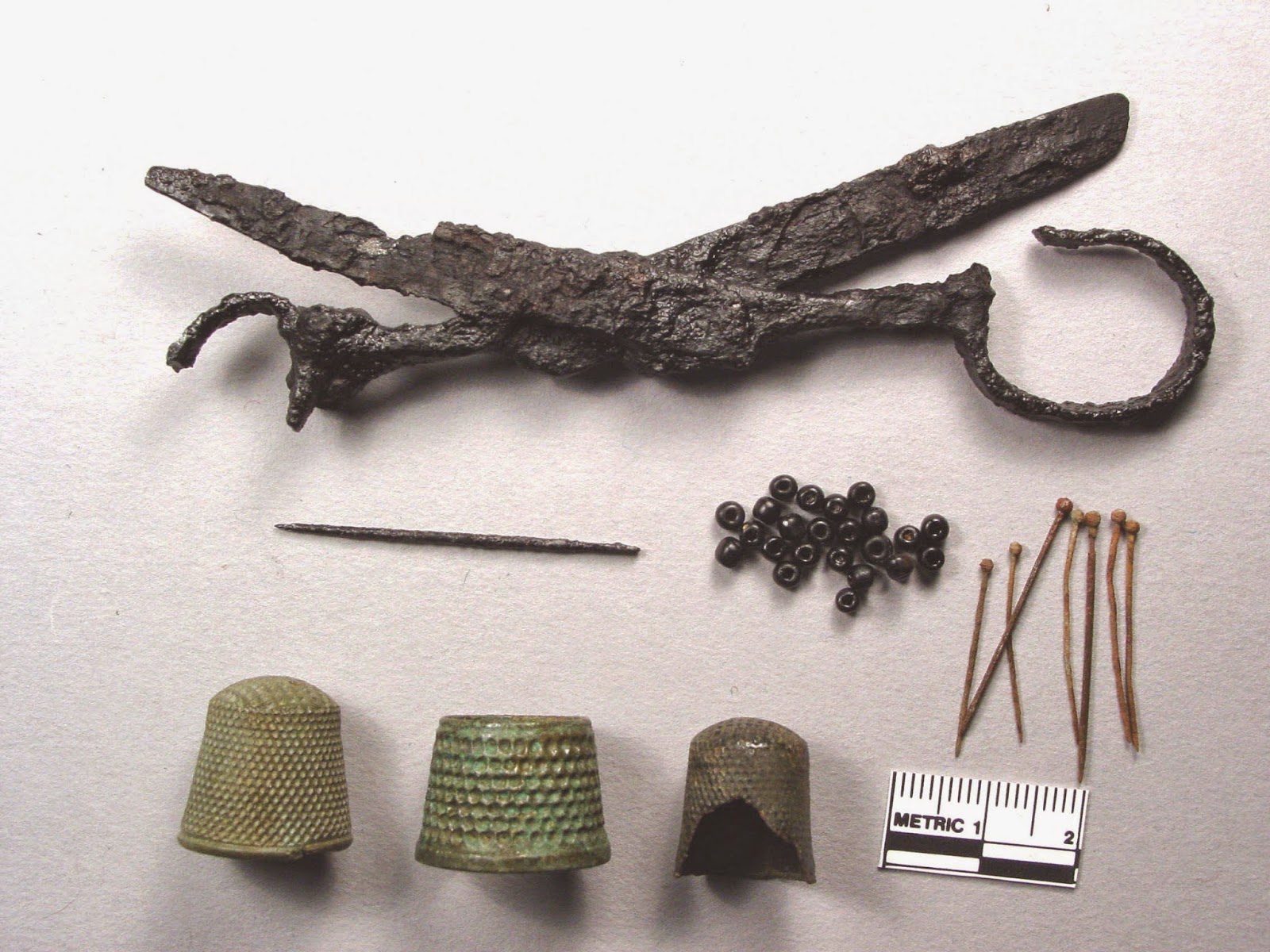
Scissors, a needle, glass beads, straight pins and thimbles.
Labels:
17th century,
18th century,
artifacts,
colonial,
English,
gun flints,
living history,
period items,
tools
Australia
North America
Subscribe to:
Posts (Atom)


2.jpg)
2.jpgpart%2Bof.jpg)