
Showing posts with label British. Show all posts
Showing posts with label British. Show all posts
Sunday, 20 May 2018


Saturday, 30 September 2017
Monday, 5 June 2017

Tuesday, 28 March 2017
New 18th Century Series on ITV.

Madam Lydia (Lesley Manville) (Photo: ITV Pictures)
More information here: http://www.mirror.co.uk/tv/tv-previews/racier-downton-abbey-period-drama-10105310
Sunday, 5 March 2017
Images from His Majesty's 60th Regiment of Foot March Training Weekend.


Scouting.

Camp dinner. Feral Chinese Water Deer.

Setting up camp.
Wednesday, 25 January 2017

Friday, 19 August 2016


Monday, 21 December 2015
Monday, 17 March 2014
British Series-Garrow's Law.
I am finding this series very interesting and educational, the British are well known for their good research and authenticity.
Sunday, 9 March 2014
The Crooked Trail to Pickawillany (1747-1752)

John Switzer commentary: Clues to 18th-century attack sought.

Friday, 7 February 2014
Monday, 11 March 2013
Gunpowder, Then and Now. Paper Cartridges.
After posting my video on how I make paper cartridges for my fusil, I got this message:
"The British Military load for the brown bess was 125g of powder with an extra 40 grains for the pan for a total of 165g per cartridge. the powder from the original cartridge I saw was course like 1f, Ive fired this combo from a repro french 1727 and it shoots well using the 1f as the priming powder, the only draw back is it burns slow in the pan so you have to watch your follow through".
Gunpowder now is not the same as gunpowder 300 years ago. I personally would not be loading 125 grains in any hand held gun. Whether or not it is proofed for such a load is not the point, the point is that there is no need for such a high load as this with modern gunpowder.
1Fg is cannon grade gunpowder, and I have no idea what it was doing in an original 18th century Brown Bess cartridge, unless (a) it was a mistake, or (b) they had run out of the regular gunpowder. Either way, just because it was done, does not mean that you should do it!
For those of you not familier with modern gunpowder/Black Powder, 1FG is a large grained gunpowder made for cannons. 2Fg is generally for any caliber over .45 but can be used in smaller calibers. 3Fg is for .45 caliber & smaller, but can be used in larger calibers with a load adjustment, i.e. the smaller the grains of powder, the higher the internal pressure. So if you are using a recommended load of 2Fg, DO NOT use the same load when using 3Fg. Use less. 4Fg is made these days as a priming powder. 4Fg is a very fine grain gunpowder and should NEVER be used as a main charge. You may also find it interesting to know that 300 years ago there were no priming horns made or used for hand held guns/rifles. The same gunpowder used as a main charge, was also used to prime the pan of the flintlock.
1Fg being a large grained gunpowder used only in cannons, would be very slow to burn if used for priming. I really can't see the British army and navy using 1Fg gunpowder as a standard in the Brown Bess.


"The British Military load for the brown bess was 125g of powder with an extra 40 grains for the pan for a total of 165g per cartridge. the powder from the original cartridge I saw was course like 1f, Ive fired this combo from a repro french 1727 and it shoots well using the 1f as the priming powder, the only draw back is it burns slow in the pan so you have to watch your follow through".
Gunpowder now is not the same as gunpowder 300 years ago. I personally would not be loading 125 grains in any hand held gun. Whether or not it is proofed for such a load is not the point, the point is that there is no need for such a high load as this with modern gunpowder.
1Fg is cannon grade gunpowder, and I have no idea what it was doing in an original 18th century Brown Bess cartridge, unless (a) it was a mistake, or (b) they had run out of the regular gunpowder. Either way, just because it was done, does not mean that you should do it!
For those of you not familier with modern gunpowder/Black Powder, 1FG is a large grained gunpowder made for cannons. 2Fg is generally for any caliber over .45 but can be used in smaller calibers. 3Fg is for .45 caliber & smaller, but can be used in larger calibers with a load adjustment, i.e. the smaller the grains of powder, the higher the internal pressure. So if you are using a recommended load of 2Fg, DO NOT use the same load when using 3Fg. Use less. 4Fg is made these days as a priming powder. 4Fg is a very fine grain gunpowder and should NEVER be used as a main charge. You may also find it interesting to know that 300 years ago there were no priming horns made or used for hand held guns/rifles. The same gunpowder used as a main charge, was also used to prime the pan of the flintlock.
1Fg being a large grained gunpowder used only in cannons, would be very slow to burn if used for priming. I really can't see the British army and navy using 1Fg gunpowder as a standard in the Brown Bess.

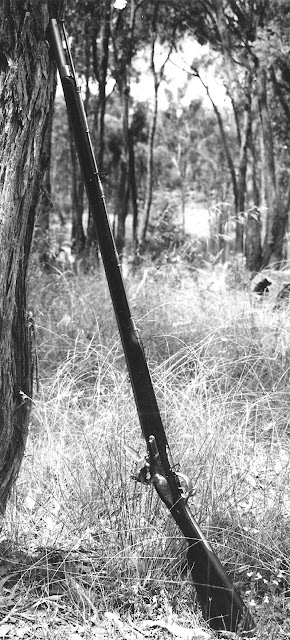
Long Land pattern Brown Bess.


Paper cartridges made for smoothbore muzzle-loading guns.
Wednesday, 9 November 2011
Tarred & Feathered. Not because of the price of tea! I stand corrected.
Please read Jenny's comments below, she is far more knowledgable than I am regarding the revolution period. Thank you Jenny.
April Morning.
I have searched for this video clip many times without finding it. My thanks to Flintlock and Tomahawk for posting this on his blog. Not a good image, but better than nothing. This is supposedly the first shot fired in the revolution at Lexington. But who fired that shot? It remains a mystery to this day.
More information here at: http://flintlockandtomahawk.blogspot.com/2011/11/lexington-scene-from-april-morning.html#comment-form
Sunday, 6 November 2011

Tuesday, 18 October 2011

Sunday, 9 October 2011
Wednesday, 5 October 2011


Subscribe to:
Posts (Atom)