
Showing posts with label rifles. Show all posts
Showing posts with label rifles. Show all posts
Thursday, 3 January 2019


Sunday, 3 September 2017
Black Powder Firearms Laws In Poland Vs Australia.

Here in Australia we have to have a Firearms licence & pass a firearms test to obtain that licence. A permit to purchase, & we have to register all guns including replica muzzle-loading guns. A replica muzzle-loading gun is the same as an identical antique muzzle-loading gun, no difference. It still loads from the muzzle, it still relies on a flint lock for ignition. But in Poland, which has the most stringent firearms laws in the world, you do not require a permit to purchase, a licence or registration. Only the gunpowder needs to be registered.
- BLACK POWDER FIREARMS IN POLAND:
Blackpowder not integrated cartridge guns, if manufactured before 1885, and
their replicas also multiple shot revolvers (separable loading only) are
available without any restrictions (Owner must to be over 18). They are also
permitted to be owned, used, and carried (You name it) loaded without any
permits. Curiously though, the purchase of the blackpowder requires
registration.
Tuesday, 21 February 2017
Antique Gun Auction Australia.

Australian Arms Auctions P/L, Melbourne Australia wish to advise that
our next auction, No.48, will be conducted at a NEW VENUE on:-
Date: Sunday 7th May 2017
at 10.00 am
Viewing: Saturday 12 noon until 5 pm & Sunday 8 am until 10
am, auction start.
Venue: Veneto Club – Basketball Stadium. 191 Bulleen Road
Bulleen 3105 Melways 32 9-D
Excellent onsite parking facilities. Club restaurant & café
available.
For those of you who have expressed an interest in submitting items
for our May auction, please be advised that we are still accepting items.
Please contact us for further information ASAP.
A “catalogue online” advice will be sent to you in early April when
it’s available to view online.
We thank you for past interest/purchases & we look forward to
servicing your enquiries or bids for our up & coming auction.
Regards,
Cheryl Martyn
~~~~~~~~~~~~~~~~~~~~~~~~~~~~~~~~
Australian Arms Auctions Pty Ltd
P.O. Box 1142 Doncaster East Vic 3109
Roland Martyn (61) 0428 54 33 77
Cheryl Martyn - Admin: (61) 03 9848 7951
Fax: (61) 03 9840 7944
NO LICENCE REQUIRED TO PURCHASE ANTIQUE FIREARMS
Tuesday, 11 October 2016
Ramrods.
The ramrod seems to be the most forgotten part of an 18th century gun when it comes to looking for information. One would think that such an important tool would receive more attention. I have noted over the years that all ramrods, original antique & modern, are always too short to be of any practicle use. When I came to make a new ramrod for my fusil, I made it out of steel & I made it longer than the barrel. Secured in the ramrod pipes under the barrel it sticks out beyond the muzzle, but with a round ball it makes no difference to the accuracy.


This is the other end of my fusil's ramrod, the end which fits through the ramrod pipes. I forged a worm on the end for cleaning the barrel.

This is the screw tip to my fusil's steel ramrod. When removed, I can screw on a "screw" tip for pulling a load.

As you can see in this image, the ramrod I made extends beyond the muzzle. This gives me a little more rod to hold when loading.

The new wooden ramrod I made for my pistol has an antler tip.

The only information available for these ramrods is that they are English.

The only information available for these ramrods is that they are English.

Ramrod or cleaning rod screw ends. No dates or any other information available.
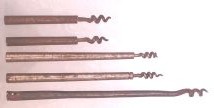
Ramrod or cleaning rod worm ends. No dates or any other information available.

Flintlock blunderbuss by GE Kope Wangen, circa 1750.
As you can see on this example the ramrod does not reach beyond the muzzle.

The first (top) ramrod is flared and is from a Double Barrel 12 Gauge
Side by Side Percussion Shotgun made by SCOTT & Co. LONDON in the 1830's.
The second ramrod has a brass tip and is from a Single Barrel 12 Gauge
Percussion Shotgun having the Black Powder Belgium Liege Proof Mark of the
1830's.
As you can see in this image of my fusil, & the .32 caliber rifle below, the ramrods extend beyond the muzzle.

More information on ramrods & loading rods here: http://www.cablesfarm.co.uk/ramrods-and-loading-rods/#more-1442
Friday, 29 July 2016


Wednesday, 9 March 2016


Monday, 29 June 2015
Firearm Legislation For NSW Australia. A Quick Run-Down or Legislation In Brief.


Firearms in Australia
are used for hunting & target shooting. Farmers & landholders have a
responsibility to eradicate feral animals on their land. Feral animals include:
goats, wild boar, rabbits, foxes, feral cats & feral dogs. The wild boar
here can grow to the size of a small family sedan & can be extremely
dangerous. Feral dogs usually exist in packs & can also be very dangerous.
Hand guns can not
legally be used for a back-up in hunting, you have to belong to a pistol club
in order to own a handgun, & this gun can only be used on a registered
pistol club range. Membership is usually expensive.
Semi-auto firearms
& pump actions are banned.Legal reasons for owning any other firearm are:
Membership to a gun club, permission to hunt on private land, or a collector.
Without proof of these you can not get a licence.
Muzzle-loading guns
are treated the same as breach-loading firearms & are subject to licensing,
permit to purchase, & registration. If you intend to use a muzzle-loading
arm for re-enactment, then you need a special permit on top of your licence.
Antique muzzle-loading
guns including pistols can be purchased & owned without a licence, permit
to purchase, or registration, but you are NOT allowed to shoot them.
All firearms are
subject to safe keeping, i.e. must be kept in an approved type of gun safe at
all times when not in use. Hand guns must be secured in a pistol safe. This
also applies to antique guns.
Legal gun owners are
subject to regular checks in their homes by police officers. Many if not most
of these officers know very little about any firearms other than their own
service weapons. This can & does cause problems as I have experienced
myself. Even after explaining & demonstrating to a police sergeant the
difference between a muzzle-loader & a breach-loader, & showing the
difference between antiques & reproductions, I was still required to spend
time & money getting a registered gunsmith to identify my firearms.
Basically here in
Australia the legal licensed firearms owner is penalised through firearms
registration. We are seen as being the problem where gun crime & violence
is concerned. Black market firearms from overseas are payed little attention
compared to the lengths they will go to make it hard for honest citizens to
acquire & keep their guns.
Firearms legislation
is not uniform Australia wide, each state having it’s own regulations. This
makes it very difficult for legal gun owners to interact with interstate group
shoots & difficult for interstate hunters. What is legal in one state, may
not be legal in another state.
In Australia we have
two factions whose agenda is to remove all firearms from law abiding citizens;
the Australian police service & the anti-gun lobby. The latter are very
strong in Australia & include, but are not restricted to, animal rights
groups, & the Greens political party.
We have only one
major firearms association in Australia, the Sporting Shooters Association of
Australia (S.S.A.A.). This association could do a lot more for it’s members,
but it is too deep in self-interest & hand kissing the government.
Basically the S.S.A.A is, in my opinion, in it for itself.
Keith.
Friday, 21 February 2014
Gunsmithing. Muzzle-Loaders. 7-10 Video.
My sincere thanks to Chris Grant for bringing these videos to my attention.
Keith.
Gunsmithing. Muzzle-loaders. 1-6 Video.
My sincere thanks to Chris Grant for bringing these videos to my attention.
Keith.
Saturday, 24 December 2011
Round Ball Moulds Of All Sizes.
Someone recently contacted me looking for a round ball mould. Some moulds only come in certain sizes, & the size you need may not be available. Dixie Gun Works sell round ball moulds, one of which is made from a 1950s hair straightener! It has no sprue cutter, but other than that it is perfect. You simply order the size you want.
I bought one many years ago as a single buckshot mould. Time is something I have in camp, room for a multi ball mould I don't have. I cut off the loops of the scissor like handles, & trimmed the head square of any access metal. I have seen originals that look just like it!

I bought one many years ago as a single buckshot mould. Time is something I have in camp, room for a multi ball mould I don't have. I cut off the loops of the scissor like handles, & trimmed the head square of any access metal. I have seen originals that look just like it!

Ball moulds get pretty hot after a while of use, so you need to wrap the handles in leather to protect your hands.
Thursday, 23 December 2010
Rifles, Smoothbores & the use of Wadding.
Smoothbores, Rifles & Wadding.
Early to mid 18th century English guns did not use patch material for round ball shooting. Instead, wadding was used in the same manner as used when firing shot. The rifling in rifles was seen as a solution to the round ball moving from side to side in the barrel, which effected accuracy when shooting over long distances. Fortunately hunters using the fusil did not shoot over long distances, and had no problems shooting game at 50-60 paces. Rifles however required the ball to be driven into the muzzle “by means of an iron rammer, struck with a mallet”. So, rifles did not use a patched ball either, leastways not in England and not by an Englishman.
In Germany however “they sometimes charge them in the following manner: a piece of thin leather or fustian is cut of a circular shape, and so large as to cover a little more than one half of the ball; this piece is then greased on one side, and being placed over the muzzle, the ball is laid upon it, and both thrust down together”.
Smoothbores however; fusils, fowlers and muskets, did not use patched ball, only wadding. “In firing with ball it is observed that the better the ball fits the piece, or the less windage there is, the greater will be the force of the discharge-the wadding of hat (wool or beaver felt hat material cut to fit the bore) may be preferable to that of card or paper…..”.
“In countries where orchards abound, a very fine moss, of greenish grey colour, is found adhering to the apple trees, which is extremely proper for wadding….tow is also very good for this purpose”.
The above information is taken from “An Essay On Shooting 1789”, this book in turn uses “La Chasse au Fusil” as a basis for this work, so it is probably safe to assume that both the English and the French used the same manner of shooting the smoothbore. This in turn makes me question the use of so called “patch knives” by the French hunters which they carried round their necks. I suspect that this knife was instead simply a utility knife.
Waterproofing Leather.
“ Take of tallow, half a pound, Hogs lard, four ounces, Turpentine, two ounces, New bees wax, two ounces, Olive oil, tow ounces. Melt the whole together in an earthen pipkin over the fire, and stir it well while melting”.
I think I have also mentioned before that no mention of priming horns can be found in this period publication, and loading and shooting is covered within.

Rifle.

Smoothbore Fusil.

I used to use hat as wadding before I even read this book, then when I ran out of hat, I started using thes leather wads, cut to size with the wad cutter below.


Tow which I also use as wadding and for cleaning my gun.
Subscribe to:
Posts (Atom)