A LIVING HISTORY BLOG.

18TH CENTURY LIVING HISTORY IN AUSTRALIA.
Showing posts with label steel. Show all posts

Wednesday, 16 November 2016

18th Century Sewing Needles & Pins.

18th century items including steel needles and  pins found in the Sprague House.

18th Century Sewing Needles and Pins.
From about the Viking age until the 17th century sewing needles were made of iron. From the 17th century onward sewing needles were made of steel. If you are looking for 18th century sewing needles for your “housewife” sewing kit, I suggest you simply purchase a set of modern sewing needles.
Iron needles.

Hand made brass pins were in use during the 17th & 18th century. The pin itself being made of brass wire, & the heads were made separately of brass wound around the top of the pin.
17th-18th century brass English pins found in the mud of the Thames River London England.

1620-1650 Silvered brass English sewing pins.

Wooden needle cases.

Author's Housewife sewing kit.

Close-up of the author's pin cushion on the housewife with steel needles.


Saturday, 4 April 2015

A Change Of Opinion. Flint & Steel Striking Methods.

I am not sure when or where, but I know that I once made the statement that striking the flint with the steel was not the correct way. Now if one was using a tinderbox or the nest method, this statement would be correct, because by striking the flint with the steel you would be directing the sparks up, instead of directing them down onto the tinder. However, some people do not use either the tinderbox or the nest method. Instead they hold the tinder on the top edge of the flint, & strike the steel upon the flint to catch sparks on the tinder.
In my opinion now, this is not a modern method, but in fact an early method perhaps before the use of the tinderbox, or perhaps this method was simply easier to use when lighting a candle.
In this illustration from Gutenberg for instance a tinderbox is being used, but the sketch appears to be showing the flint being struck by the steel as no sparks are shown as being created at this stage. Using this incorrect method would send the sparks upward before they fall on the tinder. If in fact they did reach the tinder in this round about way, the sparks would have lost their heat & may not catch on the tinder at all.


Here though in this detail of the altarpiece of the Saint Georges church in Haguenau, Bas-Rhin, France, you can see the flint is about to be struck with the steel to catch sparks on the tinder held by the hand on top of the flint.

English: Detail of the altarpiece of the Saint Georges church in Haguenau, Bas-Rhin, France.
Français : Détail du retable de l'église Saint-Georges de Haguenau, Bas-Rhin, France.


Fire Steels. Researching Three Types.

Fire Steels. Researching Three Types.
I am sure after doing so much research on fire steels, that there is still a lot to learn on my part. I have not even scratched the service on iron & steel properties & whether or not all steels were a combination of the two metals.
There are such a variety of steels from different countries, both in design, & in size. It also occurred to me whilst looking at the close resemblance of one steel to another, if perhaps some of them may have had their rat tailed handles repositioned after forging by the owner. Then there is the problem of not knowing if the artefact actually belonged to the site where it was found, or whether or not a Viking may have stolen a steel from an English village & taken it home with him on his return.
So I have tried to focus on three types or designs of steels only, principally because these are the particular ones I am interested in.

Birka Grave Fire steels Viking.


Post Medieval found in England. This same fire steel has also been described as being Roman.
5 cm long fire steel.
This one is almost a dead ringer for the one above, but this one was found on the Dawson Road convict site in Tasmania, Australia.

The following two steels were found in England.

At 9 cm long, these two steels are quite large in comparison to some copies made today. Going by the design & the amount of wear, my best guess at their period of construction is 17th century to mid 18th century, & both made in England.


From The Collector's Illustrated Encyclopedia Of The American Revolution By George C. Neumann & Frank J Kravic.
Top right you can see two steels which are very close in design to the steels found in England. All the steels in this image were found at American Revolution sites, but this does not mean that they are dated to this period, they could just as easily date to the French & Indian War or earlier.


This style of steel was surprisingly the most difficult to research. There is no doubt more information out there, but to date I have been unable to find it. This steel was shown with a late 18th century tinderbox with candle holder, but again, this does not necessarily date this steel to the same period.
http://www.collectivator.com/c/wendy-hamilton-antiques/sheet-brass-tinder-box-england-late-18th-century;


Again, a very similar steel, & even with the same amount of wear, but unfortunately there is no date on the steel.


Record ID: LON-6357F6
Object type: STRIKE A LIGHT
Broad period: POST MEDIEVAL
County: Greater London Authority
Workflow stage: Awaiting validation.
A Post Medieval iron tinder strike (17th century). This object has the characteristic rectangular body and curving square-sectioned arms with coiled terminals. There is a triangular notch in the upper surface just slightly off-centre. Dimensions: length: 78.86mm; width: 40.69mm; thickness: 5.78mm; weight: 29.91g. Identification and dating by Tony Pilson and Ian Smith based on foreshore context.

 Production Date:1500-1700 Museum Of London.
This example I think comes close to matching the squarer & sharper shoulders of the original I am researching.


Amsterdam 1650-1700.

Despite the similarity of all "C" type steels to one another, it is quite obvious that the original example that I have been trying to date is quite unique in it's design, with squarer sharper shoulders than any other of this type I have found so far.


The third design has been the easiest to research, & has been far more common than I first expected. In all these types & designs we must of course bare in mind that these steels have been made far & wide by different Blacksmiths with their own ideas of how a steel should look, or what particular style was perhaps easiest to use.
This is a closer look at the steel I have been trying to date. Note that the rat tail arm reaches down only just over half way, & that the wear is quite excessive considering the amount of steel that is shaved off each time when struck a glancing blow with a piece of sharp edged flint or other similar rock. Note the double cut marks of the file it was made from.

This steel is purported to be dated to 1620ad.

This steel showing very similar wear is dated to the 18th century. Again, note the double cut of the file this was made from.


This one is very similar, but much smaller.
Record ID: LON-891A42
Object type: STRIKING EQUIPMENT
Broad period: POST MEDIEVAL
County: Greater London Authority
Workflow stage: Awaiting validation  Find awaiting validation
Fire steel, striker light, dating to the post medieval period. The lighter is U shaped, and has flat surfaces on both sides. On side of the u shape is thicker, the thinner side curves into itself at the terminous

This one when seen in comparison to the size of the tinderbox it was displayed with is obviously large, at least I would say 9cm.
Tinder box with striker and flint. Photo taken at Ludlow Museum, Castle Street, Ludlow, Shropshire, England. (Photo credit: Wikipedia). Again the file cuts can be seen.

This steel reported to be from the medieval era is again very similar in shape. These are found open as this one is, & also closed with the rat tail handle closed against the main body of the steel.


In this detail from a painting The Fire by Giuseppe Arcimboldo 1566, two different fire steels can be seen in the ear & the nose. The nose is very similar to the one above, & the original I have been researching.

Recognition:
My sincere thanks to my close friends Russ Tyenna in Tasmania & Alan Poole in England for their major contribution to this article. Without their assistance it is doubtful I would have written this article.
Keith H. Burgess 4/4/2015.

Friday, 29 March 2013

Making a Hammer Stall & Documentation.

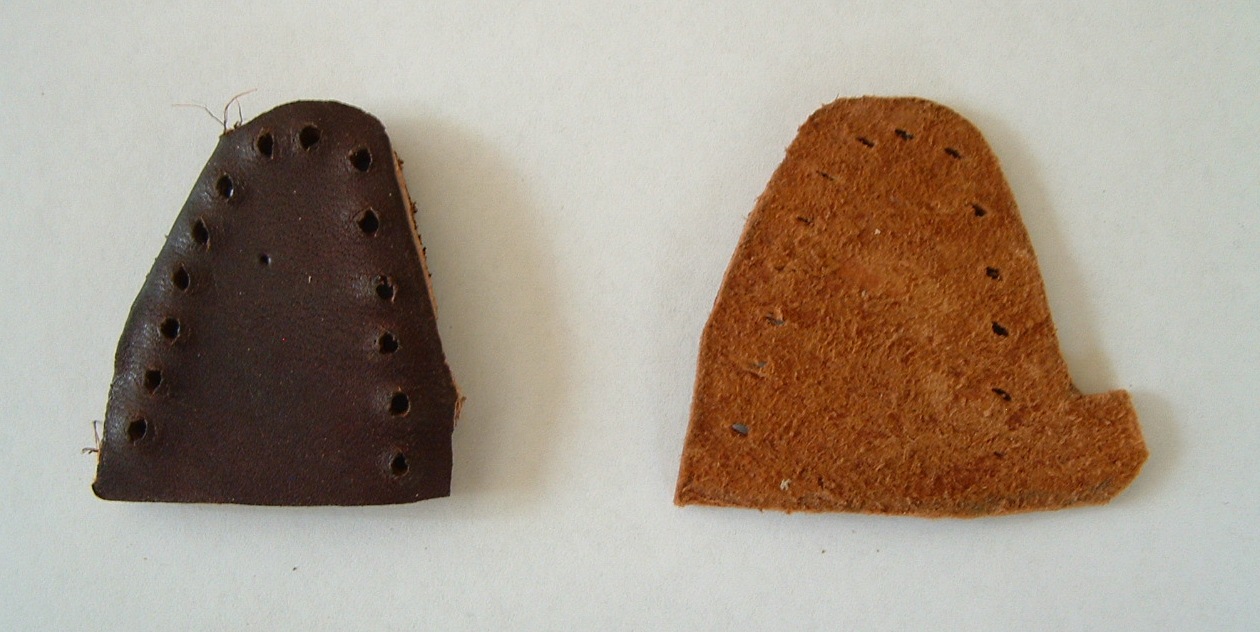
A hammer stall, also known as a hammer cap, is a leather device like a thumb stall which is placed over the hammer on a flint lock as a safety measure. With the stall in place, the flint in the jaws of the cock can not strike the hammer face, and therefore prevents accidental discharge of the gun. Although the hammer stall seems to have been mainly used by the military in the 18th century, it is possible that civilians and militia could have used them. To date, I have been unable to find any original images or originals in museum collections. Being made of leather it is possible that none have survived, though I would have thought that some of the larger military arms collections would still have intact stalls.

Quotes:


Items used for leather-work  From top and left to right: A leather palm pad, used to push the needle through the leather if it is a tight fit. I did not need to use this when making this Hammer Stall; an awl, beeswax for waxing the linen thread; needle, and linen thread.

Further research has shown that "Boot" may not be a period term. Hammer stall or hammer cap or even in one case the term "Thumb stall" was used. The term "Frizzen" is apparently a 19th century term derived from a similar German word.


On this one I placed the suspension tab on the back half of the stall because I had more of that leather, I was using scraps. But the tab can go on the back or the front half.


Here you can see a hammer stall I made some years ago for my fusil. The stall is in place on the hammer or steel.

Saturday, 11 December 2010

What it is & What it is not. Misinformation!

I think I explained a while back that I will not post corrections on other people's blogs or videos. I have done in the past, in the most respectful manner, and in private when I could, but I still attracted abuse. So instead I choose to post the correct information here, and I do not name the site on which the misinformation is posted. Which sites is not important as there is nothing to be done there. What is important is that you recognise misinformation when you see it.
If I make a mistake of my own, I will admit to it and correct it, and I do not have a problem with other people correcting me providing it is done nicely. However, do not get confused between what is wrong, and what is simply a "different way". True some ways are better than others, and some ways are just wrong, we need to keep this in mind.

The above is charred cloth which is used as tinder, it is tinder. It was not a popular tinder in the wilderness as you can imagine, but was used in some homes in the cities and towns.
It is not "char" and seperate from tinder, it is tinder.

This is a piece of punk wood, which is also used as tinder. A variety of plants and fungus are used as tinder.

This is rope fibres which can be used for kindling, just the same as dried grass or coconut fibre can be used as kindling. Light twigs and sticks are also kindling. This rope fibre is NOT tinder.


The above is a 19th century tobacco box with a burning glass in the lid used for lighting a pipe on a sunny day. It is NOT a Hudson Bay tinderbox. Yes you can use it to store tinder, flint and steel if you wish, but if you use it for making fire, or preparing tinder, it will smoke up the glass and may in time damage the burning glass.


Above are two hammers used on flint locks, they are also known as steels. Below the bottom image of a hammer you can see the hammer spring. These are NOT frizzens, and it is not therefore called a frizzen spring.

This is the cock on a flint lock, it is NOT a hammer! If it were a percussion lock it would be called a hammer, but on a flint lock it is called a COCK. The cock holds/secures the flint which strikes the hammer which creates sparks which fall upon the gunpowder priming in the pan of the flint lock which creates fire that will flash through the vent in the barrel and fire the main charge of gunpowder in the barrel of the gun.

Why does it matter if we use the correct terms or not? Well so long as we know their function it does not matter what you call an object, but if you are going to inform/instruct others, then it does matter. If dried grass is going to be called tinder, then I must assume it is kept in the tinderbox, and if charred cloth is char, then is it the only char available for making fire? Do I strike sparks on the char or the tinder? The book sais tinder, but I have not managed to catch sparks on the dried grass! Do you see where I am going here?
Yes I know people are calling the ferrocium rod a steel, and the method of using the ferrocium rod flint and steel, but it is not. Dried grass may well catch fire from a ferrocium rod scraped with a knife blade, but that does not make the dried grass into tinder! Let us all try and stick with the traditional names even when we are using modern methods and materials, otherwise it just gets confusing for the newbies.

With respect.