A LIVING HISTORY BLOG.

18TH CENTURY LIVING HISTORY IN AUSTRALIA.
Showing posts with label forest. Show all posts

Monday, 22 May 2017

The Road Not Taken, By Robert Frost. For my young friend Swamp Fox who has just graduated.

The Road Not Taken

Two roads diverged in a yellow wood,
And sorry I could not travel both
And be one traveller, long I stood
And looked down one as far as I could
To where it bent in the undergrowth;

Then took the other, as just as fair,
And having perhaps the better claim
Because it was grassy and wanted wear,
Though as for that the passing there
Had worn them really about the same,

And both that morning equally lay
In leaves no step had trodden black.
Oh, I marked the first for another day!
Yet knowing how way leads on to way
I doubted if I should ever come back.

I shall be telling this with a sigh
Somewhere ages and ages hence:
Two roads diverged in a wood, and I,
I took the one less travelled by,
And that has made all the difference.
Robert Frost


Monday, 21 December 2015

Children Of The New Forest forced to do Chores, 17th Century Style

These are only some of the chores that colonial children were required to perform. These children come from a wealthy household, but have come on hard times & are forced to live in the woods. Although this is in England & not the American colonies, the chores are the same.
Keith.


Thursday, 16 July 2015

Reconstructed Eastern Woodland Indian Wigwam. Winter Scene.

This is the reconstructed woodland Indian wigwam that I built in our forest. You can see the drying rack to the right, & the outside fireplace with tripod just in front.


Friday, 16 August 2013

Images from my Wigwam Camp in The Forest.


Inside fireplace in front of bed.

Bed of rolled bark. This is the inner bark I removed from the bush poles. I can also use this bark to make cordage.


Wednesday, 27 March 2013

A Scouting Trip.

Last weekend my wife and I had to go scouting for wood. Being a forest and not woodland the trees are fairly close together so we had to find a route where by we could get the wagon in. We could have gone up the flats in the bottom of the valley, but there is a header stream that runs through this valley and the ground is soft and easily damaged.
We cut our way through to each fire wood source as we went, and occasionally stopped to take in the view and see what we could find. These images are from that fire wood scouting trip.
Ryvardenia Cretacea, a bracket fungi used as tinder. This one on a Stringybark Tree.

On the ground beneath the same tree we found another bracket fungi from last year which had fallen from the tree.

Two more bracket fungi growing on a Mountain Gum.

In the cleft in this Stringybark Tree, center of photo, is a bees nest.

A section of bark has been removed from this tree with an iron axe. Possibly to make a shelter or a cover for something.

There are three scars around this tree where it looks as though it has been cut with a stone axe, taking off two sections of bark. The third cut is quite high, so someone would have had to climb this tree to remove this bark.


Sunday, 27 January 2013

Storm in the Forest.


Storm in the Forest.
Well the storm has finally reached us here in Wychwood Forest. This would not be a good time to be camping in the woods. If you ever find yourself in this situation, the best thing to do is either find some open area well away from the trees, or find a rocky outcrop that will protect you from falling trees. We have had rain now for two days, and the ground in the valley bottoms is soft. Up higher it is very rocky, so the trees have not been able to put their roots down deep. Water soaked ground and high winds in any forest will be a sure combination to bring down trees.
Do not light a fire in these conditions, it is wet enough to stop the spread of fire through the forest, but not wet enough to stop your shelter and gear getting burnt. The high winds will blow sparks and embers into your shelter. This is when it pays to be carrying foods that do not require cooking.
If you are using stakes to secure the lower part of your shelter, make sure they are long and driven deep. Winds like we are getting here will tear stakes out of the ground and turn them into dangerous weapons being wielded by the wind still attached to the canvas. Skills on woodsmanship really count on days like this. Once you are in a relatively safe place, stay there. Do not venture away from the protection of high rocks or large fallen trees. I have seen small sticks driven far into the ground by winds like these. If you get hit by one, it could be bad.

Thursday, 11 October 2012

Snow Here in the Mountains.

 I layed the fire again last night ready for this morning, and I was right.
 Dark up in the forest.
 Two Red Necked Wallabies in the snow.
 A closer look at the Red Necked Wallaby. Possibly it's first experience with snow!

8.15 am, and still snowing.

 8.45am. Getting heavier.
 Grey Kangaroo in the snow.

Saturday, 28 July 2012

18th Century Travel & Settlement in the New World.


18th Century Travel in the New World.
“When one travels on the roads, one constantly travels in bush or forest.  Occasionally, there is a house and several miles down the road there is another house.”
John W. Kleiner and Helmut T. Lehman, The Correspondence of Heinrich Melchior Mühlenberg, Volume 1, 1740-1747, (Picton Press, Camden, ME, 1986) 118; hereafter cited as Muhlenberg Correspondence.

 “…lost their way several times and had to cross several rivers, through one of which, the Nottway, they had to swim, as there was no one at hand to take them across in a boat.”
William J. Hinke, "Diaries Of Missionary Travels Among The German Settlers In The American Colonies 1743-1748," The Pennsylvania German Society Proceedings And Addresses, (Published By The Society 1929) 34:79.

 “ The settlements here are totally surrounded by forests.”
Muhlenberg Correspondence, 80.

“the whole country is one continuous woods!”
Benjamin F. Owen, "Letters of Rev. Richard Locke, and Rev. George Craig, Missionaries In Pennsylvania of the Society For Propagating the Gospel In Foreign Parts, 1746-1752," The Pennsylvania Magazine of History and Biography, (The Historical Society of Pennsylvania, Philadelphia, Pa., 1900), 24:470.

“…farmsteads were irregular in their appearance, they were frequently set far back from the roads and most often adjacent to a spring or stream.”
Ibid., 104.

 “The land is not really dear.  One takes up two-hundred acres, promised to pay by installments in ten years and instead clears off the debt in five years.”
Mittelberger, 119.

“Reaching a settlement is like a feast for an inexperienced traveler—to see sun shine on some open grounds, to view clear fields.  You seem to be relieved from that secret uneasiness and involuntary apprehension which is always in the woods.”
J. Hector Crevecoeur, Letters From an American Farmer And Sketches Of 18th-Century America, (Penquin Books, Ltd., Harmondsworth, Middlesex, England, 1981) 359.

“In this country the chickens are not put in houses at night nor are they looked after but they sit summer and winter upon trees near houses. Every morning many a tree is so full of chickens that the boughs bend beneath them.”
Mittelberger, 64.

Thursday, 5 July 2012

The Way I Lay My Fire. A Video.

My wife is away in Narrabri for a few days, so with no special times to keep I was able to get out in the forest again. Yes I know, I live in the forest, but you know what I mean.
http://www.youtube.com/watch?v=Y8BicvgUMuI


This camp was in Henry's Wood, a part of Wychwood Forest but more open woodland here than higher up.

Saturday, 31 December 2011

Still on the stick.

As some of you may know I am recently returned home from having a complete hip replacement. That means no woodsrunning for me for a while. As well as regular special excersizes I also have to go for a walk every day. It has been so wet here of late that walking off the track has not been possible. So I am restricted to walking our forest road to our front gate and back again, which is about 1Klm there and back. This morning being my first walk of 2012, I decided to take some photos and share them with anyone who is interested. Unfortunately I run out of room on the digital card before I reached the gate!

Looking back at the main house, "Linstock" and over Butterfly Valley to the forest beyond. As you can see, plenty of room for historical trekking.

Here Linstock is to the left, and this is looking up the road which leads to "Elm Cottage", which we use as a club house for the New England Colonial Living History group 1680-1760.

Starting my decent down toward "Bull Ant Bend". When I first put this track in, I encountered a large bull ant's nest right on that bend. It remained there for many years and was not a good place to hang around!

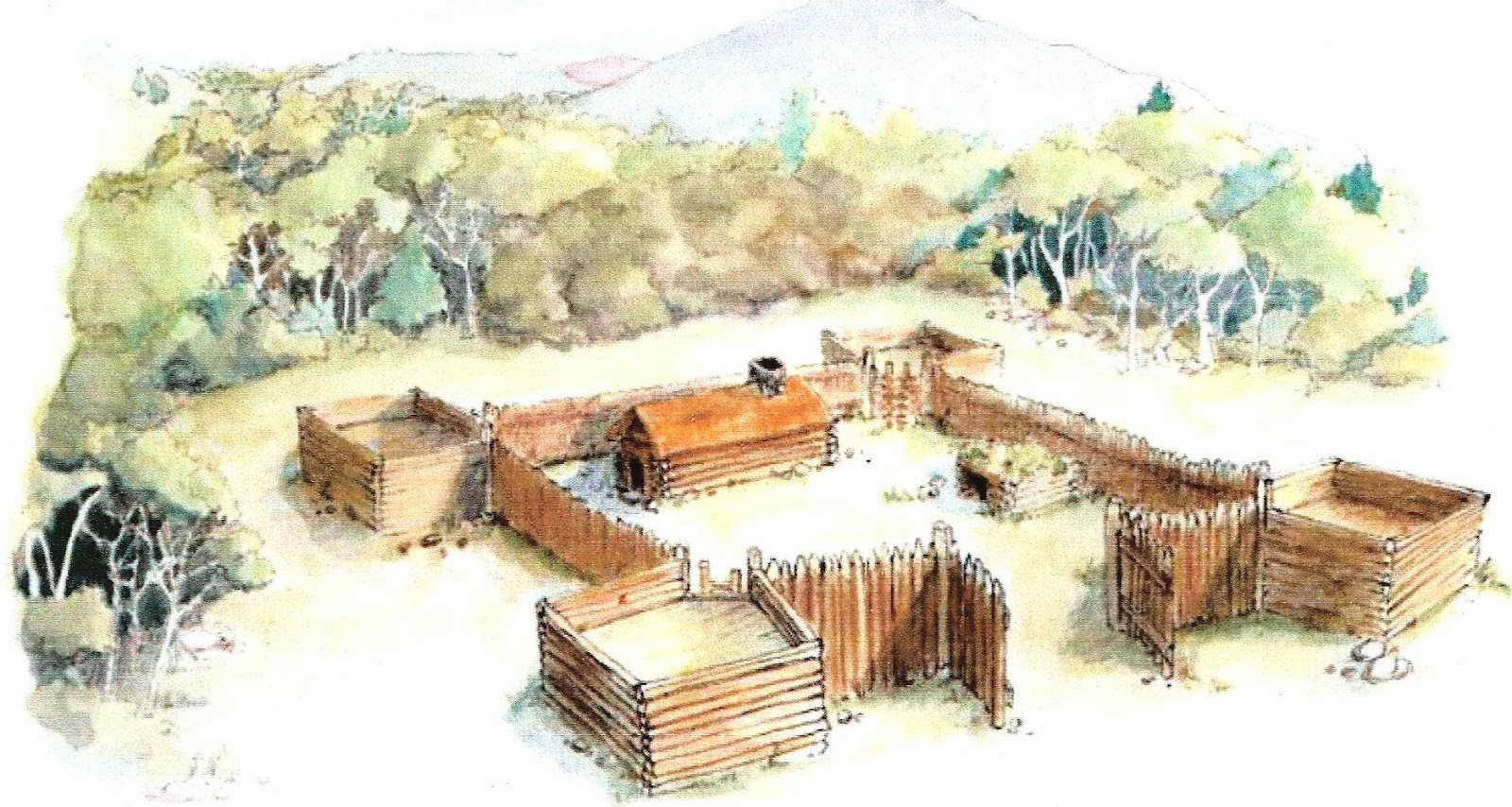
Bull Ant Bend looking further down the track. Old Fort Henry is just off to the right in Henry's Wood which is seperated from the rest of Wychwood Forest by this track.

Round the next bend.


In the distance you can see open pasture belonging to a "Brumby" farm. This is where they train the wild horses for sale. Our gate is still a little further on round the next bend. Henry's Wood to the right, the rest of the forest to the left.

Looking into Henry's Wood at the old fort.

A small stack of firewood drying in the sun ready for next winter. Green stacks like this and larger are dotted about the forest. Mostly we cut dry wood and carry it back to the wood shed, but when trees fall, then we sometimes cut them green and stack them to dry like this.

Another view of the open woodland in Henry's Wood, named after my Father. He never got to see this place, but I know he would have loved it here. Mostly Stringybark trees with some Yellow Box and Mountain Gum.

This is a Mountain Gum, very similar to look at as the Manna Gum. Can you see the Currawong centre picture? A black and white bird about the size of a Raven and similar to our Magpie but a little larger and not so much white as the Magpie. Just look at that big blue sky!

Elm Cottage with it's two chimneys, kichen on the left, living room on the right. It has solar power now as my youngest son uses one room to store some of his art work.

The living room 18th century style fire place with chains and hooks for hanging kettles. No solar lighting in this room, just candles, grease lamps and rush lights. Group members are able to bed down on the floor in this room if they wish to stay over.

Tuesday, 1 February 2011

Woolman In The Woods.

This was the first night that we lodged in the woods, and being wet with travelling in the rain, as were also our blankets, the ground, our tent, and the bushes under which we purposed to lay, all looked discouraging; but I believed that it was the Lord who had thus far brought me forward, and that he would dispose of me as he saw good, and so I felt easy. We kindled a fire, with our tent open to it, then laid some bushes next the ground, and put our blankets upon them for our bed, and, lying down, got some sleep.


Journal of John Woolman, 1760.

Life in the woods.


In the woods we were under some disadvantage, having no fire-works nor bells for our horses, but we stopped a little before night and let them feed on the wild grass, which was plentiful, in the mean time cutting with our knives a store against night. We then secured our horses, and gathering some bushes under an oak we lay down; but the mosquitoes being numerous and the ground damp I slept but little.

Journal of John Woolman. 1720-1742.

Either they did not know how to use the locks on their guns to make fire, or they had no guns!