A LIVING HISTORY BLOG.

18TH CENTURY LIVING HISTORY IN AUSTRALIA.
Showing posts with label woodland. Show all posts

Friday, 12 June 2015

NARRATIVE OF THE CAPTIVITY AND RESTORATION OF MRS. MARY ROWLANDSON. Part Eleven.


THE SEVENTEENTH REMOVE
A comfortable remove it was to me, because of my hopes. They gave me a pack, and along we went cheerfully; but quickly my will proved more than my strength; having little or no refreshing, my strength failed me, and my spirits were almost quite gone. Now may I say with David "I am poor and needy, and my heart is wounded within me. I am gone like the shadow when it declineth: I am tossed up and down like the locust; my knees are weak through fasting, and my flesh faileth of fatness" (Psalm 119.22-24). At night we came to an Indian town, and the Indians sat down by a wigwam discoursing, but I was almost spent, and could scarce speak. I laid down my load, and went into the wigwam, and there sat an Indian boiling of horses feet (they being wont to eat the flesh first, and when the feet were old and dried, and they had nothing else, they would cut off the feet and use them). I asked him to give me a little of his broth, or water they were boiling in; he took a dish, and gave me one spoonful of samp, and bid me take as much of the broth as I would. Then I put some of the hot water to the samp, and drank it up, and my spirit came again. He gave me also a piece of the ruff or ridding of the small guts, and I broiled it on the coals; and now may I say with Jonathan, "See, I pray you, how mine eyes have been enlightened, because I tasted a little of this honey" (1 Samuel 14.29). Now is my spirit revived again; though means be never so inconsiderable, yet if the Lord bestow His blessing upon them, they shall refresh both soul and body.
THE EIGHTEENTH REMOVE
We took up our packs and along we went, but a wearisome day I had of it. As we went along I saw an Englishman stripped naked, and lying dead upon the ground, but knew not who it was. Then we came to another Indian town, where we stayed all night. In this town there were four English children, captives; and one of them my own sister's. I went to see how she did, and she was well, considering her captive condition. I would have tarried that night with her, but they that owned her would not suffer it. Then I went into another wigwam, where they were boiling corn and beans, which was a lovely sight to see, but I could not get a taste thereof. Then I went to another wigwam, where there were two of the English children; the squaw was boiling horses feet; then she cut me off a little piece, and gave one of the English children a piece also. Being very hungry I had quickly eat up mine, but the child could not bite it, it was so tough and sinewy, but lay sucking, gnawing, chewing and slabbering of it in the mouth and hand. Then I took it of the child, and eat it myself, and savory it was to my taste. Then I may say as Job 6.7, "The things that my soul refused to touch are as my sorrowful meat." Thus the Lord made that pleasant refreshing, which another time would have been an abomination. Then I went home to my mistress's wigwam; and they told me I disgraced my master with begging, and if I did so any more, they would knock me in the head. I told them, they had as good knock me in head as starve me to death.

Sunday, 27 January 2013

Storm in the Forest.


Storm in the Forest.
Well the storm has finally reached us here in Wychwood Forest. This would not be a good time to be camping in the woods. If you ever find yourself in this situation, the best thing to do is either find some open area well away from the trees, or find a rocky outcrop that will protect you from falling trees. We have had rain now for two days, and the ground in the valley bottoms is soft. Up higher it is very rocky, so the trees have not been able to put their roots down deep. Water soaked ground and high winds in any forest will be a sure combination to bring down trees.
Do not light a fire in these conditions, it is wet enough to stop the spread of fire through the forest, but not wet enough to stop your shelter and gear getting burnt. The high winds will blow sparks and embers into your shelter. This is when it pays to be carrying foods that do not require cooking.
If you are using stakes to secure the lower part of your shelter, make sure they are long and driven deep. Winds like we are getting here will tear stakes out of the ground and turn them into dangerous weapons being wielded by the wind still attached to the canvas. Skills on woodsmanship really count on days like this. Once you are in a relatively safe place, stay there. Do not venture away from the protection of high rocks or large fallen trees. I have seen small sticks driven far into the ground by winds like these. If you get hit by one, it could be bad.

Sunday, 19 February 2012

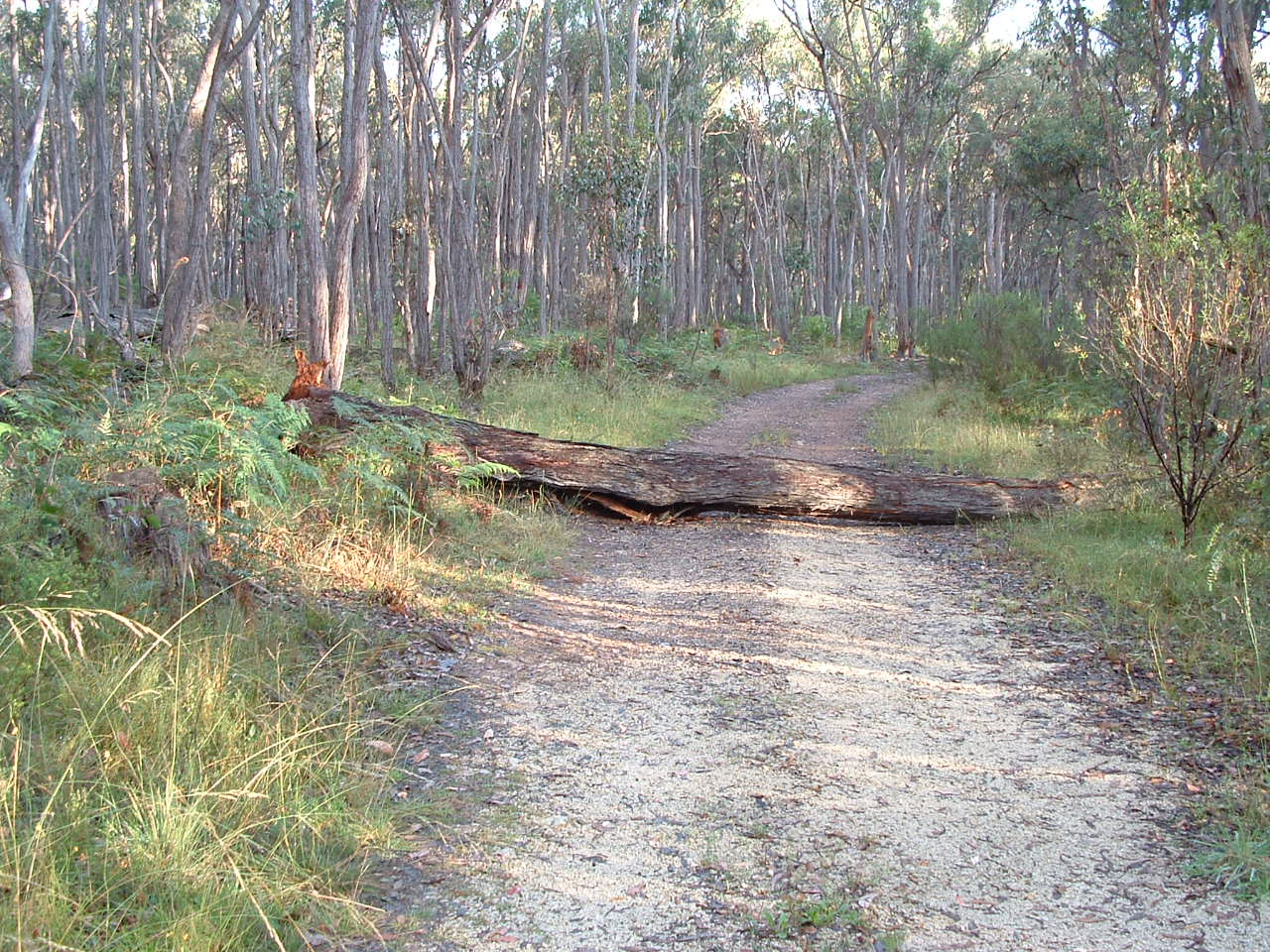
The Wagon Road Blocked !

This is what I found this morning, one of the hazards of living in a forest. I could not get the wagon round it so I had to clear a way through the less heavily treed woodland on the downside of the road higher up. I got through to our lower track that leads to the wood shed and finally got my wife on her way.


I got through here without having to move too much fallen timber, but the area is wet from recent rains.

Saturday, 31 December 2011

Still on the stick.

As some of you may know I am recently returned home from having a complete hip replacement. That means no woodsrunning for me for a while. As well as regular special excersizes I also have to go for a walk every day. It has been so wet here of late that walking off the track has not been possible. So I am restricted to walking our forest road to our front gate and back again, which is about 1Klm there and back. This morning being my first walk of 2012, I decided to take some photos and share them with anyone who is interested. Unfortunately I run out of room on the digital card before I reached the gate!

Looking back at the main house, "Linstock" and over Butterfly Valley to the forest beyond. As you can see, plenty of room for historical trekking.

Here Linstock is to the left, and this is looking up the road which leads to "Elm Cottage", which we use as a club house for the New England Colonial Living History group 1680-1760.

Starting my decent down toward "Bull Ant Bend". When I first put this track in, I encountered a large bull ant's nest right on that bend. It remained there for many years and was not a good place to hang around!

Bull Ant Bend looking further down the track. Old Fort Henry is just off to the right in Henry's Wood which is seperated from the rest of Wychwood Forest by this track.

Round the next bend.


In the distance you can see open pasture belonging to a "Brumby" farm. This is where they train the wild horses for sale. Our gate is still a little further on round the next bend. Henry's Wood to the right, the rest of the forest to the left.

Looking into Henry's Wood at the old fort.

A small stack of firewood drying in the sun ready for next winter. Green stacks like this and larger are dotted about the forest. Mostly we cut dry wood and carry it back to the wood shed, but when trees fall, then we sometimes cut them green and stack them to dry like this.

Another view of the open woodland in Henry's Wood, named after my Father. He never got to see this place, but I know he would have loved it here. Mostly Stringybark trees with some Yellow Box and Mountain Gum.

This is a Mountain Gum, very similar to look at as the Manna Gum. Can you see the Currawong centre picture? A black and white bird about the size of a Raven and similar to our Magpie but a little larger and not so much white as the Magpie. Just look at that big blue sky!

Elm Cottage with it's two chimneys, kichen on the left, living room on the right. It has solar power now as my youngest son uses one room to store some of his art work.

The living room 18th century style fire place with chains and hooks for hanging kettles. No solar lighting in this room, just candles, grease lamps and rush lights. Group members are able to bed down on the floor in this room if they wish to stay over.

Tuesday, 31 May 2011

Of The Traveling Of The Indians. Robert Beverley 1722.

Their travels they perform altogether on foot, the fatigue of which they endure to admiration. They make no other provision for their journey but their gun or bow, to supply them with food for many hundred miles together. If they carry any flesh in their marches, they barbecue it, or rather dry it by degrees, at some distance over the clear coals of a wood fire; just as the Charibees are said to preserve the bodies of their kings and great men from corruption. Their sauce to this dry meat, (if they have any besides a good stomach,) is only a little bear's oil, or oil of acorns; which last they force out by boiling the acorns in a strong lye. Sometimes also in their travels each man takes with him a pint or quart of rockahomonie, that is, the finest Indian corn parched and beaten to powder. When they find their stomach empty, (and cannot stay for the tedious cookery of other things,) they put about a spoonful of this into their mouths and drink a draught of water upon it, which stays their stomachs, and enables them to pursue their journey without delay. But their main dependence is upon the game they kill by the way, and the natural fruits of the earth. They take no care about lodging in these journeys, but content themselves with the shade of a tree or a little high grass.
Robert Beverley 1722.
Gutenberg Files.


Tuesday, 22 February 2011

The Diary of John Gyles, 1689:

The Diary of John Gyles, 1689:


"My honored father took my two eldest brothers and me to a field near the river. We planned to spend the day gathering the harvest. After we had dined at noon, we went again to our labors, some in one field gathering corn, while the others went to a nearby field to gather hay. About one o'clock, we heard shots. My father expressed the hope that they had been fired by British soldiers stationed in the area to protect the inhabitants.


We retreated to our barn where, to our great surprise, 30 or 40 Indians discharged a volley of shot at us from behind rising ground. The whistling of their shot and their horrid howls so terrified me that I tried to run away. My brothers went one way and I ran another.


Looking back, I saw a stout, painted fellow after me with a gun and a cutlass, which any moment, I expected to feel crashing through my brains. I tripped and the Indian came upon me, seizing my left hand. He offered me no abuse, but tied my arm tightly, then lifted me up and led me away. The Indians also captured my brother James, but Thomas, my elder brother, made good his escape across the river.


After doing what mischief they could to the farm, the Indians made us sit with them as they ate; then we were marched eastward a quarter mile, where we halted again, and my father was brought to us.


My father stated he was a dying man and he wanted an opportunity to pray with his children. The Indians called my father a brave man, and allowed his request. Father solemnly recommended us to the protection of God, then he gave us his best advice; and finally, very weakly - he took his leave. He parted with a cheerful voice, but he looked so pale, because of his great loss of blood. The Indians led him aside, then I heard the dull blow of a hatchet, but not a shriek or groan from father."


"We left Meductic and went up the Saint John River about ten miles . . . to where there was a wigwam. At our arrival, an old squaw saluted me with a yell, taking me by the hair and one hand; but I was so rude as to break her hold and free myself. She gave me a filthy grin and the Indians set up a laugh, so the incident was passed over. Here we lived upon fish, wild grapes, roots, berries, etc., for several months."


Tuesday, 1 February 2011

Woolman In The Woods.

This was the first night that we lodged in the woods, and being wet with travelling in the rain, as were also our blankets, the ground, our tent, and the bushes under which we purposed to lay, all looked discouraging; but I believed that it was the Lord who had thus far brought me forward, and that he would dispose of me as he saw good, and so I felt easy. We kindled a fire, with our tent open to it, then laid some bushes next the ground, and put our blankets upon them for our bed, and, lying down, got some sleep.


Journal of John Woolman, 1760.