A LIVING HISTORY BLOG.

18TH CENTURY LIVING HISTORY IN AUSTRALIA.
Showing posts with label tomahawk. Show all posts

Saturday, 20 April 2019

Tools Of The Trade UPDATE.


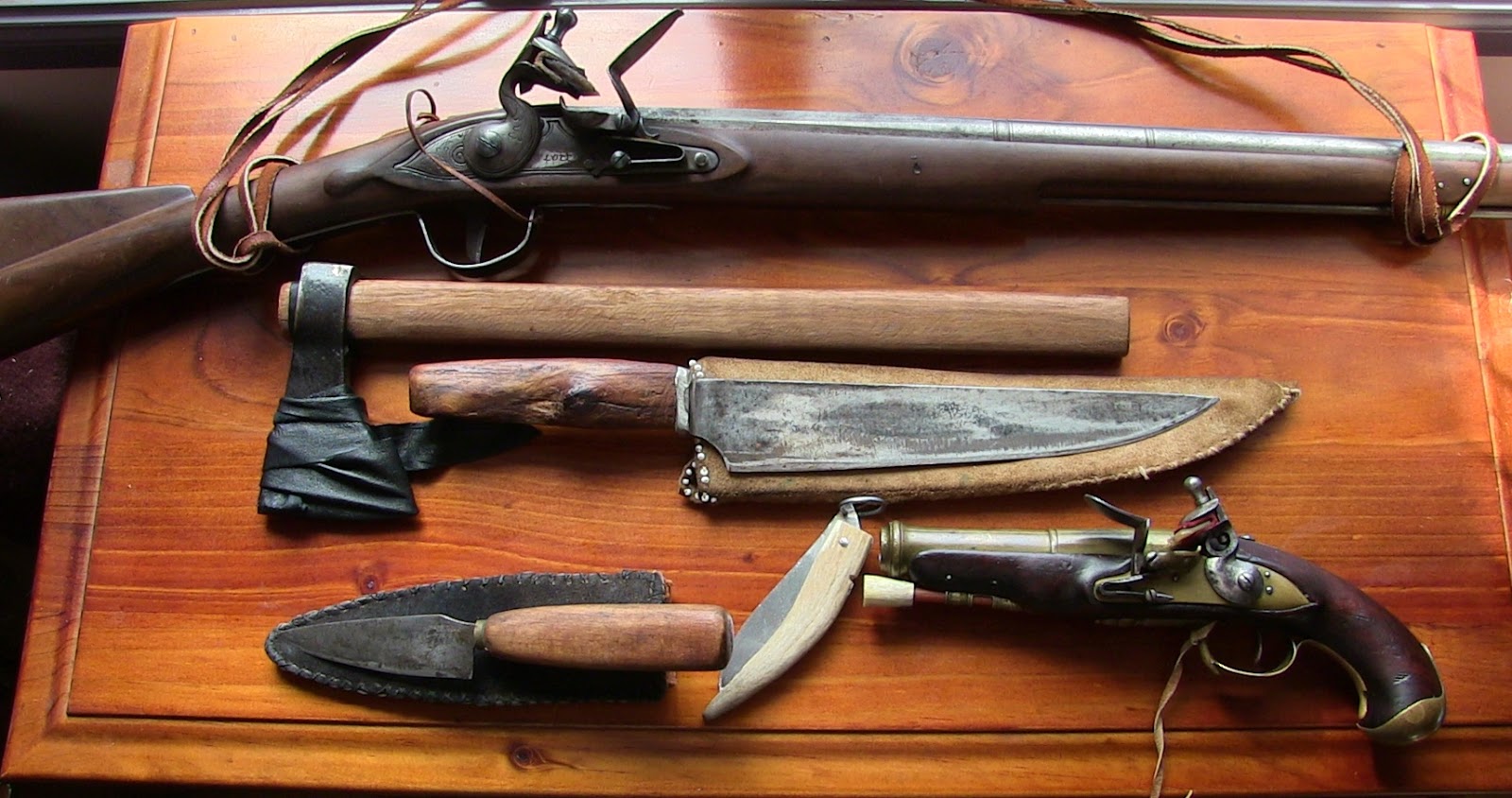
I have updated my equipment of late, I removed the pewter bolster from my hunting knife & fitted a new handle. This one as you can see is antler. Also shown is my fairly new clasp knife.
Keith.

Sunday, 24 February 2019

Blades Update.


I thought I had posted on this earlier, but a search came up blank! So here are some images of my blades including the new clasp knife I am now carrying.

Hunting knife.

Legging knife.

The clasp knife my eldest son gave me.

My tomahawk.


Tuesday, 20 September 2016

Blades & Gun Update.

A subscriber to my video channel (https://www.youtube.com/channel/UCHEOMSZJETfj3GnoyONuvCQ?view_as=public) said they would like a closer look at my knife, so I decided it was easier for me to post images of the blades & guns I carry here on my blog so it is there for future reference.


My .62 caliber/20 gauge flintlock fusil. 42 inch smoothbore barrel with a steel ramrod.

My .70 caliber smoothbore flintlock pistol.

My axe/tomahawk.

Hunting knife.

Legging knife.


Stag handle friction clasp knife.


Sunday, 14 June 2015

Using The Axe By Keith H Burgess


17th century lathing hatchet.


Tomahawk or trade axe.

I have seen many explain how to hold and swing the axe but never have explained so precisely where to hit the wood for the best results. Your tutorial is greatly appreciated and the information used. Thank you!

Tuesday, 13 August 2013

Trader for Ausie Living Historians & Historical Trekkers.

Just a reminder regarding my friend Mick's "Mopoke's Stock and Trade in Victoria Australia. If Mick does not have what you want in stock, just ask him if he can get it in for you.
http://www.mopokesstockandtrade.com/

Sunday, 5 May 2013

The Half-axe.

Skinning some more poles for a wigwam today. This is the half-axe I carry when doing heavier constructions, good for debarking. Size difference shown against my tomahawk. Both are trade axes. So if you want a half-axe, just get the larger size tomahawk head & fit a longer helve/handle.


Thursday, 29 November 2012

Sharpening Blades In The Field. Stones and Files.

Someone just recently asked me: "How did the longhunter sharpen his knife in the field".
Well although some people in the 18th century did not look after their tools, I think there were a lot more that did. The passage regarding Gist and Washington comes to mind. These two set off alone in the wilderness with only one blunt hatchet and no means of sharpening said hatchet. How dumb can you get! It always amazes me that seemingly educated people make so many bad mistakes, especially when their lives may be at stake.
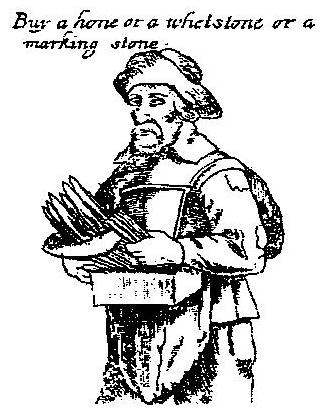
There were whetstones and metal files commonly available during all periods of the 18th century and earlier. A smart person would carry one or both of these items to keep their knife and belt axe/tomahawk sharp and in good working order. Here are some examples below.


Perret-plate Xlfigs38-39-01
 An early Barlow clasp knife, probably 17thc.-18th century, with a whetstone.
The above images are from: finds.org.uk.

Honing and whetstones. Notingham University Museum. Photo By Robin Aldworth

Basing axe and whetstones. A basing axe is used to roughly shape the whetstone at the quarry.

A whetstone from my collection. This one came from a creek bed.

An 18th century whetstone in a wooden holder.
Cries Of London. A street vendor selling honing and whetstones.
 

Monday, 24 September 2012

A Quote From The Pote Journal and Experimental Archaeology.

Bushcraft forums abound with people making wooden spoons, but this craft has never interested me. Then whilst doing some research, I came across the following quote in "The Pote Journal":


“my master told me to
Try if I Could make me a Spoon, and Gave me a hatchet
and told me he would assist me in it for he Said there
was nothing more Necessary for me to be furnished
with in my march, his orders I quickly obeyed, and
finished my Spoon with So much Dixterity, yt my
master was Verey well pleased with me, and told
me he hoped I Should make as Good a heron, as
one John Honewell an English man that had Lived
with ym Near thirty years, and was maried amongst
them and had Severel Children, this Night they
placed me between two Indians, with a String Round
my middle, and Each End made fast to my Companions,”.
The Pote Journal 1745

I have made horn spoons, but never made a wooden spoon before, but thought this quote might be an interesting project. So I decided to make a wooden spoon using just a hatchet. Below is the result.


This is of course only my interpretation, I have no way of knowing what the Pote spoon looked like. The cup of the spoon was the hardest part to shape with just a hatchet, though I dare say that I could make a better job of it given time.


Friday, 8 June 2012

Guest Speaker, Listen Up!

My friend Vieuxbois is not only a follower of this blog, but he is a valued international member of our 18th century living history group. What he has to say below regarding knives & battoning is in response to my recent article. It is really good to get the point of view from another person whos life is spent in the wild and often depends on the blades he carries with him.
My sincere thanks to Vieuxbois for this information.

Vieuxbois has left a new comment on your post "Knife Battoning! NOT!":

Frozen wood is ``brittle`` and easy to split. But it’s also very hard. Furthermore, steel is also more brittle when it’s very cold (it’s better to keep the protected blade warm by holding it close your body). So if I need to split frozen wood (which is rare and exceptional) there is more risk to damage a knife than an axe : an axe edge is generally thicker than a knife, there is more material to support the stress.

In my opinion, there are no reason for batoning with a knife unless if :

1. It’s not your choice, you need to do it : you are in a survival situation (or a survival training) with only a knife to work with, so you do with what you have, and you do it carefully because you want/need to preserve what you have like a treasure because your life depends on it. If you are in a true survival situation why would you risk breaking your knife? Break your knife and your chance of survival goes down.

2. You are playing like a kid, so you pay the game price.

3. It`s your choice, you want to do it : so you will use a very strong knife with an appropriate design/materials and heat treatment if you want to keep this tool in good condition. But does this very strong knife will do the same job than a thin blade? Of course I can carry both.


Vieuxbois has left a new comment on your post "Knife Battoning! NOT!":

From Thin, Sharp, Knives - Posted: 9 September, 2011 in http://bfelabs.com/2011/09/09/thin-sharp-knives/ : `` If you look around the working world, at the knives that are regularly used to do work, you might notice some startling differences between those knives and what is prominent in the popular knife industry. Particularly the “survival”, “tactical”, and “hard use” arenas of popular knife-making (both custom and production).
In these arenas we typically see heavy knives, from thick stock, with study handles and generally robust construction. We are told that this robustness is desirable, even absolutely necessary, for these tools to withstand the rigors of hard use. And the market sucks them up about as fast as they can be made, with companies like TOPS Knives producing ever-new variants of these beefy blades for battle and conquering barren-wastes. But what is being bought, and what is actually being used, are far different. What people actually work with is often something very different. The prominent working knife is not a robust, stout, knife but rather a thin, sharp, knife.
I was at a branding recently, out here in cattle country, and took note of the knives being used. For those unfamiliar, when branding calves it is also common practice to ear-mark with a notch in an ear and castrate. These tasks require a deft hand with a sharp knife, particularly when the calf is not forced into an immobilizing squeeze chute, but is rather roped out and held down. I’ve taken part in and observed this process numerous times in my life, and there is a great commonality to the knives being used: They are thin, sharp, knives. The same knives most of the cowboys and ranch hands carry in their pockets daily, and use for everything.


Vieuxbois has left a new comment on your post "Knife Battoning! NOT!":

The thin, sharp, knife is not unique to this environment, but rather common to every other. Moving out from the traditional slipjoint folder common to the ranching west, a survey of other traditional folding knife designs would turn up a variety of styles, locks, and construction methods, but one commonality: Thin, sharp, blades. Moving from folders, to fixed blade knives, we see the same variety in design and construction in traditional designs, but a great many have the same commonality of thin blades. The traditional Scandinavian knives, as typified by the Mora so common to woodscraft, are an easily accessible example of the type.
Thin blades are not limited to small knives, either. Many old-time woodsmen, frontiersmen, mountainmen, etc. who used big knives carried ones that, rather than resembling the Iron Mistress of Hollywood, more resembled a butcher knife, being thin although long. Now, some may use the argument that we know more than they did, and thus make more appropriate choices, but that is simply nonsense. Anyone who makes a living with a tool, or depends on it for his own life, on a day-to-day basis, knows far more about selecting the right type of that tool than anyone who does not do the same, no matter the other mans “knowledge”.


Vieuxbois has left a new comment on your post "Knife Battoning! NOT!":

If so many who’s lives depended on their knives choosing thinner blades historically holds little sway, then the fact that the trend is a modern one too should tell us something. Today, if we take a survey of the knives being used routinely, we would find many of them to be far thinner than what we’ve come to expect (or been told to expect). And not just small knives: While so many Americans and others influenced by the major knife market are of the opinion that a heavy, thick-spined, knife is required for chopping or “serious” woods work, much of the rest of the world relies on something far different; The machete, or some variant thereof.
Different tools are appropriate for different tasks. There is, beyond a shadow of a doubt, a place for robust knives. One of the most valuable characteristics of contemporary knifemaking is the rise of robust locking systems for folding knives. The matching rise of the robust blade, however, may not be the best thing. But it is important to recognize that place, and use the right tool for the right job. For the majority of tasks for which a knife is used, a thick bladed knife is not the right tool. This includes many “hard” tasks, from woodscraft to cowboying to “tactical” environments (whatever those are). You aren’t necessarily wrong is you carry a robust knife for these, or even more mundane, daily uses, but you should ask yourself if that is truly what you need. Give some thought to whether cutting performance is a greater need than brute strength, and take a thinner knife better suited for cutting out for a spin sometime.``

Regards,


Saturday, 12 November 2011

Carrying The Tomahawk[trade axe].

My thanks to Elmo for asking about the carrying and safety aspects of tomahawks. As far as the covering of blades is concerned, I think it was a personal choice based on experience. I told Elmo about the trapper who slipped on ice and fell on his tomahawk which had no blade cover and was carried under his belt. The blade cut his hand off as he tried to break his fall.

The typical and most common way for a woodsrunner to carry a tomahawk. This woodsman has removed the blade cover because he is using his tomahawk to construct a shelter.

Again, you can see the tomahawk through the back of my belt with a linen cloth cover on the blade. My half-axe is secured under the ties on my blanket roll.

This tomahawk frog belonged to a close friend of mine who went under some years ago. His persona was that of an ex Ranger and no longer needing to carry a bayonet for his Brown Bess musket, he ellected to make this frog to just carry his tomahawk. This shows my wife's belt axe in the frog.

This is the type of frog carried by some Rangers and light infantry.


This mid 18th century carrier is home made and designed to carry under the arm with the strap over the shoulder.

This I believe is a copy of an original late 18th century tomahawk blade cover. I would not take this to be one of common usage.

Monday, 17 October 2011

Choosing The Right Tools and Equipment. History and Survival.

Choosing The Right Tools and Equipment. History and Survival. © Keith H. Burgess.


As occasionally happens, the articles that Karl, Ross and myself come up with are often connected in some way. No doubt that is because we think in much the same way. The difference between myself and them is 300 years, but even so these two woodsmen still think in terms of practicality and often look to the past for inspiration.


Before I even read Ross’s blog today I had decided to post on survival, equipment and how to approach one’s choices of same. Ross made the comment that more and more people go into the bush equipped as if they are going into a life and death situation [or similar words]. Now personally I think that is how one should approach the task of selecting one’s equipment and tools, why? Because [A] one never knows what could happen out there and I think it is better to be prepared for the worst [as it happens I have found myself in several survival situations over the years and have been very glad I was equipped to handle the situations!], and [B] because I am an 18th century living historian, and that is exactly how a woodsman in the mid 18th century should be thinking. To think any other way would be folly.


So those of you who wish to emulate an 18th century woodsman or woods-woman, whether you be a Ranger or a militia member, hunter or trapper, you need to carry the tools and equipment that these people carried 300 years ago. Yes there is room for personal choice, but those choices must be within the realm of authenticity. If you want to carry a 1lb throwing knife, then do the research. Because most woodsrunners carried ordinary butcher knives.


I have said this before; your tools have specific uses. You do not need a knife that is capable of cutting down trees, you need a hunting knife that is capable of skinning and butchering, and perhaps at times used for fighting. You need to throw something? Throw your tomahawk/axe. It is designed to do the heavier work. You want to carry more than one knife? Fine, this is documented. I myself carry a hunting knife, a back-up legging knife and a jack knife for making kettle hooks and trap parts. All three have a purpose and they are light and useful.


Do not carry a percussion gun because a flintlock makes you flinch! Get over it. I have no doubt that some woodsrunners flinched 300 years ago until they got used to it. The fact is that the flintlock is the most practical arm to use, and it is a good survival tool. Woodsrunners and Mountain Men did not use percussion guns or rifles. Do you think they would risk running out of those percussion caps knowing that they had to wait a full 12 months before the traders returned to the mountains? No matter how many of those caps you have, if they get damp they won’t work [same goes for modern primers!]. But a piece of rock can be found anywhere that will create a spark, and if the lock breaks and you have run out of spare parts you can easily convert your flintlock into a matchlock or a tinderlock.

Good practical inexpensive second hand butcher knives.


Don’t go overboard with “spare” items, the chances of you losing tools, providing your equipment is well thought out, is minimal. You will need to make some compromise between minimum weight and maximum self-reliance. Look after your tools, and instead of carrying two of everything, learn the primitive skills that you would need if you were to lose those tools. If like my gear your equipment and tools are also your “Bug-out bag”, then by all means stash a spare fire steel and a spare butcher knife aside ready to be picked up on the way out the door. But rather than carry extra weight in tools, carry the weight in gunpowder, food and water.


Keep your foods simple, choose from those items that have been documented. Dried peas, dried corn, flour, popcorn, oats and dried meat. If you carry any fresh foods make sure you eat them first. If your gear is your modern survival pack, then pack some vitamin tablets if you have to “bug-out”. Vitamin C should be on the top of the list. Always carry your personal medication. There were pill containers in the 18th century and they carry easily in your weskit pockets. Carry a kettle, because it can be used for catching rain water, boiling water, cooking, foraging for berries, and preparing a brain mixture for tanning skins.


Think about how much lead you are going to carry. Mostly you will find that your round ball can be retrieved from shot game and remoulded using a ball mould and a light lead ladle. You can make your own gunpowder in the wilderness providing you can find the ingredients, but this is not likely. So I suggest you carry extra gunpowder. I have several leather gunpowder wallets/bags. When empty of gunpowder, this wallet contains spare plant tinder. I also have several large powder horns for other people to carry. Think about any others who might accompany you on an historical trek [or bug-out]. Though I think that most should be fully equipped and self reliant, there may be some members that you can use as “baggage carriers”.

Junior tomahawk. My three children learnt how to use and throw an axe using this small tomahawk/axe.


The woodland Indian women were baggage carriers, why? Because the warriors could not afford to be too encumbered with heavy items if they were expected to protect the women and children. The warriors carried their tools and weapons, and very often a small pack & a blanket. The women and children carried the rest. Likewise colonial settlers would travel in the same way. Scouts could not afford to be too burdened with baggage. Mostly it was the men who carried the guns and perhaps some other tools. The women carried what they could. This is not to say that women did not carry guns, I have no doubt that if there were an extra gun then a woman would carry it. Women like Mrs Pentry dressed as her husband did in woodsrunners clothing and she carried her gun and other equipment. Likewise Mad Ann Bailey was well known to be totally self-reliant in this respect and often acted as scout herself.

A no-frills English trade gun.


So think hard on what you and perhaps your family carry. There is no need for the purchasing of expensive items; in fact the opposite was far more common in the 18th century. Damascus blades and carved gun stocks would have been out of place 300 years ago. Most woodsrunners were not wealthy in regards to money, but the majority were probably very practicle.

Another no-frills flintlock in .32 calibre. No patchbox, just a grease hole in the stock.