A LIVING HISTORY BLOG.

18TH CENTURY LIVING HISTORY IN AUSTRALIA.
Showing posts with label belt axe. Show all posts

Tuesday, 20 September 2016

Blades & Gun Update.

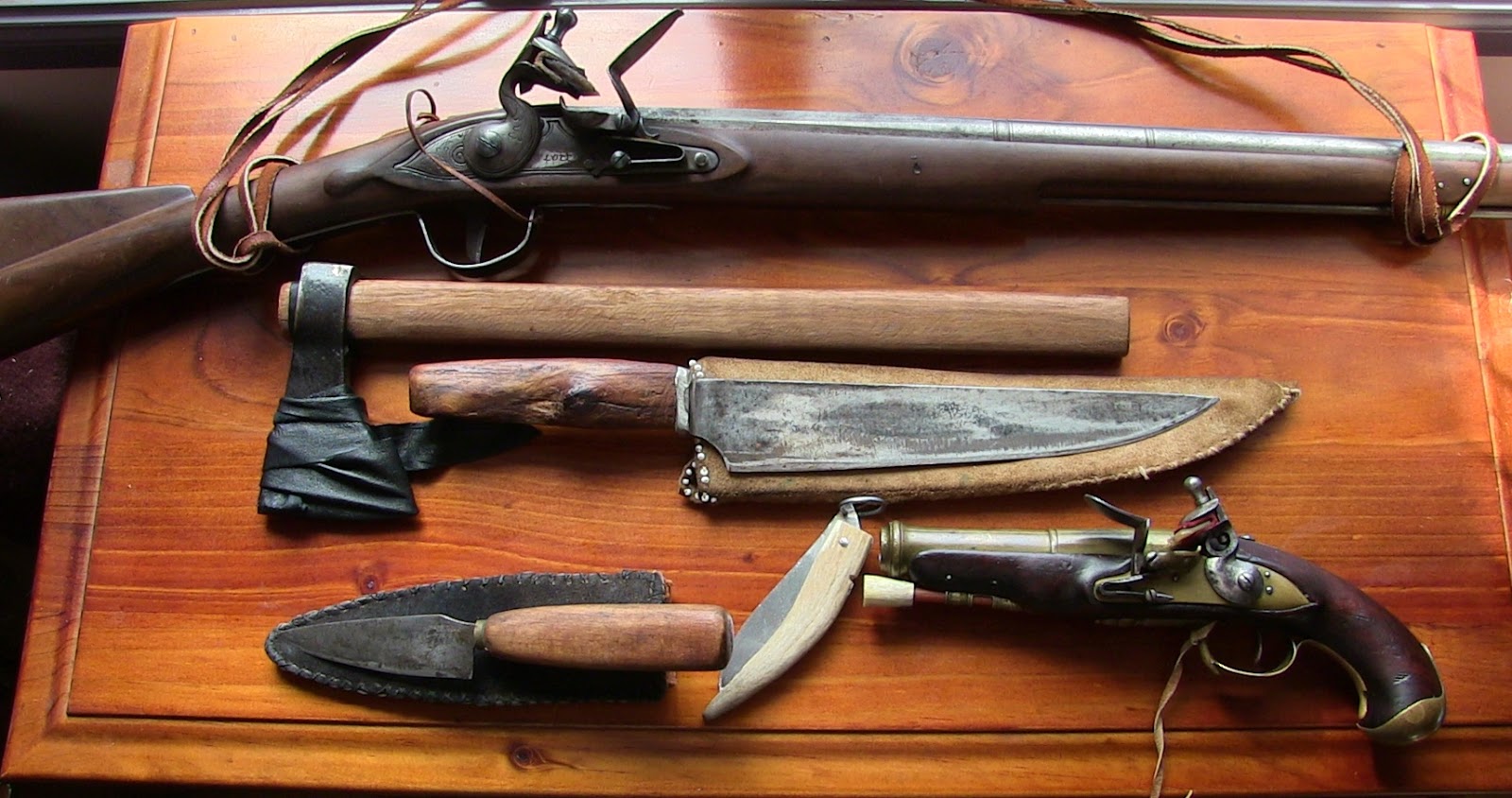
A subscriber to my video channel (https://www.youtube.com/channel/UCHEOMSZJETfj3GnoyONuvCQ?view_as=public) said they would like a closer look at my knife, so I decided it was easier for me to post images of the blades & guns I carry here on my blog so it is there for future reference.


My .62 caliber/20 gauge flintlock fusil. 42 inch smoothbore barrel with a steel ramrod.

My .70 caliber smoothbore flintlock pistol.

My axe/tomahawk.

Hunting knife.

Legging knife.


Stag handle friction clasp knife.


Sunday, 2 September 2012

The Tomahawk and Its Weight.


Recently I have received several enquiries about the weight of a trade axe/tomahawk. I had not realised that some popular brands of “off the shelf” tomahawks weighed in at about 1 kilogram! Personally I think this weight for a tomahawk/belt axe is excessive.
My tomahawk head weighs 1 lb, and all up with the helve about 500 grams. Personally I would set the upper limit of 600 grams. Even my half-axe weighs in just under 1 kilogram.
As I said, this is my personal choice. If a person has uses for the tomahawk that requires a heavier head, then so be it, but I fail to see what this use could be in a normal woodsrunning situation. I use my tomahawk for: shelter construction, trap construction, hammering in shelter and trap stakes, throwing for recreation and it is good for self-defence and hunting if needs be. None of these chores require a tomahawk head heavier than 1 lb.
So if you are thinking of purchasing a tomahawk, think about what you are going to use it for. I do not use mine for cutting firewood, I have never had the need, but even if I did, my tomahawk would still be adequate. 
 This is the tomahawk I normally carry when in the woods.
 This is the tomahawk I made from a modern axe head. Both are the same weight, 500 grams with helve/haft.
Friday, 8 June 2012

Guest Speaker, Listen Up!

My friend Vieuxbois is not only a follower of this blog, but he is a valued international member of our 18th century living history group. What he has to say below regarding knives & battoning is in response to my recent article. It is really good to get the point of view from another person whos life is spent in the wild and often depends on the blades he carries with him.
My sincere thanks to Vieuxbois for this information.

Vieuxbois has left a new comment on your post "Knife Battoning! NOT!":

Frozen wood is ``brittle`` and easy to split. But it’s also very hard. Furthermore, steel is also more brittle when it’s very cold (it’s better to keep the protected blade warm by holding it close your body). So if I need to split frozen wood (which is rare and exceptional) there is more risk to damage a knife than an axe : an axe edge is generally thicker than a knife, there is more material to support the stress.

In my opinion, there are no reason for batoning with a knife unless if :

1. It’s not your choice, you need to do it : you are in a survival situation (or a survival training) with only a knife to work with, so you do with what you have, and you do it carefully because you want/need to preserve what you have like a treasure because your life depends on it. If you are in a true survival situation why would you risk breaking your knife? Break your knife and your chance of survival goes down.

2. You are playing like a kid, so you pay the game price.

3. It`s your choice, you want to do it : so you will use a very strong knife with an appropriate design/materials and heat treatment if you want to keep this tool in good condition. But does this very strong knife will do the same job than a thin blade? Of course I can carry both.


Vieuxbois has left a new comment on your post "Knife Battoning! NOT!":

From Thin, Sharp, Knives - Posted: 9 September, 2011 in http://bfelabs.com/2011/09/09/thin-sharp-knives/ : `` If you look around the working world, at the knives that are regularly used to do work, you might notice some startling differences between those knives and what is prominent in the popular knife industry. Particularly the “survival”, “tactical”, and “hard use” arenas of popular knife-making (both custom and production).
In these arenas we typically see heavy knives, from thick stock, with study handles and generally robust construction. We are told that this robustness is desirable, even absolutely necessary, for these tools to withstand the rigors of hard use. And the market sucks them up about as fast as they can be made, with companies like TOPS Knives producing ever-new variants of these beefy blades for battle and conquering barren-wastes. But what is being bought, and what is actually being used, are far different. What people actually work with is often something very different. The prominent working knife is not a robust, stout, knife but rather a thin, sharp, knife.
I was at a branding recently, out here in cattle country, and took note of the knives being used. For those unfamiliar, when branding calves it is also common practice to ear-mark with a notch in an ear and castrate. These tasks require a deft hand with a sharp knife, particularly when the calf is not forced into an immobilizing squeeze chute, but is rather roped out and held down. I’ve taken part in and observed this process numerous times in my life, and there is a great commonality to the knives being used: They are thin, sharp, knives. The same knives most of the cowboys and ranch hands carry in their pockets daily, and use for everything.


Vieuxbois has left a new comment on your post "Knife Battoning! NOT!":

The thin, sharp, knife is not unique to this environment, but rather common to every other. Moving out from the traditional slipjoint folder common to the ranching west, a survey of other traditional folding knife designs would turn up a variety of styles, locks, and construction methods, but one commonality: Thin, sharp, blades. Moving from folders, to fixed blade knives, we see the same variety in design and construction in traditional designs, but a great many have the same commonality of thin blades. The traditional Scandinavian knives, as typified by the Mora so common to woodscraft, are an easily accessible example of the type.
Thin blades are not limited to small knives, either. Many old-time woodsmen, frontiersmen, mountainmen, etc. who used big knives carried ones that, rather than resembling the Iron Mistress of Hollywood, more resembled a butcher knife, being thin although long. Now, some may use the argument that we know more than they did, and thus make more appropriate choices, but that is simply nonsense. Anyone who makes a living with a tool, or depends on it for his own life, on a day-to-day basis, knows far more about selecting the right type of that tool than anyone who does not do the same, no matter the other mans “knowledge”.


Vieuxbois has left a new comment on your post "Knife Battoning! NOT!":

If so many who’s lives depended on their knives choosing thinner blades historically holds little sway, then the fact that the trend is a modern one too should tell us something. Today, if we take a survey of the knives being used routinely, we would find many of them to be far thinner than what we’ve come to expect (or been told to expect). And not just small knives: While so many Americans and others influenced by the major knife market are of the opinion that a heavy, thick-spined, knife is required for chopping or “serious” woods work, much of the rest of the world relies on something far different; The machete, or some variant thereof.
Different tools are appropriate for different tasks. There is, beyond a shadow of a doubt, a place for robust knives. One of the most valuable characteristics of contemporary knifemaking is the rise of robust locking systems for folding knives. The matching rise of the robust blade, however, may not be the best thing. But it is important to recognize that place, and use the right tool for the right job. For the majority of tasks for which a knife is used, a thick bladed knife is not the right tool. This includes many “hard” tasks, from woodscraft to cowboying to “tactical” environments (whatever those are). You aren’t necessarily wrong is you carry a robust knife for these, or even more mundane, daily uses, but you should ask yourself if that is truly what you need. Give some thought to whether cutting performance is a greater need than brute strength, and take a thinner knife better suited for cutting out for a spin sometime.``

Regards,


Saturday, 12 November 2011

Carrying The Tomahawk[trade axe].

My thanks to Elmo for asking about the carrying and safety aspects of tomahawks. As far as the covering of blades is concerned, I think it was a personal choice based on experience. I told Elmo about the trapper who slipped on ice and fell on his tomahawk which had no blade cover and was carried under his belt. The blade cut his hand off as he tried to break his fall.

The typical and most common way for a woodsrunner to carry a tomahawk. This woodsman has removed the blade cover because he is using his tomahawk to construct a shelter.

Again, you can see the tomahawk through the back of my belt with a linen cloth cover on the blade. My half-axe is secured under the ties on my blanket roll.

This tomahawk frog belonged to a close friend of mine who went under some years ago. His persona was that of an ex Ranger and no longer needing to carry a bayonet for his Brown Bess musket, he ellected to make this frog to just carry his tomahawk. This shows my wife's belt axe in the frog.

This is the type of frog carried by some Rangers and light infantry.


This mid 18th century carrier is home made and designed to carry under the arm with the strap over the shoulder.

This I believe is a copy of an original late 18th century tomahawk blade cover. I would not take this to be one of common usage.