A LIVING HISTORY BLOG.

18TH CENTURY LIVING HISTORY IN AUSTRALIA.
Showing posts with label knives. Show all posts

Saturday, 20 April 2019

Tools Of The Trade UPDATE.


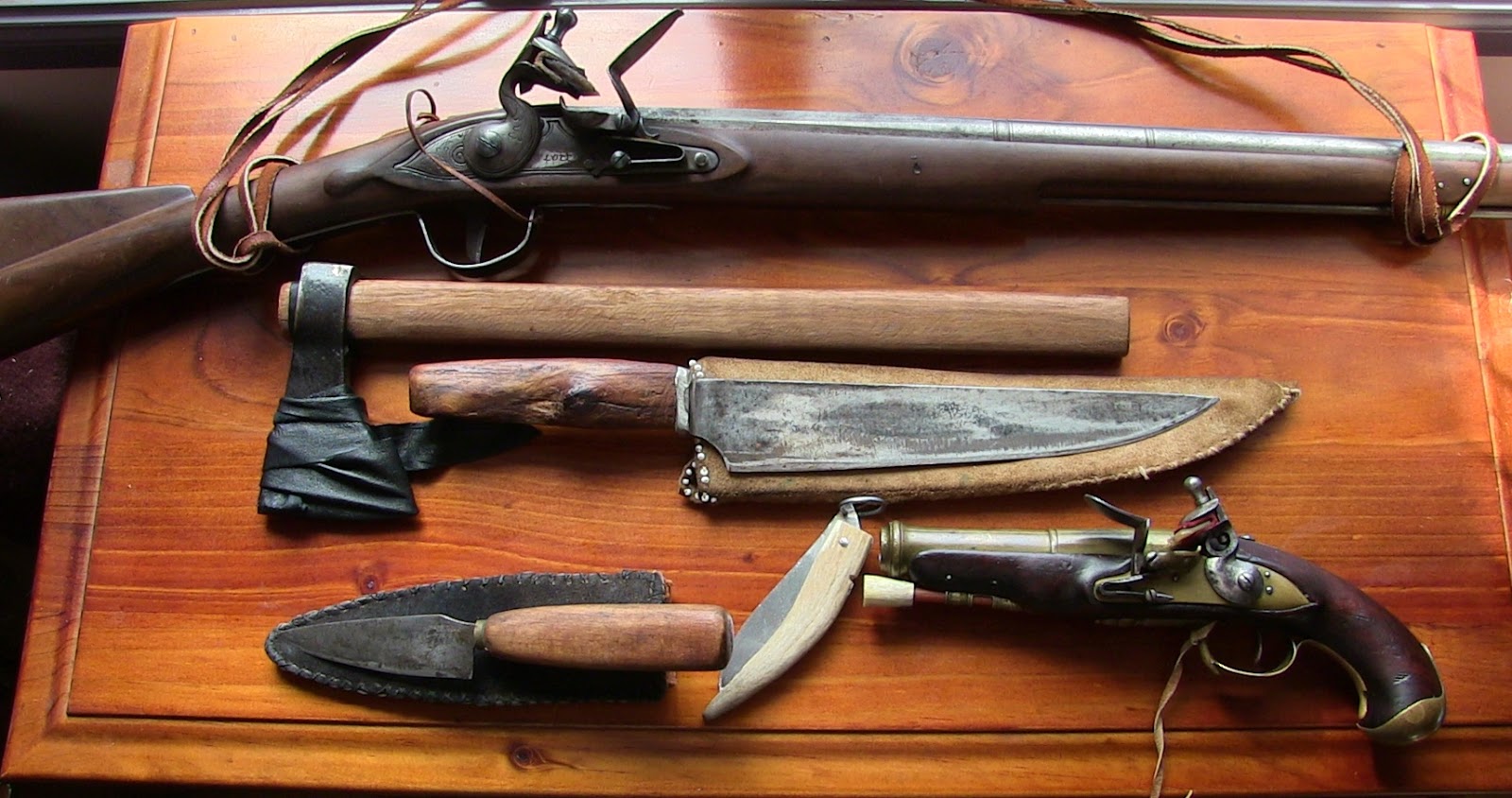
I have updated my equipment of late, I removed the pewter bolster from my hunting knife & fitted a new handle. This one as you can see is antler. Also shown is my fairly new clasp knife.
Keith.

Sunday, 24 February 2019

Blades Update.


I thought I had posted on this earlier, but a search came up blank! So here are some images of my blades including the new clasp knife I am now carrying.

Hunting knife.

Legging knife.

The clasp knife my eldest son gave me.

My tomahawk.


Wednesday, 28 November 2018

More Information on the Penny Knife.


I should have picked up on this information a long time ago when Willy contacted me saying that the penny knife looked just like a Trattenbach pocket knife. Somehow I missed Willy's post! Then recently I was contacted by Robert asking for more information on the Penny knife, I told Robert that I had no more information to give him. Then I get an email from Robert with this, to me anyway, astounding revelation that these penny knives were being made over 500 years ago in Austria, & they are still being made today! So my apologies to Willy for missing his post, & my thanks to Robert for the information he sent me that started a new line of research.
Here below then is what I have found so far:

Penny Knife Information.
Almost everyone knows the pocket faucet - a folding pocket knife with a turned wooden handle that fits in any trouser pocket and is used in a variety of ways, from jausen to mushroom picking. In 1422, the knife production in Trattenbach was first mentioned in documents, since 1682 it is considered an independent guild. One of the secrets to success was the hard, high-quality sharp steel used for the blades. The knives were exported to large parts of Europe and as far as Africa. Today two more factories produce the Trattenbacher pocket felts by hand. The knowledge about the history, production and use of the pocket fagot is still upheld today in Trattenbach:

The Trattenbach pocket knife, a foldable knife that consists of a blade and a lathed wooden handle, has been hand-produced in Trattenbach for nearly 600 years.
Since 1682, Trattenbach’s cutlers have been recognized as an independent guild. 
 The first written mention of knife-making there is from 1422. 


Monday, 30 October 2017

The Whetting Stone.


18th century whetstones Nottingham University Museum Photo Robin Aldworth.

The Whetting Stone.
Whet means sharp, so by definition if a blade has been sharpened, it has been whetted. If you are sharpening a blade, then you are whetting that blade.
Keith.

“The language surrounding so called oilstones is very misleading. First off, there’s no such thing as an “oilstone.” Long ago, these abrasive stones were simply called whetstones. “Whetting” was the period word for “sharpening” and it had nothing to do with applying liquid to a rock”. https://www.popularwoodworking.com/article/what-is-an-oilstone-2


whet
 (redirected from whetting)
Also found in: ThesaurusIdioms.
whet
  (wÄ•t, hwÄ•t)
tr.v. whet·ted, whet·ting, whets
1. To sharpen (a knife, for example); hone.
2. To make more keen; stimulate: The frying bacon whetted my appetite.
n.
Something that whets the appetite or desire.


[Middle English whetten, from Old English hwettan.]

18th century whetting and polishing machine.

Sunday, 3 September 2017

Australian Arms Auction.

Author's pistol and image.

There are some nice flintlocks & other arms in this catalogue. If I had not already got all I need, I would seriously be considering getting some of the items in this catalogue.
Remember, no licence required for antique flintlock firearms in NSW (elsewhere check you firearms regs).

Wednesday, 24 May 2017

Some Of My Equipment. Crusoe's Plunder.

I called this image "Crusoe's Plunder". I have always loved the thought of being able to collect anything & everything I wanted from a wrecked ship.

Tuesday, 20 September 2016

Blades & Gun Update.

A subscriber to my video channel (https://www.youtube.com/channel/UCHEOMSZJETfj3GnoyONuvCQ?view_as=public) said they would like a closer look at my knife, so I decided it was easier for me to post images of the blades & guns I carry here on my blog so it is there for future reference.


My .62 caliber/20 gauge flintlock fusil. 42 inch smoothbore barrel with a steel ramrod.

My .70 caliber smoothbore flintlock pistol.

My axe/tomahawk.

Hunting knife.

Legging knife.


Stag handle friction clasp knife.


Sunday, 18 September 2016

18th Century Colonial Spanish Dagger.


Spanish Colonial Dagger 18th century. Flamboyant blade with gold inlaid design including the letters "R.S." Excellent brass-mounted horn hilt with pommel in crown form. 14 7/8" overall, blade 9 1/2".

Friday, 29 April 2016

Blades from stone to steel.

French & Indian War era Penny knives.

Many good images at this site.

PLEASE NOTE: Patch knives are mentioned in this article, but to date I have found no evidence that patch knives per se existed. I think it more likely that these knives were utility knives, & some may have been used for cutting patch material.
Keith.

Tuesday, 5 January 2016

The Well Equipped Woodsrunner.

This post is just to encourage people to improve on their equipment when ever they have the opportunity. In our busy lives we can sometimes lose track of the things that are truly important to us, things that give us pleasure, and in some cases security. These things are worth spending time and money on when they are available.
Collecting things is fun, but be careful to distinguish between what you like to have in your possession and what you need to carry in your pack and on your person. There must be some compromise between minimum weight & maximum self-reliance.


The compass is probably not a necessity, but it can make life easier when moving in unknown territory. The angling tackle and flint and steel to me are a priority.

Knapsack equipped for a long stay in the woods, with the added market wallet, oilcloth secured under the flap closure, blanket roll containing extra clothing for winter use and spare moccasins. 


I very much doubt that woodsrunners carried much in the way of a medical kit, possibly some herbs. But I think that anyone who spends time away from home in the woods should carry a medical kit regardless. This kit of mine is very basic, but if I were travelling far long term, I would be packing a modern medical kit.

Shot pouch and contents. Make sure you have a ball mould & lead ladle for re moulding spent ball retrieved from shot game.


Patched ball was not commonly used in smoothbores, and at the rages in which I hunt I have no need for great accuracy, but I do carry two patched ball in a loading block for faster reloading if I should need it.

These tools, grease, spare flint leather and flints are carried in my shot pouch.

These spare lock parts and tools are carried in my knapsack.

Carrying a quality powder horn is essential, it does not have to be flash looking, but it does have to be serviceable. No leaks at spout plug or base plug, and the base plug should NEVER be glued. It should be sealed with beeswax only, and secured with metal pins.

One of three gunpowder bags that I can use to carry extra gunpowder should I need to. A lighter option than carrying extra powder horns. When empty I use this one to carry spare tinder for fire lighting.


Good blades are essential to wilderness living and survival. Choose wisely, only use them for their intended purpose and look after them.

Rifle or smoothbore long gun is your choice. Consider what type of game you are likely to be hunting, and the type of area you are likely to be hunting in. Also consider your capabilities regarding weight of the arm and your eyesight.


A good pistol for a back-up can be useful, and sometimes necessary. Choose a pistol that matches your longarm if you can, especially if it is a rifle. Other options are smoothbore pistols and you can carry shot. I carry a .62 caliber fusil, but my pistol is .70 caliber. However I can still use shot, and I can use a leather patched . 60 caliber ball in this pistol.
This is a left hand lock pistol, so I can carry it under my equipment belt on the right hand side. I am not left handed.


These two leather covered glass water flasks have proved to work very well. Not too heavy, and easy to accommodate in my pack and haversack.


I tend to alternate between carrying my kettle or my tin cup. The cup is obviously lighter, but the kettle holds more. I think that when travelling alone the tin cup suits my purpose better, & if I am in company, then someone else can carry the kettle!

I do carry other items such as soap, comb, whetstone, metal file, wooden spoon, awl, housewife sewing kit etc, but these are personal choices that some may not bother carrying.

The housewife sewing kit how ever does have other uses besides repairing clothing, shelter & packs. The needles are good for removing splinters and if necessary used to sew up a wound that can not be closed with a bandage.