A LIVING HISTORY BLOG.

18TH CENTURY LIVING HISTORY IN AUSTRALIA.
Showing posts with label fireworks. Show all posts

Tuesday, 29 March 2016

My Original 18th Century Fire Steel Update.


Some of you may remember that I acquired an original 18th century fire steel some time ago. I decided to add it to my equipment replacing the copy that I had been using. I found however that the original did not spark as well as the copy, so I re-hardened the steel in the fire. The results were no better, but I decided to keep it & use it anyway. If that was the way it was, then that is how I will use it.
I have seen in some videos copies of fire steels that shed an enormous amount of sparks as if they are coated with some radioactive material. There was such a product sold many years ago for coating the steel on a flintlock, but I think it was removed from sale!!!
Keith.

Friday, 2 March 2012

More On Flint and Steel Pouches.

Trying to find original images of pouches used for carrying flint and steel is an excercise in frustration! Plenty of contemporary artisans claim to have copied an original pouch, but they never show the original pouch or even give a link. I have to see it with my own eyes before I believe it; no documentation, no write up.

Obviously the tinderbox or seperate tinder, flint and steel were carried in something, some original quotes claim this equipment was carried, by some at least, in their shot pouch:

“Fire making is a simple process with the mountaineers. Their bullet pouches always contain a flint and steel, and sundry pieces of “punk”-a pithy substance found in dead pine trees-or tinder; and pulling a handful of dry grass, which they screw into a nest, they place the lighted punk in this, and closing the grass over it, wave it in the air, when it soon ignites, and readily kindles the dry sticks forming the foundation of a fire.”
Ruxton, 1848.

Frankly using a smoothbore myself, I have little room in my shot pouch for anything other than the tools I need to service my fusil.
I have yet to read anything in regards to keeping the tinder dry by wrapping in an oiled cloth or by placing in an oiled pouch as I do. After reading about Washington and Gist going off into the wilderness with only one "poor hatchet" between them, I am quite ready to believe that there were many woodsmen who simply did not think much about their safety or keeping their tinder dry!


“There was no Way for getting over but on a Raft, which we set about, with but one poor Hatcher, and got finished just after Sun setting, after a whole Day's Work; we got it launched, and on board of it, and set off; but before we were half Way over, we were jammed in the Ice in such a Manner that we expected every Moment our Raft to sink, and ourselves to perish: I put out my setting Pole to try to stop the Raft, that the Ice might pass by, when the Rapidity of the Stream threw it with so much Violence against the Pole, that it jirked me out into 10 Feet Water, but I fortunately saved myself by catching hold of one of the Raft Logs; notwithstanding all our Efforts we could not get the Raft to either Shore, but were obliged, as we were near an Island, to quit our Raft and make to it”. George Washington 18th century. Washington and Gist.
My greased leather fire bag which contains my tinderbox and some kindling grass. This is not a copy of an original, just my answere to keeping my tinder dry.

My belt pouch in which I carry my fire bag, fishing tackle tin and a brass sundial compass.

This was pouch was found on the Mary Rose.

16th Century.

16th century

17th century

Found in the above image.

17th century.

Found in the above image.
This is a mid 18th century belt pouch. Inside the pouch was found a powder measure, vent pick, and a fire steel. It is thought that this is a shot pouch, but of course it could have had another use.

Any belt pouch could be used for carrying items for making fire, the belt pouch took the place of pockets in a time when pockets were few and non existant on some clothing items. Providing you use period materials, and create a pouch of the type that was available in your time period, then this would be an authenticated item to use for carrying your tinderbox.

"and with a girdle of their making, bound round about their middles, to which girdle is fastned a bagg, in which his instruments be, with which hee can strike fire upon any occasion"
Thomas Morton: Manners and Customs of the Indians, 1637
Thomas Morton 1579-1647


Sunday, 12 February 2012

Part Three. A Closer Look At Flint & Steel Fire Lighting.

What do I do if my tinder is damp or wet?

Well there are several things you can do, but the best advice I can give is don't let it get wet in the first place, and always carry extra spare tinder in your pack.

1)You can dry it in the sun, or you can put some in the fork of a low twig in a tree and let the breeze dry it.
2)You can use a sewing needle to pin it to a tree so it will dry in the sun and or breeze.
3)If it is raining place some tinder inside your frock so it will dry on the material and from your body heat.
4) sprinkle some gunpowder on the tinder and strike sparks on that (keep hands and face clear of upward flash!).

What can I do if there is no dry kindling to start a fire?

1) There usually is dry kindling to find if you know where to look and know what you are looking for. Dry leaves, grass and twigs can often be found under fallen trees and even in hollow trees. DO NOT dismiss single leaves or strands of dry grass. Collect everything and keep it dry.
2) Check dead branches still on the tree. These often dry first in the wind oir breeze. Some may even have the dead leaves still attached.
3) Always carry a candle with you which you can light from your tinderbox by dripping the wax on to the smouldering tinder and blow into flame. This lit candle can then be placed underneath damp kindling twigs so they will dry out and take fire.

This is my greased lether fire bag. In this I keep some small amount of dry kindling grass and twigs, a candle stub, and my tinderbox.

I carry my fire bag inside my greased leather belt pouch. The fire steel is tied to the buckle so it cannot become mislaid or lost.

This is another type of fire bag carried seperately on a strap over the shoulder. It is made of leather and is greased, but it will admit water if it is submerged. Note the candle that is carried in this bag, and again, the steel is tied to the bag.

This is one of three gunpowder wallets or bags that I own. At least one is always carried in my knapsack. When this greased wallet is empty of gunpowder, I use it to contain spare tinder (This is documented).

   takes fire readily from the spark of a steel: but it is much improved by being kept dry in a bag that has contained gunpowder.”
Samuel Hearne, Northern Canada, 1772
 “Fierce winds and blowing snow reduced the men to huddling among large rocks, unable even to start a fire.”
Samuel Hearne, Canada, 1770.

“This induced me to resolve not to travel more by land without my gun, powder and shot, steel, spunge  (punk wood) and flint, for striking a fire…”
Patrick Campbell, 1792.

I am having trouble getting the sparks to hit the tinder.

1) Make sure you are striking the steel a downward blow with the flint, NOT striking the flint with the steel.
2) The sparks come from the steel, not from the flint.
3) Make sure you are not holding the steel too high above the tinderbox. If you are having trouble hitting the tinderbox with your hand, then you need more practice and more control. 

Saturday, 26 March 2011

A little more on Otzi The Ice Man and his Fireworks.

I can't help feeling that the Otzi site may have been contaminated, or, people did not know at the time what they were looking for. I wish I could see the site for myself. One news item sais that pyrite was found, but this appears not to be true. Pyrite particles were found suggesting that Otzi may have used flint & pyrite to make fire.
Here are some notes I made recently:
The Ice Man Otzi.


Fire kit contained:


• Pyrite.(particles found on fungus, but no actual rock was found)


• Flint


• Tinder fungus (Fomes Fomentarius & Piptoporus)

• Bark container blackened inside. Contained charcoal and birch leaves(carrying fire)


• Moss
The moss was said to be used for carrying food.
Question: Why would he carry food in moss? Is it more likely that the moss was kindling for making fire?


Question: Could two flints have been used?
Flints too small.

The charcoal in the green leaves suggested to scientists that Otzi was carrying fire. But normally this is done by burying live coals/embers in ash to keep them alive. Just like banking a fire for the night. The ash and the embers would indeed be carried in a bark container.
Question: Could this charcoal have been in fact pieces of charred punk wood intended for use as tinder?
The fire-bag/fireworks does not look very big, but then it has been under the ice for a long time & size is difficult to tell under such conditions. To use pyrite & flint you need a decent chunk of both, something to hang on to whilst striking.
I think the scenarios for why Otzi was where he was are important, because at present it looks as though he was quite unprepared. When I am travelling I collect kindling as I go along & as chance presents itself. If Otzi knew that he would be camping in a place where wood & kindling was not available, he would have taken it with him.
Question: Was the site contaminated? Was there other items to be found that people missed?
I get the feeling that these scientists, though obviously very knowledgable, may not know enough about individual primitive skills.
Question: Was the fungus for medical use as they suggest, or was it simply spare tinder such as I carry in my pack? 
I think that unless someone goes back to the Otzi site and searches further, we may never have all the answers.

Remnants of Otzi's fire bag.


Piptoporus Betulinas.

Amadou.

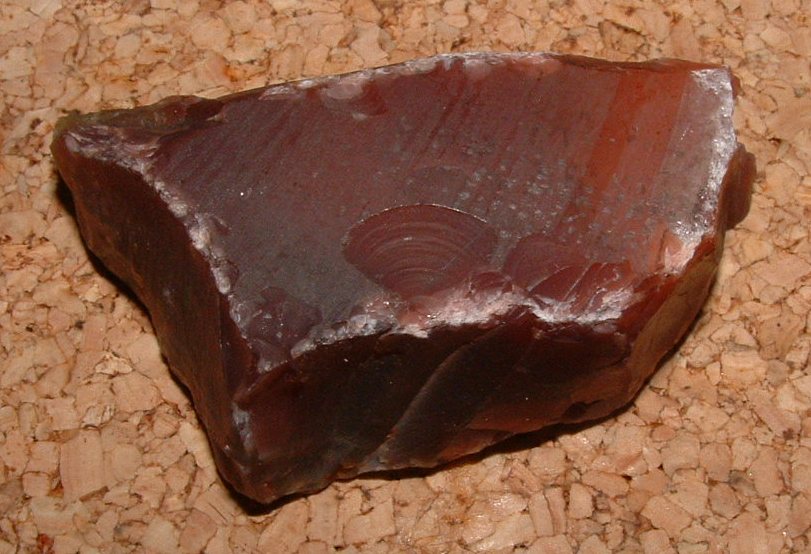
Flint nodules I collected in England.

Agate.

Two flint nodules like those above will create sparks if struck together, as will agate struck against flint, but the spark only occurs at the point of contact, it does not throw or project the sparks.

Tuesday, 1 February 2011

Life in the woods.


In the woods we were under some disadvantage, having no fire-works nor bells for our horses, but we stopped a little before night and let them feed on the wild grass, which was plentiful, in the mean time cutting with our knives a store against night. We then secured our horses, and gathering some bushes under an oak we lay down; but the mosquitoes being numerous and the ground damp I slept but little.

Journal of John Woolman. 1720-1742.

Either they did not know how to use the locks on their guns to make fire, or they had no guns!

Saturday, 5 June 2010

Leather Pouches or Bags.

I have several leather pouches made to contain different materials. Drawstring pouches are good for any items that do not have to be kept dry. The closure on a drawstring pouch will not keep water out.
The easiest way to make a waterproof leather bag is to gather, fold and tie the top of the bag, or roll the top of the bag and of course grease it.


This drawstring fire-bag will work fine, so long as water can not get into the top. If submerged in water by a fall in the creek or the boat gets swamped, then the contents will get wet.


This fire-bag when the top is rolled down becomes half the size, and it will keep water out.


This gunpowder bag top has been gathered, folded over and then tied. Whether it contains gunpowder or spare tinder, it is important that no water gets inside. Food bags can be made and secured in the same fashion.