Research and
Primary Documentation.
In our search
for historical information, we must be careful not to become too narrow
focused. Whilst it is true that we need to find out what a particular character
used and wore, we must not discard the possibility that this character, this
persona, could have used and wore other items that are not documented in the
written word or in period paintings.
One of the least
documented characters in the 18th century is the woodsman. A woodsman is a
woodsrunner, a person who is knowledgeable in woods lore. A woodman on the
other hand is a wood cutter, a totally different persona all together. I have
not as yet come across a painting, sketch or etching of an English or colonial
woodsman, so the best we can do is use common sense and combine that with
written documentation.
People are
continually getting confused between the difference in what was fashion and
what was common dress. The city and town gentleman or lady may well have been
concerned with fashion, but a woodsman or woods woman was not concerned with
social graces and fashion, they were concerned with survival, comfort to a
certain degree, and practicality. They
did not sit round the camp fire and judge others by their dress, though they
may on occasion expressed an interest in certain articles of dress and
equipment belonging to others, and in some circumstances given advice on the
practicality of certain items.
What we need to
do is establish what items of dress and equipment were available in our chosen
time period. Then we need to establish the practicality, or the lack of
practicality in using such an item. Just because we have not read that a
certain item was used, or have not seen a period painting of a woodsman using a
certain item, it does not mean that this particular item was not used. If an item
was commonly available, then it could have been used by anyone who considered
that item to have been of practical use to themselves.
Two examples of
this way of thinking come immediately to mind, the use of an oilcloth for
shelter, and the use of a belt pouch that in the 18th century was no longer
considered a fashionable item. The use of the oilcloth by traders and military
is well documented, yet some people still refuse to use it because they are
neither trades people or military. The same applies with the use of the belt
pouch. It too is well documented in paintings, sketches and etchings so we know
the belt pouch was available and being used as a practical item of wear for
carrying items that were not carried in pockets.
“The town
has increased one-third since the year 1745; at that time there was not a
single manufacture: the inhabitants either lived by one another, or by the
hiring out of ships, or by the salmon trade. At present the manufactures have
risen to a great pitch: for example, that of sailcloth, or ‘sailduck,’
as it is here called, is very considerable; in one house, eighty-two thousand
five hundred and sixty-six pieces have been made since 1755. Each piece is
thirty-eight yards long, and numbered from eight to one. No. eight weighs
twenty-four pounds, and every piece, down to no. one, gains three pounds in the
piece. The thread for this cloth is spun here, not by common wheel, but by the
hands. Women are employed, who have the flax placed round their wastes, twist a
thread with each hand as they recede from a wheel, turned by a boy at the end
of a great room.”
The men were so harassed and fatigued with continually
sitting and
lying on the ground, all huddled in a small compass,
that three days
before the convention took place, they complained to
the Captain who
commanded, that they were not permitted to fire on the
enemy, whereby
they could obtain more ease, and therefore ought to be
relieved, and
they received for an answer, when night came on it
should be mentioned
to the General. The Captain desired me to go to
head-quarters, and
when I arrived there, I found they partook of the
hardships in common,
for the three Generals had just laid down on their
matrasses, having
only an oil-skin to cover them from the weather; the
Aid-de Camps were
sitting round a fire. ..."
Anburey, 2, p. 8-9.
Anburey, Thomas; "Travels Through the Interior
Parts of America in a
Series of Letters by an Officer." 2 Vols. London,
1789. Houghton
Mifflin, NY 1923, Reprint, New York Times and Arno
Press, 1969.
, upon a baggage-cart, and nothing to
shelter her from the inclemency of the weather but a
bit of an old
oil-cloth, a soldier's wife was delivered of child,
she and the infant
are
both well, and are now at this place.
The Calendar and Quartermaster Books of General George
Rogers Clark's
Fort
Jefferson, Kentucky, 1780
Stores issued by order of Captain Robert George: to
Mr. Miles,
quartermaster Sergeant, one musket or smoothed gun; to
Captain Rogers
going to the Falls of Ohio, two muskets or smoothed
guns and five tents
or
oil cloths (VSA-50: 39)
"This morning an account was bro't to town, that
a large army of French
and Indians were seen at a small distance from the
German flats, but few
here believe it. Sir William Johnson is still in
readiness, with 1500 of
the militia. Every man in the French army that came
against Fort William
Henry, was equipped in the following manner, viz. With
two pair of
Indian shoes, 2 pair of stockings, 1 pair of
spatterdashes, 1 pair of
breeches, 2 jackets, 1 large over-coat, 2 shirts, 2
caps, 1 hat, 1 pair
of mittens, 1 tomahawk, 2 pocket-knives, 1 scalping
knife, 1 steel and
flint, every two men an ax, and every four a kettle
and oilcloth for a
tent, with one blanket and a bearskin, and 12 days
provision of pork and
bread; all which they drew on little
hand-sleighs."
Extract of a letter from Albany, dated April 2, 1757
printed in the
Boston Gazette, April 18, 1757.}
"...tarpaulins
for covering the provisions and oilcloths to cover the gunpowder."
~ Antoine Laumet de Lamothe Cadillac, Memorial to the Council, 1719 (Kent 2001, 71 )
~ Antoine Laumet de Lamothe Cadillac, Memorial to the Council, 1719 (Kent 2001, 71 )
"They
name prelat a large and heavy cloth, oil-painted in red, to keep oneself from the rain." Louis
Franquet, French Military Engineer, 1752 (Delisle, 17 )
"1
Oilcloth for every 4 men for tentage..."
~ Anonymous list of supplies for French Army in Canada, 1756 (Delisle, 42)
~ Anonymous list of supplies for French Army in Canada, 1756 (Delisle, 42)
“…I made a Lodge with an oilcloth near the small Lac de la puise on the portage.”
~ Jean Baptiste Perrault, Minnesota, 1784 (Perrault, 521 )


This street vendor is wearing two belt pouches.
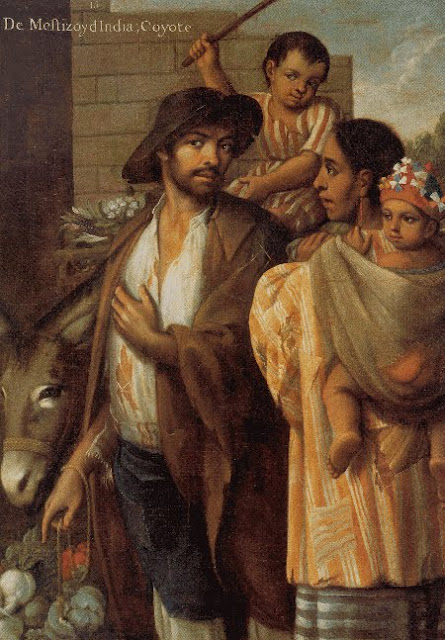


All of these images date to the early to mid 18th century.


