Showing posts with label Free Trappers. Show all posts
Showing posts with label Free Trappers. Show all posts
Sunday, 1 November 2015


Sunday, 10 May 2015

Saturday, 22 September 2012
The Fur Trade.
The Economic History of the Fur Trade:
1670 to 1870
Ann M. Carlos, University of Colorado
Frank D. Lewis, Queen's University
Frank D. Lewis, Queen's University
Introduction
A commercial fur trade in North America grew out of the early
contact between Indians and European fisherman who were netting cod on the
Grand Banks off Newfoundland and on the Bay of Gaspé near Quebec. Indians would
trade the pelts of small animals, such as mink, for knives and other iron-based
products, or for textiles. Exchange at first was haphazard and it was only in
the late sixteenth century, when the wearing of beaver hats became fashionable,
that firms were established who dealt exclusively in furs. High quality pelts
are available only where winters are severe, so the trade took place
predominantly in the regions we now know as Canada, although some activity took
place further south along the Mississippi River and in the Rocky Mountains.
There was also a market in deer skins that predominated in the Appalachians.
The first firms to participate in the fur trade were French, and under
French rule the trade spread along the St. Lawrence and Ottawa Rivers, and down
the Mississippi. In the seventeenth century, following the Dutch, the English
developed a trade through Albany. Then in 1670, a charter was granted by the
British crown to the Hudson's Bay Company, which began operating from posts
along the coast of Hudson Bay (see Figure 1). For roughly the next hundred
years, this northern region saw competition of varying intensity between the
French and the English. With the conquest of New France in 1763, the French
trade shifted to Scottish merchants operating out of Montreal.
After the negotiation the of
Jay's Treaty (1794), the northern border was defined and trade along the
Mississippi passed to the American Fur Company under John Jacob Astor. In 1821,
the northern participants merged under name of the Hudson's Bay Company,
and for many decades this merged company continued to trade in furs. Finally,
in the 1990s, under pressure from animal rights groups, the Hudson's Bay
Company, which in the twentieth century had become a large Canadian retailer,
ended the fur component of its operation.
The fur trade was based on pelts destined either for the luxury
clothing market or for the felting industries, of which hatting was the most
important. This was a transatlantic trade. The animals were trapped and
exchanged for goods in North America, and the pelts were transported to Europe
for processing and final sale. As a result, forces operating on the demand side
of the market in Europe and on the supply side in North America determined
prices and volumes; while intermediaries, who linked the two geographically
separated areas, determined how the trade was conducted.

The Fur Trader By John Buxton.
Sunday, 1 July 2012

Thursday, 10 May 2012
The Mountain Men. A Documentary Video.
This time period is a little late for me, but it is still interesting. In truth the Mountain Man period or its hey day as far as the Rendezvous is conserned, only lasted 25 years, from 1825 to 1840 ad.
WARNING! Much of the information in this video is pure fiction. I have no idea when this video was made, but much of the information is outdated research wise. I knew more than this 20 years ago, and I can offer no explanation for the misinformation in this documentary.
WARNING! Much of the information in this video is pure fiction. I have no idea when this video was made, but much of the information is outdated research wise. I knew more than this 20 years ago, and I can offer no explanation for the misinformation in this documentary.
Friday, 10 February 2012
18th Century Brass Wire Snares. For Living History & Survival.
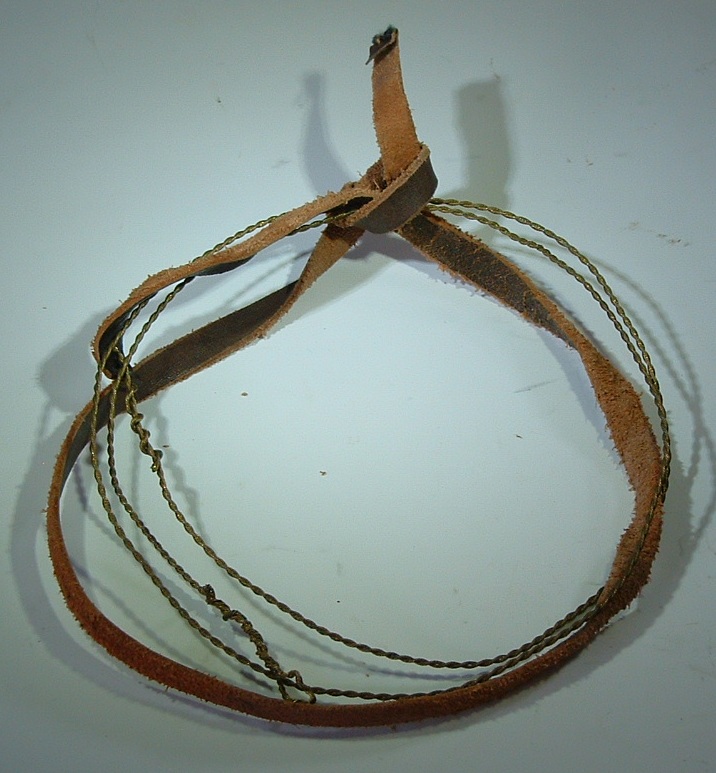
1 ¼ pounds of iron and brass wire, both thick and thin.
Ft Pontchartrain 1747.
http://www.timothyjkent.com/pontchartrainexcerpts.htm
Let the young trapper supply himself with a small, sharp hatchet, and a stout, keen edged jack-knife,—these being the only tools required. He should also provide himself with a coil of fine brass "sucker wire," or a quantity of horse-hair nooses (which will be described further on), a small ball of tough twine and a pocket full of bait, such as apples, corn, oats and the like, of course depending upon the game he intends to trap. With these, his requirements are complete, and he has the material for a score of capital snares, which will do him much excellent service if properly constructed.
CAMP LIFE IN THE WOODS AND THE TRICKS OF TRAPPING AND TRAP MAKING.
By W. HAMILTON GIBSON. Gutenberg Files.
“made earrings from brass snare wire……..”
Henry the Younger 2:514-517, 532. http://www.northwestjournal.ca/XIII2.htm
Brass wire was sometimes used for snaring and capturing animals.
http://cmich.edu/documents/Museum/Forms_and_Guides/Fur%20Trade.pdf


Using snares was a common trapping method with Eastern woodland Indians. Using the correct size of snare they could trap any size of game from quale up to deer. Cordage, raw hide & sinew snares were used, but brass snare wire obtained through trade was also used.

Original brass wire snare.
Not earlier than 1750
Not later than 1837 Minnesota Historical Society. MHS Library Catalog
http://collections.mnhs.org/cms/display.php?keywords=fur+trade&startat=61&irn=10295819Not later than 1837 Minnesota Historical Society. MHS Library Catalog
Wire, brass, 24-32 ga. [fine], snare
http://www.northwestjournal.ca/X2.htmWire of all sizes was common; much of it was likely used
for snares, but this cannot be corroborated.
http://pubs.aina.ucalgary.ca/arctic/Arctic42-2-109.pdf
The English Hare Pipe. Only one snare line, from anchoring stake through the pipe, formes a loop, then back into the pipe and secured at the other end of the pipe on a peg. The more the hare pulled, the more the points on the end of the pipe stuck in.
A more humane version could easily be made with a piece of plain pipe with no points. This would also stop the snare from strangling the hare/rabbit. Oridinary brass wire snares do not strangle either, but neck snares have been banned in NSW because of the modern snares using a lock! Another case of the government simply either not caring, or not knowing what they are talking about!
In my opinion ordinary snares are far more humane that 1080 poison which is what the government recommends! You can't of course use the meat from a poisoned animal. This 1080 is also responsible for the killing of many native animals.
Poachers in England would have used snares and hare pipes, so many who travelled to the New World were not devoid of survival skills. They were already good woodsmen and hunters.
Hunting was largely performed with a bow, although snares and pit traps were sometimes used. Wood described deer traps in Massachusetts “which are springes made of young trees, and smoote wrought coards; so strong as it will tosse a horse if hee be caught in it”.
Archaeology of the Puncheon Run Site (7K-C-51) Volume II: Technical Appendices
http://www.deldot.gov/archaeology/puncheon_run/pdf/august2005/VOL2-2005-PDF/D_Volume%20II%20PDF.pdf
Tuesday, 11 October 2011

Friday, 20 May 2011
Volume 31, Southern Cross Free Trappers News Letter Link.
http://freetrappers.org.au/2011/05/20/vol-31-may-2011/
The Southern Cross Free Trappers are based in Victoria.


The Southern Cross Free Trappers are based in Victoria.


Friday, 1 April 2011
Southern Cross Free Trappers Newsletter.
http://freetrappers.org.au/2011/04/01/vol-30-april-2011/

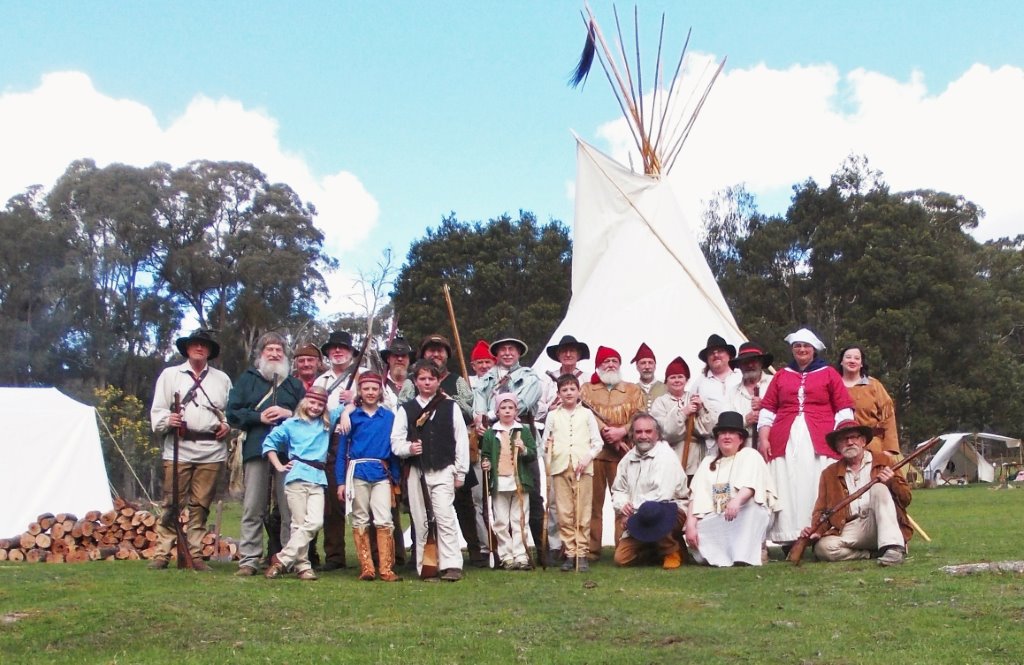
This is of course one of our Australian groups. The Southern Cross Free Trappers welcome new members with an interest in colonial living from the late 17th century to the mid 19th century. So if you have an interest in this period, I suggest you check this group out. They are a great bunch to sit around the camp fire with.

This is of course one of our Australian groups. The Southern Cross Free Trappers welcome new members with an interest in colonial living from the late 17th century to the mid 19th century. So if you have an interest in this period, I suggest you check this group out. They are a great bunch to sit around the camp fire with.
Tuesday, 21 December 2010
Interpreting The Rocky Mountain Fur Trapper 1825-1840.
Rocky Mountain Fur Trappers 1825-1840.
This is just a short article on the Mountain Men of the far west. This is not within my period, but the recreating of the Mountain Man life is a popular interpretation, and I think it requires some clarifying.
Firstly the fur trade Rendezvous only lasted 15 years, from 1825 to 1840. This was the hay day of the beaver trade, and this trade dropped off after silk top hats became the fashion and beaver fur was not so popular. Fur prices dropped, and it was no longer viable for fur trade companies to travel to the far west to trade for furs.
Facts about Mountain Man interpretation:
• You will need at least two horses or a horse and a mule or two mules. Rocky mountain fur trappers did NOT travel on foot unless they lost their horses.
• The western Mountain Man did NOT use a percussion gun, he used a flintlock. The flintlock was far more reliable and the percussion caps were hard to come by. If the caps got damp, they were no longer of any use.
• From what I have read the Mountain Men preferred linen and wool clothing when they could get it. When they started trapping they were dressed much the same as the eastern woodsman. The frock that the woodsman wore was still in use during the mid 19th century and with frocking added it was still in use in the mid 20th century. Leather clothing apparently was worn when other clothing wore out.
• The Mountain Man used steel traps to catch the beaver, this is one of the reasons he needed horses, to carry the traps and the furs.
• The western Mountain Man existed to trap beaver and collect other furs as the opportunity was offered. He was not there to roam as he pleased without working. He may have loved the wilderness, but he could only stay there providing he trapped beaver and was able to trade that beaver.
• Links to information:
• http://www.thefurtrapper.com/rendezvous_sites.htm
• http://books.google.com.au/books?id=xv5ivm13_0oC&pg=PA136&lpg=PA136&dq=clothing+of+the+rocky+mountain+fur+trapper&source=bl&ots=WRlEkiFf4K&sig=J67AUwpCeSQArlrJ1CXWVHYK4KM&hl=en&ei=cGAQTaeEOoiurAejxoW7Cw&sa=X&oi=book_result&ct=result&resnum=7&ved=0CEwQ6AEwBg#v=onepage&q&f=false
• http://books.google.com.au/books?id=0oiXpquwRA4C&pg=PA116&lpg=PA116&dq=clothing+of+the+rocky+mountain+fur+trapper&source=bl&ots=bhxljyAaKk&sig=4ry_BY8-UEjloAILMP_6T0P5jHQ&hl=en&ei=cGAQTaeEOoiurAejxoW7Cw&sa=X&oi=book_result&ct=result&resnum=10&ved=0CF4Q6AEwCQ#v=onepage&q&f=false
• http://www.xmission.com/~drudy/amm.html
• http://xroads.virginia.edu/~hyper/HNS/Mtmen/home.html
• "A Trappers equipment in such cases is generally one Animal upon which is placed...a riding Saddle and bridle a sack containing six Beaver traps a blanket with an extra pair of Moccasins his powder horn and bullet pouch with a belt to which is attached a butcher Knife a small wooden box containing bait for Beaver a Tobacco sack with a pipe and implements for making fire with sometimes a hatchet fastened to the Pommel of his saddle his personal dress is a flannel or cotton shirt (if he is fortunate to obtain one, if not Antelope skin answers the purpose of over and under shirt) a pair of leather breeches with Blanket or smoked Buffalo skin, leggings, a coat made of Blanket or Buffalo robe a hat or Cap of wool, Buffalo or Otter skin his hose are pieces of Blanket lapped round his feet which are covered with a pair of Moccasins made of Dressed Deer Elk or Buffaloe skins with his long hair falling loosely over his shoulders complete the uniform."
Osbourne Russel.

Bridger.

Baker.
By Osborne Russel.
Saturday, 10 April 2010
Tuesday, 3 March 2009
THE SOUTHERN CROSS FREE TRAPPERS of Victoria.

The Southern Cross Free Trappers are a pre 1840ad Living History group based in Victoria. They hold regular meetings and muzzle-loading shoots and attend RENDEZVOUS. You can choose any period lifestyle you wish to re-enact, and any charracter/persona from that period that you may wish to emulate. Pre 1840 living history is a lot of fun, and the Souther Cross Free Trappers are very family oriented. If you Live in Victoria or close by, and think you may be interested, contact the Southern Cross Free Trappers and arrange a visit to see for yourself who they are, and what it is they do. These chaps are a really friendly bunch and will be glad to show you around and help get you started in this great activity.
You will find the Southern Cross Free Trappers contact icon on this Blog. Just click on it to go to their main page.
Subscribe to:
Posts (Atom)