Showing posts with label frock. Show all posts
Showing posts with label frock. Show all posts
Sunday, 26 November 2017


Friday, 9 May 2014
Seaman's Slops. Museum Of London.
According to the museum of London this style of clothing was worn by seamen from the 16th century (1500s) into the 18th century (1700s).


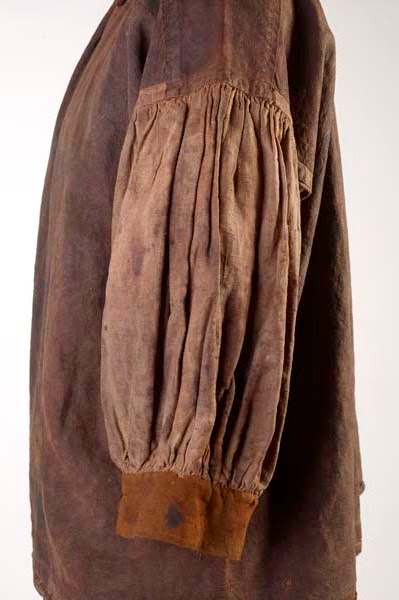


Front
Back.
Notice the pattern on the main body of the frock. This is apparently made from Lindsey Wolsey, a mix of linen & wool.
http://collections.museumoflondon.org.uk/Online/object.aspx?objectID=object-83031&rows=1&start=2&sort=summaryTitle%20asc;
Monday, 31 March 2014

Thursday, 1 August 2013
Sunday, 20 January 2013
Thoughts on Wearing a Shirt.

This could be a shirt or a frock, depending on the weight of the material used. Frocks were generally made using a heavier material than was used for making an undershirt. This one appears to be buttoned at the neck, so it is more than likely a shirt and not a frock.

This claims to be a mid 18th century French undershirt, but it also claims to be made of a heavy flax linen. This is therefore in my opinion in fact a French froc/frock. Also note the linen ties at the neck.

An 18th century bricklayer wearing a long sleeved weskit over a shirt.

A French peasant working in the fields. Note his undershirt is worn inside his breeches.

Again, no waistcoat for this peasant field worker, but his shirt is worn inside his breeches.

These two soap makers are wearing frocks.

This is a Dutch postman wearing a frock.

An Italian butcher wearing a frock.

A field worker in Brussels wearing a frock.

I think we can safely assume that these living historians interpreting French milice at Bedford Village are in fact either wearing breeches and frock, or they are wearing breechclout and shirt or frock.
Bedford Villiage- La Milice de la Belle Riviere 2009
Wednesday, 16 January 2013
The Man's Work Frock in New France Part Two.
Seeing as I have still been unable to prove that the man's work froc was worn/used in nouvelle France, perhaps I should have titled this post "Un French Froc". I guess these posts are to prove that the froc/frock did indeed exist in France, and that what one sees in paintings is NOT an undershirt being worn as outerwear, as has been suggested to me. So here are some more images. Some are 17th century, others 19th century, but I think we can safely assume that if they existed in these two time periods, then they also existed in the 18th century.


By Le Nain. 17th century.

19th century engraving of a French peasant. Note the wooden clogs.

French peasants 1859. By Hermogenes Calderon .

By one of the Le Nain brothers, 17th century.

French peasants dancing outside an inn. By David Tenniers 1649.

Detail from the above painting.
Saturday, 12 January 2013
The Man's Work Frock in New France. Part One.
Recently on another forum the use of the common work frock in New France has been questioned. This has mainly come about it seems because these French living historians had not actually ever heard of the work frock being in existance. So I have sort of opened a can of worms!
Okay, I can't at this stage in my research prove that the French work frock was used in New France, but it seems to me that if all other French clothing was taken to New France, why would the man's work frock be an exception? All I can do at this present time is show what I have for the use of the frock in France, but my research goes on.


Okay, I can't at this stage in my research prove that the French work frock was used in New France, but it seems to me that if all other French clothing was taken to New France, why would the man's work frock be an exception? All I can do at this present time is show what I have for the use of the frock in France, but my research goes on.

18th century French peasants by artist George S. Stuart.
When I first saw this exhibit I wondered about the frock having no collar and no cuffs. Obviously the cuffs could have been there originally but are now missing from wear and tear. The collar could be the same, though I have seen a common French undershirt with no collar as in this next image.

© © National Gallery, London / Art Resource;
As you can see, this common shirt does not appear to have a stand-up collar.

http://pinterest.com/textiletrunk/antique-vintage-french-fabric-and-textiles/;
This French frock looks very much like the one in the exhibit at the top of this page. No buttoned cuffs, and no stand-up collar.

A French baker. 18th century.
The next eight images of French workers wearing the frock are from Diderot's Encyclopedia.


Monday, 7 January 2013
Shirt/Frock Pattern.
The common shirt type frock is made from the same pattern as the common shirt, except that the frock is made a little longer, and usually from a slightly heavier material.


As you can see, the collar shape varied with the maker.
Shirt pattern shown here from: Tidings from the 18th Century By Beth Gilgun. This is a good book with more clothing patterns and information on a variety of 18th century items.


As you can see, the collar shape varied with the maker.
Shirt pattern shown here from: Tidings from the 18th Century By Beth Gilgun. This is a good book with more clothing patterns and information on a variety of 18th century items.
Subscribe to:
Posts (Atom)