A LIVING HISTORY BLOG.

18TH CENTURY LIVING HISTORY IN AUSTRALIA.
Showing posts with label Italy. Show all posts

Sunday, 12 March 2017

Production of Sulphur in the 18th Century.


Sulphur was obtained in a variety of ways during the 18th century. Sulphur could be mined, it could be found on the surface having been deposited there from sulphur springs or from gasses escaping from deep in the earth. Sulphur was produced in England, America & overseas in Asia & Europe.

Sulphur springs in Yellowstone Park America.

Sulphur mine in England.
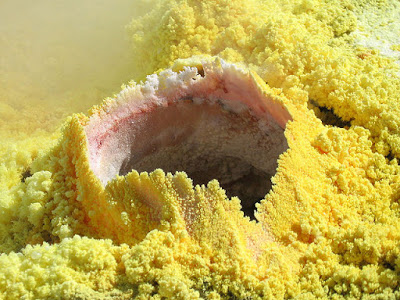
Sulfur found naturally on the ground from the island of Vulcano in Italy.

Mined sulphur in rock form.

Sulphur.
Spelling and etymology
Sulfur is derived from the Latin word sulpur, which was Hellenized to sulphur. The spelling sulfur appears toward the end of the Classical period. (The true Greek word for sulfur, θεῖον, is the source of the international chemical prefix thio-.) In 12th-century Anglo-French, it was sulfre; in the 14th century the Latin ph was restored, for sulphre; and by the 15th century the full Latin spelling was restored, for sulfur, sulphur. The parallel f~ph spellings continued in Britain until the 19th century, when the word was standardized as sulphur.[7] Sulfur was the form chosen in the United States, whereas Canada uses both. The IUPAC adopted the spelling sulfur in 1990, as did the Nomenclature Committee of the Royal Society of Chemistry in 1992, restoring the spelling sulfur to Britain.[8] Oxford Dictionaries note that "in chemistry and other technical uses … the -f- spelling is now the standard form for this and related words in British as well as US contexts, and is increasingly used in general contexts as well."[9]


Wednesday, 27 February 2013

More Clasp Knives.

Unfortunately there is no date on this one, but it appears to be a lock knife.


Blade markings: WHITBY  MADE IN ITALY.


 Two seaman's clasp knives with integral suspension rings and marlin spike. Marked 18th century, but I would guess early to mid 18th century.  
Another suspension ring clasp knife marked 18th century. This one has a wood handle.

This one is of unknown origin. All metal. My guess would be another seaman's knife looking at the fish tail. Also of course a suspension ring type.

Sunday, 20 January 2013

Thoughts on Wearing a Shirt.

It appears that some people think that the common shirt can be worn outside of the breeches. Now it has always been my understanding that the shirt was only worn out when wearing a breechclout. Further, it is my understanding that the undershirt was usually worn under other clothing, such as a waistcoat/weskit, jacket or  frock. There were acceptions of course, when men were working hard outside in summer they were known to remove outer clothing and work in shirt sleeves, but I have yet to see documentation that sais the shirt was deliberately pulled out of the breeches. The common shirt was in fact made very long, so that it could be tucked between the man's legs, & was in fact underwear.


This could be a shirt or a frock, depending on the weight of the material used. Frocks were generally made using a heavier material than was used for making an undershirt. This one appears to be buttoned at the neck, so it is more than likely a shirt and not a frock.

This claims to be a mid 18th century French undershirt, but it also claims to be made of a heavy flax linen. This is therefore in my opinion in fact a French froc/frock. Also note the linen ties at the neck. 

An 18th century bricklayer wearing a long sleeved weskit over a shirt.

A French peasant working in the fields. Note his undershirt is worn inside his breeches.

Again, no waistcoat for this peasant field worker, but his shirt is worn inside his breeches.

These two soap makers are wearing frocks.

This is a Dutch postman wearing a frock.

An Italian butcher wearing a frock.

A field worker in Brussels wearing a frock.

I think we can safely assume that these living historians interpreting French milice at Bedford Village are in fact either wearing breeches and frock, or they are wearing breechclout and shirt or frock.

Bedford Villiage- La Milice de la Belle Riviere 2009 


Tuesday, 8 May 2012

Pepys Diary.

Saturday 8 May 1669

"Up, and to the Office, and there comes Lead to me, and at last my vizards are done, and glasses got to put in and out, as I will; and I think I have brought it to the utmost, both for easiness of using and benefit, that I can; and so I paid him 15s. for what he hath done now last, in the finishing them, and they, I hope, will do me a great deal of ease".
Pepys at this time was having a great deal of trouble with his eyes, and bright light gave him discomfort.


This is an original Visard or Vizard mask, once covered with silk on the inside and velvet on the outside. To thype of mask, Pepys had tubes fitted into the eye sockets so as to cut out anu outside light and only allow him to see the page he was reading or writing.

These masks were common wear for women in the 16th and 17th centuries and similar masks were I believe used by men and women in public, in the 18th century in Italy.