A LIVING HISTORY BLOG.

18TH CENTURY LIVING HISTORY IN AUSTRALIA.
Showing posts with label powder horn. Show all posts

Monday, 16 May 2016

When Making Fire-Safety.

By Robert Griffing.


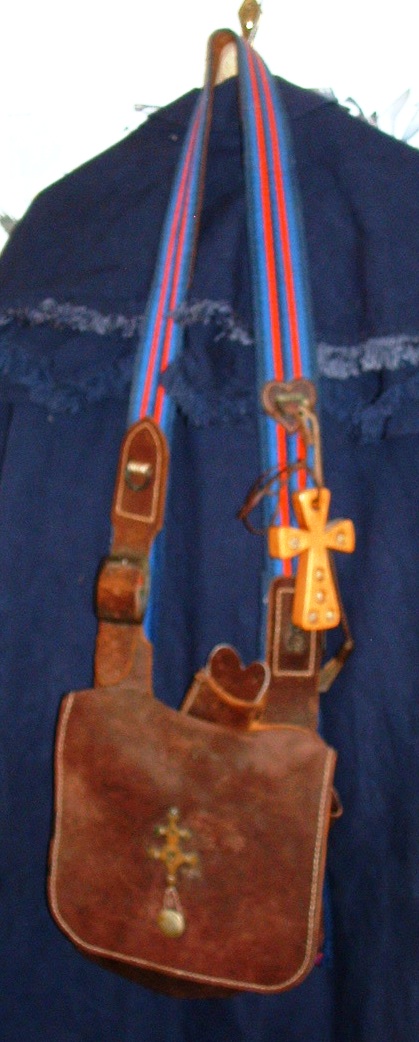
When making fire be sure that you have placed your powder horn with your gun well away from the fireplace. I suggest that you secure your fire steel to your belt bag buckle. In this way you can simply drop the steel after striking so that you can place all your attention immediately on the making of fire. In this way you are never likely to lose your steel.

Always make sure there is a clear area of at least two paces around your fireplace before making fire. Pay special attention to any debris that may take fire between the fireplace & your shelter.

Keep your fire small, large fires are a danger & they are more likely to attract attention than a small fire.

Make sure your store dry kindling in the back of your shelter in case the fire should go out at night when it is very cold.

If you do not need a fire, do not light one. It may attract unwanted attention. Always carry foods that do not require cooking.

Unless it is very cold & you need a fire for warmth, extinguish your cooking fire when you have finished cooking.

If you need to keep the fire going all night, make sure you have a good supply of firewood close to hand, so you can feed the fire at night without having to leave your bed.

Smoke from a fire made close to a tree will generally be drawn to the tree & find its way upward exiting through the forest canopy. However, this can not always be relied on because of the shifting breezes in forest areas, so keep your fire smokeless when you are able. Small dry wood will create heat quickly & produce less smoke. A hot fire will create less smoke even when larger pieces of wood are used.

Make sure that you always have plenty of dry spare tinder in your pack. If you are carrying gunpowder bags, place spare tinder in these bags as they become empty. Be sure to keep your tinderbox full of tinder.

Keith.

Tuesday, 6 November 2012

The Flintlock Gun in the 18th Century and Now.


The Flintlock Gun in the 18th Century and Now.

The flintlock, be it fusil, musket or rifle was still in use in wilderness areas in the 19th century long after the production of the percussion lock. Why? Because the flintlock is more reliable in wilderness areas; you do not need a large supply of percussion caps, any siliceous rock can be roughly knapped and used in the flint lock. Apart from running out of caps and not being able to replace them, percussion caps can be lost or destroyed by damp and corrosion.
My .62 cal/20 gauge flintlock fusil.

My .32 calibre flintlock rifle.

My 14 gauge percussion half-stock fusil.

I carry tools and spare lock springs to repair the lock on my flintlock fusil, but if I were to run out of spare parts, then I can easily convert my flintlock into a matchlock and continue using it. You can’t do this with a percussion lock. Not that these locks often break down, they are very hardy. In the 30 or so years I have been using my flintlock it has only failed me once. The hammer would not spark. I heated it to cherry red in the fire and rehardened it and it has been working fine ever since. Even so, I also carry a spare hammer (steel) in my knapsack.
Mainspring vice, spare lock springs, a spare hammer, and a wad punch. 18th century smoothbores did not use a patched ball, but you can patch the ball for better accuracy over greater distances.  Any suitable plant fibre can be used as wadding, but green will not catch fire.

Leather pouch, tallow container,screw, pin punch, leather, turn screw, and two spare flints. These are carried in the shot pouch.

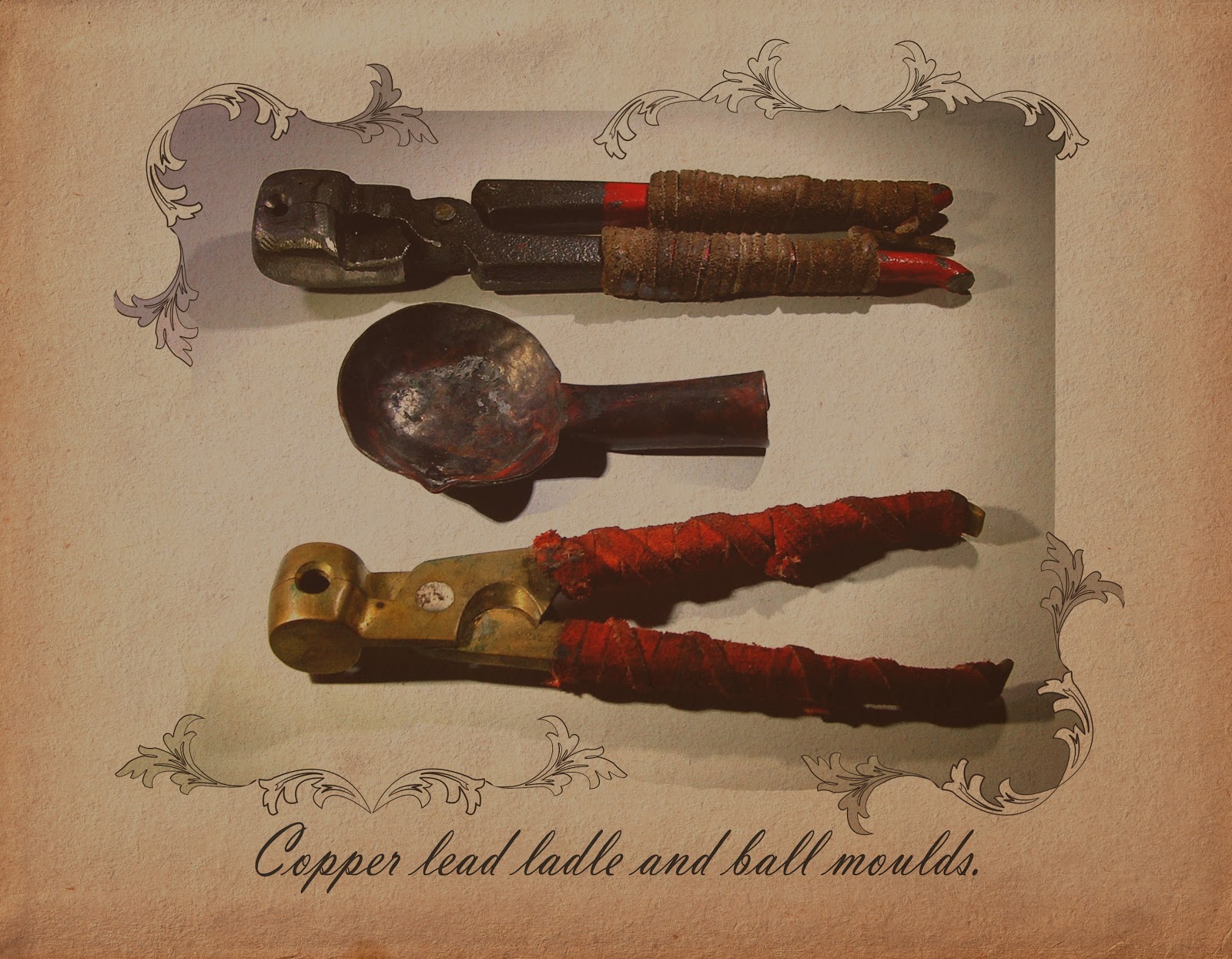
I can use the lock on my flintlock fusil to make fire without the use of gunpowder, but at the same time, I have gunpowder (black powder) to use with unprepared plant tinder if I should ever need it. I do not have to carry a lot of weight in lead, because I can retrieve lead from shot game and easily remould it into round ball or swan shot (buckshot) using the two light ball moulds I carry and a small light lead ladle. This means that I can carry more weight in gunpowder so it will last a lot longer.
The powder horn I carry.

My spare powder horn.

My gunpowder wallet. This is used to carry extra gunpowder on long trips. When empty, it is used to store tinder.


By using a smoothbore flintlock I can use round ball, swan shot, or light bird shot, or any combination of two of these. By loading bird shot and round ball, I am able to hunt small game and large game at the same time without having to change loads to suit. The flintlock has two safety devices, half-cock on the lock (no lock safety should ever be trusted!), and the use of a leather hammer boot. IF I were ever to run out of lead, then there are plenty of other projectiles available from nature which I can load instead. I can also use a hunting plug bayonet if I wish. With 42 inches of barrel plus stock length, I can keep man or beast at a good distance and kill with it.
The lock on my fusil with the leather hammer boot in place on the hammer. If the half-cock were to ever fail and release the cock, then the flint would only strike the leather boot and the gun would not fire.
My youngest son's shot pouch with ball mould, turn screw, cow's knee lock cover, and pouches for round ball and gun tools.

My shot pouch and contents.
Tools on the strap of my shot pouch. Vent quills, powder measure, loading block with two round ball, vent pricker and pan brush. A vent quill is used to mark a loaded gun, to keep the vent clear when loading, and to plug the vent when using the lock to make fire.
A worm for cleaning the bore which I hand forged onto my iron ramrod.

The rammer end of my ramrod screws off so that I can screw on the screw used for pulling a load.


I can easily make and use paper cartridges for faster reloading; I also carry a loading block hanging from my shot pouch strap. The cartridges can be carried in a cartridge box or belly box for easy access and to keep them safe and dry.


Cartridge box.

Gunpowder (Black Powder) is easy to make providing of course you have the ingredients. I of course can not recommend that you make your own gunpowder, but I will mention that it MUST always be mixed wet.  Water or urine can be used.


Sunday, 6 May 2012

You Still Need To Carry Your Shot Pouch.

Even when using a cartridge box, you still need to carry your shot pouch and powder horn. You don't know how long you are going to be out there or what may happen. Always travel fully equiped if you are going any distance.


Thursday, 21 April 2011

On Powder & Lead.

On Powder & Lead.


What are the heaviest items that we carry on a trek? I would think it was water, lead, & food. Food we can cut back on. I don’t mean that we should all start just carrying flour, bread or corn & hunt for our meat, but we can cut our provisions back to just two items, perhaps bread & hard cheese, or bread & meat. That should be fairly light & last us for a weekend or more.


Water we can’t do anything about, unless you know that you have good water where you are going. I carry water anyway, & either boil any water I find, or I collect rainwater in my kettle.


Lead can be reduced in weight because we can retrieve spent lead from shot game & remould it. By reducing the amount of lead we carry we can carry more gunpowder.


My fusil takes 60 grains of gunpowder. 60 grains = 1 Dram.


1LB of gunpowder = 256 Drams. So that is 256 shots from just one pound of gunpowder. My powder horn holds roughly one pound, & my gunpowder bag roughly two pounds. So if I only took my horn & gunpowder bag, I would still have 768 shots to hunt with. That is a lot of meat when hunting large game, & most of the meat would come from a trap line. So barring any skirmishing, I could take one shot per day for 2 years, or one shot per week for 14 years from just 3 pounds of gunpowder!


Thursday, 24 March 2011

Items Made Of Horn.


Most people know that powder horns are made from cow horns, but many other items were also made of horn in the 17th & 18th centuries. Here are some of those items: Powder horns, horn measures, horn books, horn combs, the windows in lanthorns, shoe horns, buttons, knife handles & cases.


The horn book was usually made of wood and the text was written on parchment or paper. A sheet of horn scraped thin so as to be transparent was placed over the text to protect it.

A 17th century Chapman, a seller of books.

A 17th century horn spoon.

A horn measure.

A horn framed & cased reading glass.

Horn framed specticles.

A lanthorne with horn windows.

My clasp knife with horn slab handle.


A shoe horn I made many years ago when I was a hornsmith.

My Powder Horn.

Thursday, 10 March 2011

Eluathan Ives His Horn. 1758.

"I, powder, With My Brother Baul

A Hero like do Conquer All.
Steel not this Horn For Fear of Shame
For on it is the Oners name.
The Roos is Red, the Grass is Green—
The Days Are past Which I Have Seen"

Tuesday, 8 March 2011

Shot Pouches.

Prompted by Karl's post where he mentions carrying the shot pouch high, I decided to make this post. First let me say that I totally agree with Karl, the shot pouch should be carried as high as practicable. I have seen shot pouches literally hanging down to the knees. But being too high can also be a problem when you come to use it, even if it does ride well.

Photo Curtesy of "The Complete Black Powder Handbook By Sam Fadala.
This may be okay for shooting on the range, but it is a little too low for using in the woods.

The only way you can judge is to try the pouch out. Can you get your hand into the pouch easily? My youngest son's shot pouch is much larger than mine, so it can be worn higher if he wishes. This shot pouch was originally designed for use with a Brown Bess musket. Smoothbore shot pouches tended to be larger because they had a little more to carry. The smoothbore can use round ball, swan shot (buckshot) or bird shot, or any combination of two of these. Kaelem uses this pouch now with a .32 cal flintlock rifle, so he has plenty of room inside.

Kaelem's Shot Pouch.
My shot pouch in comparrison is much smaller, even though it is designed for use with my .62 cal fusil. But I like a small pouch, and I have got used to it over the years and can find anything I need by touch. I carry my pouch as high as I can and still be able to get my hand inside.
The Author's Shot Pouch.

The powder horn should also ride high, higher than the shot pouch. You do not want the powder horn on top of your shot pouch & getting in the way of accessing the pouch. In use the gun can be liftet/raised to the powder horn to prime the pan, & it is no problem filling the powder measure.
Author's Powder Horn.

Here you can see that my shot pouch rides high on my hip. Any higher & I can't comfortably get my hand inside. The powder horn you can just see under my arm, and it rides high above my shot pouch. Both are easily kept under controle when stooping or running as can be seen from the following video.

The 18th Century Shot Pouch.