The Flintlock Gun in the 18th
Century and Now.
The flintlock, be it fusil,
musket or rifle was still in use in wilderness areas in the 19th
century long after the production of the percussion lock. Why? Because the
flintlock is more reliable in wilderness areas; you do not need a large supply
of percussion caps, any siliceous rock can be roughly knapped and used in the
flint lock. Apart from running out of caps and not being able to replace them,
percussion caps can be lost or destroyed by damp and corrosion.
My .62 cal/20 gauge flintlock fusil.
My .32 calibre flintlock rifle.
My 14 gauge percussion half-stock fusil.
I carry tools and spare lock
springs to repair the lock on my flintlock fusil, but if I were to run out of
spare parts, then I can easily convert my flintlock into a matchlock and
continue using it. You can’t do this with a percussion lock. Not that these
locks often break down, they are very hardy. In the 30 or so years I have been
using my flintlock it has only failed me once. The hammer would not spark. I
heated it to cherry red in the fire and rehardened it and it has been working
fine ever since. Even so, I also carry a spare hammer (steel) in my
knapsack.
Mainspring vice, spare lock springs, a spare hammer, and a wad punch. 18th century smoothbores did not use a patched ball, but you can patch the ball for better accuracy over greater distances. Any suitable plant fibre can be used as wadding, but green will not catch fire.
Leather pouch, tallow container,screw, pin punch, leather, turn screw, and two spare flints. These are carried in the shot pouch.
I can use the lock on my
flintlock fusil to make fire without the use of gunpowder, but at the same
time, I have gunpowder (black powder) to use with unprepared plant tinder if I
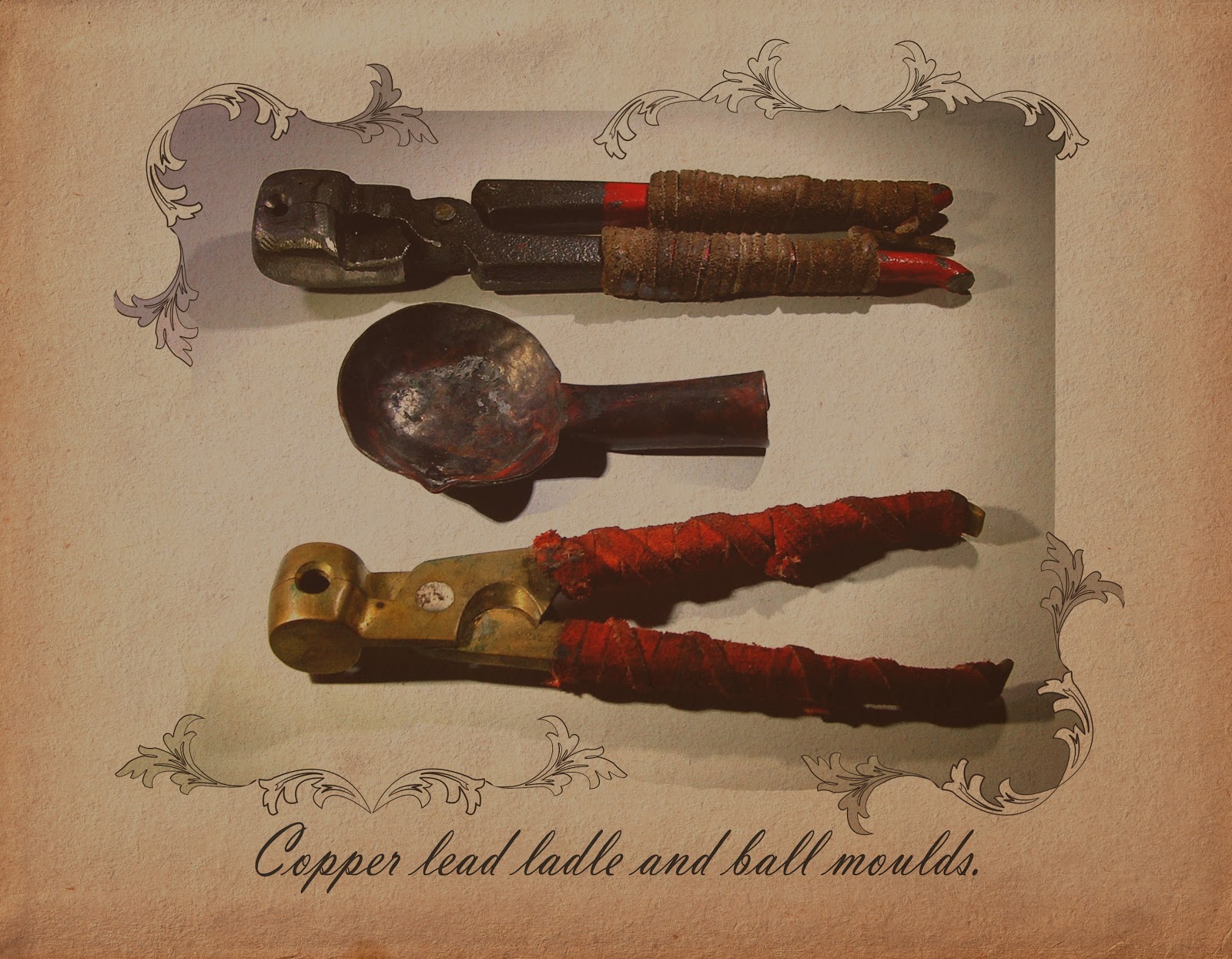
should ever need it. I do not have to carry a lot of weight in lead, because I
can retrieve lead from shot game and easily remould it into round ball or swan shot
(buckshot) using the two light ball moulds I carry and a small light lead
ladle. This means that I can carry more weight in gunpowder so it will last a
lot longer.
The powder horn I carry.
My spare powder horn.
My gunpowder wallet. This is used to carry extra gunpowder on long trips. When empty, it is used to store tinder.
By using a smoothbore flintlock I
can use round ball, swan shot, or light bird shot, or any combination of two of
these. By loading bird shot and round ball, I am able to hunt small game and
large game at the same time without having to change loads to suit. The
flintlock has two safety devices, half-cock on the lock (no lock safety should
ever be trusted!), and the use of a leather hammer boot. IF I were ever to run
out of lead, then there are plenty of other projectiles available from nature
which I can load instead. I can also use a hunting plug bayonet if I wish. With
42 inches of barrel plus stock length, I can keep man or beast at a good
distance and kill with it.
The lock on my fusil with the leather hammer boot in place on the hammer. If the half-cock were to ever fail and release the cock, then the flint would only strike the leather boot and the gun would not fire.
My youngest son's shot pouch with ball mould, turn screw, cow's knee lock cover, and pouches for round ball and gun tools.
My shot pouch and contents.
Tools on the strap of my shot pouch. Vent quills, powder measure, loading block with two round ball, vent pricker and pan brush. A vent quill is used to mark a loaded gun, to keep the vent clear when loading, and to plug the vent when using the lock to make fire.
A worm for cleaning the bore which I hand forged onto my iron ramrod.
The rammer end of my ramrod screws off so that I can screw on the screw used for pulling a load.
I can easily make and use paper
cartridges for faster reloading; I also carry a loading block hanging from my
shot pouch strap. The cartridges can be carried in a cartridge box or belly box
for easy access and to keep them safe and dry.
Cartridge box.
Gunpowder (Black Powder) is easy
to make providing of course you have the ingredients. I of course can not recommend
that you make your own gunpowder, but I will mention that it MUST always be
mixed wet. Water or urine can be used.