Showing posts with label fascine knives. Show all posts
Showing posts with label fascine knives. Show all posts
Monday, 28 May 2012


Wednesday, 30 March 2011
An Aussie Forum For Blade Lovers.
I recently joined the Australian Blade Forums site, and find the people there very friendly. Within this site there are many forums covering bushcraft and other activities. I recommend this one. If you are interested go to: http://www.australianbladeforums.com/phpbb/index.php?sid=b85af7483fa522e8e74af941ff56194d
Wednesday, 19 January 2011
Affordability. Equipment & Tools. Knives.
Knives.
There are fixed blade belt knives, and there are jack knives/clasp knives. These come in a variety of shapes and sizes. Second hand will usually be less costly than new, and these second hand knives are well worth looking out for at your local second hand dealer.


There are fixed blade belt knives, and there are jack knives/clasp knives. These come in a variety of shapes and sizes. Second hand will usually be less costly than new, and these second hand knives are well worth looking out for at your local second hand dealer.

A repro clasp knife.
Clasp knives are generally not that costly even new from living history traders. If you are on a budget, stay away from custom made knives. If you are going to purchase a new or custom knife, make sure you do your research first as to style.
A repro clasp knife.
Second hand butcher knives of the 18th century style are still available at dealers and markets. Stay away from stainless steel, only purchase carbon steel. Carbon steel is usually recognisable by it being a duller finish than the usually shiny look of stainless.
Two original butcher knives. One I found at a second hand dealer's, and the other I found at a local maket.
Handles on 18th century knives were pinned, not riveted, but handles can be replaced where they have been riveted.
This too is an original blade, and I bought it without a handle.

This one I found second hand as is. I made the sheath. This is now my legging knife.

This was my Fathers craft knife, and that is what I use it for now. The blade shape could be changed on a knife like this.

An original Gully knife.

A Gully knife custom made for me by my close friend the late Geoff W. Howarth of Tamworth NSW Australia. 9 inches long closed.


Above: Pinned. A metal rod or nail is used and peened at both ends to secure it.

Above: These are brass rivets. Most if not all modern butcher knife handles are secured by rivets. As you can see they are much larger than the pins.
Monday, 12 April 2010
Fascines and Fascine Knives.
From Wikipedia, the free encyclopedia
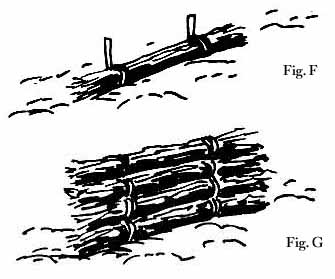
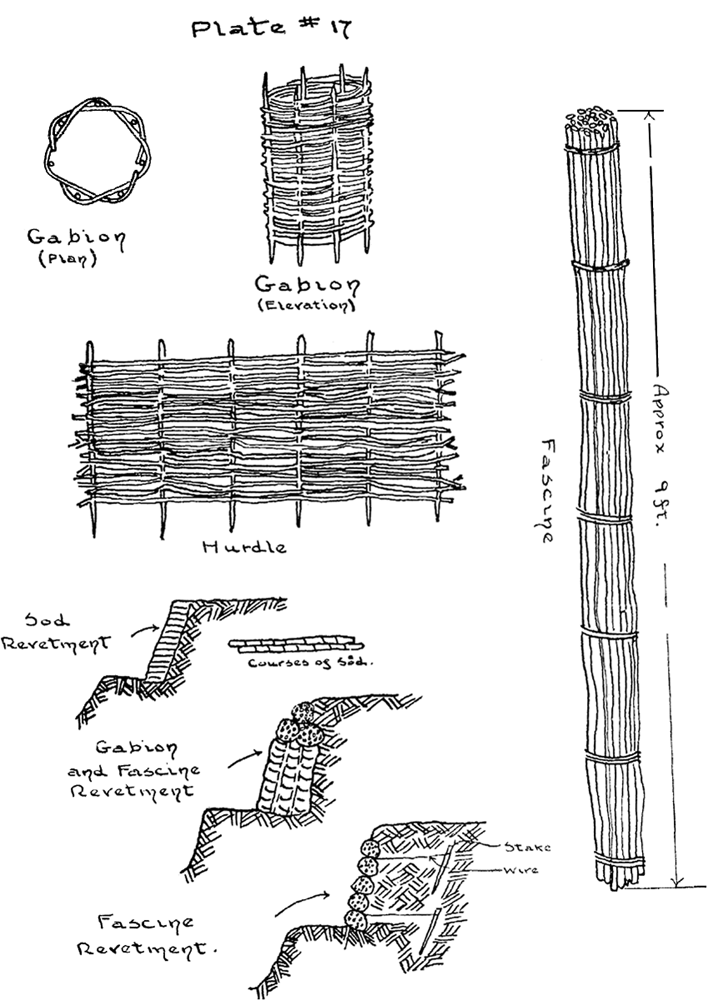
The fascine knife was a side arm / tool issued to 17th to 19th century light infantry and artillery. It served both as a personal weapon and as a tool for cutting fascines (bundles of sticks used to strengthen the sides of trenches or earth ramparts protecting the batteries).


The fascine knife was a side arm / tool issued to 17th to 19th century light infantry and artillery. It served both as a personal weapon and as a tool for cutting fascines (bundles of sticks used to strengthen the sides of trenches or earth ramparts protecting the batteries).

Two original hand forged Fascine knives that belonged to my Father.


More information at: http://www.nwta.com/couriers/8-97/fieldfort.html
Subscribe to:
Posts (Atom)