A LIVING HISTORY BLOG.

18TH CENTURY LIVING HISTORY IN AUSTRALIA.
Showing posts with label tinders. Show all posts

Monday, 23 March 2015

My Book. Primitive Fire Lighting. eBook. Written For Australian Survivalists, Preppers, Living Historians & Reenactors.

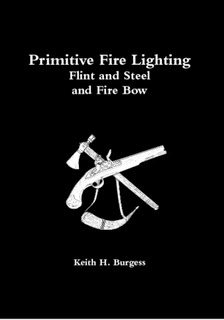
Primitive Fire Lighting-Flint & Steel & Fire Bow. eBook.

Title: Primitive Fire lighting.
ID: 9784776
Category: History
Description: “Primitive Fire Lighting”, is a hands on guide to how to make fire with flint and steel and fire bow. This includes some history, a variety of methods, tinder plants identification, and tinder production, tips on fire place construction and use, how to prepare and lay a fire, wet weather fire lighting and magnifying glass fire lighting. The skills and methods in this book will be of interest to a wider range of readers including survivalists, historical re-enactors, bush-walkers and campers, historical–trekkers and even historical novel writers. Although the plant identifications list is mainly Australian it also has some information for England, Europe and America.
Publisher: Keith H. Burgess
Copyright Year: © 2010
Language: English
Country: Australia

Table of Contents
Illustrations. 4
FOREWORD. 6
FLINT AND STEEL FIRE LIGHTING. 8
PLANT FIBRE TINDERS: 11
TINDER PREPARATION. 15
Tinder preparation-charring: 15
OTHER FLINT and STEEL FIRE LIGHTING METHODS: 16
Emergency methods: 17
A WORD ABOUT BLACK POWDER: 17
THE CAMPFIRE FIREPLACE: 18
READING GLASS/MAGNIFYING GLASS FIRE LIGHTING 20
WET WEATHER FIRE LIGHTING. 21
A FINAL WORD OF CAUTION. 23
FIRE-BOW FIRE LIGHTING. 24
Introduction 24
FIRE-BOW FIRE LIGHTING. 25
A Brief Overview. 25
The Parts of the Fire-bow. 26
The Bow. 26
The Drill Piece. 27
The Fireboard. 29
The Tinder-board. 30
The Bearing Block. 31
The Bowstring. 32
Tinder. 32
Making Fire. 32
Making Cordage. 37
The Step for making Cordage. 38
AFTERWORD. 40
Fire steel suppliers. 45
About the author. 45


$4.99 US.

Monday, 13 February 2012

Part Four. A Closer Look At Flint & Steel Fire Lighting.

Plant Tinders.

All of the plant tinders I have found I have discovered through experimentation before I read 18th century accounts. Some of these are indeed mentioned in period accounts, some under different names such as this one below, others I have found are not mentioned at all.

“They kindle fire, by striking together a piece of white or yellow pyrites and a flint stone, over a piece of touchwood”.
Alexander Mackenzie; among the Indians, 1789.

Touchwood is another name for punk wood. Here is another:

“This induced me to resolve not to travel more by land without my gun, powder and shot, steel, spunge   and flint, for striking a fire…”
Patrick Campbell, 1792.

Spunge is also punk wood, and this name gives you some indication of what this tinder feels like. With the knowledge of what this tinder looks like and feels like it enables you to search out other plant materials of similar look and feel, and experiment to see if it will catch a spark, or work as an extender. An extender is a plant material that will not necassarily catch and hold a spark like true tinder will, but it will take from a smouldering ember and can add to the heat when blown upon in the tinderbox.
Treating tinder with saltpetre/potasium nitrate is all very well, but it is not a lot of good for extended use in the woods. So whatever material you find, first see if it will catch and hold a spark as is, and if it does not work, then try charring it a little in the fire.


“Fire making is a simple process with the mountaineers. Their bullet pouches always contain a flint and steel, and sundry pieces of “punk”-a pithy substance found in dead pine trees-or tinder; and pulling a handful of dry grass, which they screw into a nest, they place the lighted punk in this, and closing the grass over it, wave it in the air, when it soon ignites, and readily kindles the dry sticks forming the foundation of a fire.”
Ruxton, 1848.


The information in these posts is taken from the revised edition of Primitive Fire Lighting, Flint & Steel, which is now a part of "The New World Woodsman. His clothing, equipment & accoutrements. 1700-1760". By Keith H. Burgess. This new book is in its final stages of editing, and its publication date will be posted on this blog.


Saturday, 15 October 2011

Creating enough heat to make fire!

In order to make fire you need heat, this heat in the 18th century was created by smouldering tinder that had caught & held a spark. Kindling such as dry grass or similar is placed next to or on the smouldering tinder and then blown into flame. But sometimes in wet weather this heat generated by the burning kindling grass is not enough to cause damp kindling twigs & sticks to burn, so you need a more constant flame.
In my fire-bag I carry a little kindling and a stubby beeswax candle. If the fuel for the fire is damp and will not easily catch fire, then I light the candle and place the candle beneath the damp fuel. This constant heat although only small, aventually will dry out some of the sticks & twigs and they will take fire.


My Tinderbox and contents.

Closed Tinderbox and steel.

My Fire-bag which holds the tinderbox, some kindling and a candle.

A dipped beeswax candle, broken but will still function.