A LIVING HISTORY BLOG.

18TH CENTURY LIVING HISTORY IN AUSTRALIA.
Showing posts with label primitive tools. Show all posts

Thursday, 30 May 2013

Period Woodworking Tools.

Diderot.


Brace and bit.

Bucksaw.


The auger and gimlet I made from some old brace bits.

Paring Ladder.


Pump Drill.

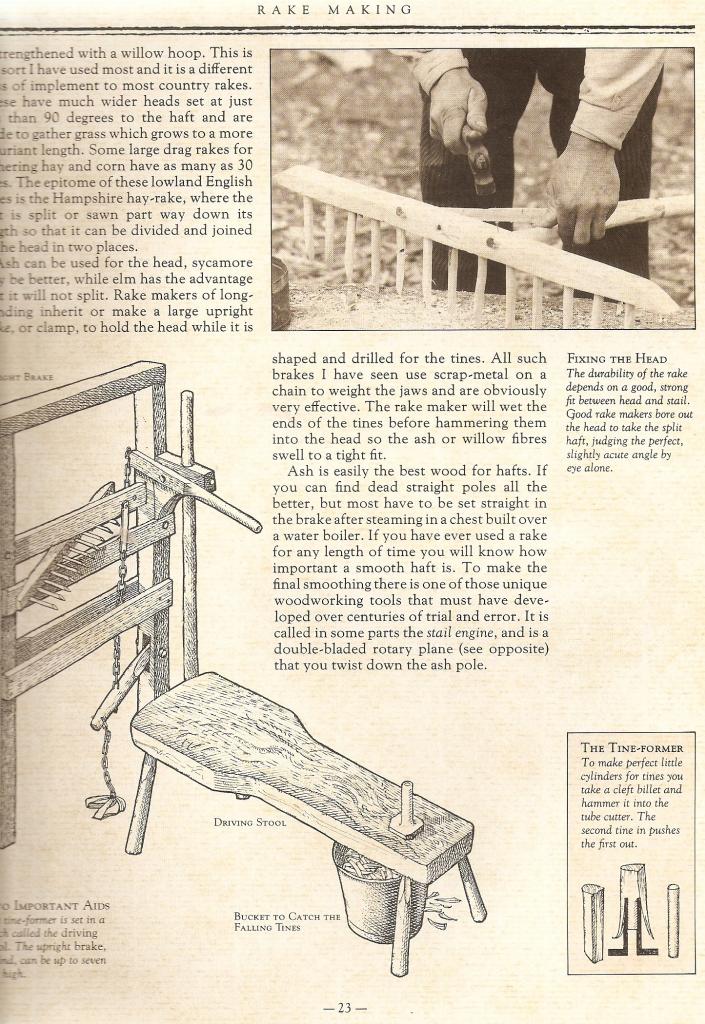
Making Rakes.

The stail is the long straight handle used on hoes and rakes. I make mine with a hatchet and drawing knife, but as you can see there is a stail engine.


This tine former can also be used for making wooden pegs for other construction work.


Wednesday, 28 July 2010

A Scenario and a Question.

As you know, it is very difficult to find specific information on 18th century lifestyles and the tools and equipment used. So most of our research has to be done through simply finding out what people did, and what tools and equipment were available to them. Then we must gather the clothing and a selection of tools and equipment and see if we can accomplish certain tasks. This is called "experimental archaeology", or by some, "experiential archaeology".
So below I have set out a scenario, and please feel free to participate.
Woodsman By John Buxton.

The Scenario.


It is sometime in the early to mid 18th century. You have been a few years in the New World doing various jobs to earn money. Recently you have been hired to range the area around a small community in New England looking for any sign of Indians. If you do find any sign of them being in the area, you are supposed to get back to the community as fast as you can and report your findings to the local militia.


You could be gone for any length of time from a few days to a month, depending on if you find anything, and it is now Indian summer, a time just before the leaves fall from the trees and bushes. There is a possibility that you could be discovered by an enemy, in which case you must just do the best you can to get back to the community.


You could of course get injured in some way and once again you will have to deal with it the best way you can. Now the question is, what equipment do you decide to carry with you when ranging the wilderness? You need to travel as light as you can, but at the same time you must be as self-reliant as possible. So some compromise must be made between these two principles, minimum weight, and maximum self-reliance.


Here below is a list of items you can take with you, you may add to this list if you think it necessary, or you can take away from this list if you don’t think an item is necessary. I will welcome any feedback on this that you are prepared to offer.

• .60 cal/20 gauge fusil. 42 inch barrel.
• .60 calibre smoothbore pistol.
• Shot pouch and contents.
• Powder horn.
• Butcher/Hunting knife.
• Legging knife.
• Clasp knife.
• Tomahawk.
• Tinderbox.
• Belt pouch.
• Fishing lines in brass container.
• Two snares.
• Gunpowder wallet (contains spare fungus tinder at present).
• Knapsack.
• Ball mould and swan shot mould.
• Lead ladle.
• Cup.
• Trade kettle.
• Medical pouch.
• Housewife.
• Piece of soap and a broken ivory comb.
• Dried foods in bags.
• Wooden spoon.
• Gun tools and spare springs.
• Compass.
• Whet stone.
• Oilcloth.
• One blanket (Monmouth cap, spare wool weskit and wool shirt rolled inside blanket).
• Leather costrel.

Friend or Foe By Griffing.


Sunday, 20 June 2010

Making Stone Tools part 2.


The first time I went into the forest to make fire with a fire-bow, I did so in the pouring rain, and I made the fire-bow with stone tools that I made in the forest.

Making Stone Tools.

I have often said that learning to make fire by a primitive means will improve your fire lighting skills overall, even if you go back to using modern methods. This same concept is mentioned in this video.

You will also note that my beliefe that primitive equipment and methods improves my enjoyment of the outdoors is also confirmed in this video, at least for people like us.

Tuesday, 9 March 2010

Foraging.

FORAGING.


How much do you see on your bush walks? I would imagine that primitive man was always on the look-out for useful items along the way. So here is something you can try next time you are out and about, something that may add a little more interest and adventure to your trekking or bush walks.


Do you have a haversack? A haversack is a bag with one strap, a knapsack has two straps. For this exercise we only really need a haversack, a bag that is easy to get into whilst on the trail without having to take it off.


Next time you are out and about, take the haversack with you and collect as many useful items as you can that you find along the way. You don’t need a lot of any one thing, and ideally these items should be natural things that are normally found in nature.


I want you to set yourself a scenario. Let us say you are a hunter and forager, you are on the move from one area to another. You know that when you camp for the night there are certain things you are going to need to be comfortable, so you need to look for these items along the trail. You are also going to need a good camp site and shelter. You can’t pack these in your haversack, but you can store them in your memory. In reality you never know when a natural shelter along the way might come in handy, say as shelter from a sudden storm. Or if it is getting late, now might be as good a time to stop and camp as any.


How good is this natural shelter? A rock overhang or just a hollow fallen tree? Maybe it is not a hollow tree, maybe it. Is just a fallen tree that affords some shelter under it or just along side of it. Maybe you can add to this fallen tree to make a better shelter. You can either stop and do this, or you can just memorise it for later. If you have a pencil and pad on you, you can just jot it down.


So what will you need when you stop for the night? Well let’s start with a fire. If it is raining or the ground is wet or covered in snow, all the better for this exercise. You have to keep an eye open for areas that will keep tinder and kindling dry. Remember that tinder is what catches a spark, and kindling is what actually flames. Tinder can be many things, punk wood is probably the most common, this is the dry rotted soft wood that can often be found in the base of dead fallen trees. Some fungus like the Horse-Hoof fungus or here in Australia the Ryvardenia Cretacea. The dried heads of the Cattail or Cumbungi. The fungus grows on trees, so you will have to look up to find these.

Fomes Fomantarius.

Amadou.

Ryvardenia Cretaceus

Ryvardenia Cretaceus

Punk Wood.

Cattail.


Kindling is dried grass and leaves, twigs and sticks. The sticks need to be dead, not green. But at the same time they should be firm and not rotten, and you will need a variety of sizes so you can build your fire slowly.


When you find this good camping place are you going to set up a trap line? If so then you need to look out for any particular shaped limbs that you may need. A forked limb is good for making trap pegs, with one side of the “V” longer than the other for hammering into the ground.


Food plants are good items to look for, like I said, you don’t have to collect a lot unless you actually intend to make a meal, but you can just collect a leaf here and a flower there as you go along. What do you have in your area? Dandelion leaves and flowers? Cattail shoots, bases and roots? Stinging nettles? Dock leaves? If you have a wild plant book for your area, why not take it along with you and see what you can find.

Dandelion.

Nettles.

Dock.

Appleberry.

Blackberry.

Warrigal Greens.

Cordage is always a handy item to have with you, and if you can find the materials to make cordage along the way all the better. You can sit in your shelter at night and make cordage in front of the fire. So what can you use for cordage? Well practically any plant fibre, it is just a matter of which is the best for the job in hand, which is the strongest. The dried leaves of the cattail will work after soaking in water for a while, but it does not make a very strong cordage. Nettle fibre is good as is blackberry vine, but I must admit I have not tried either as yet. Mostly I use the inner bark of the Stringybark tree which is plentiful around here. But I have used grass, goat hair, wool fleece, horse hair, leather, green hide, rawhide, tree bark as is without cording the same as rawhide. Whenever I see anything along the trail that I think may make cordage, I pick some and try it.

Cordage.

Throwing Sticks.

How about tools? What can be used for tools? Bone, wood, stone, shell. John at Musings Of Murphyfish http://murphyfish-musing.blogspot.com/ found several useful items on one of his walks. Pine cones for instance, great kindling. Foraging like this can be good fun, and it trains your brain to recognise useful items even when you are not actually looking for them. Good luck.

Monday, 15 February 2010

An excerpt from Paradise Found Nature in America at the Time of Discovery, Steve Nicholls.

Found that in a fascinating book "Paradise Found: Nature in America at the Time of Discovery" by Steve Nicholls, University of Chicago Press, 2009. His book is devoted to the state of the natural world in North America before the arrival of Europeans. I think you would enjoy reading it.  This is a recommendation from one of my readers/followers,Minnesotastan .
http://www.blogger.com/profile/01382888179579245181


An excerpt from


Paradise Found
Nature in America at the Time of Discovery
Steve Nicholls
The Discovery Of Paradise


At first sight, the coasts of Labrador and Newfoundland are bleak, inhospitable places. It’s a sobering thought that if not for the Gulf Stream, that great river in the North Atlantic conveying heat from the tropics to the shores of Europe, we Britons would share this climate. But these places aren’t that bad. This barren-looking scenery refreshes the soul; here a human can understand his place in the world. Nothing can hide from a searching Newfoundland wind, not even the arrogance of a species that thinks itself master of all it surveys.


Besides, these places are far from barren; you just need to know where to look. All you need to do is smell the wind, laced with the pungent aroma of ammonia. Follow your nose to the cliff tops and a cacophony of grunts and squeals rises to greet you. There below you the rocky stacks are crowded with gannets, perched on every available space. Riding the wind on elegant, ink-dipped wings, returning birds hang motionless in the air over their mates, until they’re sure they’ve found the right spot, a familiar call among the symphony. But, as impressive as the smell and din always is in these colonies, it was once even more impressive. Some of the largest seabird colonies in the world used to exist around the coasts and islands of northeast America. A French explorer in the mid-1500s once declared: “All the ships of France might load a cargo of them without once perceiving that any had been removed.”


And there’s a good reason for such unimaginable numbers of birds; the seas and shores around these colonies used to be filled with an equally inconceivable abundance of fish. It was these teeming shoals that drew Europeans here in the fifteenth century, but our first glimpse into this crowded ocean didn’t come from French or English explorers, nor even from the Spanish who, to most people, were seen as the first to encounter the New World. They’re found in two Norse sagas that date to nearly five hundred years before Columbus blundered into the Caribbean. These first recorded encounters don’t tell us a great deal about the ecology of the New World, but they do introduce us to the story of the Atlantic salmon, which is a good illustration of the way history interacts with biology and introduces many of the broad themes that will recur throughout the following chapters.


The Vikings were unrivalled in their seamanship and exploration. By the middle of the 800s, they had begun to settle Iceland, though when they first got there, the island was already populated by Irish monks, who promptly left to find peace and quiet elsewhere. For the Vikings, in the long term, Iceland turned out to be a staging post as well as a new homeland. They pushed further west and had established colonies in Greenland by the tenth century, almost on the doorstep of the American continent.


How they made the final step to the New World is recorded in two sagas, The Saga of the Greenlanders and The Saga of Eirik the Red. The Norse and Icelandic sagas are actually just elaborate family histories, with a touch of adventure for added effect, so they don’t always dwell on the natural wonders that these early explorers must have found. And although these two sagas, which describe the same events, disagree in details, they nevertheless provide tantalizing glimpses into the North American continent long before major European contact.


The story begins in the closing years of the first millennium in Norway, from where Eirik had just made a hurried departure to escape punishment for murder. His plan was to settle in the now-thriving colony in Iceland, but it didn’t take him long to become unpopular there as well. He gained his name “Red” from the color of his hair, but it might just as well have been from the trail of blood he left behind. When he became involved in a local feud and decided that life in Iceland was also getting just a little too hot, he remembered that a friend called Gunnbiorn had once run into a landmass to the west of Iceland after being blown off course. Eirik decided it would be expedient to go and find it, and to settle there if he could. He did find land and returned to pick up volunteers for his settlement. He decided to call the place Greenland, perhaps an attempt to make it sound more attractive to potential settlers, just as the first colonists in America half a millennium later would send back descriptions of Paradise to encourage expansion of their own settlements in the New World.


Eirik’s simple publicity stunt obviously worked. These hardy Norse souls did indeed manage to build several settlements along the southwest coast of Greenland. Among deep fjords that would have reminded them of Norway, they found places where sheltered harbors led up to fertile pastures for their tough little cattle. In addition, the coasts to the north were alive with seals and walrus. Offshore there were great shoals of fish and whales and on land plenty of ducks and caribou, so it didn’t take long for a regular trade to build up between Eirik’s Greenland, Iceland, and Norway. They traded whale and seal oil or eider duck feathers for such staples of life that they couldn’t provide for themselves in their remote colonies on the edge of the known world. The success of these colonies depended on regular communication with Iceland and mainland Europe, and that meant sea traffic through difficult and often dangerous waters. Sooner or later something was bound to go wrong.


It did, and it happened to one of history’s unsung heroes, a man by the name of Bjarni Herjolffson. The details of his story are preserved in only one of the sagas, The Saga of the Greenlanders, which tells how he was blown off course as he sailed between Iceland and Greenland. He eventually sighted land, which most now agree was somewhere along America’s northeast coast. He sailed north along this coast, making his way back toward Greenland, but he never bothered to land. If he had, history might have been kinder in recording him as the first undisputed European discoverer of the New World. As it happens, that honor is usually given to Leif Ericsson, son of Eirik the Red, who decided to follow up on Bjarni’s discoveries fifteen years later.


So, in the early years of the second millennium, we get our first glimpse into the nature of North America. Around AD 1000, Leif sailed west from Greenland and encountered land. At first he wasn’t impressed. He found a barren land of flat stones, which he called Helluland—“slab land.” It is now generally agreed that this was Baffin Island, and Leif’s description is still a good summary of the place today. Sailing south, things improved. Next he landed at Mark-land—“wood land”—covered in fine, large trees. Two days sailing further to the south and west, Leif stopped and built houses ready to overwinter in this strange land. The abundance they found soon impressed them. “There was no lack of salmon in the river or the lake, bigger salmon than they had ever seen. The country seemed to them so kind that no winter fodder would be needed for livestock; there was never any frost all winter and the grass hardly withered at all.”


So where were they? The general consensus was that they had landed somewhere on the coast of Labrador or Newfoundland, which makes their descriptions of the mild winters sound like a bit more Paradise publicity. However, the reason that the Vikings had been able to colonize Greenland successfully was that they did so during a period of climatic warming, so perhaps the coasts of Labrador and Newfoundland were less bleak than they seem today. Some flesh was put on the bare bones of the sagas in 1960 when, nearly a thousand years after Leif Ericsson, two more Norwegians landed on the coast of Newfoundland. Helge Ingstad and his wife, Anne, were both archaeologists, searching for evidence of their distant ancestors in the New World. What they found was astounding.


A local fisherman told them of an ancient settlement long thought to have been made by Indians. But when the Ingstads visited this site, at l’Anse aux Meadows on the very northern tip of the island of Newfoundland, they saw the unmistakable outlines of Viking long houses, familiar from their work back home in Norway. If that wasn’t convincing enough, they returned in successive years to excavate the site and found evidence of iron smelting, something no Indian had even heard of before 1492. Carbon 14 dating from the iron hearths gave figures around AD 900–1070, so it seemed the story was closed. L’Anse aux Meadows was the reality behind the sagas. But the saga isn’t finished yet.


The Saga of the Greenlanders describes another discovery that caused some consternation among later scholars. One of the party wandered away from the settlement and, when he returned, reported that he’d found the place festooned with wild grapes. There’s nothing too astounding about this. Many later explorers found the trees along the east coast covered in a dense growth of vines sporting wild grapes finer than any in Europe’s vineyards. The abundance of wild grapes impressed the Norsemen so much that Leif Ericsson called this area Vinland or “Wine-land.” But no wild grapes grow in the far north of Newfoundland today. Does this make l’Anse aux Meadows unlikely as Leif’s first settlement? Perhaps, though the Vikings were exploring during a period of warmer climate that probably meant that the range of many plants and animals, including wild grapes, extended further north. So did the saga-tellers leave any more clues?


Leif thoughtfully measured the day length at the winter solstice, which gives a good indication of latitude. “In this country, night and day were of more even length than in either Greenland or Iceland; on the shortest day of the year the sun was already up by 9 am and did not set until after 3 pm.” This should put the general location beyond doubt, but the translation above is deceptively simple. Actually, Leif recorded the sun’s position using arcane Viking terminology, and the translation into a specific latitude involves complex calculations and a few assumptions that have led to suggestions for Vinland being as far south as Florida! Other calculations point to a location somewhere to the south of the Gulf of St. Lawrence, and well within the range of Vitis riparia, the most widespread of a score of wild grape species that grow across America. V. riparia pushes north into New Brunswick and northern Quebec, so perhaps Leif’s first settlement was around the Bay of Fundy, along the coasts of Nova Scotia or New Brunswick.


The abundance and size of the fish they recorded doesn’t help. We’ll see from later descriptions that all the rivers and lakes down the east coast were choked with so many fish that it left those early explorers lost for words. So it seems the exact location of Vinland must remain a mystery, though in a way it doesn’t matter. We can still stand with those brave Norsemen, somewhere on the northeast coast of the continent, and see a vitality of nature already gone from most parts of Europe.


We can imagine that small party standing on the banks of a river, staring at water alive with the flashing silver backs of Atlantic salmon. Most of the fish are huge, on average around twenty-five pounds each, but there are plenty that are easily twice this size. They must measure four or five feet from head to tail. It’s the height of a late summer run, up river to spawning grounds on exposed gravel beds, and the river is almost solid with fish. It looks as if you could cross without getting your feet wet. These fish were born in this river but have spent the last year or two at sea, feeding and growing. Now they are returning with an almost unerring accuracy to that same river again to lay their own eggs and continue a cycle that began at the end of the last ice age. Many will die after spawning, though a fair proportion will survive to swim to sea again and return to spawn in later years. Atlantic salmon also run up the rivers of Scandinavia, so the sights in Labrador must have been spectacular indeed to have been worthy of recording in the sagas.


Behind the Norsemen, the setting sun is now filtered through arching branches of massive trees, hung with curtains of purple grapes. The vines scramble up every tree, disappearing into the fading light. With the light finally gone, the Norsemen huddle close to their fire, warming themselves against an early fall chill that descends with startling suddenness as soon as the sun disappears behind the unknown land to the west. But none can sleep. The noise coming from the river is almost deafening, like the applause of a vast unseen crowd. The giant salmon are leaping over each other, over cataracts, over and over, falling back into the water with great splashes.


What the Norsemen couldn’t have known was that this was being repeated for many hundreds of miles up and down the coast; by one estimate, three thousand such rivers provided hundreds of thousands of spawning beds for an incalculable number of Atlantic salmon. Certainly, Atlantic salmon would have run up the rivers as far south as the Housatonic, which flows into Long Island Sound, not far from New York City. To the north, they ran in numbers all the way up to Ungava Bay, on the Canadian mainland opposite Baffin Island.


And this spectacle would repeat itself year after year. Seven centuries after the Norsemen left these shores, Nicolas Denys also has sleepless nights on the Miramichi River flowing through New Brunswick in Canada:


So large a quantity of salmon enters the river at night one is unable to sleep, so great is the noise they make in falling upon the water after having thrown or darted themselves into the air passing over the river flats.


I found a little river which I named Riviere au Saulmon.… I made a cast of the seine net at its entrance where it took so great a quantity of salmon that ten men could not haul it to land and … had it not broken the salmon would have carried it off. We had a boat full of them, the smallest three feet long.


Salmon were still hugely abundant when the New England colony had grown from its beginnings as a handful of starving pilgrims, and it’s said that servants along the Connecticut River would only work on the condition that they were not fed salmon on more than two occasions each week. As splendid a comment as this is on the abundance of salmon, Robert Behnke, who wrote a definitive work on trout and salmon in North America, can find no basis in fact for what has become an often repeated myth. Nevertheless, it doesn’t alter the fact that, from Long Island Sound to Ungava Bay, Atlantic salmon abounded.


In 1770, George Cartwright, recently retired from the army, sailed from England to Labrador to set up trading posts for fur and fish. The sheltered harbor where he started his enterprise still bears his name. The community of Cartwright, population 628, stands on the eastern side of Sandwich Bay, not far from thirty-three miles of pristine sandy beach that was impressive enough for Leif Ericsson to call it Wonderstrand. It’s still an amazing place a thousand years later. There are large gannet, puffin, and guillemot colonies within a few miles, and Cartwright claims to have the best fly-fishing for Atlantic salmon anywhere in the world. While that claim might be disputed by some, salmon were certainly one of the things that drew George Cartwright here over two hundred years ago. And he kept meticulous records, not just of his salmon operation but of all the wildlife in the area.


For someone trying to earn his living from fish, Labrador must have seemed like Paradise indeed. The salmon runs in the White Bear River were so dense that George reckoned “a ball could not be fired into the water without striking a salmon.” Between June 23 and July 20 on one river he and his three companions killed 12,396 salmon, and they felt they could have killed thirty thousand if they had left their nets out. Elsewhere, fishermen only gave up catching salmon when they ran out of salt to preserve the fish. Whatever the modern community of Cartwright boasts about its salmon fishing, I doubt it’s anything like it used to be.


But Atlantic salmon, on both sides of the ocean, have had a hard time of it since George’s day. They disappeared totally from many rivers in both Europe and America. I remember the fanfares that greeted the first salmon for many years to brave the River Tees in Middlesbrough, in northeast England, the town where I grew up. The lower Tees is hemmed in by industry: a tangle of chemical works, steel foundries, and docks. They all emptied waste into the river, and although the upper reaches, with their bare gravel spawning beds, still flowed cool and clear through the dales of Yorkshire and Durham, the toxic concoction near the river mouth was as effective as any physical barrier in preventing the salmon from running upstream. And, to return to the rivers of their birth, salmon use the unique aroma of their particular river, percolating through salt water, drifting on ocean currents, to find their way. What rivers like the Tees and many others must have smelled like to the salmon’s sensitive nose is anyone’s guess. I spent many of my weekends watching birds on the Tees Estuary in the early 1970s, and the air there smelled bad enough to my insensitive human nose. To fall into the river around here meant a trip to hospital and an undignified encounter with a stomach pump. So any salmon foolish enough to come too close, even if it could have detected the delicate scent of Teesdale on the water, would soon have gasped its last.


Huge efforts have been made since then to clean up many of these rivers, and salmon have responded. Although most salmon return to the rivers where they hatched, a very small percentage—the Leif Ericssons of the salmon world—explore new territory. These pioneering fish can naturally recolonize rivers, even if all the river’s native fish have long since been eliminated. Thus, the first salmon in living memory returned to the Mersey, in northwestern England, in 2001. By then eighty to a hundred salmon per season were being reported in the higher reaches of the Tees, so presumably many more were running the gauntlet of the concrete and steel-fringed estuary. Similarly, salmon began to run once more in the rivers of Newfoundland and New Brunswick, Nova Scotia, and Quebec. But what happened to transform astonishment at limitless abundance into mere delight at the sight of a few hundred? It wasn’t entirely the fault of George Cartwright.


The problem is that there are lots of ways to kill salmon. Certainly, George and his fellow commercial fishermen contributed. Before the early 1700s, there wasn’t much interest in actually eating the salmon, but they were hauled out of the river to feed hogs or dumped in their thousands on the fields as a substitute for manure. It’s often said that the first settlers in New England were shown how to grow crops by the Indians, who taught them to bury a fish as fertilizer in a mound of earth, before planting it with corn. If so, the Indians can have only stared on in disbelief at the profligate enthusiasm with which later settlers adopted this practice.


Then, after about 1700, Europe developed a taste for salted or smoked salmon. This huge market supported men like Cartwright in growing numbers, and by the end of the eighteenth century some estimates put the total salmon exports from North America in excess of 30 million pounds each and every year. Massive seine nets spread across the entrances to rivers mopped up most of the fish trying to enter. Often the numbers were so great that the nets simply burst. But being caught for human or hog consumption or as substitute manure wasn’t the only problem facing salmon.


To support the expansion of towns and cities along the east coast, rivers were being dammed and water mills built. Then, later, iron smelters and tanneries began to pollute the pristine waters. Finally, as the human population grew, ever-increasing quantities of sewage flowed into the rivers, so both physical and chemical barriers began to impede any fish that escaped the nets. The Connecticut River lost its salmon to a dam in 1798, presumably a cause for great celebration among the working people there, if they really were trying to avoid overdosing on fish. And still the problems for salmon mounted. Wood was needed for ever-expanding building, so sawmills sprang up to serve each new township. Great rafts of logs were floated down river and destroyed the gravel spawning beds. Any that survived often ended up buried in sawdust from the lumber mills. Salmon can only spawn in clean gravel, so the few that finally made it upstream usually found they’d made a wasted journey.


In the late 1800s, a new market, in tinned salmon, stimulated the fishery, and since most of the rivers near the big population centers in New England had lost their fish, the last wild rivers of the Labrador coast were soon being plundered. The writing was on the wall. A few farsighted people could see what was happening, though, as still happens today, no one took much notice until it was way too late. One of the most eloquent of these observers was an English visitor to Canada around 1870 named John Rowan. “Thirty years ago, the salmon fishing in Nova Scotia was superb. But where nature is so bountiful in her gifts man rarely appreciates them. It would really seem that Nova Scotians hate the salmon. Overfishing is bad enough, but to shut the fish out of the rivers is little better that insanity.… By and by, when the forests have been destroyed and the rivers rendered barren, Canadians will spend large sums of money in, perhaps, fruitless efforts to bring back that which they could now so easily retain.” How right he was. In Great Britain alone, the cost of cleaning up just the sewage has climbed to over £30 billion. Industry has had to spend billions more to clean up its act.


But there’s one final twist in the salmon’s tale. Despite well-publicized returns to once-polluted rivers, Atlantic salmon populations have fallen dramatically over the last few decades right around the ocean. In November 2000, Maine, the only U.S. state with any remaining wild salmon runs, listed several of its distinctive genetic stocks as endangered. And not before time. As few as fifty fish may have returned to these rivers the year before. Six months later, in May 2001, the Committee on the State of Endangered Wildlife in Canada met to declare Atlantic salmon in the Bay of Fundy endangered.

Please note that the images are my addition, they are not in the book to my knowledge.