Single compartment dough box in the cook house at Brickenden, Tasmania. Photo © Scott Hill.
18TH CENTURY LIVING HISTORY, HISTORICAL TREKKING, AND PERIOD WILDERNESS LIVING.
A LIVING HISTORY BLOG.
18TH CENTURY LIVING HISTORY IN AUSTRALIA.
Showing posts with label bread. Show all posts
Thursday, 21 May 2015
The Cook and the Curator. Dough.
Labels:
Australia,
bread,
colonial,
Dough,
food,
living history,
settlement,
Sydney,
trough
Australia
Australia
Wednesday, 25 September 2013
Cooking Utensils For Wilderness Living.
Cooking Utensils For
Wilderness Living.
Now there is no doubt
that a variety of cooking utensils are useful, but are they really necessary?
When you are carrying everything on your back, weight and bulk is a concern,
because you need to priorities. The items of major importance for me are:
water, gunpowder, lead, and food. So let’s take a look at what is available to
you for cooking that will satisfy all your needs.
I carry food in bags inside my kettle which site sideways into my knapsack and sits squarely in the middle of my back, which is a comfortable feeling!!!
I chose to carry a trade kettle because to me it is the most versatile piece of equipment. I can use it as a bucket for carrying water or berries; I can boil water for purification or for a hot drink. It will cook stews nicely and boil dry foods. If I want to cook bread I can do it on a hot rock or in the ashes. If I want to roast meat I can put it on a stick in front of the fire. I do not need to fry my foods so I do not need a skillet or a frying pan. This saves me a lot of weight and bulk.
I also carry a tin
cup, so if I am cooking a meal in my kettle, I can still get myself a hot drink
by boiling the water in my tin cup. There is evidence of this being done in the 18th century, as the remains of tin cups have been found with replacement wire handles, the original handles being soldered on having fallen off in the heat of the fire.
The pot hook I make from a piece of wood
easily enough with my clasp knife, so there is nothing else I need to carry. My
wooden spoon and my hunting knife serve as eating utensils.
Take care on the trail.
Keith.
Take care on the trail.
Keith.
Labels:
18th century,
baking,
boiling,
bread,
colonial,
cooking,
cup,
equipment,
historical trekking,
kettle,
living history,
roasting,
stews,
survival,
utensils,
wilderness living,
woodsman,
woodsrunner
Australia
Australia
Monday, 1 April 2013
NARRATIVE OF THE CAPTIVITY OF WILLIAM BIGGS. Part 10.
I was
sitting on a
bench, when the old chief got up and put both his hands on my head and said
something, I did not know what. Then he gave me a name and called me
"Mohcossea," after the old chief that was killed, who was the father of the
Indian that I was given up to. Then I was considered one of that family,
a Kickapoo in place of their father, the old chief. Then the principal
chief took the peace pipe and smoked two or three draws. It had a
long stem about three feet in length. He then passed it round to
the
other Indians before they raised from their council. He held the pipe by
the end and each of them took two or three draws. Then he handed it to
me and I smoked. The chief then said I was a Kickapoo and that they
were good Indians and that I need not be afraid; they would not hurt
me, but I must not run away.
By this
time their dinner was prepared and they were ready to eat. They all sat
down and told me to sit by. I did, and we all eat a hearty dinner
and they all appeared to be well pleased with their new adopted Kickapoo
brother.
These
Indians lived about six miles west of the old Kickapoo trading town,
on the west side of the Wabash river. They had no traders in their town.
After dinner was over, they told the interpreter Coons that I must write
to their trading town for some bread. I told Coons to tell them I had
nothing to write with--no paper, nor pen and ink. They said I must write.
I told Coons to tell them again I had no paper nor nothing to write
with. Coons told them. Then the Indian that claimed me went to his trunk
and brought me a letter that had one-half sheet of it clean paper. I told
Coons to tell them I wanted a pen. The same Indian went and pulled
a quill out of a turkey wing and gave it to me. I told Coons I wanted
a knife to make the pen. The same Indian got his scalping knife; he gave
it two or three little whets and gave it to me. I then told Coons I
wanted some ink. Coons says, "Ink--ink; what is tat? I ton't know
what ink is." He had no name for ink in Indian or English. I told him to
tell the Indian to get me some gunpowder and water and a spoon and I
would make the ink myself. The Indian did so. I knew very well
what
their drift was; they wanted a proof to know whether I told them any
lies when they examined me in their council. When I had made the ink and was
ready to write I asked Coons how many loaves of bread I should write
for. He says, "Ho! a couple of lofes; tay only want to know if you can
write or if you told them any lies or not." I wrote to the English trader,
that I mentioned before that I had made some acquaintance with
the day
I passed the old trading town, for to get me two loaves of bread.
He very well knew my situation and circumstances. There was a Frenchman,
a baker, that lived in the trading town.
When I
had finished writing, the Indian took it up and looked at it and said,
"Depaway, vely good." Coons' master, a brother to the one that claimed
me, told Coons to go catch his horse and take the letter for the bread,
not stay, but return as soon as possible. Coons hurried off immediately
and soon returned. As soon as he came back he brought the two
loaves of bread and gave them to me. I then asked Coons what I should
do with this bread, as he was somewhat better acquainted with the ways of
the Indians than I was. He says, "Kife one loaf to tay old squaw and her
two little chiltren, and tofide the otter loaf petween you and your
master, put keep a pigest half." I did so. This old squaw was the mother
of the two Indians that claimed Coons and myself. The old squaw and her
two children soon eat their loaf. I then divided my half between the two
little children again. That pleased the old squaw very much; she tried
to make me sensible of her thanks for my kindness to her two little
children.
Labels:
18th century,
bread,
capture,
ink,
New World,
quills,
woodland Indians,
writing
Australia
North America
Wednesday, 5 December 2012
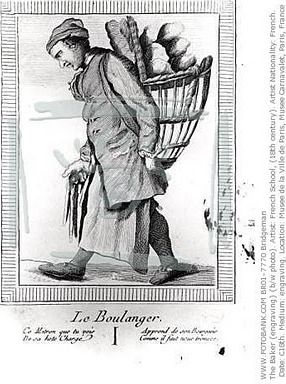
The 18th Century Baker. Links.
http://colonialbaker.net/tableofcontents.html
http://pioneerfoodie.blogspot.com.au/2010/11/pics.html
18th Century Bakery. Diderot.
18th Century Pastery Shop. Diderot.
A French Baker.
Wednesday, 16 May 2012
PRETZELS, FROM EUROPE TO THE NEW WORLD©
http://thehistoricfoodie.wordpress.com/2012/05/16/pretzels-from-europe-to-the-new-world/#comment-115
Labels:
16th century,
17th century,
18th century,
baker,
bread,
food,
Historical,
living history,
Pennsylvania German,
pretzels
Australia
Philadelphia, PA, USA
Wednesday, 6 July 2011
Friday, 10 December 2010
Interesting Historical Info.
Hogarth. There is an old Hotel/Pub in Marble Arch, London, which used to have a gallows adjacent to it. Prisoners were taken to the gallows, (after a fair trial of course) to be hanged. The horse drawn dray, carting the prisoner, was accompanied by an armed guard, who would stop the dray outside the pub and ask the prisoner if he would like ''ONE LAST DRINK''. If he said YES, it was referred to as “ONE FOR THE ROAD” If he declined, that prisoner was “ON THE WAGON”
Tanning Pits
They used to use urine to tan animal skins, so families used to all pee in a pot & then once a day it was taken & sold to the tannery.. If you had to do this to survive you were, "Piss Poor", but worse than that, were the really poor folk, who couldn’t even afford to buy a pot, they "Didn’t have a pot to Piss in" & were the lowest of the low.
Here are some facts about the 1500’s: Most people got married in June, because they took their yearly bath in May and they still smelled pretty good by June. However, since they were starting to smell, brides carried a bouquet of flowers, to hide the body odour. Hence the custom today, of carrying a bouquet when getting married... Baths consisted of a big tub filled with hot water. The man of the house had the privilege of the nice clean water, then all the other sons and men, then the women and finally the children. Last of all the babies. By then the water was so dirty you could actually lose someone in it. Hence the saying, "Don't throw the baby out with the Bath water!"
Houses had thatched roofs, thick straw piled high, with no wood underneath. It was the only place for animals to get warm, so all the cats and other small animals (mice, bugs) lived in the roof. When it rained it became slippery and sometimes the animals would slip and fall off the roof. Hence the saying "It's raining cats and dogs."
There was nothing to stop things from falling into the house. This posed a real problem in the bedroom, where bugs and other droppings could mess up your nice clean bed. Hence, a bed with big posts and a sheet hung over the top, afforded some protection. That's how canopy beds came into existence.
The floor was dirt. Only the wealthy had something other than dirt... Hence the saying, "Dirt Poor." The wealthy had slate floors, that would get slippery in the winter when wet, so they spread thresh (straw) on floor to help keep their footing. As the winter wore on, they added more thresh, until, when you opened the door, it would all start slipping outside. A piece of wood was placed in the entrance-way. Hence: a thresh hold.
In those old days, they cooked in the kitchen with a big kettle that always hung over the fire. Every day, they lit the fire and added things to the pot. They ate mostly vegetables and did not get much meat. They would eat the stew for dinner, leaving leftovers in the pot to get cold overnight, then start over the next day. Sometimes stew had food in it that had been there for quite a while. Hence the rhyme: ''Peas porridge hot, peas porridge cold, peas porridge in the pot, nine days old''
Sometimes they could obtain pork, which made them feel quite special. When visitors came over, they would hang up their bacon, to show off. It was a sign of wealth that a man could, "Bring home the Bacon." They would cut off a little, to share with guests and would all sit around talking and ''Chew the fat''.
Those with money had plates made of pewter. Food with high acid content caused some of the lead to leach onto the food, causing lead poisoning & death. This happened most often with tomatoes, so for the next 400 years or so, tomatoes were considered poisonous.
Bread was divided, according to status. Workers got the burnt bottom of the loaf, the family got the middle, and guests got the top, or ''The Upper Crust''.
Lead cups were used to drink ale or whisky. The combination would sometimes knock the imbibers out for a couple of days. Someone walking along the road, would take them for dead and prepare them for burial. They were laid out on the kitchen table for a couple of days and the family would gather around and eat and drink and wait and see if they would wake up. Hence the custom of ''Holding a Wake''.
England is old and small and the local folks started running out of places to bury people. So, they would dig up coffins and would take the bones to a bone-house and reuse the grave. When reopening these coffins, 1 out of 25 coffins were found to have scratch marks on the inside and they realized they had been burying people alive. So they would tie a string on the wrist of the corpse, thread it through the coffin and up through the ground and tie it to a bell. Someone would have to sit out in the graveyard all night, (the graveyard shift) to listen for the bell; thus, someone could be, ''Saved by the Bell'' or was considered a ''Dead Ringer''.
This information was sent to me by a close friend in England.
Thanks Gwyn, much appreciated.
Labels:
18th century,
bacon,
bathing,
beds,
bread,
cooking,
drinking vessels,
hanging,
lead,
peas porridge,
poison,
tanning,
thatching,
tomatoes,
wake
Subscribe to:
Posts (Atom)