18TH CENTURY LIVING HISTORY, HISTORICAL TREKKING, AND PERIOD WILDERNESS LIVING.
A LIVING HISTORY BLOG.
18TH CENTURY LIVING HISTORY IN AUSTRALIA.
Showing posts with label sashes. Show all posts
Friday, 28 April 2017
“Sprang interlinked:” The Construction of Eighteenth-Century British Army Sashes.
(I am now using Firefox to upload images to this blog. Chrome not allowing me to use images!).
For more information on this new blog please go here: https://www.17thregiment.com/sprang-interlinked-the-construction-of-eighteenth-century-british-army-sashes/#comment-12
Labels:
18th century,
Historical,
living history,
new blog,
sashes,
sprang,
weaving
Australia
Australia
Sunday, 11 September 2016
Some Observations on the Methods by Which Pirates Carry'd Weapons, With Illustrations.
Some Observations on the Methods by Which
Pirates Carry'd Weapons,
With Illustrations.
Pirates Carry'd Weapons,
With Illustrations.
The Pirate
Brethren Articles on The Art of Reenacting.
Plus some images I have collected.
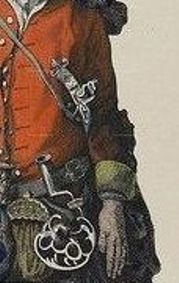
Pistol with belt hook.
To answer Keith
H. Burgess's question specifically about the Blackbeard image - an artist
hired by the author of Charles Johnson's "General History of Piracy"
in 1724 used a description in Johnson's text to create the image. The problem
is that no other document corroborates Johnson's description. Johnson's work
with Blackbeard is highly questioned since there are plenty of questionable or
outright proven wrong parts of the Blackbeard chapter - not to mention that
none of Johnson's descriptions of any pirate captains have ever been corroborated.
There is a strong chance that Johnson invented his description of Blackbeard
from thin air. I cover this issue at the end of my Blackbeard's Firsts article: https://csphistorical.com/.../the-firsts-of-blackbeard.../
To sum up my findings from over the years, the most common way for a sailor or pirate to carry his pistol or pistols during this time appears to be stuck into a belt or girdle, often with the aid of a belt hook. The use of holsters should be approached with great caution - the evidence regarding them is sketchy and not well understood as of this time. I tend to see a bias in people these days towards trying to come up with holsters since our society has been so engulfed in American Westerns where practically all guns are kept in holsters. The most accurate thing to do is to simply stick to having pistols in belts/girdles.
David Fictum.
(My thanks to David Fictum & Matty Bottles for their contribution to this blog post).
Keith.
Image: What Not To Do! Photo with kind permission of Matty Bottles.
Labels:
17th century,
18th century,
belt hooks,
belts,
flintlocks,
historical trekking,
holsters,
living history,
pirates,
pistol carrying,
sashes,
self-defence,
weapons carrying,
woodsrunners
Australia
Australia
Tuesday, 7 May 2013
Saturday, 18 February 2012
Sashes, Garters, and Equipment Straps. Fading Colours.
When researching weaving, bare in mind that colours fade with time and sunlight, and what you see now was probably a lot brighter 300 years ago.
Early to mid 18th century sashes were commonly of one colour, any decoration done with beading. Some though were of two colours, more than two colours were rare but did exist.
My wife wove these straps copying originals.
These images are COPYRIGHT Kravic. The Illustrated Encyclopedia Of The American Revolution. This style existed at least from the French and Indian War through the revolution, possibly earlier.
Early to mid 18th century. These sashes only went once around the waist and tied with the fringe. This is a copy woven by my wife C. L. Burgess. I did the beading. Beads are number 7 French glass beads as per originals.
Garters did not commonly match the sash in colour, eg green sash with green garters.
K.H and C.L. Burgess.
These lower garters are mine. They are finger woven with beaded fringe. Not very flashy, but that is how I like it.
Indian Clothing of the Great Lakes: 1740-1840 by Sheryl Hartman. Eagle’s View Publishing Co.
Sashes For The Fur Trade, by Marius Barbeau. The Beaver, June 1941.
Finger Weaving by Tim Connin, Book of BuckskinningV1, pages 180-213. Scurlock Publishing.
Sunday, 8 January 2012
Research & Authenticity.
Way back 30 years or so when I first got into living history I did not have a computor and I lived a long way from any town. But an American chap I met at a black powder pistol club showed me a "Buckskinning" magazine. I followed many things I read in those magazines not realising that the authors had not done their research properly, and so I was missled. Now I know better, and I challenge what I read. Recently I saw a video from a well known American dealer showing what was supposed to be 18th century kettles. When I asked them for documentation, they supplied a quote from the maker!!!
Correct historical documentation should be primary documentation. That is the written word from someone writing in the period, in my case that would be a writer in the early to mid 18th century such as Peter Kalm for instance. Or it could be documentation in the form of a period painting, such as these by Chardin in 1732. These images show period copper kettles, but look at the size of the originals in comparison to the lower one being sold by some of today's dealers.
Finding an 18th century image of someone wearing a waist belt with the buckle in front proves nothing, but I think we can safely assume that this was the most common way of wearing a belt. I can't say if any woodsman did not wear his belt backwards, I can only suggest that you try it yourself and come to your own conclusion.
Correct historical documentation should be primary documentation. That is the written word from someone writing in the period, in my case that would be a writer in the early to mid 18th century such as Peter Kalm for instance. Or it could be documentation in the form of a period painting, such as these by Chardin in 1732. These images show period copper kettles, but look at the size of the originals in comparison to the lower one being sold by some of today's dealers.
Being made of the same materials is not enough, the fact is this is a 19th century kettle not the larger type made in the 18th century.
The other thing that prompted this post is a post on a new blog belonging to a young man who I am aquainted with. His very first post sais that he has read that Longhunters wore their waist/equipment belts back to front for comfort and so they could wear a pouch in front. To my knowledge this is not correct, and I have found no documentation to back this up. This rumour started way back when a well known living historian misinterpreted some information. The written word stated that the belt was "tied" at the back, not buckled. Now to me this means a sash, sashes are tied, but not leather waist belts.
At the time I read this I remember trying it out myself as experimental archaeology. It was not very succsessful. Have you ever tried to buckle a belt at the back? Have you ever been caught short and had to take such a belt off?! No, it does not make any sense at all. The sash was often tied at the back because it stopped the fringe from getting caught in the brush when in the forest. But the belt was and is buckled in the front. I have never had any discomfort from a belt buckle of normal period size worn at the front.
My belt pouch is worn to one side as was the popular way. When wearing a cartridge box for militia duties I place the buckle to the side of the pouch, not behind.
Sash tied at the back to keep the fringe out of the way.
I have read of a sash lore. When men were visiting they had a way of comunicating their wishes to the opposit sex. To wear the fringe at the back as above, meant that you were not looking for a relationship. To tie the sash on the side meant that you were not actively looking for a lady, but you were open to suggestions. To wear the fringe hanging down directly in front meant that you were actively seeking a relationship with a woman. A very good idea I think.
Subscribe to:
Posts (Atom)