Sunday, 14 November 2010
New England Colonial Living History Group 1680-1760.
This group's new forum is now at: http://eighteenthcenturylivinghistory.freeforums.org/ This group is based near Armidale NSW. Membership is FREE.


Tuesday, 9 November 2010
Monday, 8 November 2010
Sunday, 7 November 2010
Behind The Scenes 1.
This is a scene from the promotional movie that was shot this past weekend. Mark and I were kept on the go all day Sunday moving from one location in Wychwood Forest to another, and from one scene to another. Each scene was shot 3-4 time or more in some cases. We never realised that acting was so tiring! Although the shoot took all day, the main promo will be cut to only 30 seconds! I can't wait to see the finished product.
Due to other shoots on that same day in different location, our film crew were without a jib, reflectors and orange crates! The scene you see here was shot with my own $50.00 camera and a tripod to match. The film crew were using a $5000,00 camera with tripod to match!!! It was tiring, but it was a lot of fun, best time I have had for a long time. If laughing is as good as they say it is for your health, then I should be good for a long time to come after this weekend.
Several people did not turn up for this shoot, which was a pitty, it also meant that there was a lack of equipment as well as actors. Mark is actually using a real sword as against my blunted practice sword, so we had to be carefull!
Wednesday, 3 November 2010
The Great Lakes NSW.
Captain Cook and Matthew Flinders sailed by the area in 1770 and 1799 respectively. Two ships were wrecked off Cape Hawke in 1816, presumably introducing the first white people to the area. The Captain of one of the ships, his wife, child and two crew reached Newcastle. The rest were presumed killed by the indigenous inhabitants of the area.


In 1818, John Oxley and his party, on route to Sydney after an inland expedition, carried a boat from Booti Booti to Boomerang Beach where they spent the night. One of the party was speared by the local Aborigines who watched them from canoes.
Timbergetters investigated Cape Hawke in 1831 and they appear to have treated the indigenous inhabitants very badly. They later scoured the rainforests for cedar and pine using the Wang Wauk River and Wallis Lake to float logs to the coast. We saw signs of old winches and lots of old wharfs now left to decay. Timbergetting, milling, shipbuilding and fishing were the principal industries in the early days with sailing ships then steamships carrying fortnightly cargoes to Sydney.

We tried to find an old mill that we knew was up one of the creeks, but our passage was blocked by years of disuse and the growth of Cumbungi. Days were spent slowly gliding over crystal clear waters where the bottom was visible and littered with gears from old winches, bolts and water logged timbers from old wharfs. There were little shacks dotted about further back in the bush which we suspect were fishing shacks. We found an old cottage on an island long deserted. Other house foundations lay not far from the shore. These houses and workshops instead of being preserved were destroyed by the government to stop people squatting in them.

It gave us a strange feeling being dressed and equipped as we were in 18th century style, travelling this area that had once been an area bustling with boats and sailing ships. Being in winter we were mostly alone on the lakes, although earlier we had met with four unsavory characters who we assumed must be river pirates. They picked up our trail shortly after leaving the wharf near the town that was still intact. We watched them jogging along the shoreline to keep up with us. They were quite a ways off, so may not have been able to see us well. We lost track of them just before we made camp. We think that they knowing the area better than we did got ahead of us to an area they expected us to camp at, because after we made camp they blundered into us coming from the opposite direction to what we had been travelling. They were surprised to see us there and very morose looking. They passed us by without a word. We think that had we not looked like we did, or had not been who we are, there could have been trouble. I could be wrong, they may just have been curious, but given the long way they had travelled and the reception we received, I don’t think so.
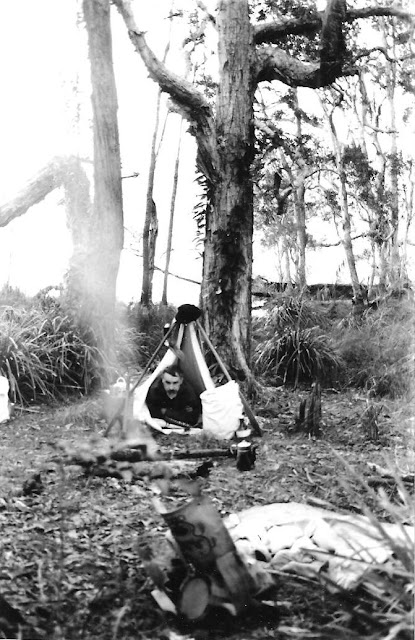
I wish we could have spent longer on the lakes, but Arthur had to return to Armidale for work at the university. There was still a lot left for us to discover on the Great Lakes, so Arthur planned to build a sea going period sail boat with a small cabin, so we could cover more distance in a shorter period of time, and go out of one lake into the sea and back into another lake. But sadly Arthur died from cancer before he could start work on the boat, and that was to be our last trip to The Great Lakes.


In 1818, John Oxley and his party, on route to Sydney after an inland expedition, carried a boat from Booti Booti to Boomerang Beach where they spent the night. One of the party was speared by the local Aborigines who watched them from canoes.
Timbergetters investigated Cape Hawke in 1831 and they appear to have treated the indigenous inhabitants very badly. They later scoured the rainforests for cedar and pine using the Wang Wauk River and Wallis Lake to float logs to the coast. We saw signs of old winches and lots of old wharfs now left to decay. Timbergetting, milling, shipbuilding and fishing were the principal industries in the early days with sailing ships then steamships carrying fortnightly cargoes to Sydney.

We tried to find an old mill that we knew was up one of the creeks, but our passage was blocked by years of disuse and the growth of Cumbungi. Days were spent slowly gliding over crystal clear waters where the bottom was visible and littered with gears from old winches, bolts and water logged timbers from old wharfs. There were little shacks dotted about further back in the bush which we suspect were fishing shacks. We found an old cottage on an island long deserted. Other house foundations lay not far from the shore. These houses and workshops instead of being preserved were destroyed by the government to stop people squatting in them.

It gave us a strange feeling being dressed and equipped as we were in 18th century style, travelling this area that had once been an area bustling with boats and sailing ships. Being in winter we were mostly alone on the lakes, although earlier we had met with four unsavory characters who we assumed must be river pirates. They picked up our trail shortly after leaving the wharf near the town that was still intact. We watched them jogging along the shoreline to keep up with us. They were quite a ways off, so may not have been able to see us well. We lost track of them just before we made camp. We think that they knowing the area better than we did got ahead of us to an area they expected us to camp at, because after we made camp they blundered into us coming from the opposite direction to what we had been travelling. They were surprised to see us there and very morose looking. They passed us by without a word. We think that had we not looked like we did, or had not been who we are, there could have been trouble. I could be wrong, they may just have been curious, but given the long way they had travelled and the reception we received, I don’t think so.

I wish we could have spent longer on the lakes, but Arthur had to return to Armidale for work at the university. There was still a lot left for us to discover on the Great Lakes, so Arthur planned to build a sea going period sail boat with a small cabin, so we could cover more distance in a shorter period of time, and go out of one lake into the sea and back into another lake. But sadly Arthur died from cancer before he could start work on the boat, and that was to be our last trip to The Great Lakes.
Tuesday, 2 November 2010
Historical Trekking by Boat. Lessons Learned!
I have been making some improvements to my boat. Many years ago there was another boat just like this one only slightly smaller. It was equiped with a sail and a detachable mast which was carried in the boat. This craft when sail rigged flew like the wind, fastest I have ever been on the water.
However, on one such trek we were hit by a storm. We got the sail down but were still swamped and we had to get out and swim the boat to shore. This was in winter on the Great Lakes.
I almost lost my water bottle as it kept getting washed away.
On another trip my canoe tipped over in crock infested waters! I lost my new 74 calibre buffalo gun that day. I was lucky to make the river bank alive, and I was not about to go diving for my gun!


However, on one such trek we were hit by a storm. We got the sail down but were still swamped and we had to get out and swim the boat to shore. This was in winter on the Great Lakes.
I almost lost my water bottle as it kept getting washed away.
On another trip my canoe tipped over in crock infested waters! I lost my new 74 calibre buffalo gun that day. I was lucky to make the river bank alive, and I was not about to go diving for my gun!

I have augered holes in the cargo hold stern board for threading rope through.

Also augered holes in the back of the new seat I added at the bow. The threaded rope will form a sort of net that will keep the cargo in the hold should the boat capsize.

I made a removable raised floor for the cargo hold to help keep things dry if water gets into the boat.

These rope holes will also be used to secure guns and anything else that might get lost in a capsize. The water canteen for instance is kept close at hand.

As you can see in this image, there was no forward seating, and I had to sit on Arthur's large bedroll.
Subscribe to:
Posts (Atom)