
Showing posts with label woodland Indian. Show all posts
Showing posts with label woodland Indian. Show all posts
Thursday, 22 August 2019


Wednesday, 21 August 2019

Tuesday, 4 June 2019

Tuesday, 15 January 2019


Friday, 16 March 2018

Tuesday, 21 November 2017
National Museum of the American Indian. A Link.

Joseph Brant, by Gore Romney
My thanks to my friend Swampfox for supplying this link. Thanks mate.
Keith.
http://www.nmai.si.edu/searchcollections/peoplescultures.aspx
Sunday, 1 October 2017
British Museum Shot Pouch. Undated!

Museum number
Am1991,09.4
Full: Front
Rectangular flat pouch or bag, with strap, fingerwoven of wool. The
flat bag is constructed from one or two pieces of red wool plaited cloth, with
a central resist [undyed] paler horizontal stripe across the front. The vertical
edges include black wool.

Rectangular flat pouch or bag, with strap, fingerwoven of wool. The
flat bag is constructed from one or two pieces of red wool plaited cloth, with
a central resist [undyed] paler horizontal stripe across the front. The
vertical edges include black wool, with a line of opaque white beads and
stitching in a brown vegetal thread. The bottom seam also includes stitching in
a brown vegetal thread, with a line of quill wrapped wool fringing, each ending
in a red hair filled metal comb, the colour of the quills being alternating
black and white bands. The front of the bag is further decorated, just above
the resist dyed strip, with a further fringe similar to that at the bottom.
Woven into the front of the bag is a geometric design in irregular opaque white
beads: two vertical lines of chevrons, with a double zig zag line up the centre
and single zig-zag lines up both vertical edges. The points of the chevrons
face downwards. The back and less faded side of the bag is decorated with a
double row, vertical, each of butterfly-like geometric designs, each row being
3 high; the vertical seams each have rows of five small diamonds. All the
patterns are in the same opaque white glass beads. The top of the bag is edged
with green tape, enclosed in lines of white beads, back and front. The bag is
lined with a coarse reddish manufactured cloth. // The strap is also plaited,
in two greenish colours, that at the edge being slightly yellower than the
reddish green colour of the body of the strap. The strap is attached by sewing with
the brown vegetable thread at the two top corners of the pouch opening. The strap
finishes on both sides with a plaited wool fringe, on the left [from the front]
with six plaits, and on the right with five plaits. Woven into these plaits or
braids are white beads, incorporating slightly darker green wool. The main body
of the strap incorporates in the weaving a diamond pattern of white beads, with
along the slightly contrasting colour edges, rows of white beads, at the
absolute edge and at the boundary between the two colours. Repairs to the
beadwork seem to have been carried out with this darker green wool.
Monday, 11 September 2017

Wednesday, 7 June 2017

Friday, 31 March 2017

Tuesday, 28 February 2017

Friday, 27 January 2017

Friday, 20 January 2017

Tuesday, 6 December 2016


Saturday, 21 May 2016
Indians At War-Period Quotes.

Summit Meeting By Robert Griffing.
Indians At War.
"Their Arms are a Gun and Tomahawk, and all the Provisions
they carry from Home is a Pouch of Rockahominy. Thus provided and accoutr'd, they
march towards their Enemy's Country, not in a Body, or by a certain Path, but
Straggling in Small Numbers, for the greater convenience of Hunting and passing
along undiscover'd. So soon as they approach the Grounds on which the Enemy is
used to hunt, they never kindle any Fire themselves, for fear of being found
out
by the smoak, nor will they Shoot at any kind of Game,
tho' they shou'd be half Famisht, lest they might alarm their Foes, and put
them upon their Guard. Sometimes indeed, while they are still at some distance,
they roast either Venison or Bear, till it is very dry, and then having Strung
it on their Belts, wear it round their Middle, eating very Sparingly of it,
because
they know not when they shall meet with a fresh Supply. But
coming nearer, they begin to look all round the Hemisphere, to watch if any smoke
ascends, and listen continually for the Report of Guns, in order to make some
happy Discovery for their own advantage".
WILLIAM BYRD'S DIVIDING LINE HISTORIES
Mid 18th century.
Sunday, 25 October 2015
Corn, can it really sustain you on a long trek?


I have read that the Woodland Indians travelled with just corn to sustain them on their long journeys, & I have often wondered, knowing a little about the properties of corn or the lack there of, how they managed to survive. Then recently one of my sons happened to mention to me the advantages of cooking corn in a lye solution. Apparently the action of the lye on the corn releases nutrients in the corn that otherwise could not be accessed. Now of course I had read about the Indians boiling & soaking corn in a solution of lye, but I had not realised the full potential of this process. So I started researching to see if the parched corn that these woodland travelers carried & ate, was first treated with a lye solution, & found that it was!
Now I don't recall when reading about parched & dried corn used as trail food the mention anywhere about treating first with a lye solution. Now of course this makes perfect sense, no wonder they were able to travel long distances on just dried corn. Of course the lye solution can only release those nutrients that are in the corn, so it does have its limitations. As daily meals under normal circumstances other foods such as meat would have to be included to keep one fit & healthy, but as a trail food for a limited time, this maize or corn was indeed quite adequate.
It is interesting to note that the Europeans did not take this knowledge of treating corn with lye back home with them, so the many recipes we use today lack the nutrition that is locked away inside the corn kernel!

The author's brass trade kettle.

Indians cooking & drying meat.
Wednesday, 23 September 2015
More On The Shot Pouch-A Personal Choice.


The shot pouch was and is a practicle item worn by some hunters/shooters. This pouch carries the shot and tools necessary for the functioning of a muzzle-loading gun or rifle. As to the wearing of a shot pouch, it is not my purpose here to dictate how it should be correctly worn, as I think this is a personal choice. I have found though that carrying the shot pouch too low poses problems when hunting in the bush, so I wear my own pouch as high as I can under my right arm and still get my hand into the pouch without having to move it to my front.
My shot pouch is not large, and a larger opening would I think allow me to wear it higher. Also I may be a little restricted from a past shoulder injury, so these are things to take into account when viewing original painting of the period. The paintings here are 18th and 19th century, as it is the position of the pouch we are concerned with when it is worn by those who earn their living from hunting and trapping.
Someone recently made the observation that Gentlemen may not necessarily wear a shot pouch in the same way as a hunter or trapper. This could quite possibly be true, so I have included artwork of Gentlemen shooters as well as hunters and trappers. But as you will see, very few Gentlemen actually used a shot pouch, preferring instead to carry their accouterments in their coat pockets.

Attributed to David, Antonio (Italian painter, active 1684) , William Howard, Viscount Andover (1714-56).

England 1769 William Hulton with Gun-Dog and Shotgun by Henry Pickering (British artist, fl 1740-c 1771).

Fleetwood Hezketh
Joseph Wright of Derby (1769)

England 1680 John Poulett, 1st Earl Poulett by John Closterman (British artist, 1660-1711).

The pouch hanging on the tree looks too small to be a game bag.
England 1774 Sir Edward Hales, Baronet, of Hales Place, Hackington, Kent by Philip Mercier (German-born painter, c 1689-1760).

Detail from James and Mary Shuttleworth...
Joseph Wright of Derby (1764)

This English Gentleman appears to have a shot pouch on a waist belt, which can be seen on the rock to the right.
England 1752 A Sportsman by Edward Haytley 1752.
England 1752 A Sportsman by Edward Haytley 1752.

This Gentleman is indeed using what appears to be a shoulder slung shot pouch, but this I believe was painted in America.
1782 Colonel John Onslow by Ralph Earl (American painter, 1751-1801).
1782 Colonel John Onslow by Ralph Earl (American painter, 1751-1801).
The following paintings are of hunters and trappers in America.
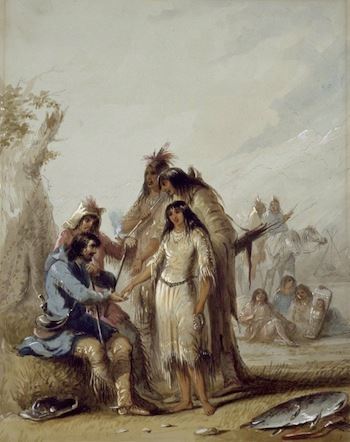
The Trapper's Bride, Alfred Jacob Miller.

charles-deas-jake-el-largo-museos-y-pinturas-juan-carlos-boveri.

No artist named for this painting.

Joseph Brant 1790.

Again, no artist named, but notice the pouch hanging over the powder horn.

Two American riflemen as drawn by a Hessian. These could be cartridge boxes or shot pouches. Also note the bayonets ! Some artistic licence being used here I suspect.


Wednesday, 27 May 2015

Sunday, 10 May 2015
COLONIAL AMERICAN DIGRESSIONS: INDIAN CAPTIVES
COLONIAL AMERICAN DIGRESSIONS: INDIAN CAPTIVES: The Capture of Mary Rowlandson Courtesy of 17th18Century.blog Mary Rowlandson, 10 February 1675 ‘…But out we must go, the fire...

Subscribe to:
Posts (Atom)