I finally got our Three Sisters Garden finished & planted. The beans will go in when the corn is about 5 inches high.
18TH CENTURY LIVING HISTORY, HISTORICAL TREKKING, AND PERIOD WILDERNESS LIVING.
A LIVING HISTORY BLOG.
18TH CENTURY LIVING HISTORY IN AUSTRALIA.
Showing posts with label corn. Show all posts
Sunday, 29 November 2015
Our Three Sisters Garden.
Labels:
18th century,
Australia,
beans,
corn,
experimental archaeology,
food,
garden,
living history,
maize,
North America,
pumpkin,
squash,
survival,
three sisters
Australia
Australia
Sunday, 25 October 2015
Corn, can it really sustain you on a long trek?
I have read that the Woodland Indians travelled with just corn to sustain them on their long journeys, & I have often wondered, knowing a little about the properties of corn or the lack there of, how they managed to survive. Then recently one of my sons happened to mention to me the advantages of cooking corn in a lye solution. Apparently the action of the lye on the corn releases nutrients in the corn that otherwise could not be accessed. Now of course I had read about the Indians boiling & soaking corn in a solution of lye, but I had not realised the full potential of this process. So I started researching to see if the parched corn that these woodland travelers carried & ate, was first treated with a lye solution, & found that it was!
Now I don't recall when reading about parched & dried corn used as trail food the mention anywhere about treating first with a lye solution. Now of course this makes perfect sense, no wonder they were able to travel long distances on just dried corn. Of course the lye solution can only release those nutrients that are in the corn, so it does have its limitations. As daily meals under normal circumstances other foods such as meat would have to be included to keep one fit & healthy, but as a trail food for a limited time, this maize or corn was indeed quite adequate.
It is interesting to note that the Europeans did not take this knowledge of treating corn with lye back home with them, so the many recipes we use today lack the nutrition that is locked away inside the corn kernel!
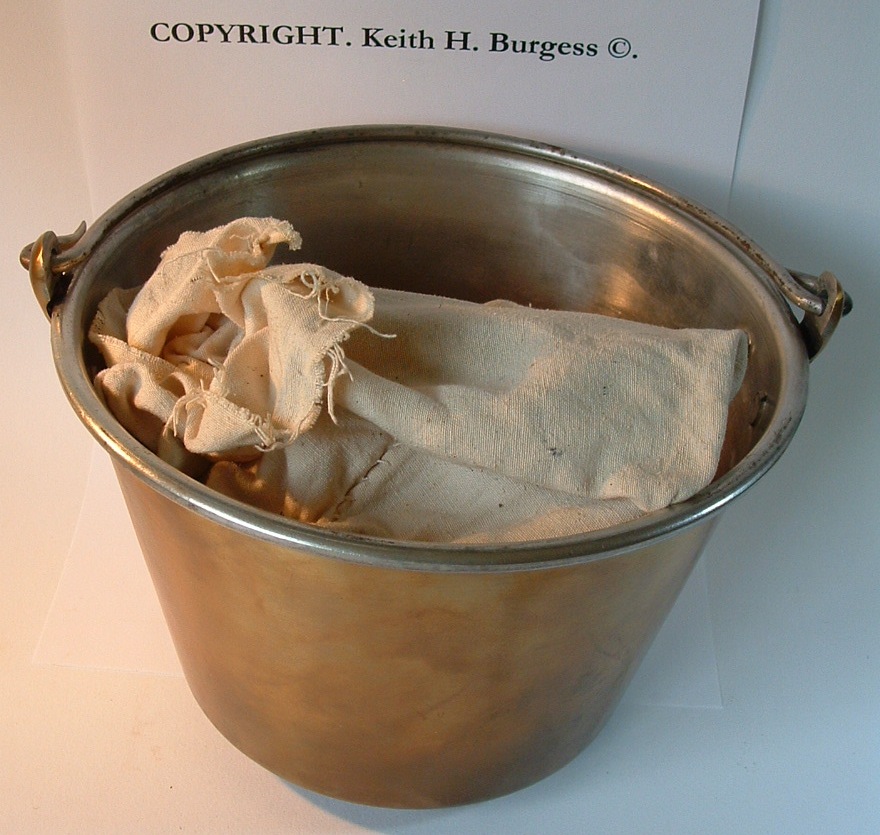
The author's brass trade kettle.
Indians cooking & drying meat.
Labels:
18th century,
colonial,
corn,
European,
historical trekking,
Hunting,
living history,
lye,
maize,
meat,
parched corn,
settlers,
survival,
sustain,
Trail foods,
trapping,
travel foods,
woodland Indian
Australia
North America
More on Kettles, a Blog Link.
Labels:
18th century,
brass kettles,
cooking,
corn,
food,
living history,
trade kettles,
woodland Indians
Australia
North America
Thursday, 9 April 2015
Drying Corn On The Cob For Storing Or Trail Food. VIDEO.
Heritage Native corn is braided by their husks and hung to finish the drying process. Demonstrated by www.WoodlandIndianEDU.com
Labels:
18th century,
colonial,
corn,
drying,
foods,
living history,
preserving,
storing,
survival,
trail food
Australia
Australia
Monday, 6 April 2015
Archive for the ‘corn’ Category. FORTBLOG.
Labels:
18th century,
colonial,
corn,
food,
historical trekking,
Indians,
living history,
preserving,
woodland
Australia
North America
Thursday, 20 October 2011
Pinole. A Request From Bob.
Thanks for asking the question Bob.
Pinole.
Their Psindamooan or Tassmanane, as they call it, is the most nourishing- and durable food made out of the Indian corn. The blue sweetish kind is the grain which they prefer for that purpose. They parch it in clean hot ashes, until it bursts, it is then sifted and cleaned, and pounded in a mortar into a kind of flour, and when they wish to make it very good, they mix some sugar [i.e., maple sugar] with it. When wanted for use, they take about a tablespoonful of this flour in their mouths, then stooping to the river or brook, drink water to it. If, however, they have a cup or other small vessel at hand, they put the flour in it and mix it with water, in the proportion of one tablespoonful to a pint. At their camps they will put a small quantity in a kettle with water and let it boil down, and they will have a thick pottage.
With this food the traveler and warrior will set out on long journeys and expeditions, and as a little of it will serve them for a day, they have not a heavy load of provisions to carry. Persons who are unacquainted with this diet ought to be careful not to take too much at a time, and not to suffer themselves to be tempted too far by its flavor; more than one or two spoonfuls, at most, at any one time or at one meal is dangerous; for it is apt to swell in the stomach or bowels, as when heated over a fire.
“History, Manners and Customs of the Indian Nations” By John Gottlieb Ernestus Heckewelder. Published in the early 19th century.
Wednesday, 20 April 2011
On Meat Alone.
On Meat Alone.
The list of period foods is quite long, but whose foods are they? Would a woodsrunner bother to carry dried peas, parched corn, oats & currents? Somehow I don’t think so. It all adds to the weight, & sooner or later it has to run out, & what then? Well, he or she hunts for meat.
So I started looking for the least weighty foods, & foods that would compliment meat. Jerky is mentioned many times, & this food I think was pretty popular with woodsrunners, & so was bread, or flour. Yes bread & flour can run out too, but is it possible to survive on meat alone & stay healthy? Or would one get the dreaded scurvy? It appears that one can survive on meat alone, & I have no doubt that this is what woodsrunners did. Following is the information I have found so far.
Faragher, John M. Daniel Boone: the life and legend of an American pioneer (1992).
"On March the 28th, as we were hunting for provisions, we found Samuel Tate's son, who gave us an account that the Indians fired on their camp on the 27th day.
On the 7th day of February, as I was hunting to procure meat for the company.
"A day was soon appointed for the march of the little cavalcade to the camp. Two or three horses furnished with pack−saddles were loaded with flour, Indian meal, blankets, and every thing else requisite for the use of the hunter.
Daniel Boone. Life & Times of Col. Daniel Boone 1775.
Tuesday 6 Wednesday 7 and Thursday 8--Had Snow and such Bad weather that we could not travel for three days; but I killed a young Bear so that we had provisions enough.
Thursday 7.--Set out with my Horse Load of Bear Meat and travelled about 30 M this afternoon I met a Young Man (a Trader) and we encamped together that night; He happened to have some Bread with him, and I had plenty of Meat so we Fared very Well.
Wednesday 16.--Set out SW 25 M to Licking Creek--the Land from Muskingum to this place rich but
Broken--Upon the N Side of Licking Creek about 6 M from the Mouth, are sevaral Salt Licks, or Ponds,
formed by little Streams or Dreins of Water, clear but of a blueish Colour, & salt taste the Traders and
Indians boil their Meat in this water which (If proper Care not be taken) will make it too salt to eat.
Monday 4.--This day I hard sevral Guns, but was afraid to examine who fired Them, lest they might be some of the French Indians, so I travelled thro the Woods about 30 M; just at night I killed a fine barren
Cow-Buffaloe and took out her tongue and a little of her best meat:
Wednesday 6.--I travelled about 30 M and killed a fat Bear.
Sunday 12.--Stayed to rest and Dry some Meat we had Killed.
The Journal of Christopher Gist, 1750-1751.
. We had carried but little provisions with us, and the next morning was entirely out of meat.
I worked on with my hands till the bears got fat, and then I turned out to hunting, to lay in a supply of meat. I soon killed and salted down as many as were necessary for my family;
Narrative of the Life of David Crockett of the State of Tennessee_ (1834) by David Crockett.
We are now without bread and are compelled to hunt the buffalo to preserve life....
"Sunday 26th...procured some buffalo meat; though poor it was palatable.
Pioneers of the Old Southwest by Constance Skinner.
These months on fish were the beginning of several years during which I lived on an exclusive meat diet.
Adventures in Diet Part 1 By Vilhjalmur Stefansson
Harper's Monthly Magazine, November 1935.
Prolonged meat diet study.
http://www.jbc.org/content/87/3/651.full.pdf
In 1785 I visited the rough and hilly country of Otsego, where there existed not an inhabitant, nor any trace of a road; I was alone three hundred miles from home, without bread, meat, or food of any kind; fire and fishing tackle were my only means of subsistence. I caught trout in the brook, and roasted them on the ashes. My horse fed on the grass that grew by the edge of the waters. I laid me down to sleep in my watch coat, nothing but the melancholy wilderness around me. In this way I explored the country, formed my plans of future settlement, and meditated upon the spot where a place of trade or a village should afterwards be established.
William Cooper.
Meat made up a large portion of the diets of residents of eighteenth-century England.
http://www.umich.edu/~ece/student_projects/food/foods.htm
Some settlers were driven by curiosity or necessity to hunt and eat the native mammals. Stuffed wombat and fried echidna were on the menu in early settlements in Van Diemen's Land, as Tasmania was known in those times.
Flour was a staple item of the early settler's diet. It was usually made into bread or damper.
Other foods that seem less palatable to modern urban Australians - such as witchetty grubs, lizards, snakes and moths - were greatly valued.
http://www.cultureandrecreation.gov.au/articles/foodanddrink/
Men Were Hunters and Brought Home Larger Animals
Men were hunters while women were gatherers. Hunting larger animals, the Aboriginal men often worked in groups while smaller animals were often hunted individually. There was plenty of animal food like kangaroos, wallabies, echidnas, possums, bats, pademelons, bandicoots, goannas, lizards, frogs, snakes and birds like cockatoos, parrots, ducks, emus, swans and bush turkeys. Coastal people also ate a wide range of seafood, fish and marine animals like dugongs and turtles. Aboriginal men used a wide range of tools like spears and boomerangs while hunting. Nocturnal animals were not hunted during the night, but caught in their burrows where they were sleeping during the day.
http://www.gondwananet.com/australian-aboriginal-food.html
That night we had a mess of wheat for our supper.
There came an Indian to them at that time with a basket of horse liver.
As we went along they killed a deer, with a young one in her, they gave me a piece of the fawn.
I went, and he gave me a pancake, about as big as two fingers. It was made of parched wheat, beaten, and fried in bear's grease, but I thought I never tasted pleasanter meat in my life.
There was a squaw who spake to me to make a shirt for her sannup, for which she gave me a piece of bear. Another asked me to knit a pair of stockings, for which she gave me a quart of peas. I boiled my peas and bear together, and invited my master and mistress to dinner;
They would eat horse's guts, and ears, and all sorts of wild birds which they could catch; also bear, venison, beaver, tortoise, frogs, squirrels, dogs, skunks, rattlesnakes; yea, the very bark of trees;
A Narrative of the Captivity and Restoration of Mrs. Mary Rowlandson 1676.
Our Kettle was put over the fire with some pounded Indian Corn, and after it had boiled about two hours, my oldest Indian Brother returned with a She Beaver, big with young, which he soon cut to pieces, and threw into the kettle, together with the guts, and took the four young beavers, whole as they came out of the dam, and put them likewise into the kettle, and when all was well boiled, gave each one of us a large dishful of broth, of which we ate freely, and then part of the Old Beaver, the Tail, of which was divided equally amongst us, there being Eight at our fire; The four young Beavers were cut in the middle, and each of us got half of a Beaver; I watched an opportunity to hide my share, having satisfied myself before that tender dish came to hand, which if they had seen, would have much displeased them.
The other Indians catched young Musk-Rats, run a stick through their bodies, and roasted, without being skinned or gutted, and so eat them."
ROBERT EASTMAN-1759
We had one — and but one— dog along with us ; he was large and very fat, and this evening he fell a sacrifice to our necessities. Our custom on this march was to encamp ten men at a fire. The dog was carefully butchered and divided into seven parts, except the entrails which the butcher had for his fees. These he brought to our fire, and ten of us made a very good supper of their fat, without bread or salt.
Journal of Rufas Putnam 1754.
and found an Indian by the river side, resting himself. All his provision was a dried eel;
John Bartram 1743.
We dined on parched meal, which is some of the Indian's best traveling provision. They take the corn and parch it in hot ashes, till it becomes brown, then clean it, pound it in a mortar and sift it; this powder is mixed
with maple sugar. About one gill, diluted in a pint of water, is a hearty traveling dinner.
John Bartram (1751) Travels In Pensilvania and Canada.
May 8th Friday Cloudy and warm, we continued at our incampment and made shift to Purchace half Bushel of Corn, which we Parched and Pounded to meal, which we thickened with water and sweeten'd with sugar and Drank for Diet….
Joel Watkins Journal* (1789)
They make also a certain sort of meal of parched maize. This meal they call nocake. It is so sweet, toothsome, and hearty, that an Indian will travel many days with no other food but this meal, which he eateth as he needs, and after it drinketh water. And for this end, when they travel a journey, or go a hunting, they carry this nocake in a basket or bag for their use.
Gookin 1674 http://plymoutharch.tripod.com/id226.html
The list of period foods is quite long, but whose foods are they? Would a woodsrunner bother to carry dried peas, parched corn, oats & currents? Somehow I don’t think so. It all adds to the weight, & sooner or later it has to run out, & what then? Well, he or she hunts for meat.
So I started looking for the least weighty foods, & foods that would compliment meat. Jerky is mentioned many times, & this food I think was pretty popular with woodsrunners, & so was bread, or flour. Yes bread & flour can run out too, but is it possible to survive on meat alone & stay healthy? Or would one get the dreaded scurvy? It appears that one can survive on meat alone, & I have no doubt that this is what woodsrunners did. Following is the information I have found so far.
"and on the first day of May 1770, my brother returned home to the settlement by himself, for a new recruit of horses and ammunition, leaving me by myself, without bread, salt or sugar, without company of my fellow creatures, or even a horse or dog."
Daniel Boone 1770.Faragher, John M. Daniel Boone: the life and legend of an American pioneer (1992).
"On March the 28th, as we were hunting for provisions, we found Samuel Tate's son, who gave us an account that the Indians fired on their camp on the 27th day.
On the 7th day of February, as I was hunting to procure meat for the company.
"A day was soon appointed for the march of the little cavalcade to the camp. Two or three horses furnished with pack−saddles were loaded with flour, Indian meal, blankets, and every thing else requisite for the use of the hunter.
Daniel Boone. Life & Times of Col. Daniel Boone 1775.
Tuesday 6 Wednesday 7 and Thursday 8--Had Snow and such Bad weather that we could not travel for three days; but I killed a young Bear so that we had provisions enough.
Thursday 7.--Set out with my Horse Load of Bear Meat and travelled about 30 M this afternoon I met a Young Man (a Trader) and we encamped together that night; He happened to have some Bread with him, and I had plenty of Meat so we Fared very Well.
Wednesday 16.--Set out SW 25 M to Licking Creek--the Land from Muskingum to this place rich but
Broken--Upon the N Side of Licking Creek about 6 M from the Mouth, are sevaral Salt Licks, or Ponds,
formed by little Streams or Dreins of Water, clear but of a blueish Colour, & salt taste the Traders and
Indians boil their Meat in this water which (If proper Care not be taken) will make it too salt to eat.
Monday 4.--This day I hard sevral Guns, but was afraid to examine who fired Them, lest they might be some of the French Indians, so I travelled thro the Woods about 30 M; just at night I killed a fine barren
Cow-Buffaloe and took out her tongue and a little of her best meat:
Wednesday 6.--I travelled about 30 M and killed a fat Bear.
Sunday 12.--Stayed to rest and Dry some Meat we had Killed.
The Journal of Christopher Gist, 1750-1751.
Pamela Patrick-White. Well Dressed Victuals.
. We had carried but little provisions with us, and the next morning was entirely out of meat.
I worked on with my hands till the bears got fat, and then I turned out to hunting, to lay in a supply of meat. I soon killed and salted down as many as were necessary for my family;
Narrative of the Life of David Crockett of the State of Tennessee_ (1834) by David Crockett.
We are now without bread and are compelled to hunt the buffalo to preserve life....
"Sunday 26th...procured some buffalo meat; though poor it was palatable.
Pioneers of the Old Southwest by Constance Skinner.
These months on fish were the beginning of several years during which I lived on an exclusive meat diet.
Adventures in Diet Part 1 By Vilhjalmur Stefansson
Harper's Monthly Magazine, November 1935.
Prolonged meat diet study.
http://www.jbc.org/content/87/3/651.full.pdf
In 1785 I visited the rough and hilly country of Otsego, where there existed not an inhabitant, nor any trace of a road; I was alone three hundred miles from home, without bread, meat, or food of any kind; fire and fishing tackle were my only means of subsistence. I caught trout in the brook, and roasted them on the ashes. My horse fed on the grass that grew by the edge of the waters. I laid me down to sleep in my watch coat, nothing but the melancholy wilderness around me. In this way I explored the country, formed my plans of future settlement, and meditated upon the spot where a place of trade or a village should afterwards be established.
William Cooper.
Meat made up a large portion of the diets of residents of eighteenth-century England.
http://www.umich.edu/~ece/student_projects/food/foods.htm
Some settlers were driven by curiosity or necessity to hunt and eat the native mammals. Stuffed wombat and fried echidna were on the menu in early settlements in Van Diemen's Land, as Tasmania was known in those times.
Flour was a staple item of the early settler's diet. It was usually made into bread or damper.
Other foods that seem less palatable to modern urban Australians - such as witchetty grubs, lizards, snakes and moths - were greatly valued.
http://www.cultureandrecreation.gov.au/articles/foodanddrink/
Men Were Hunters and Brought Home Larger Animals
Men were hunters while women were gatherers. Hunting larger animals, the Aboriginal men often worked in groups while smaller animals were often hunted individually. There was plenty of animal food like kangaroos, wallabies, echidnas, possums, bats, pademelons, bandicoots, goannas, lizards, frogs, snakes and birds like cockatoos, parrots, ducks, emus, swans and bush turkeys. Coastal people also ate a wide range of seafood, fish and marine animals like dugongs and turtles. Aboriginal men used a wide range of tools like spears and boomerangs while hunting. Nocturnal animals were not hunted during the night, but caught in their burrows where they were sleeping during the day.
http://www.gondwananet.com/australian-aboriginal-food.html
That night we had a mess of wheat for our supper.
There came an Indian to them at that time with a basket of horse liver.
As we went along they killed a deer, with a young one in her, they gave me a piece of the fawn.
I went, and he gave me a pancake, about as big as two fingers. It was made of parched wheat, beaten, and fried in bear's grease, but I thought I never tasted pleasanter meat in my life.
There was a squaw who spake to me to make a shirt for her sannup, for which she gave me a piece of bear. Another asked me to knit a pair of stockings, for which she gave me a quart of peas. I boiled my peas and bear together, and invited my master and mistress to dinner;
They would eat horse's guts, and ears, and all sorts of wild birds which they could catch; also bear, venison, beaver, tortoise, frogs, squirrels, dogs, skunks, rattlesnakes; yea, the very bark of trees;
A Narrative of the Captivity and Restoration of Mrs. Mary Rowlandson 1676.
Our Kettle was put over the fire with some pounded Indian Corn, and after it had boiled about two hours, my oldest Indian Brother returned with a She Beaver, big with young, which he soon cut to pieces, and threw into the kettle, together with the guts, and took the four young beavers, whole as they came out of the dam, and put them likewise into the kettle, and when all was well boiled, gave each one of us a large dishful of broth, of which we ate freely, and then part of the Old Beaver, the Tail, of which was divided equally amongst us, there being Eight at our fire; The four young Beavers were cut in the middle, and each of us got half of a Beaver; I watched an opportunity to hide my share, having satisfied myself before that tender dish came to hand, which if they had seen, would have much displeased them.
The other Indians catched young Musk-Rats, run a stick through their bodies, and roasted, without being skinned or gutted, and so eat them."
ROBERT EASTMAN-1759
We had one — and but one— dog along with us ; he was large and very fat, and this evening he fell a sacrifice to our necessities. Our custom on this march was to encamp ten men at a fire. The dog was carefully butchered and divided into seven parts, except the entrails which the butcher had for his fees. These he brought to our fire, and ten of us made a very good supper of their fat, without bread or salt.
Journal of Rufas Putnam 1754.
and found an Indian by the river side, resting himself. All his provision was a dried eel;
John Bartram 1743.
We dined on parched meal, which is some of the Indian's best traveling provision. They take the corn and parch it in hot ashes, till it becomes brown, then clean it, pound it in a mortar and sift it; this powder is mixed
with maple sugar. About one gill, diluted in a pint of water, is a hearty traveling dinner.
John Bartram (1751) Travels In Pensilvania and Canada.
May 8th Friday Cloudy and warm, we continued at our incampment and made shift to Purchace half Bushel of Corn, which we Parched and Pounded to meal, which we thickened with water and sweeten'd with sugar and Drank for Diet….
Joel Watkins Journal* (1789)
They make also a certain sort of meal of parched maize. This meal they call nocake. It is so sweet, toothsome, and hearty, that an Indian will travel many days with no other food but this meal, which he eateth as he needs, and after it drinketh water. And for this end, when they travel a journey, or go a hunting, they carry this nocake in a basket or bag for their use.
Gookin 1674 http://plymoutharch.tripod.com/id226.html
Friday, 14 January 2011
Puritan Family Of New England.
This one has been posted here before, but I thought it worth a re-visit.
Saturday, 14 November 2009
18th Century Gardens in the New World.

One of our garden beds ready for planting. The rock is heavy so we left it in place.
Our Jerusalem Artichoke patch.
This garden on the left has an outside clay oven.
Here the beans grow up a tripod of sticks on a mound. The pumpkins planted around the mound.In these images you can see that we have used logs to contain our gardens. This enables us to add soil and mulch without it spreading.
The woodland Indians grew the three sister together. First the corn was planted. When the corn was up and still young the beans would be planted next to the corn plants. This served two purposes, the beans would climb the corn plants as both grew, and the beans would add nitrogen to the soil for the corn to feed on. The pumpkins/squash would be planted around the outside of the corn patch.
Subscribe to:
Posts (Atom)