A LIVING HISTORY BLOG.

18TH CENTURY LIVING HISTORY IN AUSTRALIA.
Showing posts with label persona. Show all posts

Wednesday, 20 July 2016

Guns & Ammunition. The Old Bailey Records.


Guns & Ammunition. The Old Bailey Records.
 he caused a Ladder to be fetched, and a Blunderbuss charged with Peas, being Fired in at the Grate under the Arch, the dread of a further Harm, induced them to more calmness. However, they continued to declare, they would rather dye in the place, than be Executed at Tyburn,
Ordinary's Account, 15th July 1689.
And upon that, did (that is, one of them) shoot him with a Brass-Piece or Blunderbuss, and lodged seven or eight Bullets in his Body. 
Ordinary's Account, 7th February 1705.
 and purchas'd 2 Pistols and a half Blunderbuss, which was all the Arms he ever used on the High way, although Jo-s carried along with him (also) a sharp Knife, and sometimes a Dagger. 
Ordinary's Account, 26th July 1731.
 a Guard thereto, as soon as the Passengers had been plundered, discharged a Blunderbuss, and shot W - in the Hip with a Slug, and graz'd him under the Eye with another; upon which Fluellin set Spurs to his Horse, and riding up to him, shot him Dead upon the spot, and then gallopp'd off.
Ordinary's Account, 8th November 1738.


Monday, 5 January 2015

NEW ENGLAND COLONIAL LIVING HISTORY GROUP 1680-1760 FORUM AND GROUP.


This group is based near Guyra and Armidale and not far from Uralla in New England NSW Australia. Our main focus in history is the settlement of the New World, and our activities include:
Historical Trekking.
Experimental Archaeology.
Learning and practicing primitive and period living skills.
Long Term Wilderness Survival.
Historical Research.

1) Areas within our Forum include:
2) Who We Are and What We Do.
3) New member Introductions.
4) IMPORTANT NOTICES.
5) Activities Calender/Diary.
6) The Pilgrim's Forum.
7) 18th Century Historical Trekking.
8) The Homestead.
9) Living History Activity Suggestions.
10) Period Clothing.
11) Equipment Supplies and Tools.
12) Primitive and Period Living Skills.
13) Cooking.
14) Resources.
15) Period Guns.
16) Persona/Character.
17) Boats and Boating.
18) Stories and Experiences.
19) Forum Ideas and Suggestions.
20) Sword, Axe and Staff Fighting.
21) Other Groups in Australia.
22) Show and Tell.
23) Ranger, Militia, Scouts and Spies.
24) A Woodland Indian Persona.
25) Textiles.
26) General Living History Information.
27) Advertising Ideas/Recruitment.
28) The Survival Connection.
29) The Club House.
30) What Are You Up To?
31) The Trading Post.
32) UK Forums and Group.
33) Period Movies.
34) Woodworking.
35) Complaints.
36) NECLHG 1680-1760 World Wide Chapters.
37) The Chapter Captains' Lounge.
Anyone is welcome to join our group and our forum. Membership is FREE.


Saturday, 6 September 2014

What is Authentic, and what is not?

What is Authentic, and what is not?
Way back when I first got into 18th century living history, there was a belief among many that if an object was made out of authentic natural materials, then it must be right. This was called being “primitive”. But later on I learnt that this was not how it should be done, a lot of research has to be done to make sure that (a) a particular item did in fact exist, (b) what materials that item was commonly made from, and (c) the item would have been available to your persona in your particular chosen period.
We, those of us who are serious living historians, do not wish to invent something new because it makes life easier; we are only concerned with what actually was. It is simply not good enough to say “well the material was available, and someone may have thought to do this”, yes they may have, but did they? Where is your proof? Where is your documentation?
I have seen items like tricky cap holders made from horn and wood, I have seen holes drilled in the base of knife handles to be used as a powder measure, knives that are also fire steels, and shelters that there is to my knowledge no record of ever existing. Take the diamond shelter for instance, just like the 20th century “Baker Tent” the Diamond shelter seems to have become accepted at Rendezvous because it is made from canvas.
 But no where is period writings have I read that this type of shelter was ever used, the most common shelter used seems to have been the lean-to, whether made using a blanket or an oilcloth. So if you want to use a diamond shelter or a Baker Tent, fine, but don’t kid yourself that you are camping in 18th century style.

"The hunting and target rifles by their various makers, intended for the use their title denotes, had the octagon barrel turned cylindrically at the muzzle for about one inch to fit the guide bullet starter which was used in loading the rifle when used for target work... weighed from about 9 to 14 pounds, and had a longer accuracy range than the hunting rifles as well as being more accurate. These were also provided with a 'straight starter,' much lighter than the other, for use when hunting with these rifles and had various combinations of sights"

Ned Roberts, THE MUZZLE-LOADING CAPLOCK RIFLE, 1944

"Some earlier percussion rifles are 'turned for a starter' i.e., have their octagon barrels turned cylindrical for an inch or a little less at the muzzle in order to accept a plunger-like arrangement for driving the bullet the first few inches into the barrel."

Holman J. Swinney, NEW YORK STATE GUNMAKERS, 1952
New 19th Century Plungers.


http://www.living-in-the-past.com/dadsoldgun.html


Non authentic turn screw/nipple wrench combination tool with horn handle.

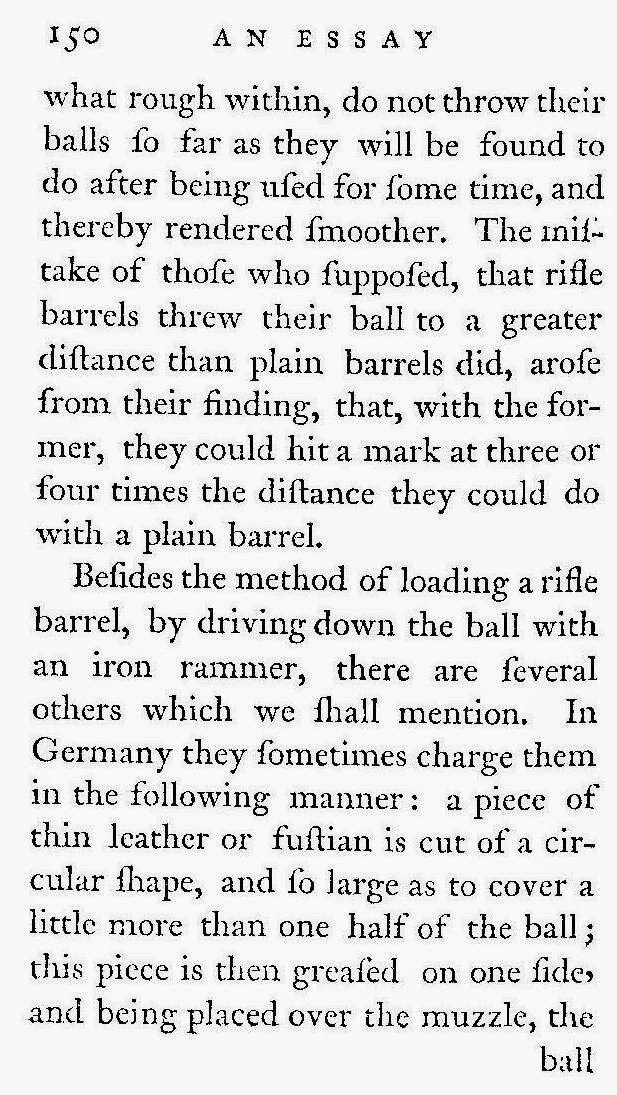
The short Starter, did it exist?


An Essay On Shooting 1789.

No mention above regarding a short starter, and it is quite precise in all other regards.


Monday, 14 April 2014

The 1640s Picturebook. Coach and Sedan.

Note that the carter on the left is carrying a sword. Very important when considering what items this character would be likely to carry with him if he travelled to the New World.
Keith.

Tuesday, 9 August 2011

Developing A Persona.

Developing A Persona.


Different people have different ideas about how to go about doing things. This is my personal view on developing a persona for living history activities that do not include living history museums or other areas where participants may need to portray a particular historical figure, e.g. you are not interpreting George Washington, you are interpreting a soldier of the period.


Developing a persona must be a mix of historical fact and your own character. I see no point in being someone I am not, that would take too much work to stay in character all the time. I did my research after deciding on a period and a place, but the clothing and equipment I chose, though authentically correct for the period and my persona, is my own choice. For instance, I carry three knives, and I have good reason to carry three knives, based on past experience. I have not read anywhere that any particular woodsman carried three knives, but there is no historical reason why I can’t carry three knives.

My hunting knife.

My legging knife.

My friction blade clasp knife.


I carry a .62 caliber flintlock fusil with a 42 inch barrel. This choice too is based on personal experience. I don’t carry anything for the sake of “looks”; I base my choices on what suits me and my woodsman lifestyle keeping within historically authentic limits. The equipment and clothing I carry and wear, to my mind, is the very best for keeping me alive in the wilderness, and long term if necessary.


So why haven’t we read anywhere that a woodsrunner, man or woman carried three knives? Well for one very few people in the 18th century actually wrote about common things. When was the last time you read about someone making fire with matches? Sure, there are more people writing about these things now, and that is because there is a great deal of interest in living history, and survival. Go on any survival forum and you will see lists of modern gear that people think they need to survive the day when TSHTF. But 300 years ago that did not happen.

There are historical records regarding woodsmen who made bad decisions regarding their equipment and personal safety. Like the man who was trapping and failed to look after his gun, when he came to use the gun it would not fire. Does this make sense for someone living such a lifestyle? I seem to recall it was Simon Kenton and George Washington that set off through the wilderness with only one blunt hatchet between them! These were supposed to be experienced men. The fact is that some woodsrunners learnt from their mistakes, and some did not. Not everyone survived that first mistake. Where one woodsrunner may see the benefit of using a particular item, another may not. It was, and still is very common for someone to say “my Father did not need one, and neither do I”, or “my Father did it this way and if it was good enough for him, then it is good enough for me”.

My leather costrel is hung from my waist belt, not from a shoulder strap.


Now I know some of you are going to be wondering, why does Le Loup carry three knives. Well I will tell you. I carry a large light butcher blade for a hunting knife, this is carried under my waist belt. This knife is for dispatching game if the animal should not be killed outright, for skinning and butchering, and for defence or offense.


Another knife I carry in the top of my right legging. It has a much shorter blade and is easy and quick to retrieve, and is used as a back-up for skinning, butchering, and fighting. The third knife is a jack knife and I carry it in my weskit pocket. This one is used for camp chores and making trap parts. It is small enough not to be clumsy when used for whittling small items, but it is large enough to be used for skinning small or large game if needs be.


When you are out hunting, and you shoot some large animal for meat and hide, the last thing you want to do is remain in the area for too long. If there is anyone about, they will have heard your shot and will come to check it out. They may be friendly, or they may not. You do not want to hang around to find out. The first thing you do is reload your gun, all the while watching and listening. You place your gun close to hand where it won’t fall and you make your cuts on the hide. Again, all the time watching and listening. You start to skin the animal, or you decide just to take a leg or two and instead of skinning you cut skin and flesh down to the knuckle. One wrong move and you can strike bone. Remember, you are working fast and still looking and listening for any danger. If you strike bone and the now dulled blade slows you down, you do not have time to sharpen the blade. You put it away and draw out your second blade and finish the job and get out of there.


Only experience will help you make the right choices of clothing and equipment. For quite some time I tried using a scrip/haversack as my main bag. It did not work for me. I could have used a snapsack too, but I think I would have had the same problem, with it only having the one carry strap. The same goes for the market bag or market wallet which has no strap at all. I found that at times I needed a more secure bag, one that did not move about, and one that did not get in the way in regards to other equipment. But this is my personal choice, and after a good deal of experience, I chose to use the knapsack that I use now.

My knapsack.


One field trip could show up all sorts of problems if there are any, on the other hand everything could appear to be fine. But anything that can distract you or get in the way can be a potential danger. What happens if you have to get over a fallen tree? In some areas in my forest it is a jumble of fallen timber, and a long way to go round. What happens when you squat or kneel to check out some sign? Does anything move or swing round to get in your way? Can you move you powder horn to your back before firing, or is something stopping it? Can you quickly and easily access your shot pouch, knife, and axe? So many things can go wrong in the field that won’t show up anywhere else. You only have to take a fall once and lose some items out of your shot pouch to convince you that despite the fact that many original shot pouch flaps were not secured with a button, if you had added a button you would not have lost some of your precious equipment.

Shot pouch.


You are an individual; you are an 18th century woodsrunner. You need to make personal choices regarding what you wear and what you carry and use. Making these decisions is a large part of developing your persona.

Woodsman By John Buxton.


Sunday, 19 June 2011

Becoming The Common Man/Woman.

Becoming The Common Man/woman.


Unless you are working in a living history museum, you are not likely to be interpreting a particular person from history; you are more likely to be interpreting a common character, the common woodsman, or a common Ranger etc. Although there were woods women, I very much doubt that they were as common as the woodsmen. Ann Bailey & Mrs Pentry would hardly be called common woods women, but woodsmen were very common & came in all classes, both poor in regard to woods lore & those that were extremely good, & quite a few in between.


You do not want to be a poor woodsman in regard to the skills, but you do need to start off being common. Later on others may class you as an uncommon woodsrunner in regard to your skills & knowledge, but that will be after you have had a good deal of experience. Even the common woodsrunner had freedom of choice, but there were items of clothing & equipment that were usually common to all. The common English or French work frock was worn by the majority of woodsrunners, men & women. Leggings were very common & were usually of the Indian style. Likewise woodland Indian moccasins were worn by the majority of people running the woods. Breeches or a breechclout, the choice is yours. Both were very common.


Beware of what you see in period paintings. Whilst this is considered to be very good primary documentation, some painters were known to glorify noted individuals by adding items that were not common usage. There are for instance paintings of Daniel Boone wearing a fur collared coat. Boone may have been an uncommon woodsman in regard to his intelligence & experience, but in every other regard he was still a common woodsman & is more likely to have worn the common English work frock than a fur collared coat. Sir John Caldwell was once painted wearing the clothing of an Ojibwe chief. The clothing is genuine I have no doubt, but this was not this gentleman’s common clothing at any time or in any place.

Here we see Daniel Boone with what appears to be fur on the top of his moccasins & he is holding a fur hat. It is well documented that Boone did not ware a fur hat & always wore a wide brimmed low crowned felt hat.

Sir John Caldwell, very fancy indeed. I believe that Sir john was an officer in the British army, and a certain book known to portray military dress has this painting as an example of an officer's dress in colonial America!


The author wearing a common frock coat at a winter solstice party.

Monday, 4 October 2010

Where you come from matters.


This may seem a strange video to be showing here, but it holds some interesting information. Authenticity versus myth for one thing, and for another the fact that early history shapes our lives later on.


Too many living historians concentrate only on their persona/character in a particular period. Let us say for instance that you are interpreting and English woodsman in 1742 as I am. I did not just suddenly appear in 1742 dressed in 1742 style clothing and using 1742 equipment, I have a history before 1742, and that history shapes who and what I am now.


If it is 1742 now, then I was born in 1680 somewhere in England. Who and what were my Father and his Father before him? What was I doing as soon as I was allowed out and about on my own? Did I work for my Father? When I arrived in the New World in 1700, had I any experience in trapping and hunting? What equipment did I bring from home?


It is reasonable to suppose that if I was 20 years of age when I arrived in the New World that I would possess items made in the 17th century, and some of those items would still be with me in 1742. By the age of 20 coming from a working family in a small country village in England, it is likely that I have formed my own opinions on what clothing I like to wear, which clothing wears best and affords me the most protection. So now let’s for arguments sake move me forward in time to 1750. I am now in my 70s, and the clothing fashions are changing. Do I care about fashions born in Europe or England? No probably not. I like the way I am and the way I dress, I think the shorter weskits are silly and not practical. Why should I think of changing now?


So here we are back in 2010, what do you own that was not made in 2010?