A LIVING HISTORY BLOG.

18TH CENTURY LIVING HISTORY IN AUSTRALIA.
Showing posts with label woodscraft. Show all posts

Wednesday, 14 January 2015

Equipment, Comfort and Weight. Historical Trekking and Survival.

Equipment, Comfort and Weight.
Historical Trekking and Survival.
Choosing the equipment you need to match your persona takes time and research. It has to be within your period, or earlier. Any items out of character need a good story to back up its use. Then on top of all this, you have the need to keep it as light as you can. But within these factors is the function of survival. So the items you choose for Historical Trekking, must be practicle, useful.

How much did an 18th century woodsrunner carry in the woods? Well if he was just hunting close to home, very little except possibly a belt pouch and a shot pouch. But longer journeys taking them further from home would require more equipment and probably some trail foods. Some I have no doubt carried very little, perhaps a blanket and some food in a haversack. These woodsrunners chanced to luck that nothing would befall them, and that they would be able to find plenty of game to keep them alive. Bread could be made from flour and water, mixed right in the flour bag. Meat could be skewered on a pointed stick and cooked in front of the fire.

For the woodsrunner who chose to travel light, survival was a gamble. If they should get sick, or wounded in some way, with no simple medical supplies their lives were at risk. With no kettle to boil water, no cloth strips to cover a wound. No water canteen and perhaps no water nearby. In wet and cold weather they had only their blanket to keep them reasonably dry. Making a fire would be important, and I doubt any would travel anywhere without flint, steel and tinderbox. Would they have carried fishing tackle in their belt pouch? Some would, some would not.
Whilst researching we may come across period accounts mentioning various items a particular person may have carried, Daniel Boone for instance once stated in his journal “leaving me by myself, without bread, salt or sugar”. So from this comment we can assume that Boone carried bread and or flour, and also salt and sugar. Salt I carry, sugar never. I don’t take sugar with anything, and from experience, I know that sugar carried in a wilderness pack is likely to attract ants when in camp. But obviously Boone thought sugar to be an important item, which brings us to the subject of “comfort”.
Most of what I carry in my pack can be said to be comfort items. Those of you that like me live in the woods, will have much the same skills that I have. We know that should we lose all our equipment whilst away from home, that we can survive, it just won’t be comfortable. Experience is our guide, and it may direct us to carry some items that others would not carry. Having had my gun fail me many years ago, I now carry tools and spare lock parts just in case it should ever happen again. But as I get older, I am aware of more physical limitations, old wounds come to plague me and the weight of my pack slows me down. I can use my Flintlock Fusil even if the lock should break, so I am considering removing these tools and spare parts from my pack to lighten my load.

The transition from English born country boy to New World woodsrunner has been a long one. As I gained experience, my pack became lighter in some areas, and heavier in others. Eventually I got to the stage in my elder years where I considered I had achieved the right choice of equipment, a compromise between minimum weight, and maximum self-reliance. Now though with more skills under my belt, and a body that can no longer take the punishment it used to, I am having to lighten my load even further. I will have to abandon the method of “what if” in lightening my load, or I will end up putting it all back in my pack again. I must now gamble that I will never need those items that made me feel more secure in my travels.
But comfort in my latter years is something that I will not completely abandon. I will still carry my oilcloth for use as a shelter, tea I will brew in my tin cup instead of carrying a kettle. With the brass kettle gone, plus the gun tools and spare lock parts; that may be enough. I must wait and see. But if ever I should have to move from this place with my family, then survival and security must take precedent over the perceived ability to carry a heavier load again, and I must do the best I can and carry my share.
Take care out there.
Keith.

Saturday, 24 August 2013

The Kindling Bag.

The Kindling Bag.
Some things you just don’t read about in period journals, other events are recorded but they are far and few between. We as Living Historians and Experimental Archaeologists are given the job of reading between the lines and filling in the gaps. For instance, what information do you glean from the following quote:
“Fierce winds and blowing snow reduced the men to huddling among large rocks, unable even to start a fire.”
Samuel Hearne, Canada, 1770.
I deduce from this journal record that these men had no dry kindling, or, they had run out of tinder. For one man to run out of tinder I might expect, but for two or more men to neglect to collect more tinder seems unlikely. So I suspect the problem was no dry kindling being available given the weather conditions.
A smart man or woman in this period under these sorts of living conditions is unlikely to make this same mistake twice. So I think it is safe to assume that at least some people would have made provision for carrying dry kindling with them in future and certainly to make sure their tinderbox was well stocked with prepared tinder.

My close friend the late Arthur W. Baker and I shared many adventures over the years, travelling on the Great Lakes in winter by boat and canoe, being caught in sudden storms before we could reach shelter we have huddled under canvas and spent some cold nights using our boat as a shelter turned on its side. We never failed to make fire even under the most arduous weather conditions because we both learnt early on how important it was to be well prepared when travelling in the bush and never to take anything for granted. A week or more of wet weather can reduce your tinder and dry kindling supplies to nought.


 This bag was Arthur’s kindling bag. On short trips he may not bother to carry this bag with him, but on longer trips and certainly when he was travelling by water, he always carried this bag containing dry kindling. It weighs very little when packed, but is a little bulky, but well worth the effort of carrying it along.
Recently I did find myself in the position of having run low on supplies of kindling which I carry in the bottom of my fire-bag. A week of wet weather meant everything was at least damp if not totally wet, so I had to resort to using a lot of tinder and fanning the fire with my hat to get it hot enough to flame. Had I been carrying this kindling bag it would have made my fire lighting much easier.
Maybe Mr Hearn did not learn the lesson the first time: “…rain began hammering down so heavily that, one hundred miles from the nearest trees, and with nothing available but moss, nobody could start a fire.” Samuel Hearne, 1770.
“In the woods we were under some disadvantage, having no fire-works”. Journal of John Woolman, 1720-1742.
There is also an Indian kindling bag in the United States National Museum. Figs. 19-21.—Fire-making set and extra hearth. Cat. No. 10258, TJ.S.N.M. Frobisher Bat.
Collected by C. F. Hall. 20, Moss in a leathern case. Cat. No. 10191, U.S.N.M.

Collected by C. F. Hall

Saturday, 26 May 2012

Woodland Indian Women.


“If a man who wishes his wife to be with him while he is out hunting in the woods, he needs only tell her that on such a day they will go to such a place where he will hunt for a length of time, and she will be sure to have provisions and everything else that is necessary in complete readiness, and well packed up to carry to the spot. The woman, therefore takes charge of the baggage, brings it to the place of encampment, and there immediately enters on the duties of housekeeping, as if they were at home. She moreover takes pains to dry as much meat as she can, that none may be lost; she carefully puts tallow up, assists in drying the skins, gathers in as much wild hemp as possible for the purpose of making strings, carrying-bands, bags and other necessary articles, collects roots for drying; in short, does everything in her power to leave no care to her husband but the important one of providing meat for the family.”

John Heckewelder 18th century.

Monday, 2 April 2012

Special Book Sale Promotion By LuLu.

http://www.lulu.com/shop/search.ep?type=Print+Products&keyWords=primitive+fire+lighting-flint+and+steel+and+fire-bow&sitesearch=lulu.com&q=&x=11&y=8

We just made saving, sharing and selling easier than ever. For the first time, registration-less checkout and no coupons required.
You and your readers can save just by adding an item to your cart, between now and Friday, April 6th. Use this opportunity to promote your book or buy more copies for yourself. The cost of this promotion is on us, but only for a limited time, so hurry for your chance to save big! Just add an item to your Lulu shopping cart to see your savings.

Sunday, 14 August 2011

Sunday, 3 July 2011

Siliceous Rock Found At Nundle, New England, NSW.

A good Friend & fellow group member came to our Winter Solstice Masquerade Party yesterday bareing gifts, two pieces of soliceous rock which he picked up in Nundle at the gold mine. The images here are of the larger piece. Believed to be Australian flint, I think it looks more like quartz. Whichever it is, it would be great for gun flints or flint & steel fire lighting.

Sunday, 26 June 2011

Colonial Settlers Travel 4. Tools & Hardware.

Colonial Settlers Travel 4. Tools & Hardware.
So what tools should you take with you when settling your own place? I have often thought about the post & beam dwellings with wattle & daub walls. Digging post holes is not that hard when using a crow bar & a post hole shovel, but how did the early settlers do it? I decided it would be easier to dig a trench instead of a hole. Easier to get the earth out too with a simple wooden shovel. So I would put a pick on my list.

Nice sized small pick, but not 18th century.

18th century picks & mattocks appear to have come in various styles & sizes. Here you can see two small picks that I have collected so far. Both able to be carried without too much effort, & both would double as a weapon.

I really can’t see a crosscut saw being carried unless there were some animal to carry it. So that leaves an axe. Many tools can double as weapons if need be.
• I gave orders to them to go home and fetch their arms whether guns, swords, pitchforks, axes or whatsoever might be of use against the enemy and for three days provision in their knapsacks” Journals of Conrad Weiser (early 18th century).
Post & beam construction is better pegged than tied, & the best tool for making the peg holes is probably an auger.

This auger is easily carried tied to my blanket roll along with my half-axe. This one is probably 19th century, but apart from the gimlet tip, it is pretty much the same as an 18th century one.


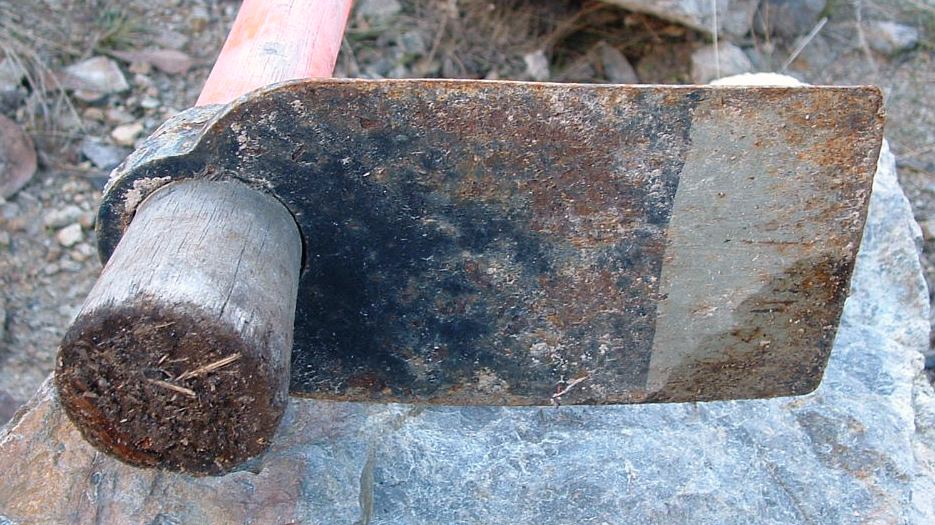
For the gardening a hoe & a small mattock would probably suffice. The carrier/s can decide whether to leave the stails & helves attached or to just carry the tool heads.

A modern hoe, but the head is very much the same as they were in the 18th century.

A modern hoe at top in an 18th century design, and a small modern made mattock head in period design. Both good finds. You just have to know what you are looking for.


What can be carried depends on the transport available, whether just people or if animals are included. Kitchen wares would be needed, sewing kit, knitting needles can be made on site. A spinning wheel is a large item but is easier to use than a drop spindle unless you are used to using one. Brooms can be made easy enough, as can a garden rake. We take so many things about the home for granted, & it is not until we consider moving that we fully realise just how much hardware we have & use each day to make our lives easier & more comfortable.

My wife's spinning wheel. This is not a heavy item, and can easily be pulled apart to carry in separate pieces and reassembled later. Not sure on the period of this design.


What about smaller tools such as metal files, whet stones, hand vices, rasps. As the list grows we start to see how greater numbers of people will allow us to carry more equipment. More people more security, but also more food needed to feed everyone. A large number of people moving through an area will scare the game away, so hunters must move far ahead of the column. Having been in the position of feeding my family from our garden & by hunting game, I can tell you that the game is not always there to hunt. If I got a buffalo then there was meat for some time if dried, but what I did was share it with my neighbours who also depended on game for food. Even a large buffalo does not last long between several families. Hunting for me was a constant activity, especially when only smaller game was available.

The author's flintlock fusil.

Author's shot pouch he made himself.


So each family will need to have at least one gun and the accouterments to service that gun. Hunting knives & tomahawks are a must, & I learnt a long time ago to carry more than one knife when hunting. Arms for defence are also very important, so the more you have the better. Each adult member of our group including the women have guns, so they will have to carry their guns as well as any other burdens that fall to them. I find as I get older the heavy packs slow me down & I need to take more breaks. Fortunately I am the oldest in our group, so I will be able to leave the heavier loads to the younger people.

Left to right: Light felling axe, two facsine knives or bills, an adze, half-axe, and tomahawk/axe.
Not sure on the date of the felling axe. The half-axe and the tomahawk are copies.


Using a travois would allow a person to carry more weight, but I have not found any documentation to suggest such a device was ever used by white settlers. The downside of using a travois is that it leaves a clear sign on the forest floor that you have passed that way. Horses & cattle also leave clear sign for even the poorest of trackers to follow.

The travois I made to be used on foot.
This sickle in invalueable for cutting reeds for thatching or making mats. Note the corn cob handle I fitted.

The only difference between this modern made pruning saw and an 18th century one, is that the 18th century saw has a straight blade where as this one is slightly curved. Plus of course the screws in the handle. I was amazed at how well this little saw cuts. This is the saw I am using in the video on making a tomahawk helve.


My son Laban when he was only a little person. He is using an "A" frame pack frame with a leather pack to carry his gear.

Kids like to have their own things, just make sure you don't make the pack too heavy.  Some basic camp items should suffice such as a light kettle, a spoon, a knife if they are responsible enough & of course a small tomahawk.

My youngest son Kaelem when also a little person. He has his own hunting knife & tomahawk as seen here. Also you can just see Kaelem's fire bag on his right side, which of course holds his flint, steel & tinderbox. All three of my sons were making fire with flint & steel at a very early age.

My tomahawk/axe at top compared to my son's smaller tomahawk when they were children. Now of course all three sons are adults & have full sized tomahawks.


Friday, 20 May 2011

Observation. Pay more attention to your surroundings.

When I went for a walk the other day looking for roo dung to use as tinder, I took my camera along. As I wandered along a trail I wondered how much the average person would actually see, & having seen it would they know what they were looking at? So I took some pics of good places to set up a shelter easily using fallen trees etc, plus a shot of the trail. Trails are easy to spot if you know what you are looking for, but animal trails in the woods are generally not marked by cleared ground. They may have a slight depression, & the forest leaves will be turned more on a well used trail.

A ready made shelter, narrow, but better than nothing. It would be improved by an oil cloth thrown over it.

Some poles leant against the back of this fallen tree with an oil cloth would make an excellent shelter.

Walls but no roof.

Plenty of room inside. Some has been digging in here.

Can you see the trail?

Ringtail Possum scat?

Fresh roo dung, but not in pellet form, all run together.

Dry roo dung.

Old Fox scat.

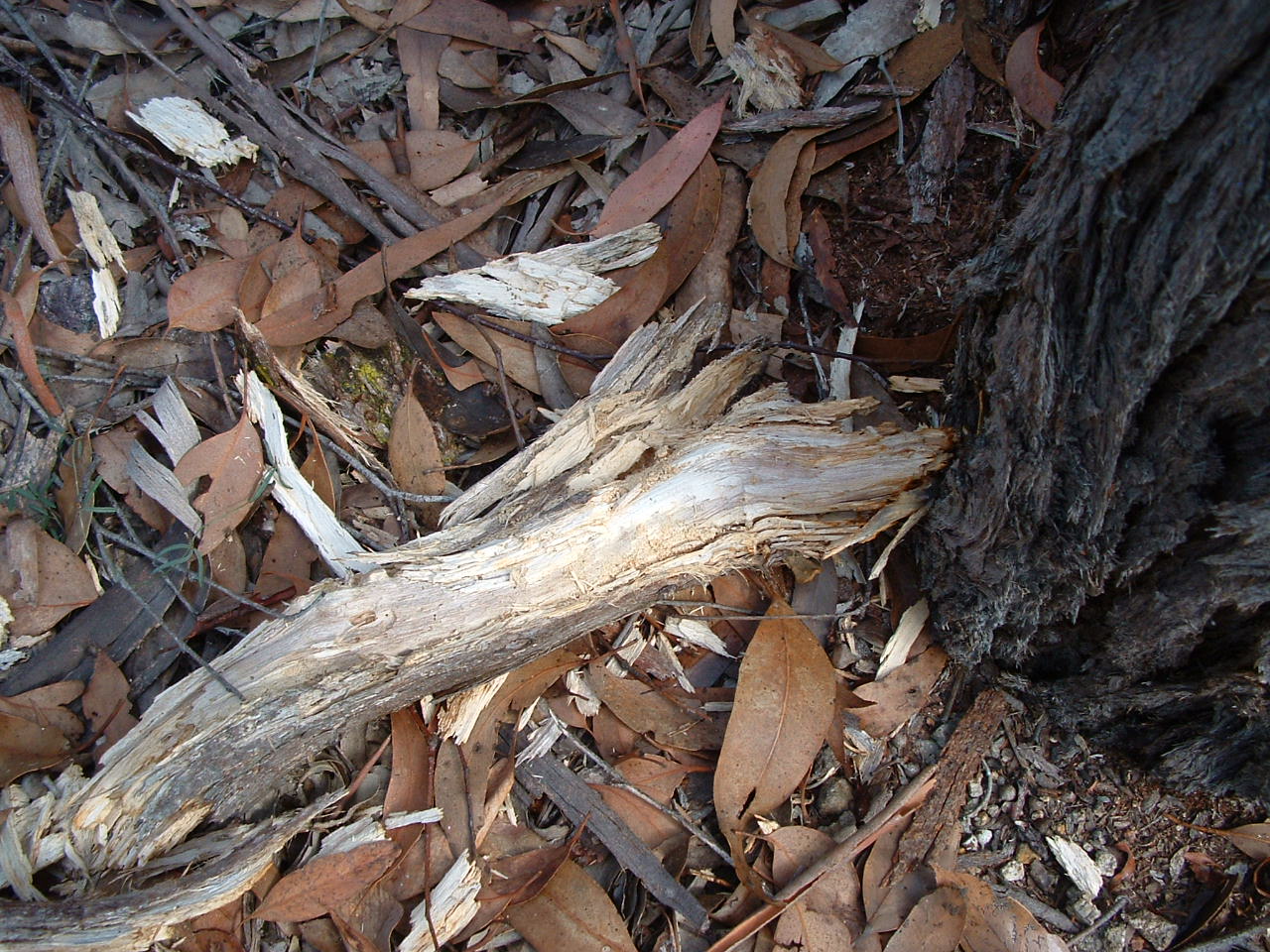
Not much punk wood here, but enough around this stick to use as tinder to make fire.

Thursday, 19 May 2011

Kangaroo Dung As Tinder.

Not the best tinder to use, but there is plenty of it about if you can't find anything else. However, I have only used it with reading glass fire lighting.
The lighter dung in the far left pile is what to look for. It is more sun bleached than the other two piles.

A good one!

And some more.


But would you see it on the trail? This is where observation & experience count, it is not something you start practicing when you urgently need to find some tinder.

I found this punk wood beside the trail. Not all punk wood, but enough around the wood to use for making fire, & better than Kangaroo dung.


It actually took longer to make fire than this video shows, but I had to edit. Regardless it did work.

Wednesday, 18 May 2011

A Winter's Tale.

18th century Historical Trekking-A Winter’s Tale. © Le Loup

MSF 2007, Armidale 2350 Australia.


I left alone early in the morning with the frost still on the ground. Before leaving I loaded my fusil just in case I should need it. I started north following the wilderness trail until I reached Pilot’s Rock at the head of Hazard Valley, so named for a close friend who died some years ago. His Living History persona was that of Arthur Hazard, but his real name was Arthur William Baker. From Pilot’s Rock I moved steeply down into the valley below catching at saplings to steady me on the slippery decent. This was true forest with sticks and leaves and rocks littering my downward path. In order for me to take advantage of every hand hold I was continually having to swap my fusil from hand to hand. Finally I reached the bottom and crossed the narrow now dry Header stream and started my ascent again on the other side.


I took my time in the climb as I did not want to perspire too much. If one goes to bed at night damp in the winter you are very likely to freeze. The best thing to do is to dry your clothes in front of the fire before lying down for the night. I saw pig sign along the trail but it was not recent, then a strong scent of wild pig came to me and I stood still surveying the forest about me. It does not pay to hurry on a walk or trek, you can miss seeing a lot of things if you do. Slowly and quietly are best in the woods. Seeing nothing I moved on but held my fusil at the ready, and then beside the trail I saw fresh diggings and large rocks that had been turned over. Further on I found a downed tree, now hollow and split with age, part of it had been torn apart as if by a huge bear looking for grubs. Here the smell was strongest and the tracks in the earth, about the size of my palm were fresh since the last rain the day before. Again I stopped and listened and looked, but all was silence. I took this opportunity to pour a measure of buckshot down the barrel on top of the round ball load. I topped this off with a leather wad to hold the shot in place, then cradling my fusil in my left arm I moved on.


As I reached the ridge above the country changed, now the ground beneath the trees was covered in bracken and old mossy logs, here too were many Goonagurra, grass trees. This part of the forest had a primeval look and feel about it. The trail was narrow here among the bracken and the grass trees and I felt it necessary to stop frequently to look and listen. As I reached a bend in the trail I saw a giant tree had fallen against another and was being held there after having smashed large branches to the ground. It was an eerie feeling walking past these giants knowing that sooner or later the pressure would become too much and both would come crashing across the trail.


A movement up ahead caught my attention but it was only two wood duck taking off from the pond. They beat their way through the trees weaving and dodging and then slowly turned to come speeding back toward me again. I raised my fusil in mock readiness and they would have made easy targets with a load of number 6.

The pond was full which was a pleasing site and I found more pig tracks and a couple of wallows in the muddy edges. There was sign of goat having been there too but not recent. I made my way into the edge of the woods and took off my pack, water bottle, shot pouch and horn and then just stood for a while taking in the serenity. Sunlight was now sending shafts of pale light through the trees and far off I heard the morning serenade of magpies.


It was an easy matter to use the leather ties from my bedroll to secure a cross pole between two trees and from there I secured my oil cloth making wooden pegs with my tomahawk to peg the lower edge down. Inside this I lay a thick bed of sticks and over this I cast my blanket. My shot pouch, horn and fusil I lay on the blanket well back from where my fireplace would be, and covered them with one side of the blanket. Then I found another pole and pushed it between the cross pole and the oil cloth forming a ridge in the oil cloth from cross pole down to the ground. The upper part of this pole stuck out over the fireplace to be used for hanging my kettle.


The morning was spent clearing the area around my shelter of debris and building a pile of sticks next to the shelter to keep the wind out and to be used as firewood. I collected a good pile of heavy wood that would last me through the night and placed it close to the shelter so I could reach it without getting out of my blanket. In the back of the shelter I stored plenty of kindling, both dry grass and larger kindling sticks. These would remain dry regardless of rain or snow and would be used if the fire should go out in the night.


I dug a small fire pit and surrounded it with rocks and earth, rocks furthest away from the shelter to reflect warmth back into the shelter, and earth on the near side to keep any running water out of the pit. This done I picked up my fusil, shot pouch and horn and went for a scout about to see what I could find.


I was back in camp well before dark having found plenty of sign of wild goats and pigs but sighted no animals except roos and wallaby. I set about laying my fire and making fire with flint and steel. There is something very satisfying about using primitive methods to accomplish a task; it gives one a strong feeling of self-reliance. Once the fire was going well I put a kettle of water on to boil. My 18th century style brass trade kettle weighs just under 1-1/2lbs, but it is sturdy and large enough for a big stew and with its bail it is a pleasure to use. It does not take up much room in my knapsack despite being about 7 inches wide and 4 ½ inches deep, because I pack it with my bags of dried foods. My water I carry in a leather costrel which is very light when empty and holds about 2 litres.


Once the kettle was boiling I added some loose tea and lifted it off the fire to brew. A dash of rum from my period flask improved the taste and I enjoyed a meal of bread and corned beef. I woke several times in the night to build up the fire, the cold having woken me. Sometime in the early morning hours I woke again to find only a few remaining coals kept alive by the ash. I quickly grabbed a handful of light kindling from the back of my shelter and gently blew until I had flames again. In the flickering firelight I could see a light fluttering of snow falling. I stoked the fire well and pulling my Monmouth cap down over my ears tried to get some more sleep.


Morning was a winter wonderland with snow on the ground and the trees. I climbed out of my bedroll and shelter to go for a walk and relieve myself. Then back to my shelter and put on a kettle of water to boil. It was a beautiful sight and I just sat there looking at all the whiteness. I was jerked out of my thoughts by screams like a demented seagull as three large black cockies flew over looking more like giant vampire bats in the early light. What a strange wild land this is, but it has its own beauty.


As the sun came up in the east behind me the rays of light came through the forest trees in shafts and shone on the mist like a mirror making things seem brighter than they really were. As the sun rose the shafts of light moved over the snow and the dripping from the trees began. I wished it had kept snowing. After the tea had brewed I poured myself a cup and put some oats and currents on to cook. Then got out my little handmade journal and began to make a record of this trek so far.


There can be nothing finer I think than sitting snug in a primitive shelter on a cold morning with snow all around whilst eating a hot meal and sipping a hot drink. I did not want to leave, though I knew I had to sooner or later. So I sat there thinking how nice it would be to live a life like this, then realised that I virtually did, except in a house in the forest instead of a primitive shelter. My thoughts strayed to life 300 years ago, the adventure and the hardships and thought myself very lucky that I could experience this lifestyle still. I sat there a long time before finally heading for home.


Author’s Note: The accompanying photos are not from this trek. They were taken by my youngest son Kaelem around about the same time earlier in the year when he followed me part way on a trek.