A LIVING HISTORY BLOG.

18TH CENTURY LIVING HISTORY IN AUSTRALIA.
Showing posts with label videos. Show all posts

Friday, 7 December 2018

Gun Cleaning. A personal Point Of View.

This post has been prompted by several posts on forums concerning the problems people are having with gun cleaning. Principally the cleaning of the barrel.

All of the problems I have read about to date, to my thinking, seems to come from the use of modern cleaning agents & solvents. I fail to see why anyone would bother to try & fix something that is not broken! A method that has been working for over 300 years, but it seems that muzzle-loader users are getting lazy; they don't want to use the old tried & true methods because it seems too arduous & time consuming. So they turn to simpler quicker methods.

Some facts: When you oil the bore of your gun, pistol or rifle, the barrel absorbs some of that oil. If you use a modern solvent or cleaning product it will remove that oil from your barrel. Then you will have to purchase some other modern product that promises to stop your barrel rusting after you have cleaned it!

The best method is the oldest method, clean your barrel & lock with boiling water, dry the barrel with cloth or some other natural plant fibre. If I have a fire going I usually let the barrel stand where it will warm but not get too hot. Next, using a natural plant fibre again I oil the barrel & lock with sweet oil or neetsfoot oil. Job done. If you are seeing signs of black on your cleaning cloth, then you have not washed the barrel sufficiently. DO IT AGAIN! If you are getting signs of rust on your cleaning material, it can be because the wash water was not hot enough, or you did not dry the bore sufficiently. Keep running oiled material down the bore with your ramrod or cleaning rod until the bore is clean.

There is such a product as water soluble engineers oil, my Father called it "Pigeon's milk"! This product is what my Father told me to use when cleaning the barrels on my guns, this is what he used on his guns. The same method was used as in these videos, but the water soluble oil was added to the wash water, just a small amount. I have not used this oil since I was a lad, but it worked well back then. If it is the right oil, it will turn white in contact with the water.
Take care out there.
Keith.


Monday, 18 November 2013

Two Of My DVDs About To Be Deleted.

Just a Heads-Up that Trepstar are going to delet a couple of my DVDs due to lack of sales over the past 240 days. They are Muzle-loaders & More, & Off The Grid. If you intended to purchase one of these, now is the time to get it before it is deleted. A purchase will keep it running, & I could do this myself, but I make so little from these DVDs that it simply would not be worth my while.
Regards, Keith.
http://woodsrunnersdiary.blogspot.com.au/search?q=DVDs

Tuesday, 9 April 2013

From a Happy Customer.


Keith Burgess is one of the clearest voices in bushcrafting today. In a scene filled with marketing, drama and mythology, Keith's no nonsense (and historically accurate) approach to primitive firelighting are both universal and extremely effective. After watching his dvd, I was immediately able to start a fire in minutes with a butcher knife, punkwood from my woodpile, and stones from my driveway.
As a Alaskan, over and over again, I see bushcrafting techniques that fall flat in my enviroment, and oftimes have to wade through unbelievable amounts of material to find a gem or two that are actually applicable.
Keiths methods are so adaptable that what he demonstrates in Australia is immediately effective at the other end of the planet. I have learned more from what he has produced than any other source I have encountered, and now posses skills and knowledge that I have wanted for years.
If he has a flaw, it is that he so de-mystifies these methods as to make it anti-climatic! If I had to walk across Alaska and Keith was my partner, flintlock and all, I wouldn't worry about anything but keeping up.
Thanks Keith, and I cant wait to check out some of your other dvd's.

Happy in the North,

--Shanon
Hope your well, Keith.
--Shanon
"Man is the animal that can get used to anything"

---Fyodor Dostoyevsky

My FIRE DVD Index.

Tuesday, 10 January 2012

A Letter From Dan at Jamestown.

plane2lisbon said...
Hello,

Thanks for posting our video. I'm Dan Smith, the Jamestown Rediscovery archaeologist you see digging in the well in this one. We're not sure why we find so many metal tools in the bottoms of wells. One theory is that they were used as bucket weights—they would be tied to the handle of a bucket to get it to tip over and fill with water after hitting the water's surface. Our head curator, Bly Straube, isn't convinced that's the reason, though.

In answer to Le Loup's questions, we find almost everything that was used on a daily basis in the wells. Once wells went bad—maybe from an animal falling in and spoiling the water, but more often here at Jamestown because the brackish James River water and nearby swamp water eventually seeped into the reservoir and made the water undrinkable—they were turned into trash pits. Like Gorges Smythe wrote, that turns the well into a treasure trove for us because of all the information waiting to be rediscovered. We've found a number of wells here, but never a privy. The wells alone have yielded about a million of the two-million-plus artifacts we've found here at Historic Jamestowne since 1994, so we're not complaining.

Thanks, again, for posting the video. Three more well videos, the first and second wells the colonists dug, and a third, brick-lined well can be found at:

http://www.youtube.com/user/JamestownRediscovery#p/u/24/owYBccAs8UU

http://www.youtube.com/user/JamestownRediscovery#p/u/17/ONQQMmUxz-4

http://www.youtube.com/user/JamestownRediscovery#p/u/13/l1rZR

My thanks to Dan for this information, very much appreciated Dan.
Keith.

Monday, 15 August 2011

Muzzle-Loading Information.

Muzzle-Loading Information.

This article is a compilation of several previous articles. Copyright Keith H. Burgess.


I am often asked for information regarding guns, loads, making gunpowder etc. First let me say that I take no responsibility for any harm that may come to the reader or anyone else from reading this information. I can’t be there with you to help you, so I can’t be responsible for your actions. I must also say that I personally do not recommend you make your own gunpowder, you are better off purchasing the correct grade for your particular gun. IF you do use your home made gunpowder/black powder in a gun, I recommend you reduce the load to one third of the manufacturers recommended load for 3FG. I only include the manufacturing of black powder here for historical and survival purposes.


Recommended grades for calibres. Long Arms Only:
Up to .45 calibre 3FG Black Powder [NEVER use smokeless gunpowder in a muzzle-loading gun].
.50 calibre and musket calibres 2FG.


Making Gunpowder:
Always mix wet, NEVER dry. You can add urine if you wish. NEVER use iron or steel utensils when making gunpowder. Gunpowder is highly volatile & dangerous. Keep away from heat, fire and sparks. NO SMOKING!
75 parts potassium nitrate, 15 parts charcoal, 10 parts sulphur.


Smoothbore or Rifle?
Someone asked me recently which did I recommend, smoothbore or rifle. They also wanted to know about advantages & disadvantages & what calibres I would recommend, & what do I use & if I had a choice what would I purchase. The choice you make depends on several factors; what are you used to using, do you have a personal preference, what sort of country are you using this gun in, what game are you likely to encounter? So baring this in mind, I will do the best I can to answer the question, smoothbore or rifle?


I have used both, rifle & smoothbore. In the Territory I hunted Buffalo & wild boar with a .50 calibre rifle. Here in New England I use a .60 calibre/20 gauge flintlock fusil with a 42 inch barrel & hunt small game such as rabbit & larger game like goat & wild boar.


The smoothbore is more versatile than the rifle, in that it is easier to load, you do not have to wipe the barrel in between shots, you can use bird shot, swan shot (buckshot), or round ball, or any combination of two of these. You do not need to use a patched ball, in fact the smoothbore was not originally shot with patching. It uses wads or wadding which is easier to come by in a wilderness situation. If for some reason you were to run out of lead, then you can use other projectiles wrapped in leather or cloth to protect the bore. Disadvantages of the smoothbore are: not as accurate over long distances. Maximum accurate range is generally accepted as being 50-75 yards. I have never shot game at a distance greater than 30 yards with my fusil, & usually the distance is from point blank to 25 yards. But in target practice I have shot accurately out to at least 50 yards.

The author’s firelock English fusil in .62 cal/20 gauge with a 42 inch barrel.

The rifle is generally accepted as being accurate out to 100 yards, some claim accuracy out to 200 yards. Even with a rifle I have never shot game at these distances, I prefer to get in close. Just as the smoothbore comes in a variety of bore sizes, so does the rifle. A good middle of the road calibre in my opinion is a .45 fullstock. This calibre with good placement will take small game such as rabbits, & larger game such as goats & wild boar. For larger game such as buffalo I recommend a .50 or .54 calibre. I have a lovely little .32 calibre flintlock which will take small game like rabbits, or larger game like goats, but I would not take on large pigs with it at any distance. However, it is very economical using very little lead, & only requires about 14 grains of 3FG gunpowder.


Disadvantages of the rifle are: harder to load, you need to wipe the barrel on most rifles between shots or it is possible to get a ball stuck in the barrel, unless you are prepared to sacrifice some accuracy & reload with just a ball & no patch. You can’t use shot in a rifle without leading up the rifling, & you are limited to what you can use as a projectile should you run out of lead. Rifles have heavier barrels & tend to be heavier to carry than a fusil but probably no heavier than a large musket such as the Brown Bess.

Author’s .32 calibre Mountain Rifle with double triggers & an extended ramrod.

Survival Note: Someone suggested that in a modern day self defence/skirmish situation they would rather have a modern firearm than a flintlock gun. Given the choice I would tend to agree, but there are other considerations. (1) other aspects of the flintlock make it a more viable proposition as a survival firearm, (2) one must also consider all of a woodsrunner’s equipment & take it into account. And (3) no matter how fast a person can shoot, it all comes down to one shot in the end. If your first shot does not count, then there is a good chance that the rest of the magazine won’t do any better than the first if fired rapidly with no clear shot of the target. If I were using a modern gun against a muzzle-loading gun in a skirmish, I would not consider myself any safer just because I had a modern gun.


On Powder & Lead.
What are the heaviest items that we carry on a trek? I would think it was water, lead, & food. Food we can cut back on. I don’t mean that we should all start just carrying flour, bread or corn & hunt for our meat, but we can cut our provisions back to just two items, perhaps bread & hard cheese, or bread & meat. That should be fairly light & last us for a weekend or more.


Water we can’t do anything about, unless you know that you have good water where you are going. I carry water anyway, & either boil any water I find, or I collect rainwater in my kettle.


Lead can be reduced in weight because we can retrieve spent lead from shot game & remould it. By reducing the amount of lead we carry we can carry more gunpowder.


My fusil takes 60 grains of gunpowder. 60 grains = 1 Dram.
1LB of gunpowder = 256 Drams. So that is 256 shots from just one pound of gunpowder. My powder horn holds roughly one pound, & my gunpowder bag roughly two pounds. So if I only took my horn & gunpowder bag, I would still have 768 shots to hunt with. That is a lot of meat when hunting large game, & most of the meat would come from a trap line. So barring any skirmishing, I could take one shot per day for 2 years, or one shot per week for 14 years from just 3 pounds of gunpowder!

More On Wads. Wads and Wadding.
For wadding in the 18th century as you may have read in my earlier post dried grass and tow was often used, but bear in mind that this material can easily catch fire! Therefore I recommend that unless the area is safe from fires spreading; or the weather or ground is wet, that you use wool felt or leather wads.

Powder Horns.
If making your own powder horn, only seal the base plug with beeswax, NEVER use glue. The base plug is a safety valve in case the gunpowder should take fire. For the same reason only secure this base plug with small pins, tooth picks are fine, or 1/16” brass braising rod. 4 pins should be enough.


Gunpowder Wallet or bag for carrying extra gunpowder.


Unfortunately I neglected to show how to use the vent pick and the vent quill in this video. Not necassarily a required action, but a recommended one. The vent pick is used after loading to make sure the vent is clear of gunpowder. Gunpowder in the vent can slow ignition. Vent quills are used to block the vent when loading so the vent remains clear, the quill is also used to mark a loaded gun. If you see a gun with a quill in the vent, it means it is loaded but not primed. My apologies for not including this in the video.


Tuesday, 8 March 2011

Shot Pouches.

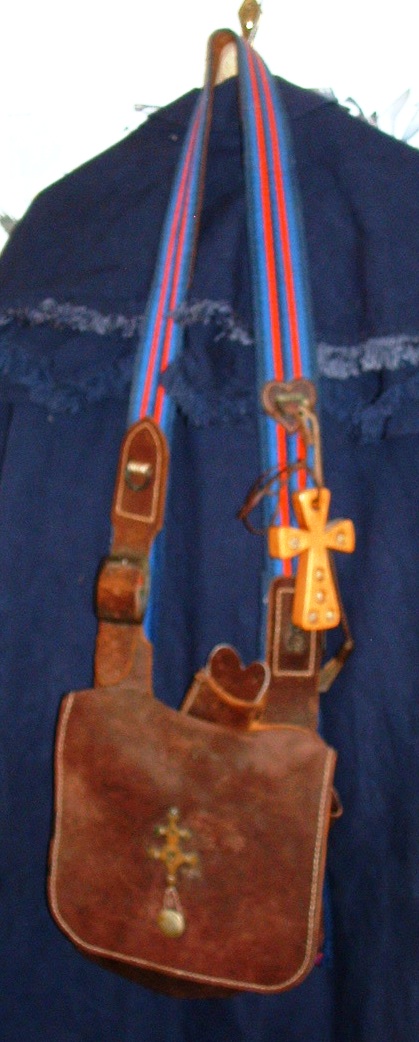
Prompted by Karl's post where he mentions carrying the shot pouch high, I decided to make this post. First let me say that I totally agree with Karl, the shot pouch should be carried as high as practicable. I have seen shot pouches literally hanging down to the knees. But being too high can also be a problem when you come to use it, even if it does ride well.

Photo Curtesy of "The Complete Black Powder Handbook By Sam Fadala.
This may be okay for shooting on the range, but it is a little too low for using in the woods.

The only way you can judge is to try the pouch out. Can you get your hand into the pouch easily? My youngest son's shot pouch is much larger than mine, so it can be worn higher if he wishes. This shot pouch was originally designed for use with a Brown Bess musket. Smoothbore shot pouches tended to be larger because they had a little more to carry. The smoothbore can use round ball, swan shot (buckshot) or bird shot, or any combination of two of these. Kaelem uses this pouch now with a .32 cal flintlock rifle, so he has plenty of room inside.

Kaelem's Shot Pouch.
My shot pouch in comparrison is much smaller, even though it is designed for use with my .62 cal fusil. But I like a small pouch, and I have got used to it over the years and can find anything I need by touch. I carry my pouch as high as I can and still be able to get my hand inside.
The Author's Shot Pouch.

The powder horn should also ride high, higher than the shot pouch. You do not want the powder horn on top of your shot pouch & getting in the way of accessing the pouch. In use the gun can be liftet/raised to the powder horn to prime the pan, & it is no problem filling the powder measure.
Author's Powder Horn.

Here you can see that my shot pouch rides high on my hip. Any higher & I can't comfortably get my hand inside. The powder horn you can just see under my arm, and it rides high above my shot pouch. Both are easily kept under controle when stooping or running as can be seen from the following video.

The 18th Century Shot Pouch.

Sunday, 6 March 2011

The Hunt For Ned Kelly By Sophie Masson.

This book is written by a very close personal friend of mine & a close family friend Sophie Masson. I will be posting news on other historical books by Sophie in the future.