A LIVING HISTORY BLOG.

18TH CENTURY LIVING HISTORY IN AUSTRALIA.
Showing posts with label woodswomen. Show all posts

Monday, 20 November 2017

Group Forum Moving to a New Site. Please sign up for membership.

As many of you may have realised by now our group forum was taken over by Tapatalk, since then I have had a lot of problems, & the HELP at tapatalk is non existent. SO, I checked with other members on this forum & we decided to move to another site.

There are years of information on this present site which we don't want to lose if we can help it, a lot of work has gone into this site by a lot of present members. If you are still interested in this group/forum, then please go to our new forum & sign up for membership http://neclhg.freeforums.net/ . Some of you have been made Moderators on this present forum, obviously you do not have to accept & if this is the case please let me know. I will need help transferring all the posts from this forum to the new forum, but I know this will not happen overnight, & some of you may simply not have the time to spare to help.

If individuals could copy & paste their own posts to the new forum, this would be very much appreciated. If you are unable to help. then the Moderators & myself will do the best we can. Please check out the new forum, it does not look the same as this one, but I hope that we will have less problems with it.
Regards, Keith.

Sunday, 6 June 2010

The Story Of Mrs Pentry Part 1.

I mean no disrespect to the original author of this piece, and I claim no copyright or gain through my editing. I have simply changed the story to be more period correct in the terms and methods used in that time.

In the year 1672 a small party of hunters arrived at the mouth of the Kennebec in two canoes. The larger one of the canoes was paddled up stream by three men; the other was propelled swiftly forward by a man and a woman. Both were dressed in hunters' clothes; the woman in a close-fitting tunic of deerskin reaching to the knees, with leggings to match, and the man in a frock, breaches and leggings of the same material. Edward Pentry, for this was the name of the man, was a stalwart Cornishman who had spent ten years in hunting and exploring the American wilderness. Mrs. Pentry, his wife, was of French extraction, and had passed most of her life in the settlements in Canada, where she had met her adventurous husband on one of his hunting expeditions. She was of manly stature and strength, and like her husband, was a splendid shot and skilful fisher. Both were passionately fond of forest life, and perfectly fearless of its dangers, whether from savage man or beast.


It was their purpose to explore thoroughly the region watered by the upper Kennebec, and to establish a trading-post which would serve as the headquarters of fur-traders, and ultimately open the country for settlement. Their outfit was extremely simple: guns, traps, axes, fishing-gear, powder, and bullets, and with an assorted cargo of such trinkets and other articles as the Indians desired in return for peltry.


In three weeks they reached the head-waters of the Kennebec, at Moosehead Lake. There they built a large cabin, divided into two compartments, one of which was occupied by three of the men, the other by Mr. and Mrs. Pentry. All of the party were versed in the Indian dialect of the region, and as Mrs. Pentry could speak French, no trouble was anticipated from the Indians, who in that part of the country were generally friendly to the French.


The labours of the men in felling trees and shaping logs for the cabin, as well as in framing the structure, were shared in by Mrs. Pentry, who in addition did all the necessary cooking and other culinary offices. They decided to explore the surrounding country for the purpose of discovering the lay of the land and the haunts of game. No signs of any Indians had yet been seen, and it was thought best that the four men should start, each in a different direction, and having explored the neighbouring region return to the cabin at night, Mrs. Pentry meanwhile being left alone--a situation which she did not in the least dread. Accordingly, early in the morning, after eating a hunter's breakfast of salt pork, fried fish, and parched corn, the quartet selected their several routes, and started, taking good care to mark their trail as they went, that they could the more readily find the way back.


It was agreed that they should return by sunset, which would give them twelve good hours for exploration, as it was the month of July, and the days were long. After their departure Mrs. P. put things to rights about the house, and barring the door against intruders, took her gun and fishing-tackle and went out in the woods.


The cabin stood on the border of Moosehead Lake. Unloosing the canoes, she embarked in one, and towing the other behind her, rowed across a part of the lake which jutted in shore to the southwest; she soon reached a dense piece of woods which skirted the lake, and there mooring her canoe, watched for the deer which came down to that place to drink. A fat young buck before long made his appearance, and as he bent down his head to quaff the water, a brace of buck-shot planted behind his left foreleg laid him low, and his carcase was speedily deposited in the canoe.


The sun was now well up, and as Mrs. P. had provided for the wants of the party, and no more deer made their appearance, she lay down in the bottom of the boat, and soon fell fast asleep. Hunters and soldiers should be light sleepers, as was Mrs. Pentry upon this occasion.


How long she slept she never exactly knew, but she was awakened by a splash; lifting her head above the edge of the boat, she saw nothing but a muddy spot on the water some thirty feet away, near the shore. This was a suspicious sign. Looking more closely, she saw a slight motion beneath the lily-pads, which covered closely, like a broad green carpet, the surface of the lake. Her hand was on her gun, and as she levelled the barrel towards the turbid spot, she saw a head suddenly lifted, and at the same moment a huge Indian sprang from the water and struggled up through the dense undergrowth that lined the edge of the lake.


It was a sudden impulse rather than a thought, which made Mrs. P. level the gun and pull the trigger. The Indian leaped into the air, and fell back in the water dead, with half a dozen buck-shot through his heart. At the same moment she felt movement and turning her head she saw another Indian standing waist-deep in the water, with one hand on the canoe which he was dragging towards the shore.


A swift side-blow from the gun-barrel, and he tumbled into the water; before he could recover, the brave woman had snatched the paddle, and sent the canoe out into the lake. Then dropping the paddle and seizing her gun she dashed in a heavy charge of powder, some grass wadding, dropped a dozen buck-shot down the muzzle, primed the pan, and levelled it again at the savage, who having recovered from the blow, was floundering towards the shore. Again the report of her gun awakened the forest echoes, and before the echoes had died away, the savage's corpse was floating on the water.

(I am certain that illustrators never read the books!)


THE HUNTRESS OF THE LAKES SURPRISED BY INDIANS.


She dared not immediately approach the shore, fearing that other savages might be lying in ambush; but after closely scrutinizing the bushes, she saw no signs of others, besides the two whom she had shot. She then cut long strips of raw hide from the dead buck, and towing the bodies of the Indians far out into the lake sunk them with the stones that served to anchor the canoes. Returning to the shore, she took their guns which lay upon the shelving bank, and rapidly paddled the canoe homeward.
http://www.internetclassicbooks.com/Woman_on_the_American_Frontier1.htm

Tuesday, 1 June 2010

Lady Of The Woods. Mad Ann Bailey.


As some of you will know I have a particular interest in promoting women in Historical Trekking. Woodsmen are dressed for woods travel, but the average 18th century woman is not, despite claims to the contrary by women who trek in all woman attire, I still think the men's clothing and the Indian women's clothing is better suited.
I don't know if the term woodswomen or woods women was ever used in the 18th century, but I use this term, or woodsrunner, to denote a woman who is at home in the woods, as much at home as a woodsman. I think Mrs Pentry and Mad Ann Bailey were such women, and I have no doubt that there were others that we simply have not heard about yet.
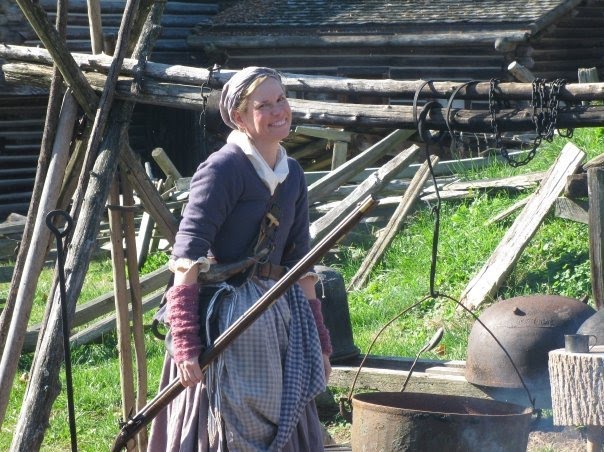
Up until now I have been really stuck for finding images of these women, but now finally I can introduce you to a lovely young lady who actually interprets the life style of Ann Bailey. In real life this lady is known as Suzanne, and I would like to introduce Suzanne to you in the following images. I hope that these images will encourage other women to take on the persona of a woodswoman.


Suzanne, thank you so much for allowing me to use your photos, very much appreciated.
Regards, your Friend, Le Loup.

Friday, 23 October 2009

To Be Or Not To Be, That Is The Question!


Woodswomen Or Women In Men’s Clothing.
This topic is important to me so forgive me if this turns into an epic blog post!
For a long time now I have been promoting the idea of a woodswoman for a living history persona. Arguements against my proposal include: we only have records of two women wearing men’s clothes and being woodsrunners, and, women did not wear men’s clothing in this period and these two women (Mrs Pentry & Ann Bailey) are the exception to the rule, and, women did women’s work not men’s work. Their job was to mind the house, cook, wash, clean, and raise children. Sometimes they had to help their husband with the farm work and to help fight Indians if the cabin was attacked but that is all.
Well firstly the record of Mrs Pentry is from the 17th century, and the record of Ann Bailey is from the 18th century. Mrs Pentry was a French Lady living in a fort until she met Mr Pentry. After marrying Mr Pentry she donned woodsmen clothing and joined her husband in a trading adventure deep in the wilderness (1).
Ann Bailey was also known as “Mad Ann” because after her husband was killed by Indians she started wearing men’s clothing and scouting the forests, sometimes alone and at other times accompanying militia (2).
Then there are all the primary records of women dressing as men and joining the army and navy, one became an officer and yet another was a doctor! (3).
I remember reading about a woman who’s husband was killed on the frontier whilst trying to prepare a home to receive his wife and nine children. On hearing of his death this woman travelled to their home site in the wilderness with her nine children and finished what her husband had started and settled there.
There are also records of women accompanying their husbands on hunts, but they do not state whether or not they were wearing men’s clothing.
All this makes me wonder why people are so against the idea of woodswomen, why don’t they think that this persona should be allowed. I can understand the red necks and macho types who hate to think that a woman may be his equal, but why should women be against the idea?
What is it we are trying to achieve in living history and historical re-enactment? I think perhaps we are losing sight of why we are involved in this activity. For some of us it is an academic exercise, but for most of us we do it for the experience and the fun.
We have no idea how many women were woodswomen, just as we have no idea how many men were woodsmen. We know about Mrs Pentry and Ann Bailey because someone wrote about them, kept a record of their existence. But how many other men and women lived and died on the New World frontier without any recognition of their existence.
Personally I do not think anyone has the right to say a woman, or women, can not take on the persona of a woodswoman and experience that lifestyle based on the fact that we only know of two women who did that. Even if you are re-enacting a battle in a specific place at a specific date in history, I can not see how you can say that there were no woodswomen present based on the fact that no one said there was.
Woodswomen existed, women did wear men’s clothing, and women did do men’s work. This to me proves that a determined woman in the 18th century was just as capable of being what ever she wanted to be just as much as a determined man.


1) , the other was propelled swiftly forward by a man and a woman. Both were dressed in hunters' costume; the woman in a close-fitting tunic of deerskin reaching to the knees, with leggins to match, and the man in hunting-shirt and trowsers of the same material.http://www.internetclassicbooks.com/Woman_on_the_American_Frontier9.htm


2) Her dress “differed little in appearance from the ordinary scout of the border”
Charles Mc Knight , Our western border 100 years ago. page 709.
“Attired herself like a man in hat, hunting-shirt, leggings and moccasins”
West Virginia History Quarterly, Vol XV11, October 1955.
http://andreasworld.0catch.com/Military%20Page/revolutionary.html


3) There are accounts, verified by multiple official sources, of more than 20 women who dressed as men and served in the British Royal Navy or Marines from the late 17th to the early 19th centuries http://www.leatherneck.com/forums/archive/index.php/t-13474.html


4) Phoebe Hessel's gravestone in Brighton churchyard Sussex, tells of her having, "served for many years as a private Soldier http://www.leatherneck.com/forums/archive/index.php/t-13474.html


5) Kit Cavanagh, better known as "Mother Ross" was one of several women who served as dragoons in the British Army. She fought during the 1690's at first disguised as a manhttp://www.leatherneck.com/forums/archive/index.php/t-13474.html


6) 1643. Mrs. Peter Nash and her daughter were women of almost masculine courage and firmness. They all handled axe and gun as skillfully as the men of the household; they could row a boat, ride horseback, swim, and drag a seine for shad; and Mehitabel, the younger daughter, though only fourteen years old, was already a woman of more than ordinary size and strength. These three women accompanied the men on their hunting and fishing excursions and assisted them in hoeing corn, in felling trees, and dragging home fuel and timber. http://www.internetclassicbooks.com/Woman_on_the_American_Frontier8.htm


7) "while the household slumbers, the captives, each with a tomahawk, strike vigorously, and fleetly, and with division of labor,--and of the twelve sleepers, ten lie dead; of one squaw the wound was not mortal; one child was spared from design. The love of glory next asserted its power; and the gun and tomahawk of the murderer of her infant, and a bag heaped full of scalps were choicely kept as trophies of the heroine. The streams are the guides which God has set for the stranger in the wilderness: in a bark canoe the three descend the Merrimac to the English settlement, astonishing their friends by their escape and filling the land with wonder at their successful daring."http://www.internetclassicbooks.com/Woman_on_the_American_Frontier13.htm


8) Who were these lonely wanderers in that wild and wintry waste! The presence of the rifle and of the large high boots which she wore, together with other circumstances, were evidences which enabled the shrewd hunters to guess a part of their story. It appeared that the family must have consisted originally of three persons, a man and wife, with the child now the sole survivor of the party. Voyaging down the Red river during the preceding summer and autumn; lured onward by the fatal beauty of the region, and deluded by the ease with which their wants could be supplied, they had evidently neglected to provide against the winter, which at length burst upon them all unprepared to encounter its rigors.http://www.usgennet.org/usa/ga/county/fulton/library/women/woffinal.pdf


9) Eventually Anne tired of her husband’s recreant ways and ran off with Captain Jack Rackham – Calico Jack. Dressed as a man, she immersed herself in the pirate culture,……
Mary, now on her own, continued to play a male role and became first a footman and then a soldier in the English army.
http://www.essortment.com/all/pirateswomen_rzzx.htm


10) Carin or Karin (Catharina) du Rietz (1766-1788), was a Swedish woman who became a soldier at the Royal guard dressed as a man;http://en.wikipedia.org/wiki/Carin_du_Rietz
Here are two more links kindly posted by an anonymous follower to whom I am very grateful. Thank you, much appreciated.
Women Warriors of the 18th Century http://www.lothene.org/others/women18.html
Women Warriors of the 17th Century http://www.lothene.org/others/women17.html

Monday, 12 October 2009

Women In Men's Clothing.

Who were these lonely wanderers in that wild and wintry waste! The presence of the rifle and of the large high boots which she wore, together with other circumstances, were evidences which enabled the shrewd hunters to guess a part of their story. It appeared that the family must have consisted originally of three persons, a man and wife, with the child now the sole survivor of the party. Voyaging down the Red river during the preceding summer and autumn; lured onward by the fatal beauty of the region, and deluded by the ease with which their wants could be supplied, they had evidently neglected to provide against the winter, which at length burst upon them all unprepared to encounter its rigors.
http://www.usgennet.org/usa/ga/county/fulton/library/women/woffinal.pdf
One of the famous huntresses of the northwest, while returning home from the woods with a wild turkey which she had shot, unexpectedly encountered a large moose in her path, which manifested a disposition to attack her. She tried to avoid it, but the animal came towards her rapidly and in a furious manner. Her rifle was unloaded, and she was obliged to take shelter behind a tree, shifting her position from tree to tree as the brute made at her.
At length, as she fled, she picked up a pole, and quickly untying her moccasin strings, she bound her knife to the end of the pole. Then, placing herself in a favourable position, as the moose came up, she stabbed him several times in the neck and breast. At last the animal, exhausted with the loss of blood, fell. She then dispatched it, and cut out its tongue to carry home as a trophy of victory. When they went back to the spot for the carcass, they found the snow trampled down in a wide circle, and copiously sprinkled with blood, which gave the place the appearance of a battle-field. It proved to be a male of extraordinary size.
http://www.usgennet.org/usa/ga/county/fulton/library/women/woffinal.pdf

The first thing to be done was to strike her husband's trail and then follow it till she overtook him or met him returning. Swiftly, and yet cautiously, she struck out into the forest in a direction at right angles with the Indian camp. Being clad in trousers of deer skin and a short tunic and moccasins of the same material, she made her way through the woods as easily as a man, and fortunately in a few moments discovered a trail which she concluded was that of her husband. Her opinion was soon verified by finding a piece of leather which she recognized as part of his accoutrements.
http://www.usgennet.org/usa/ga/county/fulton/library/women/woffinal.pdf

Mrs. McM., after a moment's remonstrance, on account of the depth of the snow, regained her courage, and, hastily putting on her husband's boots, started, shrieking “fire!” as she passed up the road, and disappeared
http://www.usgennet.org/usa/ga/county/fulton/library/women/woffinal.pdf

Immediately upon learning of her husband's death, Anne became "Mad Anne" and, clothing herself in the garb of a frontiersman, set out to avenge her loss.
http://www.ncgenweb.us/ncrevwar/womenar.htm

Charlotte Charke (1713-1760) was a comedian whose portrayals of men were brilliant caricatures. Having married at 17 and borne a child the next year, Charlotte turned to acting to support herself and her daughter when her lothario husband abandoned them. Once she had tasted success in breeches she wouldn't take them off; she scandalously went on to live her life dressed as a man. She insisted on being called "Mr. Charles" while working in London theatre.
http://www.accessmylibrary.com/coms2/summary_0286-15696746_ITM

Mary, now on her own, continued to play a male role and became first a footman and then a soldier in the English army. She fell in love with an infantryman. The two of them left the army and opened a tavern called The Three Horseshoes in 1697, right around the time her future comrade-in-arms, Anne Bonny, was born. They ran the tavern for nearly twenty years until Mary’s husband died, leaving her once again alone. Taking up old habits to survive, Mary slipped into her male alter ego and became a shipmate on a sloop bound for the West Indies.
During this same time, Anne was growing up spoiled and plagued by a murderous disposition. On one occasion it’s said she stabbed a maid to death in a fit of temper. Growing bored with plantation life in her adolescence, Anne married a scoundrel and sometimes pirate named Jack Bonny whose designs were more on her father’s wealth than on Anne. Furious with the marriage, William disinherited her; Anne burned the plantation in retaliation.
Eventually Anne tired of her husband’s recreant ways and ran off with Captain Jack Rackham – Calico Jack. Dressed as a man, she immersed herself in the pirate culture, fighting no less savagely than the male crew. She and Calico Jack prowled the shipping lanes around Jamaica, plundering ships and taking as prisoners those they didn’t kill, one of whom was Mary Read.
Mary and Anne soon discovered each other’s true identity and became fast friends. Anne offered, and Mary accepted, a place on the ship. Any doubts the crew harboured about Mary quickly disappeared when, in a rage over the planned execution of a prisoner with whom she’d fallen in love, Mary challenged one of the pirates to a duel; using pistols and daggers, she promptly dispatched him.
http://www.essortment.com/all/pirateswomen_rzzx.htm

Carin or Karin (Catharina) du Rietz (1766-1788), was a Swedish woman who became a soldier at the Royal guard dressed as a man;
http://en.wikipedia.org/wiki/Carin_du_Rietz

Friday, 28 August 2009

Mrs Pentry. Woodswoman.

In the year 1672 a small party of hunters arrived at the mouth of the Kennebec in two canoes. The larger one of the canoes was paddled up stream by three men, the other was propelled swiftly forward by a man and a woman. Both were dressed in hunters' costume; the woman in a close-fitting tunic of deerskin reaching to the knees, with leggins to match, and the man in hunting-shirt and trowsers of the same material. Edward Pentry, for this was the name of the man, was a stalwart Cornishman who had spent ten years in hunting and exploring the American wilderness. Mrs. Pentry, his wife, was of French extraction, and had passed most of her life in the settlements in Canada, where she had met her adventurous husband on one of his hunting expeditions. She was of manly stature and strength, and like her husband, was a splendid shot and skillful fisher. Both were passionately fond of forest life, and perfectly fearless of its dangers, whether from savage man or beast.


At length she descried the object of their hostility behind the trunk of a fallen tree. It was clearly a white man who crouched there, and he seemed to be wounded. She immediately took aim at the nearest Indian and sent two bullets through his lungs. The other Indian at the same instant had fired at the white man and then sprang forward to finish him with his tomahawk. Mrs. Pentry flew to the rescue and just as the savage lifted his arm to brain his foe, she drove her hunting knife to the haft into his spine.


How long she slept she never exactly knew, but she was awakened by a splash; lifting her head above the edge of the boat, she saw nothing but a muddy spot on the water some thirty feet away, near the shore. This was a suspicious sign. Looking more closely, she saw a slight motion beneath the lily-pads, which covered closely, like a broad green carpet, the surface of the lake. Her hand was on her gun, and as she leveled the barrel towards the turbid spot, she saw a head suddenly lifted, and at the same moment a huge Indian sprang from the water and struggled up through the dense undergrowth that lined the edge of the lake.
It was a sudden impulse rather than a thought, which made Mrs. Pentry. level the gun at his broad back and pull the trigger. The Indian leaped into the air, and fell back in the water dead, with half a dozen buck-shot through his heart. At the same moment she felt a strong grasp on her shoulder, and heard a deep guttural "ugh!" Turning her head she saw the malignant face of another Indian standing waist-deep in the water, with one hand on the boat which he was dragging towards the shore.
A swift side-blow from the gun-barrel, and he tumbled into the water; before he could recover, the brave woman had snatched the paddle, and sent the canoe spinning out into the lake. Then dropping the paddle and seizing her gun she dashed in a heavy charge of powder, dropped a dozen buck-shot down the muzzle, rammed in some dry grass, primed the pan, and leveled it again at the savage, who having recovered from the blow, was floundering towards the shore, turning and shaking his tomahawk at her, meanwhile, with a ferocious grin. Again the report of her gun awakened the forest echoes, and before the echoes had died away, the savage's corpse was floating on the water.

Tuesday, 25 August 2009

Anne Bailey-Woodswoman.


This site is worth checking out for information on "Mad Anne Bailey". This is a good example of a pioneer woman becoming a woodswoman. Here is piece from the site:


"It was also time for Anne to change her style of dress. She would be clad for revenge in an old petticoat, a man’s great coat and hat, and buckskin leggings that reached from hips to feet. Those feet sometimes sported moccasins, sometimes a pair of men’s sturdy shoes. Around her head was tied a bandana the hue of any one of many lonely wilderness campfires that would warm her in the coming years. That red scarf held in place her hair, said to be long, grizzled and matted. In addition to a tomahawk and a knife, about her person hung a bullet-pouch and a powder horn. A good and sturdy rifle completed her outfit". Copyright Mary Trotter Kion 2005.


Monday, 24 August 2009

FREE Book give away & Recruiting for the New England Colonial Living History Group.


I am extending the offer of the Primitive Skills Book give away until the end of September. The first 5 people granted membership to our group before the end of September will recieve a copy of my book "Primitive Fire Lighting-Flint & Steel".

This is only open to those members who can actually attend our meetings near Armidale and participate in our activities.

If you THINK that you MIGHT be genuinely interested in joining our group then we would be very pleased to have you visit so that we can explain what our group is and what we do.

I can be contacted on Phone: 67 755 292, or you can contact me through this blog.