Colonial Williamsburg Foundation has submitted a proposal to the
city’s zoning board to construct a “tomahawk/axe throwing range” in the
Historic Area at the old military encampment site at 311 East Nicholson
Street.. (Courtesy Google Maps)
Wade Stoner, a French and Indian War reenactor, poses for
a portrait at Fort Ligonier on Thursday, Oct. 6, 2016.
PHOTO BY STEPH CHAMBERS | TRIBUNE-REVIEW.
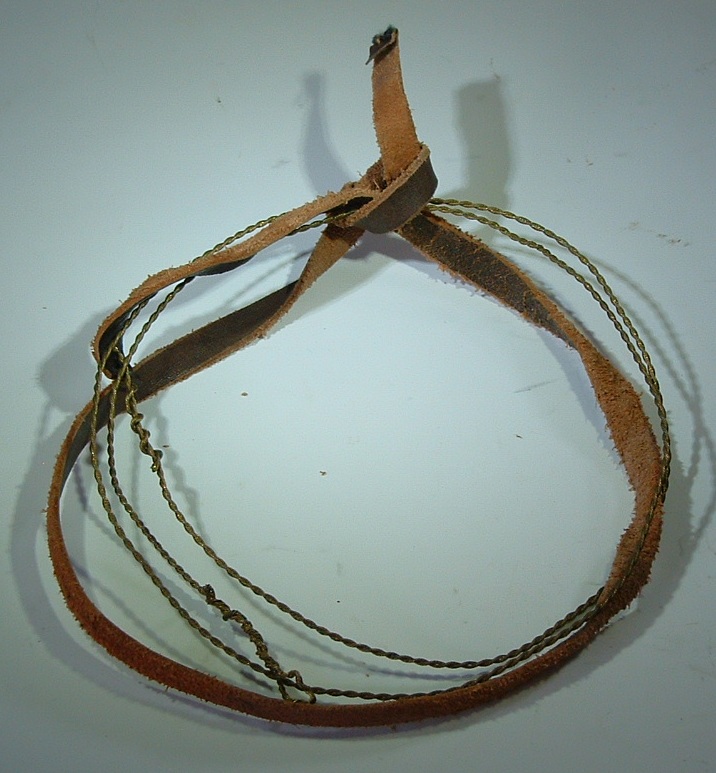
Let the young trapper supply himself with a small, sharp hatchet, and a stout, keen edged jack-knife,—these being the only tools required. He should also provide himself with a coil of fine brass "sucker wire," or a quantity of horse-hair nooses (which will be described further on), a small ball of tough twine and a pocket full of bait, such as apples, corn, oats and the like, of course depending upon the game he intends to trap. With these, his requirements are complete, and he has the material for a score of capital snares, which will do him much excellent service if properly constructed. CAMP LIFE IN THE WOODS AND THE TRICKS OF TRAPPING AND TRAP MAKING. By W. HAMILTON GIBSON. Gutenberg Files.
Using snares was a common trapping method with Eastern woodland Indians. Using the correct size of snare they could trap any size of game from quale up to deer. Cordage, raw hide & sinew snares were used, but brass snare wire obtained through trade was also used.
Original brass wire snare.
Not earlier than 1750
Not later than 1837Minnesota Historical Society. MHS Library Catalog
The English Hare Pipe. Only one snare line, from anchoring stake through the pipe, formes a loop, then back into the pipe and secured at the other end of the pipe on a peg. The more the hare pulled, the more the points on the end of the pipe stuck in.
A more humane version could easily be made with a piece of plain pipe with no points. This would also stop the snare from strangling the hare/rabbit. Oridinary brass wire snares do not strangle either, but neck snares have been banned in NSW because of the modern snares using a lock! Another case of the government simply either not caring, or not knowing what they are talking about! In my opinion ordinary snares are far more humane that 1080 poison which is what the government recommends! You can't of course use the meat from a poisoned animal. This 1080 is also responsible for the killing of many native animals.
Poachers in England would have used snares and hare pipes, so many who travelled to the New World were not devoid of survival skills. They were already good woodsmen and hunters.
Hunting was largely performed with a bow, although snares and pit traps were sometimes used. Wood described deer traps in Massachusetts “which are springes made of young trees, and smoote wrought coards; so strong as it will tosse a horse if hee be caught in it”. Archaeology of the Puncheon Run Site (7K-C-51) Volume II: Technical Appendices http://www.deldot.gov/archaeology/puncheon_run/pdf/august2005/VOL2-2005-PDF/D_Volume%20II%20PDF.pdf
MORGAN TO BAYNTON AND WHARTON The same Party of Indians a very few days after attackd six Virginia Men Who were hunting with six Horses on One of the Branches of Green River — They killd One Man named…… took one Joseph Blankenship Prisoner With all the Horses. The other four Men made their Escape Which Blankenship also did after they had crossed the Ohio A particular Relation of his Story you have inclosed N° 2^ I have cloathd him & furnish.d him with a Gun & Ammunition to carry him home. This fellow met with Copes Cannoe the same Morning that he made his Escape & came in her to the Cherokee Fort from whence he set out with him & Galloway for this Place He seperated from Cope on Thursday the 14th Instant after being five Days from the Fort in which Time they had expended all their Powder & Balls & were without Provisions.
On Saturday Evening following being the 16th Instant Blankenship arrived. On Sunday Morning I sent out Simon Girty with three other good Woodsmen to seek for Cope & his Partner. As they did not return that Day, L* Ancram my Chickasaw Indian & myself went out on Monday Morning. About 9 Miles off we fired several Guns & were answerd by Girty Who the Evening before had found Cope & Galloway strolling up & down the Woods they knew not Where. As the Road to return on that Side the River Was very bad & round about, We made a Raft for our Guns & the Letters & swam the Kaskaskia at the Mouth & arrived here at two OClock Which Cope desired me to be very particular in mentioning to........
I cannot say but I was much vex'd to hear him say & before L* Ancram that he was ordered by you to take no Letters from any Officers or any Persons Whatever on Pain of forfeiting his Wages. A Continuance of such Orders in future may do Us more Injury than all the Letters Which can be sent here. Nay We have already suffer'd in the Esteem of the Army as they have always been acquainted with our Orders as well as We ourselves. They declare We have no Right to do it & that We make Ourselves liable to have our Letters stop'd Without a Pass from the Commanding Officer at Fort Pitt. How this is I cannot say. But I do assure you I would rather not have rec^ these Letters by Cope than they should have come off in so private a Manner. Cap^ Forbes Who is much our Friend, advises Us to avoid the like in future.
I challenge anyone to find primary documentation that a longhunter existed in the 18th century. By this I mean the word or term longhunter or long hunter actually being used in the 18th century. So far I have found no proof that this term was ever in existance before the 20th century! So what was this so called longhunter supposed to be? I mean we now see adverts for "longhunter shirts" and "longhunter packs", and the list goes on as if this longhunter was something special, out of the ordinary compared to a woodsman. Well in fact the modern meaning of a so called longhunter is that he hunted for a long time, or he was in the woods hunting for a long time. Woodsmen who hunted commercially for meat and deer skins are now called longhunters because they were in the woods hunting for a long time, i.e. months at a time. But this does not make them any different from any other woodsman who hunts, they did not wear different clothes or use different guns. My point here is, that if the term longhunter was not in use in the 18th century, then why are we using it now? Fine to say a woodsman has been gone for a long time, fine to say he has been out there hunting for a long time now, but to call him a longhunter? At what point is an ordinary hunter supposed to become a long one? Personally I think it is time we stopped using this term "longhunter" until someone can come up with proof that the term was in use in the 18th century. Until then they are woodsmen and hunters regardless of the length of time they are in the woods.
The Eastern Woodsman. Interpreting The Eastern Woodsman 1700-1760. A woodsman was someone who spent time in the woods, either wholly or part time. The woodsman could have a variety of jobs. He could be a town tradesman, a militia man, a farmer. He could work as a ranger, a scout, a guide or a messenger. Depending on his present occupation he may travel by horse, wagon or on foot. Scouting areas for trapping was often done on foot. If he did not want to attract attention he would travel on foot and leave less sign. Daniel Boone worked as a labourer for a Wagoner in the French and Indian war. Later he became a land owner and farmer, but he spent most of his time in the woods whilst his family looked after the farm. The woodsman and even the woods woman are easy characters to emulate, because you have a variety of choices regarding dress and equipment. • You do not need a horse to be a woodsman or woods woman. • You do not need to carry steel traps. • You have a variety of Historical Trekking scenarios to choose from. • You can be an “Indian Influenced” woodsman. • Men & Women can interpret this character & share this experience together. • Woods women can wear men’s clothing or a mixture of men’s and women’s clothing. The fur trade started very early on in the history of the New World. Woodsmen involved in the fur trade could be beaver trappers or they could hunt bear, deer, and a variety of other fur bearing animals for the skins.
I mean no disrespect to the original author of this piece, and I claim no copyright or gain through my editing. I have simply changed the story to be more period correct in the terms and methods used in that time.
In the year 1672 a small party of hunters arrived at the mouth of the Kennebec in two canoes. The larger one of the canoes was paddled up stream by three men; the other was propelled swiftly forward by a man and a woman. Both were dressed in hunters' clothes; the woman in a close-fitting tunic of deerskin reaching to the knees, with leggings to match, and the man in a frock, breaches and leggings of the same material. Edward Pentry, for this was the name of the man, was a stalwart Cornishman who had spent ten years in hunting and exploring the American wilderness. Mrs. Pentry, his wife, was of French extraction, and had passed most of her life in the settlements in Canada, where she had met her adventurous husband on one of his hunting expeditions. She was of manly stature and strength, and like her husband, was a splendid shot and skilful fisher. Both were passionately fond of forest life, and perfectly fearless of its dangers, whether from savage man or beast. It was their purpose to explore thoroughly the region watered by the upper Kennebec, and to establish a trading-post which would serve as the headquarters of fur-traders, and ultimately open the country for settlement. Their outfit was extremely simple: guns, traps, axes, fishing-gear, powder, and bullets, and with an assorted cargo of such trinkets and other articles as the Indians desired in return for peltry. In three weeks they reached the head-waters of the Kennebec, at Moosehead Lake. There they built a large cabin, divided into two compartments, one of which was occupied by three of the men, the other by Mr. and Mrs. Pentry. All of the party were versed in the Indian dialect of the region, and as Mrs. Pentry could speak French, no trouble was anticipated from the Indians, who in that part of the country were generally friendly to the French. The labours of the men in felling trees and shaping logs for the cabin, as well as in framing the structure, were shared in by Mrs. Pentry, who in addition did all the necessary cooking and other culinary offices. They decided to explore the surrounding country for the purpose of discovering the lay of the land and the haunts of game. No signs of any Indians had yet been seen, and it was thought best that the four men should start, each in a different direction, and having explored the neighbouring region return to the cabin at night, Mrs. Pentry meanwhile being left alone--a situation which she did not in the least dread. Accordingly, early in the morning, after eating a hunter's breakfast of salt pork, fried fish, and parched corn, the quartet selected their several routes, and started, taking good care to mark their trail as they went, that they could the more readily find the way back.
It was agreed that they should return by sunset, which would give them twelve good hours for exploration, as it was the month of July, and the days were long. After their departure Mrs. P. put things to rights about the house, and barring the door against intruders, took her gun and fishing-tackle and went out in the woods. The cabin stood on the border of Moosehead Lake. Unloosing the canoes, she embarked in one, and towing the other behind her, rowed across a part of the lake which jutted in shore to the southwest; she soon reached a dense piece of woods which skirted the lake, and there mooring her canoe, watched for the deer which came down to that place to drink. A fat young buck before long made his appearance, and as he bent down his head to quaff the water, a brace of buck-shot planted behind his left foreleg laid him low, and his carcase was speedily deposited in the canoe. The sun was now well up, and as Mrs. P. had provided for the wants of the party, and no more deer made their appearance, she lay down in the bottom of the boat, and soon fell fast asleep. Hunters and soldiers should be light sleepers, as was Mrs. Pentry upon this occasion. How long she slept she never exactly knew, but she was awakened by a splash; lifting her head above the edge of the boat, she saw nothing but a muddy spot on the water some thirty feet away, near the shore. This was a suspicious sign. Looking more closely, she saw a slight motion beneath the lily-pads, which covered closely, like a broad green carpet, the surface of the lake. Her hand was on her gun, and as she levelled the barrel towards the turbid spot, she saw a head suddenly lifted, and at the same moment a huge Indian sprang from the water and struggled up through the dense undergrowth that lined the edge of the lake. It was a sudden impulse rather than a thought, which made Mrs. P. level the gun and pull the trigger. The Indian leaped into the air, and fell back in the water dead, with half a dozen buck-shot through his heart. At the same moment she felt movement and turning her head she saw another Indian standing waist-deep in the water, with one hand on the canoe which he was dragging towards the shore. A swift side-blow from the gun-barrel, and he tumbled into the water; before he could recover, the brave woman had snatched the paddle, and sent the canoe out into the lake. Then dropping the paddle and seizing her gun she dashed in a heavy charge of powder, some grass wadding, dropped a dozen buck-shot down the muzzle, primed the pan, and levelled it again at the savage, who having recovered from the blow, was floundering towards the shore. Again the report of her gun awakened the forest echoes, and before the echoes had died away, the savage's corpse was floating on the water.
(I am certain that illustrators never read the books!)
THE HUNTRESS OF THE LAKES SURPRISED BY INDIANS. She dared not immediately approach the shore, fearing that other savages might be lying in ambush; but after closely scrutinizing the bushes, she saw no signs of others, besides the two whom she had shot. She then cut long strips of raw hide from the dead buck, and towing the bodies of the Indians far out into the lake sunk them with the stones that served to anchor the canoes. Returning to the shore, she took their guns which lay upon the shelving bank, and rapidly paddled the canoe homeward. http://www.internetclassicbooks.com/Woman_on_the_American_Frontier1.htm
These are some images of the half-faced shelter I built in Fox Valley in Wychwood Forest. The ground here was very hard so there was no way of putting upright posts into the ground and I had to utilise standing trees.
This is the sort of shelter I imagine a settler would put up first before building a more permanent structure. This Half-Faced shelter was reasonable quick and easy for me to construct on my own just using the tomahawk that I always carry. If I wanted to I could close this shelter in a lot more and make it more weather proof to house a small family through winter.
This was a project that I have wanted to do for a long time now because I wanted to know if the average settler without many tools and no horse or cattle to carry a burden could infact make a decent shelter large enough to house a small family. For me this Half-Faced shelter proves that they could. I have slept in this shelter in winter and even with the front and one side open I stayed reasonably comfortable. But for really cold weather I would close it in a lot better than this.
I could have used bark on the roof but it would have meant killing several trees, so I compromised and used thin ply. If this had been in the Northern Hemisphere I could have used Birch bark. Alternatively I could have made a less permanent roof covering by using oilcloth and covering it with brush. When I make a simple lean-to for myself I use my oilcloth as is with no brush cover and it works very well.




 These are some images of the half-faced shelter I built in Fox Valley in Wychwood Forest. The ground here was very hard so there was no way of putting upright posts into the ground and I had to utilise standing trees.


