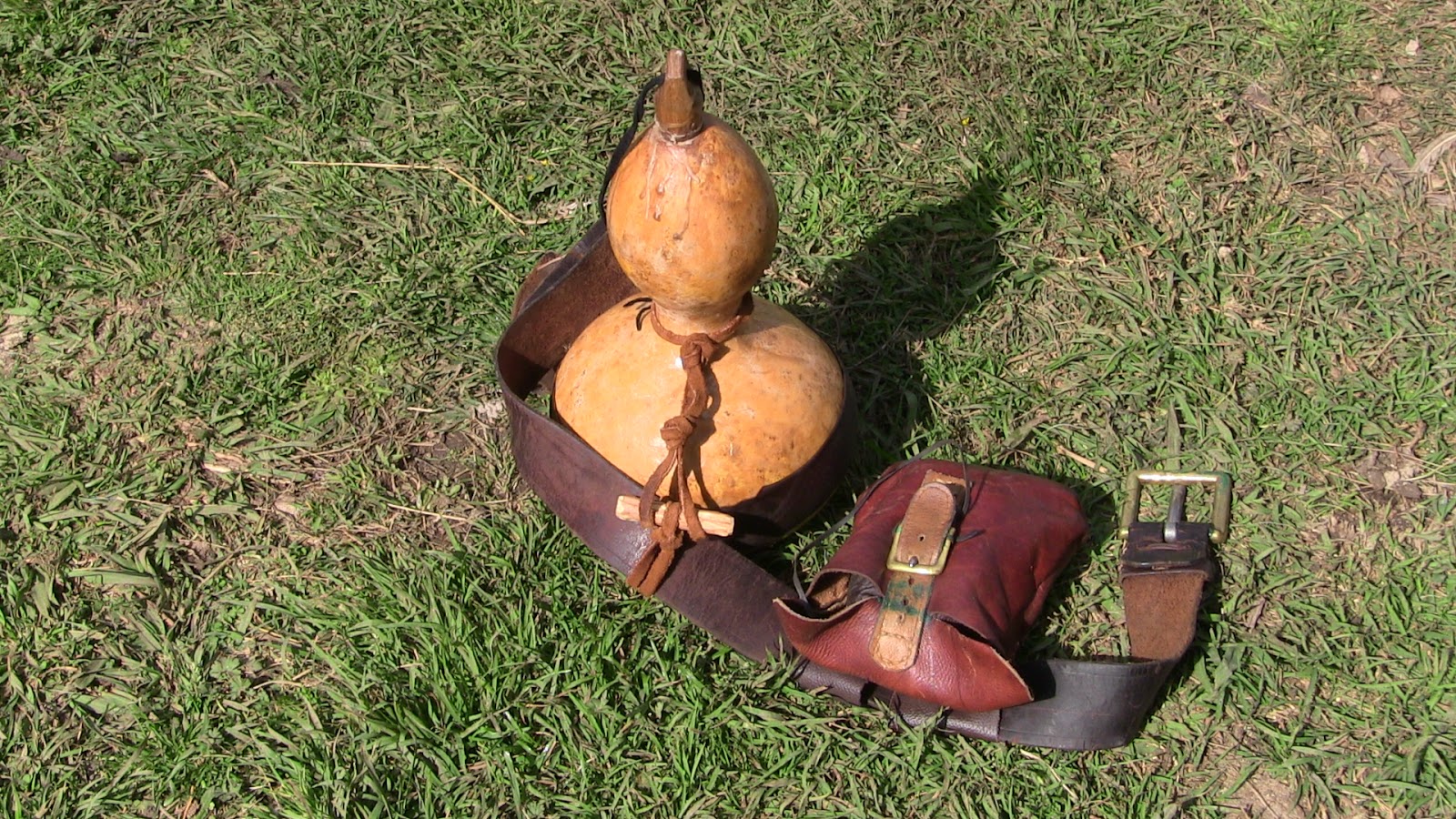
Water bottle gourd found at Bents Fort.
17th & 18th Century water & wine
gourds.
Were they lined inside?
To date I have not been able to find any primary documentation
suggesting that water bottle gourds were actually sealed inside. However, this
does not mean that you can’t seal the inside if you so wish. A close friend of
mine purchased a gourd water bottle from a living history trader in America,
& it grew mould inside.
“Now we are ready to make the canteen capable of holding liquid
without it tasting like swamp sludge. In this procedure I use paraffin wax and
a heat source. As you all should know paraffin is extremely flammable and it
can be dangerous if used carelessly so I'm not responsible if you flame your
gourd, kitty or your humble abode in this next step.
I use pure canning paraffin as opposed to beeswax because beeswax can
make the water sort of taste well, like beeswax. Gourds I have waxed with this
method have held out over ten years with its original application, however the
larger, more often used storage bottles I usually rewax every few years until
they get too heavy from all the wax coatings.
The initial waxing is the most important since this can never be
undone or redone. So take care - be careful - take your time and you will have
success. I use an electric stove and oven in this process so there is no open
flame. If you choose to do this on a gas stove it could be dangerous, so please
take care.
Get your gourd, a coffee can and a cork that fits the gourd. Also,
some towels or rags to handle the hot gourd will be necessary. I set my oven on
250-275 degrees and place the dry and cleaned gourd on the middle rack. Then I
take a coffee can which is clean and bend a spout in its side to use as a
pouring aid. In this can I carefully melt down two hunks or slabs of wax. When
melting wax watch it carefully. Melt at low heat and just as the last solid bit
disappears it is ready. If you leave wax to heat too long you may lose track of
how hot it is getting and it could burst into flames. As soon at the last traces
of wax just disappear in the can take it off the heat. From here on in this
must be done quickly and without hesitation to achieve the initial coating in
the gourd.
The gourd is removed from the oven and quickly you will pour the
melted wax inside it (not near a source of flame). Put the cork in the hole and
start vigorously shaking it for a few minutes until the liquid wax starts to
"feel different" as it starts to solidify. Then quickly take out the
cork and pour the excess back into the can. Set the gourd aside to cool slowly.
Don't touch until fully cool. If you did this initial step correctly all of the
pores inside the gourd, including whatever fluff remained, are encapsulated in
wax. You can do up to two more applications of wax but do not put the gourd
back in the oven because you will undo all your hard work. Just melt the wax in
the can as before and pour in the gourd, shake vigorously and pour out. Let the
gourd cool thoroughly each time; otherwise, you will remove the previous wax.
All you need now is a new clean cork and a method of carrying it and
you have a fine water container. I never used this type of container for
spirits because they may adversely affect the wax.
Gourds done this way should be fine holding water during events. My
big supply bottle gets filled when I leave home for an event and is not emptied
until I return home. The water always tastes fine. There is some maintenance
however.
For storage after an event you must drain and dry (no heat) the
container thoroughly. Do not put the cork back in unless it has dried for a few
weeks. I leave my corks out while in storage. Store in a clean dry area. A damp
gourd can form a bit of mold on its exterior while drying in storage (not
detrimental). Never expose an empty or partially full container to the sun or
leave in a hot tent for any length of time as the wax will melt. Keep
containers full and in the shade and this will be no problem. I also have found
that some hot paraffin rubbed into the exterior of the gourd during the initial
waxing process protects the gourd's exterior as well. If at any time the water
in the gourd starts to taste foul this would indicate that it is time to
reapply a wax coating on the inside. (Follow the instructions for repeated
applications of wax)”.
“Bottle Gourds – a natural alternative, one of the things we know
about the Dutch that inhabited New Jersey at this time is that they were
resourceful and not a wasteful lot. A Gourd Canteen would be cost effective to
make though they are fragile.
This first step is to procure a dried bottle gourd. You can either grow your
own from seed or look for them at the farm stand in the fall. Your gourd must
then be placed in a dry location and be allowed to thoroughly dry out. Once you
can hear the seeds rattle inside, clean the outside of the gourd with soap and
water so the mold that is on the outside comes off. Next, you want to make sure
you are outside and have some sort of breathing mask on. Drill a hole on the
top of the gourd (The dried gourd particles inside are not good to breath in,
thus why it’s important that this is done outside, along with wearing
protection over your mouth), this whole will be used as your opening to
dispense water as well. You can then put a few rocks into the gourd, shake them
around and this will help to loosen any other objects inside the gourd. To
water proof your canteen, some recommend a natural material, like bees wax.
Working with bees wax is very hot so be careful. Melt the wax and pour it into
the gourd. Shake the gourd around to have even coverage and drain the wax
before it dries. Your gourd bottle is now water proof, you just need a cork for
the top and you have a very authentic canteen. The fun part of Bottle Gourds is
that if you break it, you can always grow more”.
Beeswax was used for sealing the inside of water vessels very early
on in history.
“While it’s hard to pin specific dates when archaeologists take us
this far back in history, we can say with certainty that the Ancient Georgians
were using these large, beeswax coated, earthenware vessels as early as 6,000
BC”.
More gourd history & uses:
Beggar in
soldiers clothing by Marquard Wocher 1760-1830.




 18th century wine bottle.


