A LIVING HISTORY BLOG.

18TH CENTURY LIVING HISTORY IN AUSTRALIA.
Showing posts with label sewing kit. Show all posts

Wednesday, 16 November 2016

18th Century Sewing Needles & Pins.

18th century items including steel needles and  pins found in the Sprague House.

18th Century Sewing Needles and Pins.
From about the Viking age until the 17th century sewing needles were made of iron. From the 17th century onward sewing needles were made of steel. If you are looking for 18th century sewing needles for your “housewife” sewing kit, I suggest you simply purchase a set of modern sewing needles.
Iron needles.

Hand made brass pins were in use during the 17th & 18th century. The pin itself being made of brass wire, & the heads were made separately of brass wound around the top of the pin.
17th-18th century brass English pins found in the mud of the Thames River London England.

1620-1650 Silvered brass English sewing pins.

Wooden needle cases.

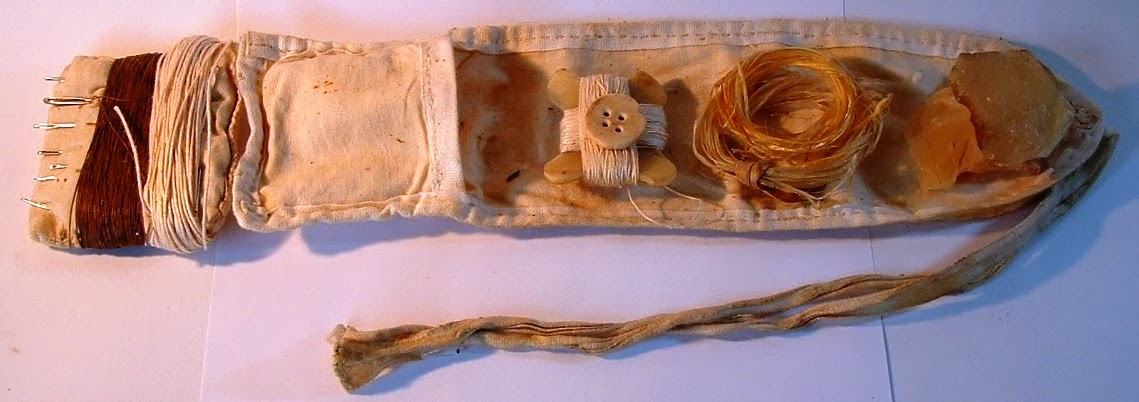
Author's Housewife sewing kit.

Close-up of the author's pin cushion on the housewife with steel needles.


Saturday, 21 December 2013

The Housewife Sewing Kit and Comfort.

Everything we carry on the trail is for comfort. Different people have different ideas about what was carried by the average woodsman. But with basic items I do not find it hard to make a decision. Take the housewife for instance. We know for a fact that everyone, no matter who they are or what they are sooner or later will need clothing repair. For the woodsrunner it is even more so because of the increased wear and tear involved in the job. Some will say that we can make a needle and the thread when we need it, which is true, but would it be sensible after going to all the trouble to make a bone needle to then not carry it with you so you have to make a new needle each time you need to make new moccasins or repair your present ones?

The answer is no, it would not be sensible, so using the same logic, if you have access to metal sewing needles, why would you not obtain some and carry them with you? The same then applies to the thread, beeswax and maybe spare clothing buttons. It is just plain common sense to carry these items with you.

Here then are some items you may wish to consider carrying with you on the trail. Needles can do double duty used for removing wood splinters. Fine linen thread may be used in an emergency for stitching up wounds. Beeswax used to wax linen thread can also be used to seal tears in your oilcloth after repair.
Plain wood handled awl with wooden sheath.

An antler handled awl made by the author, a waxed linen thread wrapped wooden sheath, and the author's original awl once owned by his Father.

The author's Housewife and contents.

The pin cushion holds a variety of needles and is wrapped in two sizes of linen thread.

More linen thread on a horn thread winder made by the author, and a hand made bone button.

Rolls of animal sinew and rawhide used for repairing moccasins, and a piece of beeswax for waxing linen thread.

Showing the open pocket that holds spare buttons, beeswax and sinew and rawhide.

Showing the housewife rolled up and tied.

Early 18th century case and accessories.

Wooden needle cases.

Sewing items, including needles, straight pins, thimbles, scissors and a bone cap, possibly to a needle case.


Friday, 28 December 2012

Primitive and Period Living Skills.

Our group members are presently evaluating their skills. When I posted the list of skills I personally would expect one of our woodsrunners to have, I also asked if anyone could add to that list. 
What has arisen from that discussion is the question of "would everyone have had that skill". In this particular case the question referred to leather work skills. This was my reply.

I think that if an item was needed, then the person needing that item would do his best to acquire it. If he/she could not purchase the item, then they would have to make it if possible. I have seen some rough leather work and some good leather work. Not everyone was good at everything. I am fair at making leather items with just the basic tools, awl, knife & needle. This is all the tools that one could expect the average person to be carrying or owning.
I think we should make the best we can with these basic tools, & if it does not look good, but is functional, then that is the way it is and was. The more we do, the better we get, up to a point. There is the "that will do" attitude, which is mostly mine, and there is the "not good enough" attitude which involves more time to make something look its best. 
Our individual levels of skill are such that someone's "that will do" or "good enough" may well be better than the "not good enough" attitude, but in the end all that matters is that the item is functional. That is the skill level you need.
Keith.
So many skills are involved in putting your 18th century gear together. Before you can do any leather work, you need to make an awl. The top one I made, the lower one was my Father's awl.

On the left is an awl which belonged to a close friend. He also made the three trade awls on the right.

The "housewife" or sewing kit can come in various forms, but this one is the most popular type.


These lower three examples all have a double sheath. Softer leather cover over a hard leather sheath.

This one above has an inner bark sheath.

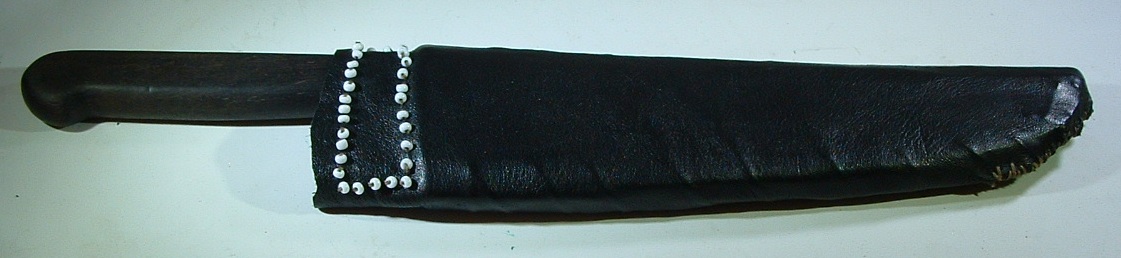
Various knife sheaths, all functional.


This is a list of basic skills in which I personally would expect an 18th century woodsman or woods-woman to have some experience with.
·         Flint & steel fire lighting
·         Wet weather fire lighting
·         Fire-bow fire lighting
·         Flintlock fire lighting
·         Flintlock use, service & repair
·         Field dressing & butchering game
·         Blade sharpening
·         Tomahawk throwing
·         Making rawhide
·         Brain tanning
·         Primitive shelter construction
·         How to stay warm in winter with only one blanket
·         Cordage manufacture
·         Moccasin construction and repair
·         Sewing
·         Axe and tomahawk helve making
·         Fishing
·         Hunting
·         Evasion
·         Tracking
·         Reading sign
·         Woods lore
·         Navigation
·         Primitive trap construction & trapping
·         Open fire cooking
·         Fireplace construction
·         Clothing manufacture
·         Drying meat & other foods
·         Knowledge of plant tinders & preparation
·         Knowledge of native foods & preparation
·         Knowledge of native plants in the area and their uses for other than tinder and food.
·         Scouting/Ranging.
·         Basic first aid.
·         Finding and treating water.
·         General leather work. 

Wednesday, 22 August 2012

Handmade Antler Pins & Needles By Yooper.

Yooper is one of our group members in America, and he makes a lot of his own gear. Below is an image of part of Yooper's sewing kit, showing the antler needles and pins he made himself. I think there is something very special in producing something practicle like this and actually being able to carry it with you and use it when needed.
I think these pins and needles are a work of art, beautiful.

Saturday, 24 March 2012

The 18th Century Housewife or Hussif, and some Pocket Books.

The term Housewife refering to a sewing kit was first mentioned I believe in a dictionary in 1749. But for it to be posted in a dictionary at that time, it must already have been in common usage. The sewing kit retained this name and style right into the American civil war, and the same term was still in use in the late 20th century.
This sewing kit was also known as a hussiv and a hussif, depending on the English dialect being used. The term Hussif became very popular with many people regardless of where they came from. There must have been other forms of sewing kits, and no doubt the housewife developed from a simple roll of material which contained everything needed for mending clothing and cloth packs when away from home. It was especially popular with military personel.

Horn thread winder with linen thread and sinew for repairing moccasins.
Sinew and beeswax. The beeswax is for waxing the linen thread.
Thread winder and a bone button. Bone buttons were very popular in the early to mid 18th century.

Looking inside the pocket on the housewife.
The attached pin cushion with a variety of different sized needles and two sizes of linen thread. The pin cushion is stuffed with unwashed sheep fleece which still retains its lanolin helping keep the pins from rusting.

Rolled up and secured. Note that I taped the edges as per the original to make a neater and stronger finish.


 My wife coppied these from an original early to mid 18th century pocket book. The cover though a period pattern is usually found on bedding and is a loom woven overshot pattern. The original pocket book did not have this pattern.

I would think it quite acceptable if a pocket book was also used to contain a sewing kit. As you can see from the image above, there are two pockets with flaps, one on each side.

Monday, 26 December 2011

That Time of Year.

That Time Of Year.
Had I not been in hospital, I should have written this way before Xmas. Never mind, better late than never.  For some of us this is the season for historical trekking, regardless of whether you are in the Northern or Southern hemisphere. Personally I dislike trekking & camping in summer in Australia, I prefer the winter, though actually right now there is a cool breeze blowing through the forest & it is very pleasant out.
  For me this is a time to check over my gear in readiness for winter. There are rarely any repairs to do these days, because I tend to repair items of gear & clothing whilst in camp. But for many newbies there may still be period items to improve on or add to your gear. Not that I am recommending that you add more stuff, but some small items are indispensible. Such as thread winders.

Copies of originals are generally not expensive, and they are very easy to make yourself from bone or horn. In the 18th century linen and silk thread came in skeins, and for use they required winding on to a thread winder. Of course you could just use a piece of stick, but a proper thread winder takes up little room in the sewing kit and looks good as well.

My sewing kit or "housewife". Another easy item to make. The pin cushion on the end I stuffed with natural greasy fleece. In the pocket I have beeswax, more linen thread, and sinew for repairing the soles on my moccasins and some spare bone buttons.


There are various styles of thread winders, but this style I found the easiest to make. I made this one from horn.


Spools of silk thread a close friend sent me as a gift. I need to transfere some of this thead on to thread winders. Silk is very strong and can be used as fishing line. Traditionally it has been used for making fishing flys. Some of this will go into my fishing kit.