A LIVING HISTORY BLOG.

18TH CENTURY LIVING HISTORY IN AUSTRALIA.
Showing posts with label needles. Show all posts

Monday, 1 December 2014

17th Century Knitting Sheath.

Knitting sheaths were attached to the waist and used to support one knitting needle so that the knitter only needed to use one hand for plain knitting. Many women supplemented their incomes by making knitted goods for sale and a knitting sheath made it possible to knit while carrying out other domestic chores, in particular carrying or feeding infants.
Knitting sheaths were often made as love tokens. This carved boxwood example bears the initials AT and the date 1679 with an inscription, 'I am box and brass within, my place is on your apron string'. The hole at the top of the sheath to hold the needle is lined with brass.
Brass lined wood knitting sheath, English 1679.

Saturday, 21 December 2013

The Housewife Sewing Kit and Comfort.

Everything we carry on the trail is for comfort. Different people have different ideas about what was carried by the average woodsman. But with basic items I do not find it hard to make a decision. Take the housewife for instance. We know for a fact that everyone, no matter who they are or what they are sooner or later will need clothing repair. For the woodsrunner it is even more so because of the increased wear and tear involved in the job. Some will say that we can make a needle and the thread when we need it, which is true, but would it be sensible after going to all the trouble to make a bone needle to then not carry it with you so you have to make a new needle each time you need to make new moccasins or repair your present ones?

The answer is no, it would not be sensible, so using the same logic, if you have access to metal sewing needles, why would you not obtain some and carry them with you? The same then applies to the thread, beeswax and maybe spare clothing buttons. It is just plain common sense to carry these items with you.

Here then are some items you may wish to consider carrying with you on the trail. Needles can do double duty used for removing wood splinters. Fine linen thread may be used in an emergency for stitching up wounds. Beeswax used to wax linen thread can also be used to seal tears in your oilcloth after repair.
Plain wood handled awl with wooden sheath.

An antler handled awl made by the author, a waxed linen thread wrapped wooden sheath, and the author's original awl once owned by his Father.

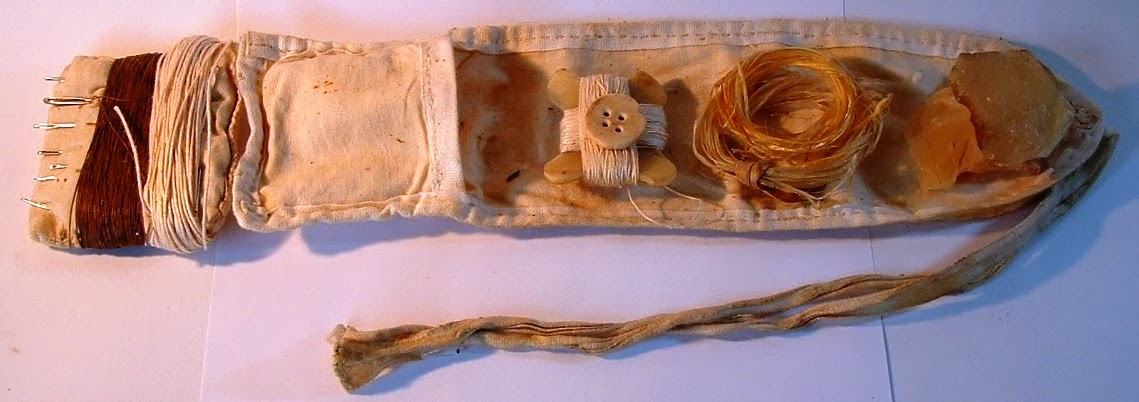
The author's Housewife and contents.

The pin cushion holds a variety of needles and is wrapped in two sizes of linen thread.

More linen thread on a horn thread winder made by the author, and a hand made bone button.

Rolls of animal sinew and rawhide used for repairing moccasins, and a piece of beeswax for waxing linen thread.

Showing the open pocket that holds spare buttons, beeswax and sinew and rawhide.

Showing the housewife rolled up and tied.

Early 18th century case and accessories.

Wooden needle cases.

Sewing items, including needles, straight pins, thimbles, scissors and a bone cap, possibly to a needle case.


Tuesday, 25 December 2012

What I got for Xmas, and Fly Fishing.


A friend came out on Sunday & gave me some instruction on 21st century fly fishing. A lot harder than 18th century fly fishing. This modern fly fishing line is far longer than an 18th century fly fishing line and the method used to cast this modern line needs far more skill and coordination.
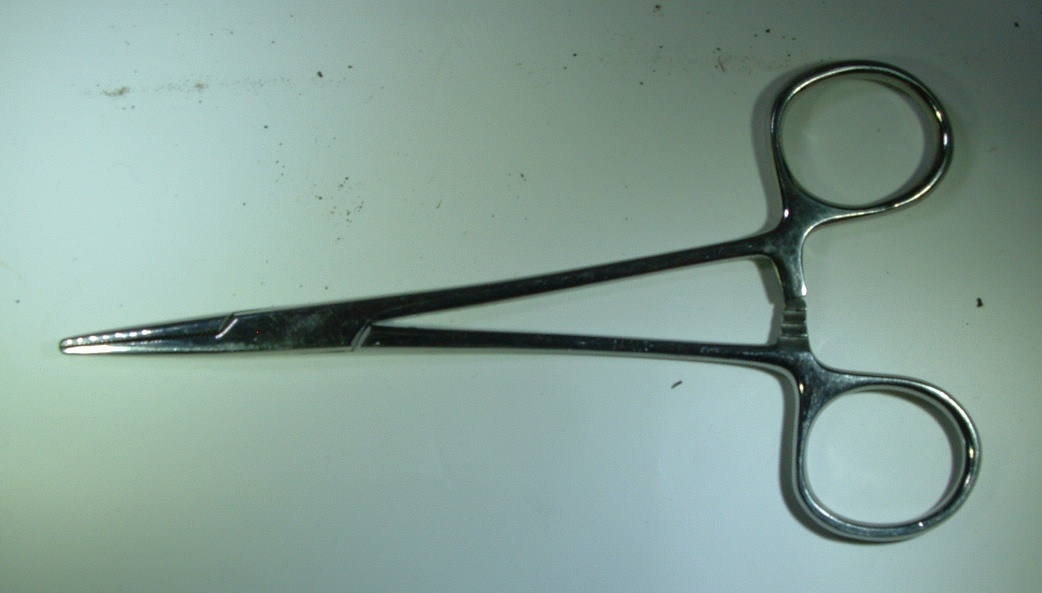
My friend Deer Slayer also showed me a pair of forceps that he uses to work on flies, and to remove hooks from the fish. I had been wanting some forceps for ages for suturing, just in case I should need them. Now I had a double purpose for getting some. 


"THe rod light and taper, thy tackle fine,
  Thy lead ten inches upon the line;
Bigger or lesse, according to the stream, 
  Angle in the dark, when others dream:
Or in a cloudy day with a lively worm,
  The Brandlin is best, but give him a turn
Before thou do land a large wel grown Trout.
  And if with a flye thou wilt have about, 
Overload not with links, that the flye nay fall
  First on the stream, for that's all in all.
The line shorter than the rods, with a naturall flye:
  But the chief point of all is the cookery".
BARKER'S DELIGHT:  OR, THE ART OF A N G L I N G.1659

Fly fishing from a boat requires a shorter rod and shorter line:

"There is no better sport then whipping for Bleaks in a boat in a Summers 206evening, with a hazle top about five or six foot long, and a line twice the length of the Rod".

Fishing from the bank requires a long rod and a long line, but not as longer line as used these days.

"Let your rod be light, and very gentle, I think the best are of two pieces; the line should not exceed (especially for three or four links towards the hook) I say, not exceed three or four haires; but if you can attain to Angle with one haire; you will have more rises, and catch more fish. Now you must bee sure not to cumber yourselfe with too long a Line, as most do: and before you begin to angle, cast to have the wind on your back, and the Sun (if it shines) to be before you, and to fish down the streame, and carry the point or tip of the Rod downeward; by which meanes the shadow of yourselfe, and Rod too will be the least offensive to the Fish, for the sight of any shadow amazes the fish, and spoiles your sport, of which you must take a great care".
THE COMPLETE ANGLER;OR, THE CONTEMPLATIVE MAN’S
RECREATION.
By ISAAK WALTON. 1653.
In Summary:


Yesterday, these forceps arrived in the mail from a very close friend of mine, Grey Wolf. How on earth did he know! Just what I wanted. These of course are modern locking forceps, but they are not a lot different from various types of 18th century forceps. See below:


18th century case of suturing needles. Just like the modern ones I carry in my medical pouch.


Grey Wolf also sent me this excellent kettle hook which he made himself.

Thank you my Friends, Deer Slayer and Grey Wolf. Very much appreciated.
Regards, Keith.


Wednesday, 22 August 2012

Handmade Antler Pins & Needles By Yooper.

Yooper is one of our group members in America, and he makes a lot of his own gear. Below is an image of part of Yooper's sewing kit, showing the antler needles and pins he made himself. I think there is something very special in producing something practicle like this and actually being able to carry it with you and use it when needed.
I think these pins and needles are a work of art, beautiful.