
Showing posts with label sewing. Show all posts
Showing posts with label sewing. Show all posts
Sunday, 23 February 2020


Tuesday, 5 December 2017

Wednesday, 10 February 2016

Saturday, 23 May 2015
At the Sign of the Golden Scissors: To Stroke or Not to Stroke
At the Sign of the Golden Scissors: To Stroke or Not to Stroke: Stephanie Smith of Larkin & Smith After you have done your first section of gathering stitches; pull your thread tightly enough to cre...


Thursday, 21 May 2015
At the Sign of the Golden Scissors: Stroke Gathers: Gathering Stitch

At the Sign of the Golden Scissors: Stroke Gathers: Gathering Stitch: Stephanie Smith of Larkin & Smith Before you start your gathering stitches you need to mark off the sections of your pieces. I mark t...
Wednesday, 13 May 2015
At the Sign of the Golden Scissors: Stroke Gathers-First Steps

Paul Revere By J.S.Copely
At the Sign of the Golden Scissors: Stroke Gathers-First Steps: Stephanie Smith of Larkin and Smith Step 1: Look at originals. As I mentioned in an earlier post, children's shirts exhibit the most ...
Wednesday, 23 July 2014


Saturday, 21 December 2013
The Housewife Sewing Kit and Comfort.
Everything we carry on the trail is for comfort. Different people have different ideas about what was carried by the average woodsman. But with basic items I do not find it hard to make a decision. Take the housewife for instance. We know for a fact that everyone, no matter who they are or what they are sooner or later will need clothing repair. For the woodsrunner it is even more so because of the increased wear and tear involved in the job. Some will say that we can make a needle and the thread when we need it, which is true, but would it be sensible after going to all the trouble to make a bone needle to then not carry it with you so you have to make a new needle each time you need to make new moccasins or repair your present ones?
The answer is no, it would not be sensible, so using the same logic, if you have access to metal sewing needles, why would you not obtain some and carry them with you? The same then applies to the thread, beeswax and maybe spare clothing buttons. It is just plain common sense to carry these items with you.
Here then are some items you may wish to consider carrying with you on the trail. Needles can do double duty used for removing wood splinters. Fine linen thread may be used in an emergency for stitching up wounds. Beeswax used to wax linen thread can also be used to seal tears in your oilcloth after repair.


The answer is no, it would not be sensible, so using the same logic, if you have access to metal sewing needles, why would you not obtain some and carry them with you? The same then applies to the thread, beeswax and maybe spare clothing buttons. It is just plain common sense to carry these items with you.
Here then are some items you may wish to consider carrying with you on the trail. Needles can do double duty used for removing wood splinters. Fine linen thread may be used in an emergency for stitching up wounds. Beeswax used to wax linen thread can also be used to seal tears in your oilcloth after repair.

Plain wood handled awl with wooden sheath.

An antler handled awl made by the author, a waxed linen thread wrapped wooden sheath, and the author's original awl once owned by his Father.
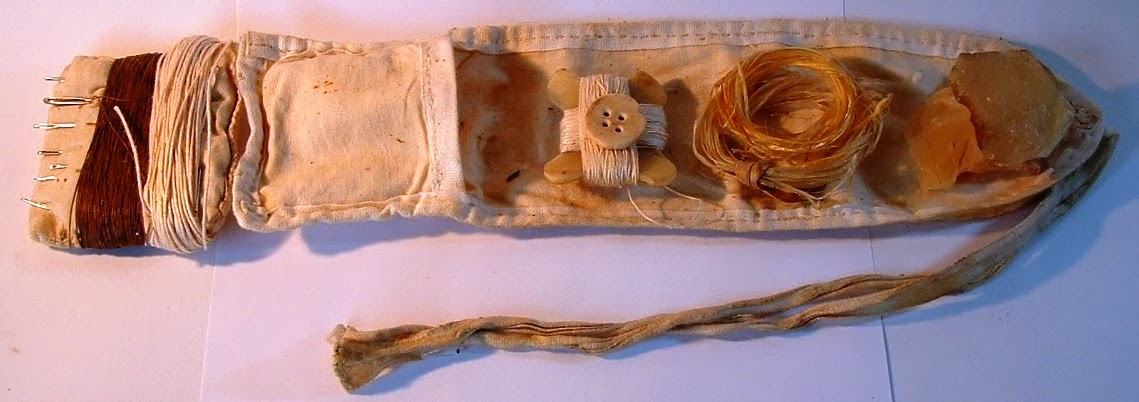
The author's Housewife and contents.

The pin cushion holds a variety of needles and is wrapped in two sizes of linen thread.

More linen thread on a horn thread winder made by the author, and a hand made bone button.

Rolls of animal sinew and rawhide used for repairing moccasins, and a piece of beeswax for waxing linen thread.

Showing the open pocket that holds spare buttons, beeswax and sinew and rawhide.

Showing the housewife rolled up and tied.

Early 18th century case and accessories.

Wooden needle cases.

Sewing items, including needles, straight pins, thimbles, scissors and a bone cap, possibly to a needle case.
Tuesday, 22 January 2013
Monday, 29 October 2012
My Latest Knapsack Project.
Whenever I see something in an op-shop or second hand shop that can be used for living history purposes, I grab it. Apart from my own family we have our group, and using second hand items to produce good equipment only seems sensible. A new member can purchase an item from me at cost, and if they can't afford that, then I will give it too them for free.
Some time ago I found another one of those all cotton made in China knapsacks, the ones that school kids used to use before all these synthetic zip-ups came into use. Only this one was already partly stripped. The lower straps were missing, and so were all the outside pockets and the piece that covers the back of the top straps. In amongst my bits and pieces I also had an all cotton waist belt, so I decided to cut up this belt and use it for the lower straps.
Normally I would use leather, but I am short on leather so I decided that if I used an awl to make the adjustment holes in the cotton straps, I could use standard type brass buckles.
Are cotton straps authentic when used in this manner? I think one would be hard put to not be authentic, given that these days cotton is often used in place of the more common linen, and given the fact that many 18th century knapsacks were home made and people simply used whatever they had. Some packs in period painting look as though they are using rope for straps.


If at some date I find that this arrangement is not suitable to the period I can always change it. Nothing lost. But for now it gives me another knapsack for someone.


Some time ago I found another one of those all cotton made in China knapsacks, the ones that school kids used to use before all these synthetic zip-ups came into use. Only this one was already partly stripped. The lower straps were missing, and so were all the outside pockets and the piece that covers the back of the top straps. In amongst my bits and pieces I also had an all cotton waist belt, so I decided to cut up this belt and use it for the lower straps.
Normally I would use leather, but I am short on leather so I decided that if I used an awl to make the adjustment holes in the cotton straps, I could use standard type brass buckles.
Are cotton straps authentic when used in this manner? I think one would be hard put to not be authentic, given that these days cotton is often used in place of the more common linen, and given the fact that many 18th century knapsacks were home made and people simply used whatever they had. Some packs in period painting look as though they are using rope for straps.


If at some date I find that this arrangement is not suitable to the period I can always change it. Nothing lost. But for now it gives me another knapsack for someone.

This is how it was when I bought it. Devoide of lower carry straps, pockets and flap securing straps and buckles.

Aluminium tabs on the ends of the top carry straps. I cut these off, doubled the ends over and stitched them.

Brass buckles added to the straps I cut from a belt. By using an awl I was able to push the buckle's tongue through the strap without breaking any threads in the weave.

Straps sewn to the bottom of the bag with heavy linen thread.

I did a double row of stitching on the top straps as the securing strip was also missing.

Again I used the awl when adjusting the carry straps.

I made two button holes and whip stitched them with heavy linen thread.

Two pewter buttons used to secure the flap.
The bag cost me a couple of dollars I think, so all up this knapsack cost me no more than $4.00 plus my time. I already had the buckles and the buttons. I could have used wood, horn or bone for the buttons and old saddle buckles are often only a dollar or two from a friendly saddler.
Saturday, 12 May 2012

Tuesday, 27 March 2012

Friday, 23 March 2012
Mary Rose Thread Bobbins by Wayne Robinson.
These thread bobbins have been crafted by Wayne Robinson from originals found on the Mary Rose.

As you can see from the centre bobbin, this one at least was made to also contain sewing needles. What a great idea!
It seems that Wayne Robinson is better known as the Leatherworking Reverend!
Monday, 26 December 2011
That Time of Year.
That Time Of Year.


Had I not been in hospital, I should have written this way before Xmas. Never mind, better late than never. For some of us this is the season for historical trekking, regardless of whether you are in the Northern or Southern hemisphere. Personally I dislike trekking & camping in summer in Australia, I prefer the winter, though actually right now there is a cool breeze blowing through the forest & it is very pleasant out.
For me this is a time to check over my gear in readiness for winter. There are rarely any repairs to do these days, because I tend to repair items of gear & clothing whilst in camp. But for many newbies there may still be period items to improve on or add to your gear. Not that I am recommending that you add more stuff, but some small items are indispensible. Such as thread winders.Copies of originals are generally not expensive, and they are very easy to make yourself from bone or horn. In the 18th century linen and silk thread came in skeins, and for use they required winding on to a thread winder. Of course you could just use a piece of stick, but a proper thread winder takes up little room in the sewing kit and looks good as well.

My sewing kit or "housewife". Another easy item to make. The pin cushion on the end I stuffed with natural greasy fleece. In the pocket I have beeswax, more linen thread, and sinew for repairing the soles on my moccasins and some spare bone buttons.

There are various styles of thread winders, but this style I found the easiest to make. I made this one from horn.

Spools of silk thread a close friend sent me as a gift. I need to transfere some of this thead on to thread winders. Silk is very strong and can be used as fishing line. Traditionally it has been used for making fishing flys. Some of this will go into my fishing kit.
Sunday, 9 October 2011
Tuesday, 17 May 2011
Needle Making.


Author's Housewife or sewing kit. Contains needles, pins, linen thread, beeswax, animal sinew, & spare horn buttons.
The book on needlemaking can be found here: http://www.shirebooks.co.uk/store/Needlemaking_9780852635636
Subscribe to:
Posts (Atom)