Sunday, 19 March 2017
MY NEIGHBOR WELLINGTON: REVULSION, RANCOR AND REVENGE
MY NEIGHBOR WELLINGTON: REVULSION, RANCOR AND REVENGE: To continue the theme of this month, where only the best qualities of humanity are presented (the previous post was "Random Racist...


Poole Museum Bringing the Swash Channel Wreck back to life.


It was probably in 1630 or 1631 that a large merchant ship, sailing
between the Low Countries and the tropics, was wrecked on the edge of the Hook
Sands at the entrance to Poole Harbour. How she came to be wrecked we don’t
know but it seems that the vessel was intact enough to allow the salvagers to
remove much of her cargo and some of her cannon. The ship sank on to the mud
and was forgotten for four centuries. Then, in 1990 a dredger disturbed some of
her timbers. After a brief excavation, the site was largely ignored until its
rediscovery by a Wessex Archaeology survey in 2004 which led to the present
Bournemouth University excavation. Now that parts of the wreck and some
artefacts have been brought to the surface and put on display in Poole Museum,
it is interesting to investigate what Poole was like 400 years ago when
these objects last saw the light of day.


Havresack/Snapsack. More Images.


Jacques Lagniet (French, 1620–1672)
Tel fait la faute qu'un autre boit [One makes the mistake, another drinks it]
Etching bound in a collection of proverb etchings published by Lagniet, ca. 1660
Print Collection, Kennedy Fund.

French soldiers near the town of Grey in Franche Comte, during the Dutch War. 1690 after Van Der Meulen.


Sortie de la garnison de Gand, le 12 mars 1678.

By Vernet, 1754.

I have no info on this one but looks to be 17th century.


Travelers By The Well By Andries Booth, 1635-41.


Netherlands. 17th century. War-Scene By Sebastian-Vrancx.


Sebastian Vrancx - Plünderung eines Dorfes. 17th century Netherlands.


I find these images very interesting as they show the snapsack being used in conjunction with a backpack.
A Village Kermesse, Netherlands 17th century By Sebastian Vrancx.

Unknown artist 1745-46

Author's linen snapsack with the strap sewn to the bag at both ends. Closer is achieved using a leather tie.
The snapsack from what I can see in period paintings comes in a variety of sizes and the carry strap can either be sewn to the bag both ends, or it can be attached with some form of tie such as cordage or leather.
Friday, 17 March 2017
Banned from Facebook, can you please share this post on Facebook for me?

Yesterday I made a comment on one of the groups I belong to on Facebook regarding a video that I did not think was suitable. The group is a public group & to my mind the video was not within the aims of the group, which is to promote sensible gun ownership & laws & to try & explain to the average Australian citizen why it is that we need to own guns & hopefully show them that the present gun laws are not stopping crime & the continued war on law abiding licensed gun owners will not make the public safe. The person who posted the video did not take kindly to my comment & got personal & rude.
Now I am not saying that this person has reported my membership in retaliation, this may be nothing to do with me being struck off Facebook. However, I am now unable to continue posting on Facebook & that also means that I am no longer able to manage the 18th century Living History group I started. If someone could please post this blog link to Facebook I would very much appreciate it, I hate to think that people may think I am ignoring their comments & requests for membership.
Thank you.
Regards, Keith H. Burgess.
Thursday, 16 March 2017

Sunday, 12 March 2017
Production of Sulphur in the 18th Century.

Sulphur was obtained in a variety of ways during the 18th century. Sulphur could be mined, it could be found on the surface having been deposited there from sulphur springs or from gasses escaping from deep in the earth. Sulphur was produced in England, America & overseas in Asia & Europe.

Sulphur springs in Yellowstone Park America.

Sulphur mine in England.
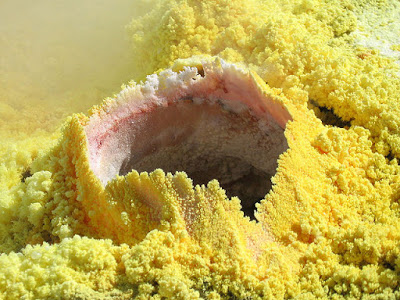
Sulfur found naturally on the ground from the island of Vulcano in Italy.

Mined sulphur in rock form.
Sulphur.
Spelling and etymology
Sulfur is derived from the Latin word sulpur, which was Hellenized to sulphur. The spelling
sulfur appears toward the end of the Classical period. (The true
Greek word for sulfur, θεῖον, is the source of the international chemical
prefix thio-.) In 12th-century Anglo-French, it was sulfre;
in the 14th century the Latin ph was restored, for sulphre; and by the 15th
century the full Latin spelling was restored, for sulfur, sulphur. The parallel
f~ph spellings continued in Britain until the 19th century, when the word was
standardized as sulphur.[7] Sulfur was the form chosen in the United
States, whereas Canada uses both. The IUPAC adopted
the spelling sulfur in 1990, as did the Nomenclature Committee of the Royal Society of Chemistry in
1992, restoring the spelling sulfur to Britain.[8] Oxford Dictionaries
note that "in chemistry and other technical uses … the -f- spelling is now
the standard form for this and related words in British as well as US contexts,
and is increasingly used in general contexts as well."[9]
Subscribe to:
Posts (Atom)