A LIVING HISTORY BLOG.

18TH CENTURY LIVING HISTORY IN AUSTRALIA.
Showing posts with label hunting knife. Show all posts

Tuesday, 20 September 2016

Blades & Gun Update.

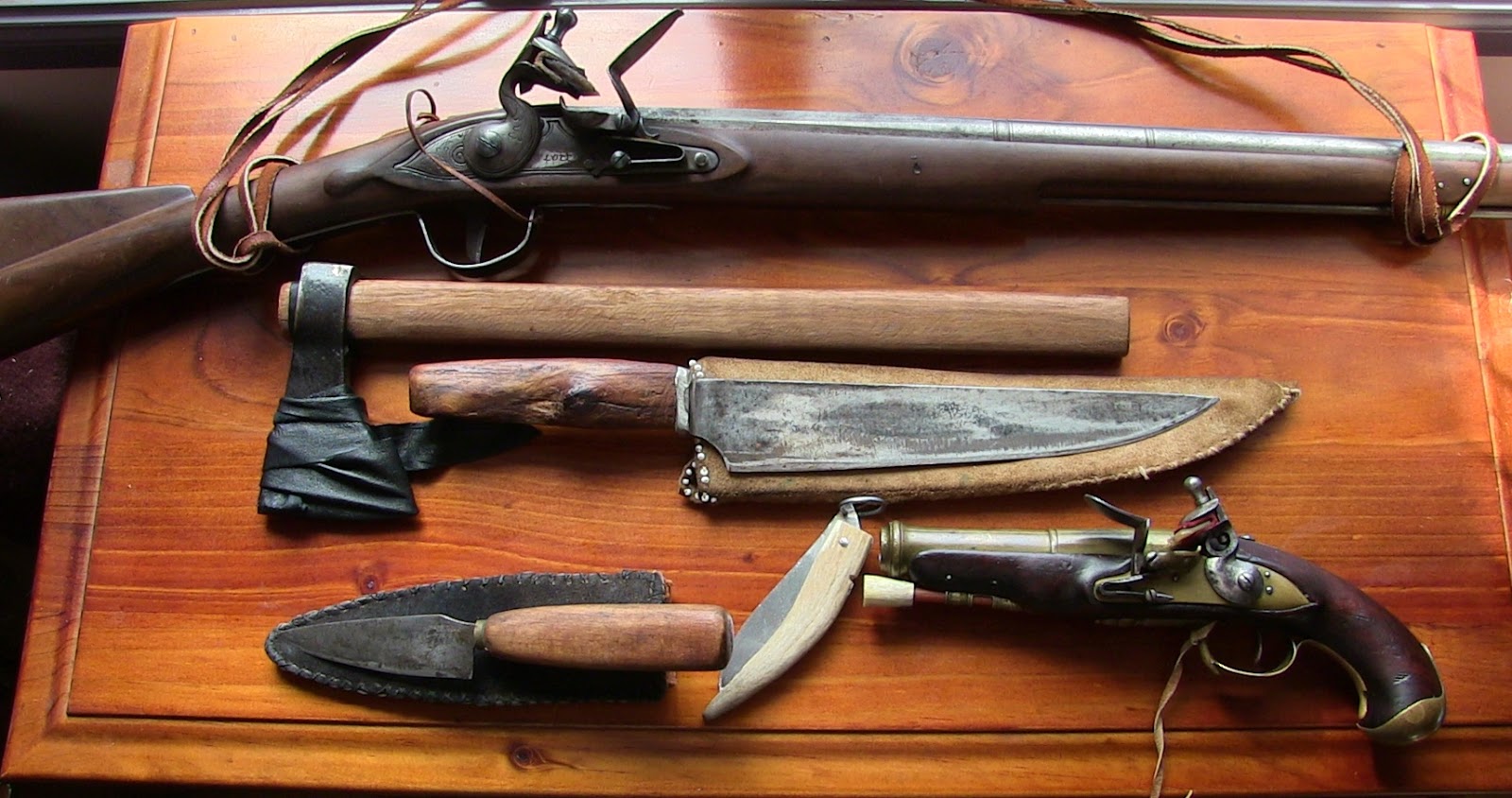
A subscriber to my video channel (https://www.youtube.com/channel/UCHEOMSZJETfj3GnoyONuvCQ?view_as=public) said they would like a closer look at my knife, so I decided it was easier for me to post images of the blades & guns I carry here on my blog so it is there for future reference.


My .62 caliber/20 gauge flintlock fusil. 42 inch smoothbore barrel with a steel ramrod.

My .70 caliber smoothbore flintlock pistol.

My axe/tomahawk.

Hunting knife.

Legging knife.


Stag handle friction clasp knife.


Thursday, 1 August 2013

Thoughts on the so-called Patch Knife.

I have often wondered if there ever was such a knife as the Patch Knife in the 18th century. I carry three knives for practicle reasons, the hunting knife at my belt, the legging knife in my right legging, and a clasp knife in my waistcoat pocket. I would not want to carry a fourth knife, and I have always used my ready to hand hunting knife for cutting patch material.
Having said that, I have not carried a flintlock rifle for years, and only use my fusil. Patch material was not used with smoothbores in the 18th century, in fact even early rifles did not use patch material. Some people suggest that the clasp knife was used to cut the patch material, but to my mind the whole process of getting this knife out, then opening the blade, cutting the material, closing the blade and putting it away again just simply takes too long when taking a second shot or more.


I welcome any constructive comments or information on this subject.

Dutch 1604.
 Trade butcher knives commonly used as hunting knives in the 18th century.

A more up-market hunting knife (Metmuseum).

18th century hunting knife.

French trade knives.


Friday, 5 October 2012

Second Hand French Butcher Knife Conversion.

This is a good alternative for a Living Historian who can't afford to purchase a custom knife or even one off the shelf. This conversion takes it from a riveted 20th century knife to a pinned 18th century style knife. 
 Before.
 Before.
 Before.
 The tang after the removal of the 20th century handle.
 After. The new handle is pinned with hand forged nails.

 New handle rubbed with lindseed oil. I think I will soak it in lindseed oil.


Thursday, 4 October 2012

20th Century Butcher Knife Conversion. Part One.

 As the knife was originally.
 After the conversion.
I changed the chape of the tang, which in turn changed the shape of the blade. I made and fitted a new handle using pins as in 18th century knives.

Thursday, 27 September 2012

Found In Australia. Part Seven.

 There really should not be a need to spend big money on purchasing period correct knives. Most knives off the shelf are not period correct and custom knives can be costly. But second hand shops often sell good butcher knives that make excellent hunting knives. 20th century knives will require a new handle to be period correct, but 19th and 18th century knives are fine as is.
All these knives were found in either a market or a second hand shop with prices ranging from $2.00 to $18.00.

 A French butcher knife.

 Two very similar English butcher knives. The handles are pinned and not riveted which is period correct.
 This blade probably French, was a lot larger than show here, almost twice the size. I reshaped this blade and made and fitted the handle..
 This one is a 20th century knife and not much good as is. The blade is very worn, and the handle is riveted. But the steel is good, and I was thinking of making a jack knife out of it.
 This jack knife has had new bone slab handles fitted.
 English butcher knife with a pinned handle.
This is a great little knife which I presently use as a legging knife. 

Thursday, 20 September 2012

Reshaped Knife & Its Bark Sheath.

I have been wanting to make a bark sheath for a long time now, and I finally got round to making one. This one is made out of Australian Stringybark.
 The outer fibres of the bark have been removed, and I soaked the bark in water for 24 hours or until the bark sinks to the bottom.
 The bark is shaped and I have made a leather welt (above and below).

 Here I have stitched the bark sheath edges with linen thread. The holes are made with an awl wide apart so as not to split the bark.
 Covered with leather (above and below.

The finished product with the knife it was made for. Beading is #7 French white glass beads.
 This is the knife reshaped (above and below).
I did also experiment making a bark sheath from green bark of the Stringybark, but after it dried it curled and distorted. I found the best way is to use dried bark, soak it in water for roughly 24 hours or until it sinks, heat it over a hot fire, bend it and add weights. Then whilst it is still damp, cut it to shape with a tomahawk and knife. Before adding the outer leather sheath I also thinned the bark with my jack knife to reduce bulk and weight.
I have made a video, and will post it later.
Friday, 14 September 2012

Another great find at the Second Hand Shop!

This is actually an early 19th century French blade, but the style is older.


The blade is obviously worn but I can reshape it to original without losing too much length. The bird head handle is original ebony.

Friday, 8 June 2012

Guest Speaker, Listen Up!

My friend Vieuxbois is not only a follower of this blog, but he is a valued international member of our 18th century living history group. What he has to say below regarding knives & battoning is in response to my recent article. It is really good to get the point of view from another person whos life is spent in the wild and often depends on the blades he carries with him.
My sincere thanks to Vieuxbois for this information.

Vieuxbois has left a new comment on your post "Knife Battoning! NOT!":

Frozen wood is ``brittle`` and easy to split. But it’s also very hard. Furthermore, steel is also more brittle when it’s very cold (it’s better to keep the protected blade warm by holding it close your body). So if I need to split frozen wood (which is rare and exceptional) there is more risk to damage a knife than an axe : an axe edge is generally thicker than a knife, there is more material to support the stress.

In my opinion, there are no reason for batoning with a knife unless if :

1. It’s not your choice, you need to do it : you are in a survival situation (or a survival training) with only a knife to work with, so you do with what you have, and you do it carefully because you want/need to preserve what you have like a treasure because your life depends on it. If you are in a true survival situation why would you risk breaking your knife? Break your knife and your chance of survival goes down.

2. You are playing like a kid, so you pay the game price.

3. It`s your choice, you want to do it : so you will use a very strong knife with an appropriate design/materials and heat treatment if you want to keep this tool in good condition. But does this very strong knife will do the same job than a thin blade? Of course I can carry both.


Vieuxbois has left a new comment on your post "Knife Battoning! NOT!":

From Thin, Sharp, Knives - Posted: 9 September, 2011 in http://bfelabs.com/2011/09/09/thin-sharp-knives/ : `` If you look around the working world, at the knives that are regularly used to do work, you might notice some startling differences between those knives and what is prominent in the popular knife industry. Particularly the “survival”, “tactical”, and “hard use” arenas of popular knife-making (both custom and production).
In these arenas we typically see heavy knives, from thick stock, with study handles and generally robust construction. We are told that this robustness is desirable, even absolutely necessary, for these tools to withstand the rigors of hard use. And the market sucks them up about as fast as they can be made, with companies like TOPS Knives producing ever-new variants of these beefy blades for battle and conquering barren-wastes. But what is being bought, and what is actually being used, are far different. What people actually work with is often something very different. The prominent working knife is not a robust, stout, knife but rather a thin, sharp, knife.
I was at a branding recently, out here in cattle country, and took note of the knives being used. For those unfamiliar, when branding calves it is also common practice to ear-mark with a notch in an ear and castrate. These tasks require a deft hand with a sharp knife, particularly when the calf is not forced into an immobilizing squeeze chute, but is rather roped out and held down. I’ve taken part in and observed this process numerous times in my life, and there is a great commonality to the knives being used: They are thin, sharp, knives. The same knives most of the cowboys and ranch hands carry in their pockets daily, and use for everything.


Vieuxbois has left a new comment on your post "Knife Battoning! NOT!":

The thin, sharp, knife is not unique to this environment, but rather common to every other. Moving out from the traditional slipjoint folder common to the ranching west, a survey of other traditional folding knife designs would turn up a variety of styles, locks, and construction methods, but one commonality: Thin, sharp, blades. Moving from folders, to fixed blade knives, we see the same variety in design and construction in traditional designs, but a great many have the same commonality of thin blades. The traditional Scandinavian knives, as typified by the Mora so common to woodscraft, are an easily accessible example of the type.
Thin blades are not limited to small knives, either. Many old-time woodsmen, frontiersmen, mountainmen, etc. who used big knives carried ones that, rather than resembling the Iron Mistress of Hollywood, more resembled a butcher knife, being thin although long. Now, some may use the argument that we know more than they did, and thus make more appropriate choices, but that is simply nonsense. Anyone who makes a living with a tool, or depends on it for his own life, on a day-to-day basis, knows far more about selecting the right type of that tool than anyone who does not do the same, no matter the other mans “knowledge”.


Vieuxbois has left a new comment on your post "Knife Battoning! NOT!":

If so many who’s lives depended on their knives choosing thinner blades historically holds little sway, then the fact that the trend is a modern one too should tell us something. Today, if we take a survey of the knives being used routinely, we would find many of them to be far thinner than what we’ve come to expect (or been told to expect). And not just small knives: While so many Americans and others influenced by the major knife market are of the opinion that a heavy, thick-spined, knife is required for chopping or “serious” woods work, much of the rest of the world relies on something far different; The machete, or some variant thereof.
Different tools are appropriate for different tasks. There is, beyond a shadow of a doubt, a place for robust knives. One of the most valuable characteristics of contemporary knifemaking is the rise of robust locking systems for folding knives. The matching rise of the robust blade, however, may not be the best thing. But it is important to recognize that place, and use the right tool for the right job. For the majority of tasks for which a knife is used, a thick bladed knife is not the right tool. This includes many “hard” tasks, from woodscraft to cowboying to “tactical” environments (whatever those are). You aren’t necessarily wrong is you carry a robust knife for these, or even more mundane, daily uses, but you should ask yourself if that is truly what you need. Give some thought to whether cutting performance is a greater need than brute strength, and take a thinner knife better suited for cutting out for a spin sometime.``

Regards,


Saturday, 24 September 2011

Tools of the trade. The knife, The axe, and The gun.

Tools of the trade.


The Axe, The Knife, And The Gun.


The Axe.


When choosing your tools you must think about what the tool will be used for. Small axes are not used for cutting down large trees, if you need to do that then you need to pack along a felling axe. My tomahawk/axe is used to construct shelters, make traps, for recreational throwing, for self-defence, for hunting if needs be, and sometimes as an aid in butchering game.


I don’t need it for cutting firewood; there are plenty of ways to get firewood without having to use an axe. So what do I need? I need a light axe that I can easily make and fit a new helve to if one should get broken. That is it. I don’t care if it is slightly easier to cut saplings down & split kindling with a heavier hatchet, I don’t need the extra weight and I don’t need to split kindling wood. This choice has nothing to do with me living in Australia; I would make the same choice if I lived in the UK or in America. For me, it is simply the right tool for the job.


The Knife.


What do I need a knife for? Self-defence, skinning and butchering game, eating meat with, cutting up food, hunting if needs be, making trap parts. Now I don’t want to use my hunting knife for making trap parts, so I carry a jack knife as well.


I don’t need to split kindling wood at all, and if I did I would use my tomahawk, not hit the back of my blade with a chunk of wood! Someone said recently that it is hard to strike the right place on the end of a small piece of timber by striking it with a tomahawk. He was right, but this person also has no idea how the job should be done. You do not strike with the tomahawk blade when the target is too small, you simply place the blade on the wood and lift both wood and axe together and strike the wood on a firm surface. Knives were not originally meant to be used as an axe. You need the right tool for the job in hand.


Anyone who has done a lot of hunting will tell you that it is a good idea to carry a back-up knife. I carry a legging knife because it is out of the way and easy to retrieve.


A small knife like this is an excellent back-up for butchering or self-defence.


Dutch 1604.


The Gun.


The flintlock is a natural choice, either that or a gun from an earlier period or a bow. Once again you must consider what sort of game you are likely to be hunting, and in what sort of environment. I need an arm that is versatile, one that can shoot anything from small game to large game. Small game includes birds and rabbits so I really need to be able to use small shot, swan shot, and round ball. So the gun for me is a smoothbore, and I chose a 20 gauge/.62 calibre trade fusil with a 42 inch barrel.


This arm serves me well for self-defence using swan shot and ball [buck and ball] loads. The lock is also a good back-up tinderbox [fire lighting tool]. Being a smoothbore I can load this fusil faster than it takes to load a rifle, and it loads even faster again if I use paper cartridges. It is also lighter to carry than some rifles and muskets.


I don’t carry a lot of lead with me because more often than not I can retrieve the shot ball from the downed game and remould it. This means that I can carry more weight in gunpowder. I don’t need to carry patch material unless I intend to shoot over long distances which I never do. I will start off on a journey carrying patch material and wads, but it is not a problem if I run out of these items.

A word on hunting knives: The most commonly used hunting knife by Indians & woodsmen/woods women was the butcher knife, also known as a scalping knife. This knife was generally light with a long blade. The handle was riveted with pins, not the modern rivets with heads. Usually just three pins, but this is very general and there could be more or less pins depending on the style of butcher knife.


Above you can see a pinned handle and a 19th century knife handle which is riveted.