A LIVING HISTORY BLOG.

18TH CENTURY LIVING HISTORY IN AUSTRALIA.
Showing posts with label legging knife. Show all posts

Tuesday, 20 September 2016

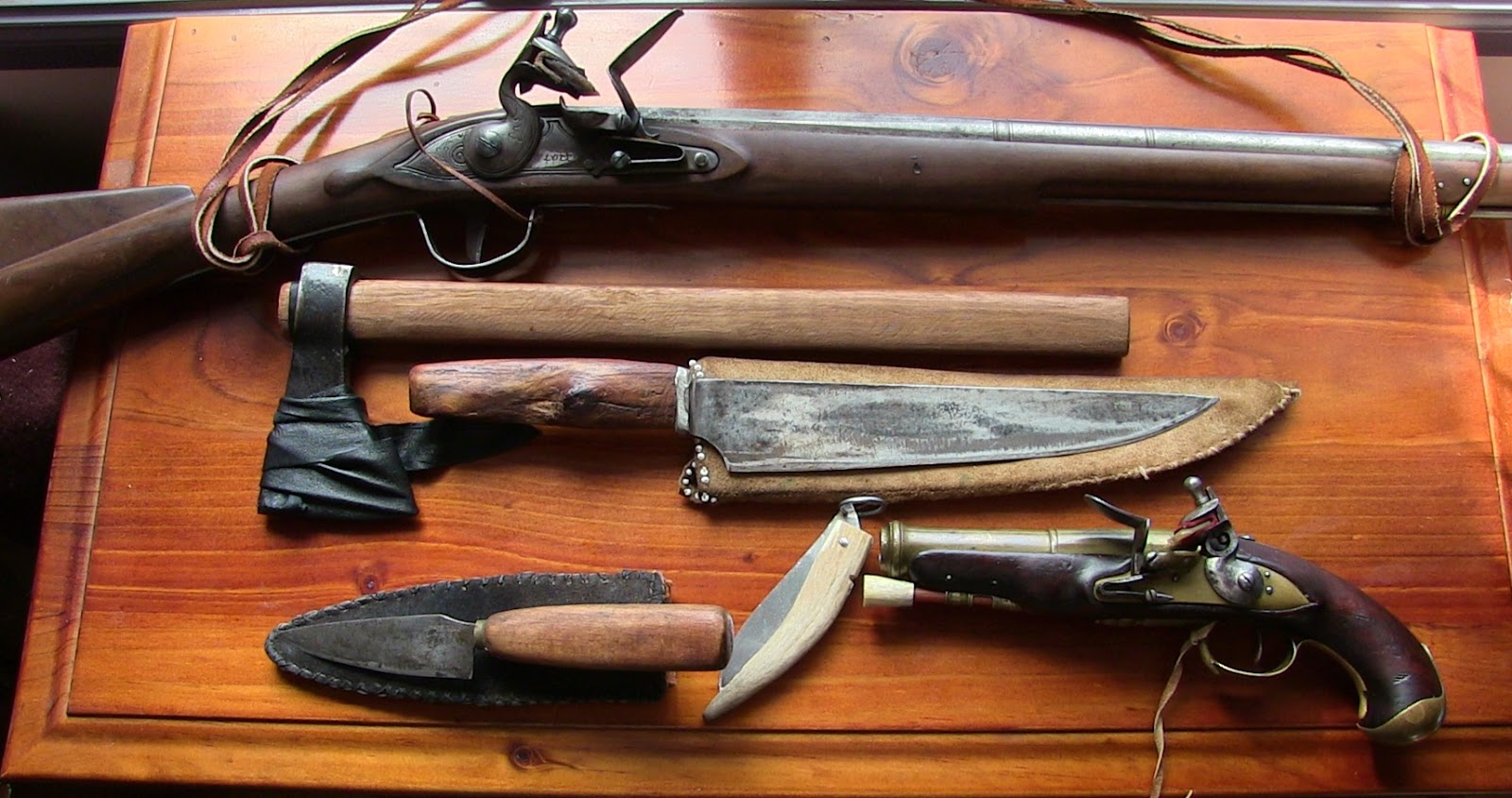
Blades & Gun Update.

A subscriber to my video channel (https://www.youtube.com/channel/UCHEOMSZJETfj3GnoyONuvCQ?view_as=public) said they would like a closer look at my knife, so I decided it was easier for me to post images of the blades & guns I carry here on my blog so it is there for future reference.


My .62 caliber/20 gauge flintlock fusil. 42 inch smoothbore barrel with a steel ramrod.

My .70 caliber smoothbore flintlock pistol.

My axe/tomahawk.

Hunting knife.

Legging knife.


Stag handle friction clasp knife.


Saturday, 6 July 2013

The legging Knife.

My legging knife.


This is how I have always carried my legging knife.

This is a modern artists interpretation of how the legging knife was worn, tied to the garter.

Then recently I came across this image, which appears to be a period image, but there was no provenance for it.

Thursday, 27 September 2012

Found In Australia. Part Seven.

 There really should not be a need to spend big money on purchasing period correct knives. Most knives off the shelf are not period correct and custom knives can be costly. But second hand shops often sell good butcher knives that make excellent hunting knives. 20th century knives will require a new handle to be period correct, but 19th and 18th century knives are fine as is.
All these knives were found in either a market or a second hand shop with prices ranging from $2.00 to $18.00.

 A French butcher knife.

 Two very similar English butcher knives. The handles are pinned and not riveted which is period correct.
 This blade probably French, was a lot larger than show here, almost twice the size. I reshaped this blade and made and fitted the handle..
 This one is a 20th century knife and not much good as is. The blade is very worn, and the handle is riveted. But the steel is good, and I was thinking of making a jack knife out of it.
 This jack knife has had new bone slab handles fitted.
 English butcher knife with a pinned handle.
This is a great little knife which I presently use as a legging knife. 
Wednesday, 8 February 2012

A Nice Legging Knife Made By One Of Our Forum Members.

This image is COPYRIGHT Vieuxbois
Vieuxbois lives in Quebec & made this lovely legging knife from an old cleaver blade. This is my kind of knife, I love it.

Saturday, 24 September 2011

Tools of the trade. The knife, The axe, and The gun.

Tools of the trade.


The Axe, The Knife, And The Gun.


The Axe.


When choosing your tools you must think about what the tool will be used for. Small axes are not used for cutting down large trees, if you need to do that then you need to pack along a felling axe. My tomahawk/axe is used to construct shelters, make traps, for recreational throwing, for self-defence, for hunting if needs be, and sometimes as an aid in butchering game.


I don’t need it for cutting firewood; there are plenty of ways to get firewood without having to use an axe. So what do I need? I need a light axe that I can easily make and fit a new helve to if one should get broken. That is it. I don’t care if it is slightly easier to cut saplings down & split kindling with a heavier hatchet, I don’t need the extra weight and I don’t need to split kindling wood. This choice has nothing to do with me living in Australia; I would make the same choice if I lived in the UK or in America. For me, it is simply the right tool for the job.


The Knife.


What do I need a knife for? Self-defence, skinning and butchering game, eating meat with, cutting up food, hunting if needs be, making trap parts. Now I don’t want to use my hunting knife for making trap parts, so I carry a jack knife as well.


I don’t need to split kindling wood at all, and if I did I would use my tomahawk, not hit the back of my blade with a chunk of wood! Someone said recently that it is hard to strike the right place on the end of a small piece of timber by striking it with a tomahawk. He was right, but this person also has no idea how the job should be done. You do not strike with the tomahawk blade when the target is too small, you simply place the blade on the wood and lift both wood and axe together and strike the wood on a firm surface. Knives were not originally meant to be used as an axe. You need the right tool for the job in hand.


Anyone who has done a lot of hunting will tell you that it is a good idea to carry a back-up knife. I carry a legging knife because it is out of the way and easy to retrieve.


A small knife like this is an excellent back-up for butchering or self-defence.


Dutch 1604.


The Gun.


The flintlock is a natural choice, either that or a gun from an earlier period or a bow. Once again you must consider what sort of game you are likely to be hunting, and in what sort of environment. I need an arm that is versatile, one that can shoot anything from small game to large game. Small game includes birds and rabbits so I really need to be able to use small shot, swan shot, and round ball. So the gun for me is a smoothbore, and I chose a 20 gauge/.62 calibre trade fusil with a 42 inch barrel.


This arm serves me well for self-defence using swan shot and ball [buck and ball] loads. The lock is also a good back-up tinderbox [fire lighting tool]. Being a smoothbore I can load this fusil faster than it takes to load a rifle, and it loads even faster again if I use paper cartridges. It is also lighter to carry than some rifles and muskets.


I don’t carry a lot of lead with me because more often than not I can retrieve the shot ball from the downed game and remould it. This means that I can carry more weight in gunpowder. I don’t need to carry patch material unless I intend to shoot over long distances which I never do. I will start off on a journey carrying patch material and wads, but it is not a problem if I run out of these items.

A word on hunting knives: The most commonly used hunting knife by Indians & woodsmen/woods women was the butcher knife, also known as a scalping knife. This knife was generally light with a long blade. The handle was riveted with pins, not the modern rivets with heads. Usually just three pins, but this is very general and there could be more or less pins depending on the style of butcher knife.


Above you can see a pinned handle and a 19th century knife handle which is riveted.