My thanks to Gorges for this link below. http://gorges-smythe.blogspot.com.au/2012/12/two-cautionary-tales-of-gun-control.html
http://online.wsj.com/article/SB10001424127887323777204578195470446855466.html?mod=WSJ_Opinion_LEADTop
All this evidence, and still the Australian Government can't come up with fair and decent gun legislation.
Saturday, 29 December 2012


Eastern Woodland Indian Use Of The Fire Bow.
Not much information to be found, certainly not primary documentation.
http://books.google.com.au/books?id=pZBPkOYTDvMC&pg=PA108&lpg=PA108&dq=great+lakes+indian+fire+bow&source=bl&ots=J-O3apCnBK&sig=o6KlEAGGYEWidpRJPia4ngpcqw8&hl=en&sa=X&ei=qbHfUMCcCumSiQeBgoGYAw&ved=0CFoQ6AEwBg#v=onepage&q=great%20lakes%20indian%20fire%20bow&f=false
Page 108.


http://books.google.com.au/books?id=pZBPkOYTDvMC&pg=PA108&lpg=PA108&dq=great+lakes+indian+fire+bow&source=bl&ots=J-O3apCnBK&sig=o6KlEAGGYEWidpRJPia4ngpcqw8&hl=en&sa=X&ei=qbHfUMCcCumSiQeBgoGYAw&ved=0CFoQ6AEwBg#v=onepage&q=great%20lakes%20indian%20fire%20bow&f=false
Page 108.

Barry Rivera demonstrates how to make fire with a stick and a bow during a program on Woodland Indian culture and history.

http://southwhitehall.patch.com/articles/viewfinder-northeast-woodland-indian-culture#photo-6940226;
Photo Credit: Betty Cauler
Friday, 28 December 2012
Primitive and Period Living Skills.
Our group members are presently evaluating their skills. When I posted the list of skills I personally would expect one of our woodsrunners to have, I also asked if anyone could add to that list.
What has arisen from that discussion is the question of "would everyone have had that skill". In this particular case the question referred to leather work skills. This was my reply.
I think that if an item was needed, then the person needing that item would do his best to acquire it. If he/she could not purchase the item, then they would have to make it if possible. I have seen some rough leather work and some good leather work. Not everyone was good at everything. I am fair at making leather items with just the basic tools, awl, knife & needle. This is all the tools that one could expect the average person to be carrying or owning.
I think we should make the best we can with these basic tools, & if it does not look good, but is functional, then that is the way it is and was. The more we do, the better we get, up to a point. There is the "that will do" attitude, which is mostly mine, and there is the "not good enough" attitude which involves more time to make something look its best.
Our individual levels of skill are such that someone's "that will do" or "good enough" may well be better than the "not good enough" attitude, but in the end all that matters is that the item is functional. That is the skill level you need.
Keith.

So many skills are involved in putting your 18th century gear together. Before you can do any leather work, you need to make an awl. The top one I made, the lower one was my Father's awl.

On the left is an awl which belonged to a close friend. He also made the three trade awls on the right.

The "housewife" or sewing kit can come in various forms, but this one is the most popular type.


These lower three examples all have a double sheath. Softer leather cover over a hard leather sheath.
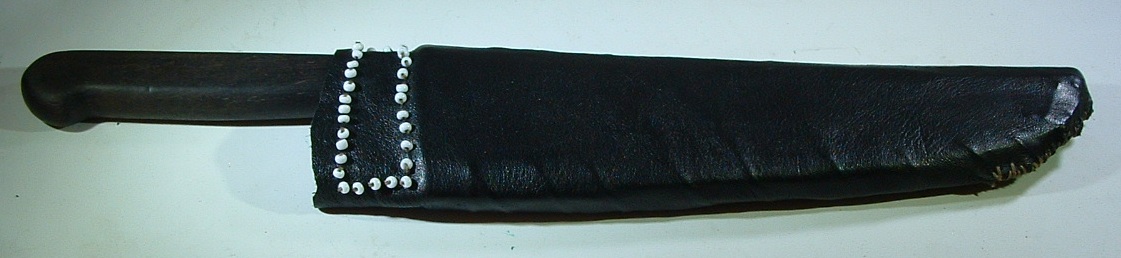
This one above has an inner bark sheath.

Various knife sheaths, all functional.
This
is a list of basic skills in which I personally would expect an 18th
century woodsman or woods-woman to have some experience with.
·
Flint
& steel fire lighting
·
Wet
weather fire lighting
·
Fire-bow
fire lighting
·
Flintlock
fire lighting
·
Flintlock
use, service & repair
·
Field
dressing & butchering game
·
Blade
sharpening
·
Tomahawk
throwing
·
Making
rawhide
·
Brain
tanning
·
Primitive
shelter construction
·
How
to stay warm in winter with only one blanket
·
Cordage
manufacture
·
Moccasin
construction and repair
·
Sewing
·
Axe
and tomahawk helve making
·
Fishing
·
Hunting
·
Evasion
·
Tracking
·
Reading
sign
·
Woods
lore
·
Navigation
·
Primitive
trap construction & trapping
·
Open
fire cooking
·
Fireplace
construction
·
Clothing
manufacture
·
Drying
meat & other foods
·
Knowledge
of plant tinders & preparation
·
Knowledge
of native foods & preparation
·
Knowledge
of native plants in the area and their uses for other than tinder and food.
·
Scouting/Ranging.
·
Basic
first aid.
·
Finding
and treating water.
·
General
leather work.
Wednesday, 26 December 2012
Making Fish Hooks.
YE shall understand, that the moste
subtill and hardest craft in makyng your harneys, is for to make your hookes.
For whose makyng ye must have feete toles thyn and sharpe and small beaten, a
semy clam of yron, a bender, a payre of long and small tones, and an harde
knyfe somedely thyke and an anuylde, and a lytle hamner.
And for small fysshe, ye shall make your hookes of the
smallest quarell nedilles that ye can fynde of stele, and in this wyse ye shall
put the quarell in a read charcole fyre, tyll it be of the same coloure that
the fyre is. Than take hym out and let hym kele, and ye shall fynde hym well
allayed for to fyle. Than rayse the barbe with your knyfe, and make the poynt
sharpe. Than alay him agayne or els he will breake in the bendyng. Than bende
hym lyke to the bende accordyng to the purpose. And greater hookes ye shall
make in the same wyse of great nedles, as broderers nedelles, or taylers, or
shoomakers nedles, spere pointes of shoomakers nailes, in especiall the best
for greate fysshe, and loke that they bend at the poynt wha[n] they ben
assayed, for els they be not good. whan the hoke is bended bete the hinder ende
abrode, and fyle it smothe for fretting of the lyne. Than put it into the fyre
agayne, & geue it an easy read heate. Than sodonly quenche it in water, and
it wyll be harde and strong. And for to haue knowledge in your instruments: loe
they be here in figure portrayed.

A treatyse
of fysshynge wyth an Angle.
I heat my stock to a bright red and flatten one end on the anvil. When it cools I shape the barb with a file and then shape the point of the hook with a file.
Then I heat again and hammer the other end flat. When cool I shape the end
that the line is tied to. Then I heat again and bend the hook into the stock. The stock I use is fencing wire.


I secure my hooks in a piece of leather. I have not made any flies yet.
Tuesday, 25 December 2012
What I got for Xmas, and Fly Fishing.

A friend came out on Sunday & gave me some instruction on 21st century fly fishing. A lot harder than 18th century fly fishing. This modern fly fishing line is far longer than an 18th century fly fishing line and the method used to cast this modern line needs far more skill and coordination.
My friend Deer Slayer also showed me a pair of forceps that he uses to work on flies, and to remove hooks from the fish. I had been wanting some forceps for ages for suturing, just in case I should need them. Now I had a double purpose for getting some.
"THe rod light and taper,
thy tackle fine,
Thy lead ten inches upon the line;
Bigger or lesse, according to the stream,
Angle in the dark, when others dream:
Or in a cloudy day with a lively worm,
The Brandlin is best, but give him a turn
Before thou do land a large wel grown Trout.
And if with a flye thou wilt have about,
Overload not with links, that the flye nay fall
First on the stream, for that's all in all.
The line shorter than the rods, with a naturall flye:
But the chief point of all is the cookery".
BARKER'S DELIGHT: OR,
THE ART OF A N G L I N G.1659
Fly fishing from a boat requires a shorter rod and shorter line:
"There is no better sport then whipping for Bleaks in a boat in a Summers 206evening,
with a hazle top about five or six foot long, and a line twice the length of
the Rod".
Fishing from the bank requires a long rod and a long line, but not as longer line as used these days.
"Let your rod be light,
and very gentle, I think the best are of two pieces; the line should not
exceed (especially for three or four links towards the hook) I say,
not exceed three or four haires; but if you can
attain to Angle with one haire; you will have more rises, and catch more fish.
Now you must bee sure not to cumber yourselfe with too long a Line, as most do:
and before you begin to angle, cast to have the wind on your back, and the Sun
(if it shines) to be before you, and to fish down the streame, and carry the
point or tip of the Rod downeward; by which meanes the shadow of yourselfe, and
Rod too will be the least offensive to the Fish, for the sight of any shadow
amazes the fish, and spoiles your sport, of which you must take a great care".
THE COMPLETE
ANGLER;OR, THE CONTEMPLATIVE MAN’S
RECREATION. By ISAAK WALTON. 1653.
RECREATION. By ISAAK WALTON. 1653.
In Summary:

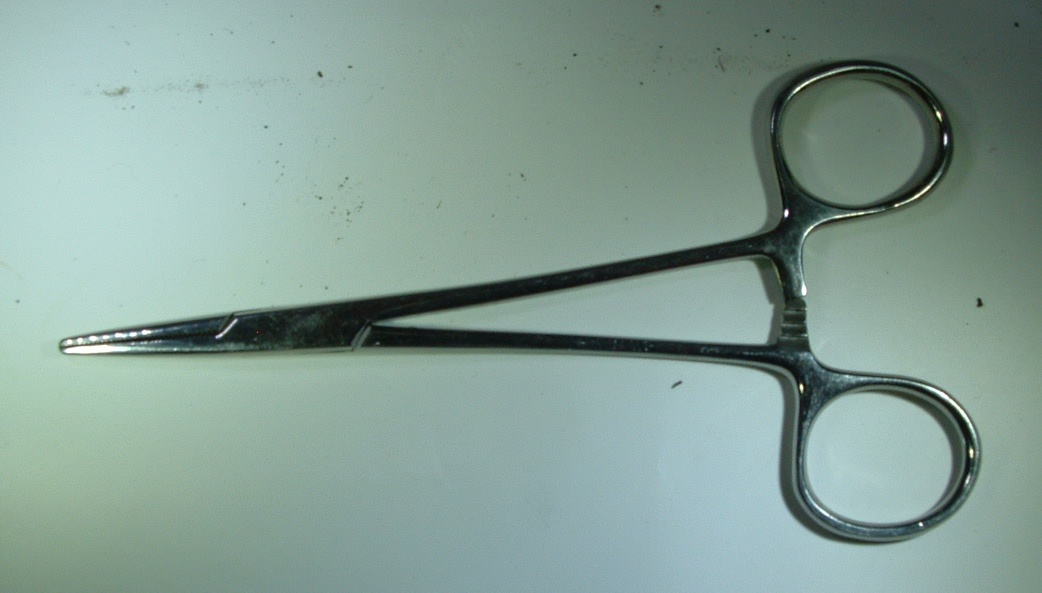
Yesterday, these forceps arrived in the mail from a very close friend of mine, Grey Wolf. How on earth did he know! Just what I wanted. These of course are modern locking forceps, but they are not a lot different from various types of 18th century forceps. See below:


18th century case of suturing needles. Just like the modern ones I carry in my medical pouch.
Grey Wolf also sent me this excellent kettle hook which he made himself.

Thank you my Friends, Deer Slayer and Grey Wolf. Very much appreciated.
Regards, Keith.
Saturday, 22 December 2012
A Merry Xmas to You All.

I am not a christian, and xmas here in summer is no xmas at all for us. But I wish all of you the very best at this time of year, regardless of faith or creed.
CHEERS EVERYONE!
Keith.
Friday, 21 December 2012
Indian Version of a Coat using a blanket.

Equipage des Chasseurs Sauvages Canadiens, no. 1-Circa 1730ad.
http://beinecke.library.yale.edu/dl_crosscollex/SearchExecXC.asp


http://beinecke.library.yale.edu/dl_crosscollex/SearchExecXC.asp


Can you see the split pouch at the waist. I would say that this is being used as a shot pouch, Powder horn is at his left side.

Notice the hood that is formed at the back.
Blue
was the favored color. Like most textiles, capots rapidly became highly
sought-after trade goods in New France. Native North Americans soon adopted the
design to make their own garments from square-cut blankets, creating a kind of
knee-length hooded cloak held together at the waist by a sash and closed at the
chest with a clasp or pin.
My sincere thanks to my Friend Gilbert Desmarais for supplying this image.
Subscribe to:
Posts (Atom)