
Showing posts with label grog. Show all posts
Showing posts with label grog. Show all posts
Sunday, 8 November 2015


Friday, 23 October 2015

Tuesday, 15 July 2014

Friday, 20 June 2014
Colonial Drinks. A Link.

Sunday, 30 January 2011


Monday, 26 July 2010
Rum Punch.
If there are no posts on Dave's and Joel's blogs for a while, I guess you cam blame me. Here is another 18th century recipe!
~~~~~~ Rum Punch ~~~~~~
________________________________________
6 cups water
1 cup sugar
1 4/5 quart bottle rum
2 12 ounce cans beer
1 cup brandy
1 cup apple juice or apple cider
1 tablespoon grated lemon peel
1 cup lemon juice
________________________________________
In a large kettle combine water and sugar; bring to boiling, stirring to dissolve sugar. Add rum, beer, brandy, apple juice, lemon peel, and lemon juice. Heat through. Serve warm in mugs. Makes 32 (4 ounce) servings.
http://www.11thpa.org/Recipes.html#Rum Punch

Saturday, 24 July 2010
18th Century Flip-Can.
Well I now know that a flip-can is a brown glazed stoneware jug made for holding flip, and it was made in Fulham. But I do not know the size or shape.
This is what was enscribed on Selkirk's flip-can:
Alexander Selkirk. This is my one.
When you me take on board of ship,
Pray fill me full with punch or flip.
Fulham.
I think we are looking at something like this:


"The days are short, the weather's cold,
By tavern fires tales are told.
Some ask for dram when first come in,
Others with flip and bounce begin."
This one supplied by Dave Reid.
"Where dozed a fire of beechen logs that bred
Strange fancies in its embers golden-red,
And nursed the loggerhead, whose hissing dip,
Timed by wise instinct, creamed the bowl of flip."
http://www.davesact.com/
This is what was enscribed on Selkirk's flip-can:
Alexander Selkirk. This is my one.
When you me take on board of ship,
Pray fill me full with punch or flip.
Fulham.
I think we are looking at something like this:

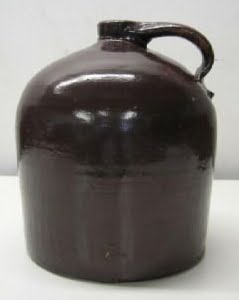

New England Almanac for 1704 under December:-
"The days are short, the weather's cold,
By tavern fires tales are told.
Some ask for dram when first come in,
Others with flip and bounce begin."
This one supplied by Dave Reid.
"Where dozed a fire of beechen logs that bred
Strange fancies in its embers golden-red,
And nursed the loggerhead, whose hissing dip,
Timed by wise instinct, creamed the bowl of flip."
http://www.davesact.com/
Friday, 28 August 2009
Wine Use In The Colonies.
Nothing like a nice wine to finish off the day around the camp fire after trekking in and constructing your primitive shelter.
However by the mid 18th century, longer, flat-sided bottles were designed which would lie down, their corks kept wet by contact with the wine. As a consequence wine making now took on a new dimension. As a consequence today’s great names of Bordeaux, Burgundy and the Rhine first started to be spotted. In Italy eighty percent of people were earning their living from wine and in France there were massive plantings rolling southwards from Paris. Also the vine had moved abroad thanks to explorers, colonists and missionaries. It went to South America with the Spaniards, S. A. with French Huguenots, and to Australia with the Brit . Could anything stop this tide of wine expansion?
http://www.hugepedia.com/wine-spirits/the-history-of-wine.html
Subscribe to:
Posts (Atom)