Thursday, 20 December 2012


DuPlessis 1690-1725. 1700ad Painting shows Capot.

DuPlessis 1700ad.
"My
drawings of their bodies and clothes are true to life."DuPlessis journal, 1690-1725.

Wednesday, 19 December 2012
More on the French Capot

This reproduction capot, a hooded coat, is representative of those worn circa 1690-1720 in French Canada.


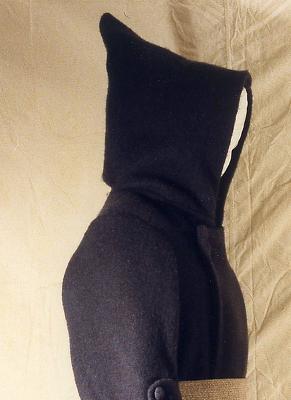
An
ample coat with hood and sleeves, the capot was derived from the coat used by
French sailors in inclement weather. The French inhabitants of Quebec modified
the design by giving them a slightly more tailored look. These alterations were
meant to imitate the justaucorps, the fashionable coat of the day. This
reproduction example has mariner's cuffs. Some sleeves were plain and others
had long "boot cuffs" like those on justaucorps. Capots were fastened
around the waist with a sash. A single button on the right shoulder allowed the
left flap to cross over the breast. These coats were typically made of serge, a
woolen cloth that is pliable and drapable but durable. Blue was the favored
color. Like most textiles, capots rapidly became highly sought-after trade
goods in New France. Native North Americans soon adopted the design to make
their own garments from square-cut blankets, creating a kind of knee-length
hooded cloak held together at the waist by a sash and closed at the chest with
a clasp or pin.

This is supposed to be dated 1730, but I have no provenance as yet.
"the native people wear French capots, and in the
winter, bed-blankets."
Father Baird in Acadia in 1616.
Tuesday, 18 December 2012
Blanket Coats, Blankets and Matchcoats.
Blanket Coats and
Matchcoats.
Finding a pattern for
an authentic blanket coat or French capot is not easy. Information on the 17th
century to early 18th century capot has been contaminated with
western patterns showing blanket coats of many stripes and fringes. The
original capot was as far as I am able to discern a simple plain coat made out
of blanket material, wrap around with a sash or belt to hold it together. As I
have read that French sailors originally wore these coats, I would imagine that
using a button at the neck would not be beyond the realm of authenticity.


However, the more
common use of the blanket seems to have been for the matchcoat.

"The Indians fasten their blankets
below with their belts, and make them pass over the head like a monk's hood,
arranging them so well that they only expose their nose and hands" (Pierre
Pouchot, Memoir upon the Late War in North America, Between the French and
English, 1755-60).
To me, the matchcoat
seems like a much better garment to wear. It appears to have traditionally been
made out of either a length of woollen material, or from a blanket. The
original matchcoat was an Indian garment and it was made of feathers.
The matchcoat can
simply be wrapped around the body, or it can also go over the head. A belt or
sash can be used to secure it around the waist and by making a few folds; it
can resemble a great coat.
I found that wearing a
capot I got too hot on the trail and it was not easy to remove. I had to take
off my packs and accoutrements to do so. Also the capot did not keep all of me
warm at night, and carrying a blanket as well as a capot just meant I was
carrying more weight. Now I simply use a half blanket round my shoulders cape
fashion. If it is very cold then I can wear my blanket as a matchcoat. These
two items keep me relatively warm at night and are more versatile than the capot.

Wearing the half-blanket.

Here I have simply taken the half-blanket off, and passed it over my head to sit at my back over my pack.

soldiers-on-the-march_watteau-jean-antoine-1684-1721.

Detail from above painting. man on a horse wrapped in a blanket.
Monday, 17 December 2012
Off Topic. Advice for off the grid solar power users.
Most people who follow this blog have realised by now the connection between 18th century living history/historical trekking and survival. So the other posts I make on here are not so far off the track in that respect. My wife and I have been living off the grid for over 30 years now, and we were living up in Elm Cottage without any electricity for at least 20 years. Hence once in a while I like to share some of my learnt knowledge with you, in the hope that it may improve your standard of living, or at least help prepare you for hard times.
Many people when going off the grid think that only the power source changes, not their lives. This is NOT the case. When living off the grid you need to change the way you used to think back in town, your lifestyle needs to change. You do not have to live without comforts, but you do need to adapt to your new way of living.
You can't use an electric stove, it will drain and kill your batteries. You can not leave the television turned on all day when not actually watching something and you may need to limit your viewing hours depending on the solar system you have, and the weather conditions.
If you have any questions or suggestions I have missed, please contact me.

For Solar Power
Users Off The Grid.
·
Really hot weather here in Australia, so check the water/acid level on
your batteries frequently. Hot weather and high charging rates will deplete the
level of distilled water in your battery cells.
·
Only use distilled water in your batteries.
·
Do not overload your batteries regardless of weather conditions; only
use items that your solar system was built to handle.
Items Not To Use.
·
Electric stoves and ovens.
·
Electric grills.
·
Electric irons.
·
Electric hot water systems.
·
Electric toasters.
·
Electric lawn mowers (other than those with self battery power).
·
Electric jugs.
·
Electric kettles.
·
Clothes dryers.
·
Electric heating appliances.
·
Air conditioners.
·
Flood lights.
·
Electric welders.
·
Compressors.
·
240 Volt water pumps.
·
Anything that uses a lot of power.
Do Use.
·
The highest star rating appliances you can get in Television monitors,
washing machines and fridges.
·
LED lighting.
·
Wood burning stoves and heaters.
·
Outdoor washing lines and indoor washing racks.
·
Large windows and fly screens.
·
Curtains to shut out the sun on very hot days and keep the heat in on
cold days.
·
Security screen doors so you can leave the doors open on a hot day.
·
Solar powered battery operated security lights that run on their own separate
solar panels.
·
A back-up generator that will charge your batteries and power the house
at the same time.

Do Not:
·
Leave lights on.
·
Leave appliances tuned on when not in use.
·
Leave the fridge door open for any longer than necessary.
·
Use the washing machine or any other high power usage appliances on
overcast days.
·
Run your batteries down below the recommended levels. If you do, use
your generator to charge the batteries until they are back up to the recommended
specific gravity and voltage levels.
·
Use power tools for any longer than necessary. Consider alternatives for
these electric tools, such as foot powered or hand powered.
·
Allow trades people to use your power. Inform them before hand that you
run your house on solar power and they need to supply their own power generator
for power tools and other electric appliances.
Do.
·
Check your batteries specific gravity, amps input, and volts frequently
in winter. Record these levels along with the date, weather conditions, and
what type of appliances you were using the day before.
·
Keep your batteries up off the cold ground. Batteries work more
efficiently when hot, solar panels work more efficiently when cold.
·
Clear the snow off your solar panels as soon as possible in winter.
·
Place your solar panels so you can reach them without going onto your roof
if you live in snow country.
·
Make sure trees and bushes are not shading your solar panels at any time
of the day.
·
If you need to, use high power usage appliances during sunny days whilst
the sun is shining, e.g. washing machine, electric drills etc.
·
Close your wood burning stove down when not in use. This will save you
wood and will not add to the heat in summer.
Sunday, 16 December 2012
Its good news week, someone dropped a bomb somewhere Etc Etc !
The good news is I managed to track down the gunsmith. I feared he had gone out of business as I was unable to contact him. But this afternoon we took a trip & tracked him down. Lovely chap, very helpful. Knows his stuff. He was able to identify two of the guns on the spot, and by the time we got home he had confirmed that the Belgium barrel was also an antique & pre 1900ad.
Thank you Tony, you are a champion.
Now for the paperwork and the cost! All because a police officer was ignorant of the firearms legislation and had no general knowledge of firearms and was unable to perform his duties in regards to firearms checks correctly. If this had been about moderm breechloaders I could understand it, but all this over two incomplete muzzle-loading guns and one percussion muzzleloader that is quite obviously not of modern make? What a farce.
Subscribe to:
Posts (Atom)