All about soap
& shaving in the 18th century.

Image taken from
Perret’s Book “The Art to Shave Oneself” 1770
A question was raised about what soap was used for shaving in the 18th
century, so I thought I would do a little research. No doubt many of you carry
a piece of soap in your pack as I do, so soap is an interesting subject even if
you do not shave.

George Washington's shaving items.

Honing a straight razor
Perret’s Book “The Art to Shave Oneself” 1770

Honing a straight razor
Perret’s Book “The Art to Shave Oneself” 1770

The Art of Cookery Made Plain and Easy: Which Far Exceeds Any Thing
of the kind yet published by
It seems that soap came in large bars, sometimes a person could
choose the length of the bar they wished to purchase, & this bar was then
cut to size. Other methods saw these bars cut into bricks for sale. I do not
get the impression that we are talking about the bars of soap we purchase these
days, I think these bricks were square & much larger. This type of soap was
known as hard soap, soft soap was apparently the sort of soap that was made at
home by the settlers. Whether or not there was a preference in hard or soft
soap for shaving I can’t say, but it was this ordinary soap that was used for
washing & shaving.


Cutting bars of soap by Diderot
Soap.
Ordinary soap was used for shaving in the 18th century.
Spain during the 11th and 12th centuries, where Spanish Muslims made
Castile soap.
http://www.todayifoundout.com/index.php/2013/03/the-history-of-soap/
http://www.todayifoundout.com/index.php/2013/03/the-history-of-soap/
Castile soap for shaving, washing & weight loss.
In 1752 Richard Barnard of Temple Bar claimed to be the inventor of
the ‘True original shaving powder’. A rival powder, advertised the same year by
J. Emon, claimed to ‘make razors cut easy and [was] very good for tender
faces’.
https://dralun.wordpress.com/2016/05/17/splash-it-all-over-a-brief-history-of-aftershave/
https://dralun.wordpress.com/2016/05/17/splash-it-all-over-a-brief-history-of-aftershave/
“To make very good washing balls take storax of both kings, benjamin,
calamus aromaticus, labdanum of each a like; and bray them to powder with
cloves and orris; then beat all with a sufficient quantity of soap till it be
stiff, them with your hand you shall work it like paste, and make round balls
thereof.”
Gervaise Markham, The English Housewife 1683.
“TO BE SOLD BY EDWARD LANGDON,
IN FLEET STREET, NEAR THE OLD NORTH MEETING HOUSE, A QUANTITY OF HARD SOAP BY
THE BOX, SOFT SOAP BY THE BARREL”.
Pearlash soap add, Boston Gazette Mid 18th century.
https://spadet.com/19th-century-soap-making-its-history-and-techniques/
https://spadet.com/19th-century-soap-making-its-history-and-techniques/


In all the material I have researched so far, no where does it mention the size of bar soap, nor are there any images of sketches of 18th century soap. However, I did find a painting, & it does give a fair indication of the size of a brick of soap.

A Lady’s Maid Soaping Linen
c.1765–82

Soap detail.
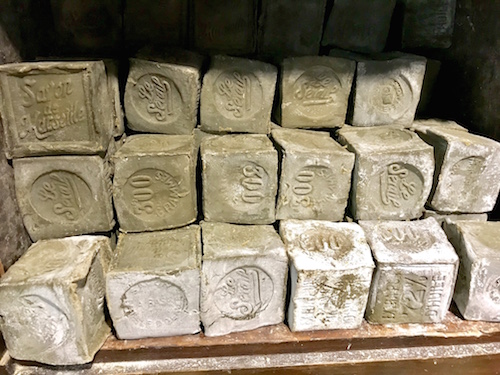
This is an image of Marseille soap as it is sold today, I have no proof, but I suspect that this could have been what it looked like in the 18th century.


