A LIVING HISTORY BLOG.

18TH CENTURY LIVING HISTORY IN AUSTRALIA.
Showing posts with label winter clothing. Show all posts

Wednesday, 19 December 2012

More on the French Capot

This reproduction capot, a hooded coat, is representative of those worn circa 1690-1720 in French Canada.


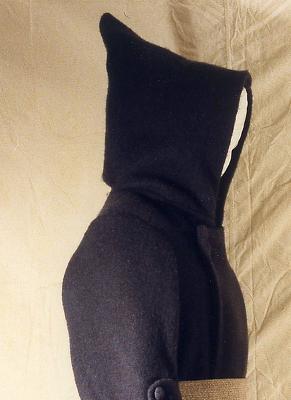

An ample coat with hood and sleeves, the capot was derived from the coat used by French sailors in inclement weather. The French inhabitants of Quebec modified the design by giving them a slightly more tailored look. These alterations were meant to imitate the justaucorps, the fashionable coat of the day. This reproduction example has mariner's cuffs. Some sleeves were plain and others had long "boot cuffs" like those on justaucorps. Capots were fastened around the waist with a sash. A single button on the right shoulder allowed the left flap to cross over the breast. These coats were typically made of serge, a woolen cloth that is pliable and drapable but durable. Blue was the favored color. Like most textiles, capots rapidly became highly sought-after trade goods in New France. Native North Americans soon adopted the design to make their own garments from square-cut blankets, creating a kind of knee-length hooded cloak held together at the waist by a sash and closed at the chest with a clasp or pin.


This is supposed to be dated 1730, but I have no provenance as yet.
Capots were originally a kind of a hooded coat or gown worn by French sailors in wet or bad weather. Capots were first used in Canada by Natives ; as early as 1606, French sailors were trading their capots to the Micmac on the Atlantic coast. They seem to have become popular trade goods ; by 1620, a French captain found it necessary to order his sailors not to trade away their capots until all the other trade goods had been used up [1].


"the native people wear French capots, and in the winter, bed-blankets."

Father Baird in Acadia in 1616.


Wednesday, 18 July 2012

More Than One Weskit.

You may remember the post I made a long time ago regarding the wearing of more than one weskit/waistcoat in winter. Well here is some more documentation.
As you can see, some waistcoats had sleeves.
The body of a man found drowned in the Sault St-Louis opposite the house of Andre Lamarre; approximately five feet and a half tall, long auburn hair with a braid held against the head with a rosary, a shirt of common linen, a pair of breeches of homespun linen, a white short waistcoat, another brown one and a waistcoat fastened with a double row of pewter buttons, blue leggings.
Parish of Saint-Antoine-de-Longueuil. 1747
Costume in New France, 1740-1760: A Visual Dictionary by Suzanne and Andre Gousse, page 66:


Wednesday, 10 February 2010

Winter in the northern forest By Nick.

For true mastery of this environment we look to the indigenous peoples of the North. In North America those resident in the northern forests (such as Cree, Ojibway, Mi'kmaq, Algonquin) developed and refined their bushcraft, clothing and equipment to deal with cold conditions over many lifetimes of experience. After experimenting with some of their technology I’m astonished at how it performs.


A great example of this is the mukluk. Mukluks are the traditional winter footwear of the indigenous people of the far North of North America. The design is basically a boot - high enough to keep snow out and roomy enough for plenty of insulation. Exact design and materials vary by region and what was available. More about this later but briefly these things outperform any cold weather footwear I’ve tried before. Light, comfortable, dry, warm. Made by my own fair hand they cost a fraction of the price of the fancy gore lined boots I normally wear.


While there’s much to be said for modern stuff it’s good to step back and weigh up the benefits. If you’re just going out for a couple of hours and are 99% sure you’ll be back in a nice warm house before supper to dry everything off this becomes less important - just use anything that works for a few hours. However, to live and work comfortably outdoors for even a few days in cold weather you need kit you can rely on and that can be repaired easily on the trail. Failure of key items in these conditions could spell big trouble.


Of course it’s difficult to pick some of this stuff up in shops - mukluks don’t tend to be up there on the shelf alongside the rubber pac boots. Some are commercially available but in my experience just don’t match up to your own hand made creations! This becomes a great advantage. Most items are pretty easy to make. Once you’ve made them you have the knowledge to make repairs or even replacements in the field. Before you know it these things are meeting all your needs and turning all you thought about outdoor gear on its head.
This article was written by Nick at: http://skillsforwildlives.typepad.com/skills_for_wild_lives/2010/02/winter-in-the-northern-forest.html

Friday, 1 May 2009

17th & 18th century underclothing for winter. An update on the under-waistcoat research.

17th and 18th century winter clothing for the common people.
Despite my earlier post on under-waistcoats, and undershirts, further research has found nothing to confirm that there ever was a specific undergarment. However, for those who are looking for more items of clothing to wear for winter, there is good news!
Although there is no proof of specific undergarments such as the under-waistcoat, an extra normal waistcoat can be worn under the normal shirt, or under another waistcoat. The same applies to an extra shirt, which can also be worn under another shirt. There is even documentation of two coats being worn at the same time.
Primary information for the above can be found at the following links: http://archaeologydataservice.ac.uk/catalogue/adsdata/PSAS_2002/pdf/vol_055/55_213_221.pdf
And
http://ads.ahds.ac.uk/catalogue/adsdata/PSAS_2002/pdf/vol_106/106_172_182.pdf