A LIVING HISTORY BLOG.

18TH CENTURY LIVING HISTORY IN AUSTRALIA.
Showing posts with label flint and steel. Show all posts

Tuesday, 27 June 2017

18th Century Period Fire Lighting Methods. Ebook.

Authors, historical, living history, authenticity, flint and steel, burning glass, reading glass, fire-bow, Mountain men, woodsmen, woodsrunners, books, reading, experimental archaeology, plant tinder, fungi tinder, tinderbox, fire lighting, 18th century, 17th century, 19th century, survival, Indians, primitive, fur trade, French and Indian War, Revolution, historical trekking, long term wilderness living, colonial, Australia, North America, cooking, heating, Reenacting, Reenactment, 

Primitive Fire Lighting-Flint & Steel & Fire Bow.

Title: Primitive Fire Lighting
ID: 9784776
Category: History
Description: “Primitive Fire Lighting”, is a hands on guide to how to make fire with flint and steel and fire bow. This includes some history, a variety of methods, tinder plants identification, and tinder production, tips on fire place construction and use, how to prepare and lay a fire, wet weather fire lighting and magnifying glass fire lighting. The skills and methods in this book will be of interest to a wider range of readers including survivalists, historical re-enactors, bush-walkers and campers, historical–trekkers and even historical novel writers. Although the plant identifications list is mainly Australian it also has some information for England, Europe and America.
Publisher: Keith H. Burgess
Copyright Year: © 2010
Language: English
Country: Australia

Table of Contents
Illustrations. 4
FOREWORD. 6
FLINT AND STEEL FIRE LIGHTING. 8
PLANT FIBRE TINDERS: 11
TINDER PREPARATION. 15
Tinder preparation-charring: 15
OTHER FLINT and STEEL FIRE LIGHTING METHODS: 16
Emergency methods: 17
A WORD ABOUT BLACK POWDER: 17
THE CAMPFIRE FIREPLACE: 18
READING GLASS/MAGNIFYING GLASS FIRE LIGHTING 20
WET WEATHER FIRE LIGHTING. 21
A FINAL WORD OF CAUTION. 23
FIRE-BOW FIRE LIGHTING. 24
Introduction 24
FIRE-BOW FIRE LIGHTING. 25
A Brief Overview. 25
The Parts of the Fire-bow. 26
The Bow. 26
The Drill Piece. 27
The Fireboard. 29
The Tinder-board. 30
The Bearing Block. 31
The Bowstring. 32
Tinder. 32
Making Fire. 32
Making Cordage. 37
The Step for making Cordage. 38
AFTERWORD. 40
Fire steel suppliers. 45
About the author. 45

5.83" x 8.26", saddle-stitch binding, white interior paper (60# weight), black and white interior ink, white exterior paper (100# weight), full-colour exterior ink.
Cost: Book $11.00 US. Plus P&P. Download $7.00 US


Monday, 12 June 2017

18th Century Brass Tinderbox with Burn Marks Inside.


This is claimed to be an original 18th century brass tinderbox. Note the burn marks on the inside of the lid, suggesting that this tinderbox was indeed used for snuffing out smouldering tinder. This indicates that this item was used for preparing tinder & for making fire from the tinder whilst it was still in the tinderbox.

Wednesday, 21 October 2015

Tinder Tubes.

There has been a lot of speculation as to the use of the Tinder Tube and its manufacture date. Personally I have yet to see one made before the 19th century, though I see many 18th century living historians carrying these for fire lighting. I have found little information available on the Tinder Tube, however, being very familiar with 18th century fire lighting methods, I very much doubt that the Tinder Tube was ever intended for fire lighting. 
I believe that the Tinder Tube was simply a method of lighting pipes & cigarettes. After all, it is not only far easier to use a tinderbox for fire lighting, but the tinderbox is essential for the ease of processing plant tinders and charring cloth. One researcher believes that the Tinder Tube was used for firing some form of hand held firearm or cannon. Again, this makes no sense as the matchlock had its own match holder, and the cannon used a Linstock.


Common copy of a tinder tube as sold by Track Of The Wolf.


Three antique 19th century tinder tubes.


Three Russian cigarette cases with built in tinder tubes.
If anyone has any further information on tinder tubes, I would be very pleased to hear from you.
Thank you.
Keith.

Saturday, 14 February 2015

The Correct 18th Century Term For The Steel On A Flint Lock.

The Flint Lock Hammer.
The part of the flint lock that is struck by the flint which is held in the cock, is called a “hammer” or steel. The reason it has this name is because the earlier Snaphance lock had a steel that reminded people of a hammer. See below.
Here on the Snaphance lock on the left you can see the shape of the hammer, & on the right, we see the hammer on the later flintlock.

Here again the lock on a pistol shows the hammer shape of the steel.

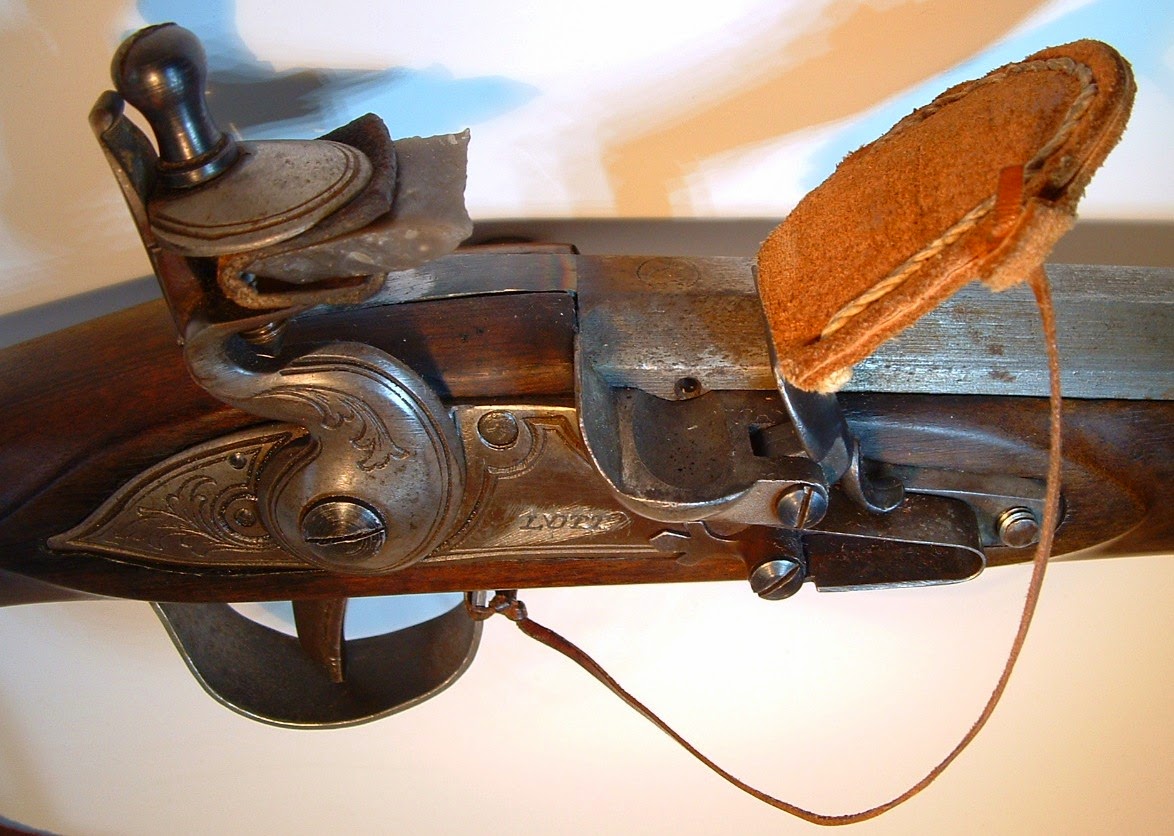
This is the lock on my Flintlock Fusil.

Here you can see the hammer boot or cap in place on the hammer.


Hammer Stall Documentation.
Lieutenant Colonel Wyatt immediately gave the order, Off hammer caps'
Thorp, 1808.
...On Service, leather Hammer-stalls are undoubtedly an advantage to a Battalion, when loaded, and resting on their Arms, as accidents may be prevented by having them fixed upon the hammers of the Firelocks..."
Cuthbertson. (pg 93, XIII).
It is left to their [officers] discretion in time of real Action to disencumber such men as they may think proper entirely of them [arms], taking care that they be lodged in their Ammunition Carriages and to prevent any possible Accident happening therefrom, thumb stalls have been ordered to be provided which the men are constantly to keep on the hammer of their pieces except when posted centrys." Great Britain, Royal Artillery Regiment Library, Woolwich, Brigade Orderly Book, James Pattison Papers. 1778.

The hammer stalls shall always be made of red Russia leather.

The men arms to be clean and in perfect repair, to be completed
with stoppers, pickers and brush, and hammer caps, which ought to be
made of
black leather.
CAMP AT WATSONS FERRY
20TH SEPTEMBER 1761.
REGTL.ORDERS
On service, leather Hammer-Stalls are undoubtedly an advantage
to the
battalion, when loaded and resting on their arms, as accidents
may be prevented, by having them fixed upon the hammers of the
firelocks.
(Cuthbertson, Bennett. System, for the Complete Interior Management

and Oecomomy for a Battalion of Infantry , Bristol, 1765.
page 93)


The term used now for the hammer on a flint lock is “frizzen”. This term was first used for the hammer on a flintlock in the 19th century. No one it seems knows where this name originated from, though it seems quite possible that it originated from my following findings:
Flint & Steel/Flint & Frezell or Fusil.
Frizzle ,fri'z'l), sbl dial. Also 7 frezel, 9 friz- (z)el. [? Corruption of FUSIL.] (See quot. 1892.) 1629 Z. BOYD Last Kattell Soule 1266 He is euer readie to strik fyre with his frezell and his flint,
1670-80; < French: musket, Old French fuisil, foisil steel for striking fire <Vulgar Latin *focÄ«lis, derivative of Latin focus fire.
(in the sense: steel for a tinderbox): from Old French fuisil, from VulgarLatin focÄ«lis (unattested), from Latin focus fire.
fusil
noun
A light flintlock musket.
Origin of fusil
French, steel in a flintlock, firearm, from Old French fuisil, steel for a tinderbox, from Vulgar Latin*focÄ«lis (petra), fire-(stone), from Late Latin focus, fire, from Latin, hearth.
The author's English style steel.


Author's Tinderbox.


Showing an open tinderbox with tinder inside & the flint & steel beside it.


Wednesday, 24 December 2014

Identifying Touchwood/Punk Wood.

More on Punkwood or Touchwood.

Recently someone contacted me and told me that to date they had not managed to make fire with flint and steel using uncharred punk wood. At the same time he quoted a passage from an Indian captivity document claiming that a John Tanner had indeed accomplished this. 
However, having read the passage that I think he is referring to, I think it more likely that John Tanner used gunpowder on the rotten wood in order for it to catch a spark. Here below is the quote in question:

"Owing to our hands being benumbed with the cold, it was long before we could extricate ourselves from our snow shoes, and we were no sooner out of the water than our moccasins and clothes were frozen so stiff that we could not travel. I began also to think that we must die. But I was not like my Indian brother, willing to sit down and wait patiently for death to come. I kept moving about to the best of my power, while he lay in a dry place by the side of the bank where the wind had blown away the snow. I at length found some very dry rotten wood which I used as a substitute for spunk, and was so happy as to raise a fire. We then applied ourselves to thaw and dry our moccasins, and when partly dry we put them on, and went to collect fuel [Page 24] for a larger fire than we had before been able to make".

Now although no mention is made here of using gunpowder, it is obvious to me that this method was known to John Tanner, and that he had used this method before. Note this earlier comment by John Tanner:

"Fortunately the water was not deep about the rock, nor between it and the land, and though a thin ice had formed, I was able to break it, and carry my children on shore. But here we had nearly perished from cold, as my spunk wood was wet, and I had no means of kindling a fire, until I thought to split open my powder horn, when I found in the middle of the mass of powder, a little which the water had not reached. This enabled me to kindle a fire, and was the means of saving all our lives".

Note also the term "spunk" is used and not "punk". This I think is the first time I have heard this term used for tinder rather than sulphur tipped splints which are known as spunks.

Here are a couple of videos I made on the use of gunpowder for making fire:


Tuesday, 3 June 2014

Another Plant Tinder For Fire Making.

As I have said many times before, once you become familiar with what plant tinders look like & feel like, you can start to identify many more. Some such as the beaten inner bark of the Stringybark Tree are not so readily recognised, but still the same thought processes enabled me to see the possibilities.
The inner core of the Sunflower plant again is not so readily identified, just like the inner core of the Yacca Plant, it is hidden from view until the stem is cut open. Here in the images below you can see the soft white pithy core of the Sunflower stem. Treat this as you would punkwood, & char it to prepare it. This stem is still green so you can better see the core, but for tinder use use only the dried stems.
Not a native to Australia, but many of you may grow Sunflowers in your gardens, as we do for chook feed. The Sunflower is believed to have originated and was first domesticated in Mexico. The Sunflower is a member of the Jerusalem Artichoke, which is native to the Great Lakes area in the Americas. The stem pith of the Jerusalem Artichoke can also be used as tinder, but the stems are much smaller and thus yield far less tinder.


This is a dried Sunflower stem cut open.

Another type of Sunflower in our garden with multiple flower heads.


Sunflowers drying in the sun in front of a stand of corn.

Jerusalem Artichokes in our garden. These are also prized as a food source. You will never starve if you are growing Jerusalem Artichokes. The dried stems make excellent kindling.


Thursday, 13 February 2014

Tinder Horns.

Not everyone used a tinder box, and no doubt some of those who did have a tinder box may not have used it for making fire per se. Some people used the bird nest method of placing tinder in a bundle of small kindling & striking sparks on the tinder in the nest. Others may have used the tinder box to prepare tinder, but used the nest method to actually make fire, instead of striking sparks into the tinder box.
Others used a tinder horn, this could be used like the tinderbox and was a good alternative if you did not have a tinder box/tinderbox.
 Then again, not everyone was successful in making fire. Understanding how some people thought back in the 18th and 19th centuries is very difficult. Some having experienced hardship still failed to improve their lot so they would have better luck next time. Others however took notice and improved on their equipment. Others still did not survive because of their short comings.

“This induced me to resolve not to travel more by land without my gun, powder and shot, steel, spunge and flint, for striking a fire…”
~Patrick Campbell, Canada/New York, 1792 

"There was Dry leaves and sticks under our shelter. I stoped the tuch hole of my gun with tallow and then did ketch fire and we made up a fire and Dryed our selves."
Westward Into Kentucky, Daniel Trabue, 1779:


"There happened to be an iron pot and an ax on board--- they cut off a piece of the boat rope, and picked it to oakum, and putting it in the pan of a gun, with some powder, catched it on fire, which with some thin pieces cut from the mast, they kindled in the pot, and then cut up their mast, seats, &c. for fuel, and making a tent of their sail, wrapt themselves as well as they could;"
From The Pennsylvania Gazette, 1765


“Fierce winds and blowing snow reduced the men to huddling among large rocks, unable even to start a fire.”
Samuel Hearne, Canada, 1770.

“Fire making is a simple process with the mountaineers. Their bullet pouches always contain a flint and steel, and sundry pieces of “punk”-a pithy substance found in dead pine trees-or tinder; and pulling a handful of dry grass, which they screw into a nest, they place the lighted punk in this, and closing the grass over it, wave it in the air, when it soon ignites, and readily kindles the dry sticks forming the foundation of a fire.”
Ruxton, 1848.

 “…rain began hammering down so heavily that, one hundred miles from the nearest trees, and with nothing available but moss, nobody could start a fire.”
                        Samuel Hearne, 1770.

“In the woods we were under some disadvantage, having no fire-works”. Journal of John Woolman, 1720-1742.


Wednesday, 12 February 2014

18th Century Tinder Box Types.

A wood tinder box showing the damper on the left for smothering the smouldering tinder, and a lid.

My brass tinder box which is a copy of an original. Those tinder boxes which are smaller and shallow I assume were for carrying on the person, either in a pocket or pouch. Though we can't say for sure that larger tinder boxes were not carried beyond the home.


My brass tinder box opened, showing the tinder inside.

A Dutch tinder box made from wood with a carved design and a sliding lid.

This is a Russian tinder box which appears to have a ceramic inlay to the hinged lid.

Four small tinder boxes with hinged lids.

This tinder box is dated 1734.

A wood tinder box with a sliding draw dated 1761. Wood tinder boxes were typically used in the home.

A brass Russian tinder box found in a shipwreck. Dated 1714.

This tinder box reminds me of a period spectacle case, and it may have been so. What is important is that it has been used as a tinder box. 

My copy of a candle holder tinder box. Again a clumsy shape to carry in a pouch or pocket and typically a style used in the home.

The same tinder box with a beeswax candle.

Tuesday, 11 February 2014

More on Flint and Steel and Tinderbox Fire Lighting.

Madam JOHNSON’S Present:
Or, every YOUNG WOMAN’S companion.
To make a Substitute for Tinder made with Linen.
Dissolve three ounces of salt petre in a pint and an half of fair Water in a Kettle or Pan over clear Fire: Then thoroughly wet twenty-four Sheets of smooth brown Paper separately in the hot Liquor, and lay them on some clean Place to dry. When you have Occasion, you may put a Piece in your Tinder-box, and using the Steel and Flint, it will catch like Wildfire. (please note that paper then was made from linen flax. Keith.).
But when you will make tinder for a Gunners tinder boxe, take peeces of fustian, or of old and fine linnen clothe, make them to burn and flame in a fire, & suddenly before the flame which is in the  doth die, choke the fire, & keepe their tinder so made in a boxe lined within with clothe, to the ende that it may not be moyste at any time.
Appendix 20-1,  Lucar, C., Translation of Tartaglia, Three Bookes of Colloquies Concerning the Arte of Shooting in Great and Samll Peeces of Artillerie with Appendix, London,1588.
Finding information directly relating to Europe is a long haul, but I think we can take it for granted that whatever was used in England was also used in France, & if France was using cloth tinder, then most of if not all Europe was also using it.
Mostly cloth tinder was used in the homes, tow rag was a common source, but linen also. Other places of use were aboard ship, as in the quote above. Travellers from one place to another eg from one town to another or from town house to country house would also normally carry charred cloth tinder.
Cloth was charred like other plant tinders, directly in the fire, then it was smothered in the tinderbox. Normally the tinder remained in the tinderbox, fire was made directly from the tinderbox.

Fire lighting using gunpowder was also used, with tinder material & with kindling material.
"There happened to be an iron pot and an ax on board--- they cut off a piece of the boat rope, and picked it to oakum, and putting it in the pan of a gun, with some powder, catched it on fire, which with some thin pieces cut from the mast, they kindled in the pot, and then cut up their mast, seats, &c. for fuel, and making a tent of their sail, wrapt themselves as well as they could;"
From The Pennsylvania Gazette, 1765, 3 men trapped in the ice in their boat during a waterfowl hunt and likely to freeze to death:

'Our party having separated, the important articles of tinder and matches were in the baggage of the division which had proceeded: and as the night was rainy and excessively dark, we were, for some time, under anxiety, lest we should have been deprived of the comfort and security of a fire. Fortunately, my powder-flask was in my saddlebags, and we succeeded in supplying the place of tinder, by moistening a piece of paper, and rubbing it with gunpowder. We placed our touch paper on an old cambric handkerchief, as the most readily combustible article in our stores. On this we scattered gunpowder pretty copiously, and our flint and steel soon enabled us to raise a flame, and collecting dry wood, we made a noble fire.
Birkbeck, Morris. Notes on a Journey in America . London: Severn and Co., 1818.

"Weapons of Warre: The Armaments of the Mary Rose"
"Four unusual boxes have been tentatively identified as tinder boxes,
with the possibility of a fifth (see Chapter 8) of a somewhat
different design and about half the size. Traditionally, these would
contain items required to make fire: dry, flammable substances
together with a flint and a steel. Although the identification is
tentative***, these objects are of a completely different construction
to any other boxes found on the Mary Rose. Each is carved out of a
single block of oak rather than being made of boards or laths. All
are rectangular

310 - 385 mm in length
175 - 212 mm in width
and 90 - 105 mm in height

with a wall thickness of 25 mm. All have sliding lids, or slots to
accept them. All are divided into a large compartment and one or two
small compartments. Most bear cut marks inside the large
compartment; one contained a knife. All have circular impressions
(one or two) on the inside of the large compartment and two have holes
though the base. These are darkened as though slightly scorched.
Three of the boxes contained what was thought to be felt
or soft contents which were sampled for analysis. The boxes
appear similar to boxes used in the eighteenth century to contain
linseed soaked cloths used in caulking. The method of manufacture and
distribution would accommodate both uses, so identification is still
uncertain.


Monday, 10 February 2014

Authentication. Use Of The Tinderbox.

Recently I was asked what proof did I have that the tinderbox was used for making fire. First let me say that the tinderbox was not always used by everyone to make fire, there are period ways to make fire without using the tinderbox. But, using the tinderbox is the easiest way to prepare tinder, and I have found that it is the easiest way to make fire when you know how to use the tinderbox properly, and have had plenty of experience.
Here then is the primary information that I have so far, in the written word, and in images.


The maid is stirring betimes, and slipping on her shoes and her petticoat, gropes for the tinder box, where after a conflict between the steel and the stone she begets a spark, at last the candle lights.... Matthew Stevenson, The Twelve Months, c1661.

To make Tinder.
Take three ounces of Salt-petre, put it to a Pint and a half of fair Water, set it on a Fire in a Kettle or Pan to heat till the Salt-petre be dissolved; then take a Quire of smooth brown Paper, and
put them in Sheet by Sheet into the hot water till they are wet through, and then lay them on a clean Floor or Grass to dry. You may at any Time tear a Piece off, and put it in your Tinderbox,; it will catch like Wild-Fire. By this Means you may save all your Linen Rags in the Family, keep them clean in a Bag, and, if you are careful of them, they may produce you a Pair of Shoes and Stockings at the Years End; and by this Frugality you will have the Pleasure to think of encouraging the making of Paper, and employing the Industrious.

Madam Johnson's present: or, every young woman's companion in ... - Page 181

Mary Johnson (fl. 1753.) - 1770 - 197 pages 

To make a Substitute for Tinder made with Linen.
Dissolve three ounces of Salt petre in a Pint an half of fair Water in a Kettle or Pan over a clear Fire: Then thoroughly wet twenty-four Sheets of Smooth brown Paper separately in the hot Liquor, and lay them on some clean Place to dry. When you have Occasion, yoiu may put a Piece in your Tinder-box, and using the Steel and Flint, it will catch like Wildfire

The Swiss family Robinson: or, Adventures of a father and mother (first published in 1812)
Page 296

We might make tinder by burning: some linen rag, and putting it in & close box*: but we have unfortunately^ none to spare ? and;,, therefore, the best thing for us would be to find ... Johann David Wyss, Johann Rudolf Wyss - 1818 

Take those great things which are called olde Todestooles growing out of the bottomes of nuttrees, beechtrees, okes, and such like trees, drye them with the smoke of fire, & then cut them into as many peeces as you will, and hauing well beaten them, boyle the  in strong lie with waule floure, or saltpeeter, till all the lie shal be consumend. After this laying them in a heape uppon a boorde, drie them in an oven which must not be made verie hotte, and after you haue so done, beate them well with a wooden mallet, and when you shall haue cause to use any parte of those Todestooles (now by the means above declared made touchwood) rubbe well that parte betweene your handes for to make it softe and apte to take fire. But when you will make tinder for a Gunners tinder boxe, take peeces of fustian, or of old and fine linnen clothe, make them to burn and flame in a fire, & suddenly before the flame which is in the  doth die, choke the fire, & keepe their tinder so made in a boxe lined within with clothe, to the ende that it may not be moyste at any time.

Appendix 20-1,  Lucar, C., Translation of Tartaglia, Three Bookes of Colloquies Concerning the Arte of Shooting in Great and Samll Peeces of Artillerie with Appendix, London,1588


An Indian often goes off alone...with only his musket, powder and shot, a tinderbox...
Pouchot, Pierre. Memoirs on the Late War in North America between France and England. Page 482.

"You must provide yourself with a tinder box or with a burning mirror, or with both, to furnish them fire in the daytime to light their pipes, and in the evening when they have to encamp; these little services win their hearts. "Instructions for the Fathers of our Society who shall be sent to the Hurons." l637.

It (the tinderbox) was with this instrument, long before the invention of matches, that our grandfathers obtained light. I want to show you how the trick was managed. First of all it was necessary to have good tinder. To obtain this, they took a piece of linen and simply charred or burnt it, as you see I am doing now (Fig. 4). (Cambric, I am told, makes the best tinder for match-lighting, and the ladies, in the kindness of their hearts, formerly made a point of saving their old cambric handkerchiefs for this purpose.) The servants prepared the tinder over-night, for reasons I shall explain to you directly. Having made the tinder, they shut it down in the box with the lid (Fig. 3 A) to prevent contact with air. You see I have the tinder now safely secured in my tinder-box. Here is a piece of common flint, and here is the steel. Here too are the matches, and I am fortunate in having some of the old matches made many years ago, prepared as you see with a little sulphur upon their tips. Well, having got all these etceteras, box, tinder, flint and steel, we set to work in this way:—Taking the steel in one hand, and the flint in the other, I must give the steel a blow, or rather a succession of blows with the flint (Fig. 3 B). Notice what beautiful sparks I obtain! I want one of these sparks, if I can persuade it to do so, to fall on my tinder. There! it has done so, and my tinder has caught fire. I blow my fired tinder a little to make it burn better, and now I apply a sulphur match to the red-hot tinder. See, I have succeeded in getting my match in flame. I will now set light to one of these old-fashioned candles—a rushlight—with which our ancestors were satisfied before the days of gas and electric lighting. This was their light, and this was the way they lighted it. No wonder (perhaps you say) that they went to bed early.
Delivered before a Juvenile Auditory at the London Institution
during the Christmas Holidays of 1888-89.
BY THE LATE
CHARLES MEYMOTT TIDY, M.B., M.S., F.C.S.


The fact that the tinderbox existed and was used is beyond doubt, what is being questioned here is "how was it used". My personal knowledge started a long time ago when I realised that I needed a renewable fire lighting method. As I was at that time already using flint and steel, this meant that I had to find a natural source of tinder growing in the wild, and I needed a way to prepare it.
By experimentation I started to find several plants that could be used as tinder, but I needed to char most of them in a fire to make them catch a spark. This meant that I had to find a way to smother this smouldering tinder for future use. I started by burying it under earth, this worked okay, but soiled the tinder, and, this method could not be used in wet weather. Next I wrapped the smouldering tinder in soft leather and then buried it in the earth. This worked fine, but I needed to find an easier method.
It was then one of those moments when you strike your forehead as the obvious comes to mind and you can't believe that you had not seen it before. The smouldering tinder was to be smothered in a tinderbox. From there it was but a short step to realising that in fact the fire was also created with the tinderbox. Subsequent  experimentation and further research proved my findings to be correct. That of course was many years ago, and I made my first flint, steel and tinderbox video in 2008.
Keith H. Burgess. 11/2/2014.