A LIVING HISTORY BLOG.

18TH CENTURY LIVING HISTORY IN AUSTRALIA.
Showing posts with label fashion. Show all posts

Friday, 24 May 2013

To Shave or Not To Shave. Beards in the 18th century.

There is a lot of talk on other forums and a lot of people have different opinions about whether people had beards in the 18th century or not. To me it has always seemed common sense that away from city fashions, a man did exactly what he wanted to do. So I do not get into arguments over this issue, and to the bitchy guy who said I do not portray a true woodsman because I have a beard, I say, absolutely nothing. Instead I will post my thoughts and findings here, and as I have already stated above, I think it always has been a matter of personal preference.

Quote: Twenty pounds reward
Run away from... Alexandria, Fairfax County Virginia, a convict servant man, named John Murphy, born in Ireland, about 28 Years of Age, by trade a joiner, a low set fellow, about 5 feet 4 inches high, struts in his walk, has a pale complexion, large black beard and eyebrows, wide mouth, and pleasant countenance, sings extraordinarily well, having followed it in playhouses in London, talks proper English, and that in a polite manner... It is imagined he has forged a pass and likely will deny his name, trade and place of nativity.
NB All Masters of Vessels are forbid to take him off at their Peril. (August 1760)


17th century oil painting  a bearded man with a young girl  by Jacob Toorenvliet.

Blackbeard (c. 1736 engraving used to illustrate Johnson's General History)

French school 18th century head_of_a_bearded_man.

Gaetano Gandolfi ,Study_of_a_Bearded_Man  1770

Johann Andreas Benjamin Nothnagel 18thc.

John Worley, 1624-1721 Painted 1705.

The Old Beggar , French School, 18th century Musee Bargoin.

Thomas Gent, printer and author of the book depicted in his right hand, The Antient and Modern History of the Loyal Town of Rippon (published in 1733).


Tuesday, 30 October 2012

Wearing Out Of Date Clothing. Old Clothes Sellers.

I have spoken before about the using of equipment and clothing from an earlier period than ones interpretation. On the frontiers style was not only slow to change, but it really had no place at all. What was important was being comfortable in the clothing you wore, and the equipment you used. Both had to be hardy and functional. Home made clothing would I think have tended to follow a set style, one the women folk were used to making, and the men used to wearing. The same goes for the women.
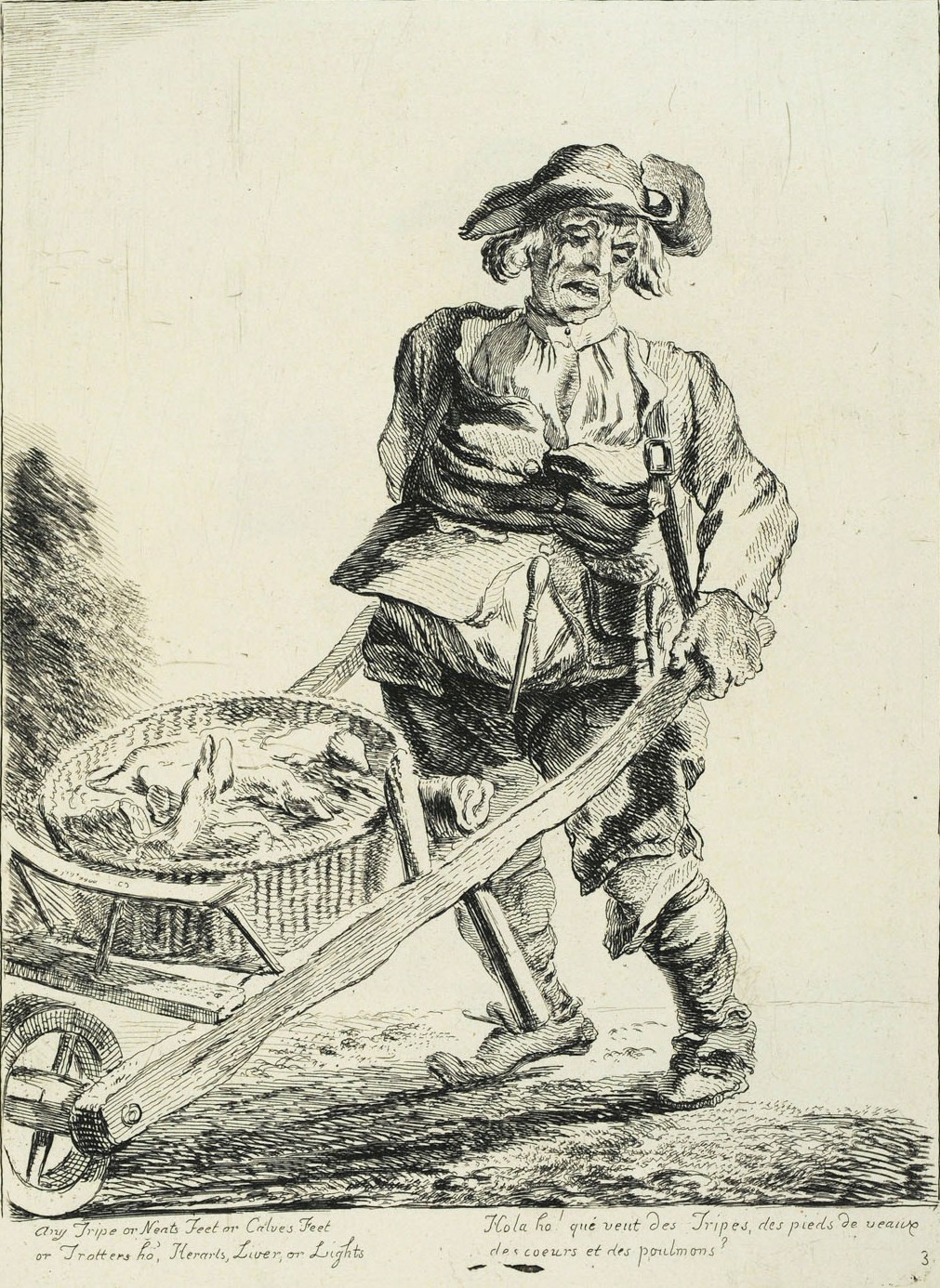
But until recently I had not considered second hand clothing dealers. Then I came across this etching of an old clothes street vendor and I realised that this opened up a whole new outlook for the wearing of out of date clothing. Apparently not only were these clothing items bought and sold in a town or city in England, but they were also exported overseas!


Contrary to the impression generally given, the old-clothes trade was
not primarily devoted to buying and refurbishing hawkers' goods, known
as 'clobbering'. London was certainly a centre for the wholesale traffic in
used clothing. This is borne out by the known export of bales of clothes,
carpets and so on to Belgium, France and specifically to Holland and later
South America, some of them purchased by wealthy merchants from
different parts of the United Kingdom and Europe (for example, Lazarus
Jacobs48 and Samuel Wolf Oppenheimer from Paris49 and Jacob Schloss from
Frankfurt).50 The first stage of this seemingly lucrative trade was
performed by the old-clothes hawker. A traveller towards the end of the
18th century says that the poorer class wander through the streets of
London, calling 'old clothes', 'which they buy up and mostly send
abroad'.51 This export trade continued well towards the end of the 19th
century, as is confirmed by the case of Solomon Joseph, who was a dealer in
new and second-hand clothing and was said to have bought his
merchandise for colonial export.52

Old-clothes men: 18th and 19th centuries*
BETTY NAGGAR

By Edme Bouchardon 18th century.

By Paul Sandby 1759.

A Rag Fair in Rosemary Lane By Thomas Rowlandson late 18th century.
 

Thursday, 27 October 2011

More On 18th Century Belt Pouches.

Many historians and costume experts will tell you that the belt pouch went out of fashion in the 17th century and was no longer being used in the 18th century. My arguement has always been that items from earlier periods were indeed worn and used because of practicallity and not fashion. A waistcoat per se may not survive 50 years of hard wear, but the style will. If a person on a frontier wants to wear a long 17th century waistcoat in the 18th century, then he/she can do so.
Below is a sketch from 1760. You will note that he is wearing two belt pouches. One large one in front, and a smaller one on his left side.

By Paul Sandby 1760ad.


Saturday, 10 November 2007

Earlier Items in A Later period.

18th century clothing of the common man on the New World Frontier.
Clothing styles on the frontier was slow to changes, and people had their own preferences and tended to make things the same way as they always had, this applied to women’s clothing as well as men’s. When recreating the early to mid 18th century, it is good to remember that not all of your clothing and equipment will be new in that era, some items and styles will date back into the 17th century. As an example, let us say that you are 40 years of age and the year is 1710. That means that you were born in 1670. In 1690 you were 20 years of age. One could assume that you would still have some items of equipment or accoutrements from that period. If your Parents had given you something of theirs, then it would date back even further, and further again if your Grandfather had given you something, his folding knife or tinderbox for instance.
Another thing to remember is that early items of clothing and equipment can be used in a later period, but later items cannot be used in an earlier period. For instance if your main period of interest is say 1700-1760, like mine, then the same period clothing and equipment could still be used in say the American Revolution period of the 1770s.
The man’s shirt: The shirt needs to be long, knee length at least. Don’t forget that woods women can wear the same clothing as the men.
The waistcoat: The waistcoat too should be long, reaching almost, if not entirely to the knees.
Breeches: The breeches should be French fly and not falls.
The frock: The frock it seems was commonly the shirt-frock. This style is the pull-over type, closed front, open neck with no buttons except one button on each sleeve cuff.
If you need more information, don’t hesitate to contact me.